Daridraraksha: Protecting the Poor

When the poor have no voice, wisdom must speak for them

Two stories of standing up for the powerless. In The Widow's Complaint, Tenali fights for a woman whom everyone ignores. In The Beggar's Rights, he teaches that dignity belongs to everyone, even those with nothing. Both tales show that true justice sees no difference between rich and poor.

The Widow's Complaint

Outside the palace gates, a woman sat crying. She had been there for three days.

The guards ignored her. Nobles walked past without looking. Servants shooed her away from the entrance. But every day she returned, waiting.

Tenali noticed her on his way to court.

"Mother, why are you crying here?"

The old woman looked up with exhausted eyes. "My husband was a soldier. He died serving the king. The army promised me a widow's pension, five gold coins a month. But I haven't received anything for two years!"

"Did you complain to the pension office?"

"Many times! They say my papers are being processed. They say I should wait. They say the treasury is busy." She wiped her eyes. "I've sold everything I own to survive. My children are hungry. No one will help me."

"Have you asked to see the king?"

"They won't let me in. They say the king is too busy for small matters. Small matters!" Her voice cracked. "My husband gave his LIFE. And his family starves while officials make excuses."

Tenali felt anger rise in his chest. But he kept his voice calm.

"Wait here, mother. I'll see what I can do."
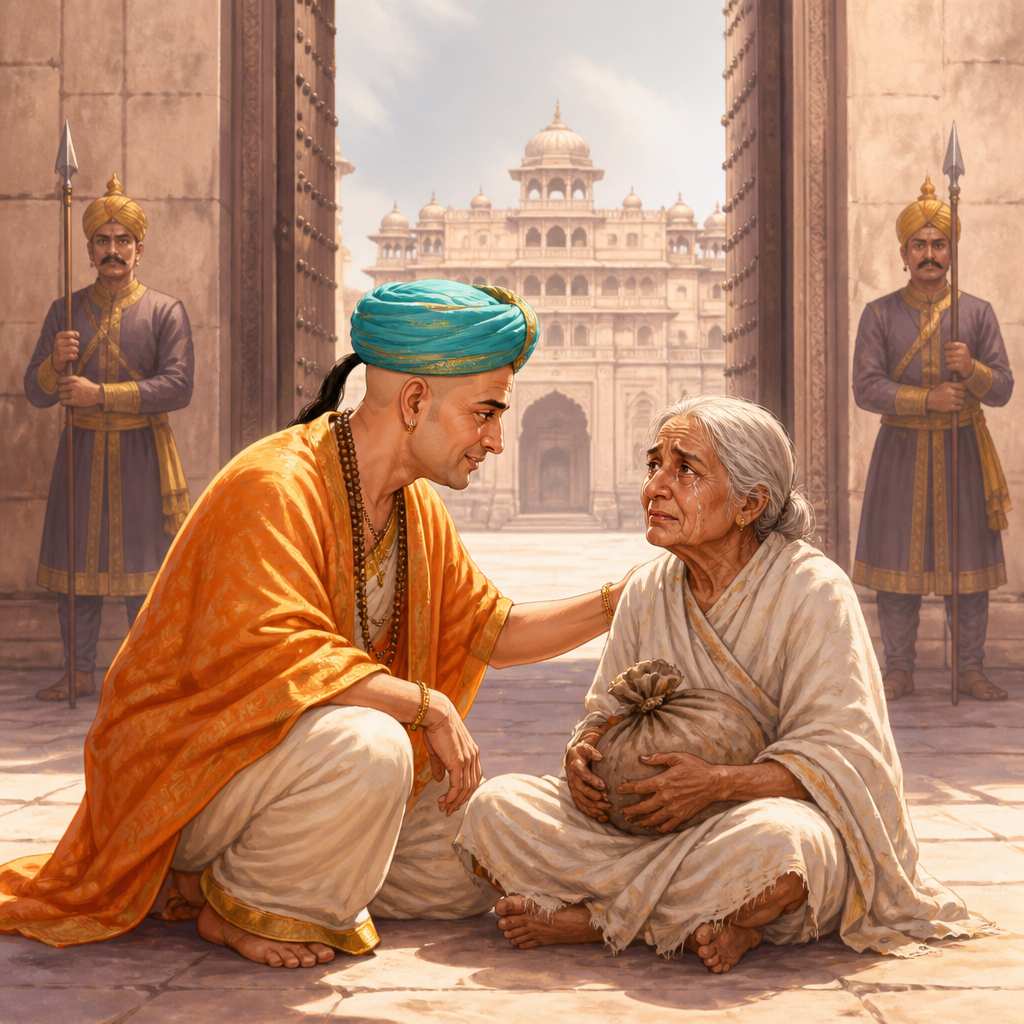
Tenali kneels beside the soldier's widow at the palace gates

In court that day, Tenali waited until all important business was finished. Then he approached the king.

"Maharaja, I have a puzzle for you."

The king smiled. He loved Tenali's puzzles. "Go ahead."

"If a soldier dies protecting your kingdom, what do you owe his family?"

"Everything," the king said immediately. "His family should want for nothing. That's why we have the widow's pension."

"And if that pension is not paid for two years? If his widow starves while officials give excuses?"

The king's smile faded. "That would be a grave injustice. It would dishonor the soldier's sacrifice."

"Then Maharaja, there is a woman outside your gates who has been waiting three days to tell you exactly this. Her husband died in your service. Her pension has not been paid for two years. Your officials won't see her. Your guards won't let her in."

Tenali's voice was gentle but firm. "She is not powerful. She has no connections. She can offer no bribes. She has only her husband's service and your promise. Is that enough to see the king?"

The king's face turned red, not with anger at Tenali, but with shame.

"Bring her in. NOW."

The widow was brought to court. The king himself heard her complaint. The pension official who had ignored her for two years was summoned and dismissed on the spot. The widow received her full back payment that same day.

As she left, the king made a new rule: any widow of a soldier could request a direct audience. No official could turn them away.

The Beggar's Rights

One day, a wealthy merchant was walking through the market when a beggar touched his robe.

"Sir, please, a coin for food..."

The merchant recoiled in disgust. "How DARE you touch me, you filthy creature!" He struck the beggar across the face. "Learn your place!"

A wealthy merchant striking a beggar in the marketplace

The beggar fell, blood streaming from his lip. People watched, but no one interfered. He was just a beggar, after all.

But the beggar stood up slowly, his eyes burning.

"You have injured me. I demand justice."

The merchant laughed. "Justice? You? You're nothing! You have no money, no status, no family. Who will listen to a beggar?"

"The king will."

Still laughing, the merchant walked away. But the beggar went to the palace.

Of course, the guards refused to let him in. But Tenali happened to be passing by.

"What's this commotion?"

"This beggar demands to see the king!" a guard said, still laughing. "He says a merchant hit him!"

Tenali looked at the beggar's injured face. "Did the merchant hit you?"

"Yes, lord. For touching his robe to ask for alms. He said I was 'nothing' and had no right to justice."

Tenali's expression hardened. "Come with me."

Tenali presenting the bruised beggar's case to the king

In court, Tenali presented the case. The merchant was summoned.

"Maharaja," the merchant said smoothly, "this is ridiculous. He's a BEGGAR. I was merely... correcting his behavior. Surely the king's court has more important matters."

"Let me understand," Tenali said. "You struck him because he touched your robe?"

"He had no right to touch me!"

"I see. And if I touched your robe right now, would you strike ME?"

The merchant looked confused. "Of course not! You're Tenali Ramakrishna!"

"So hitting someone is wrong when they're important, but acceptable when they're poor?"

"That's... that's not..." the merchant stammered.

"Let me ask differently," Tenali continued. "Does this beggar feel pain when struck?"

"I suppose..."

"Does his blood flow red, like yours or mine?"

"Yes, but, "

"Does he feel hunger, cold, shame? Does he have the same number of bones, the same heart, the same breath?"

The merchant was silent.

"The only difference between you and him," Tenali said, "is that you have gold and he doesn't. But the king's law doesn't say 'hitting is wrong unless the victim is poor.' It says hitting is wrong. Period."

He turned to the king. "Maharaja, what is the penalty for assault?"

The king's voice was cold. "Fifty gold coins to the victim. And ten lashes if they cannot pay."

The merchant's face went pale. "Fifty gold coins! To a BEGGAR?!"

"Would you prefer the lashes?" the king asked.

The merchant paid. The beggar walked out with more money than he'd seen in his entire life.

But more importantly, he walked out with his dignity intact.

The Wisdom

These stories teach us something crucial about justice: it doesn't ask how much money you have before deciding if you matter.

The widow had nothing, no power, no connections, no gold. But her husband's sacrifice was real. Her suffering was real. She deserved to be heard.

The beggar had nothing, not even respect in most people's eyes. But he still felt pain. He still bled. He still had rights.

Tenali didn't help these people because they could repay him. He helped them because it was RIGHT. That's what protecting the poor means, using whatever power you have to help those who have none.

In Your Life

You probably know kids at school who seem "invisible", the quiet ones, the ones without popular friends, the ones who don't have the nicest clothes or latest gadgets.

It's easy to walk past them. It's easy to treat them like they matter less.

But Tenali's stories remind us: every person has the same right to dignity, kindness, and fairness. The kid who's being ignored or bullied feels the same pain as anyone else.

You don't have to be powerful to help. Sometimes just saying "That's not fair" or "Hey, sit with us" makes all the difference. Sometimes being the one person who SEES someone is enough to change their whole day.

Reflection

More in Nyaya: Justice and Fairness

All lessons in Nyaya: Justice and Fairness · Tenali Rama: The Wit of Vijayanagara course