Daya: Her Share of the Home

Property rights for daughters

Property rights for daughters

The Ancient Right Restored

There is a widespread misconception that women's property rights are a modern, Western concept imposed on traditional Indian society. Nothing could be further from the truth.

The Dharmasutras and Smritis extensively discuss stri-dhan, wealth that belongs exclusively to a woman. This included gifts received at marriage, jewelry, and anything given to her by family members. Crucially, stri-dhan was HER property, her husband had no claim to it, and she could dispose of it as she wished.

What the Texts Actually Say

Yajnavalkya Smriti (2.143) declares that stri-dhan belongs to the woman alone. The Dayabhaga system of Bengal gave daughters inheritance rights centuries before modern law. The Mitakshara system, while more restrictive, still recognized women's independent property rights in certain categories.

Manusmriti 9.130, often misused to deny women rights, actually states that a daughter without brothers inherits her father's estate. The selective reading of texts to deny women their rights is itself adharmic.

Women Who Owned and Ruled

History provides abundant examples of women who owned, managed, and multiplied property:
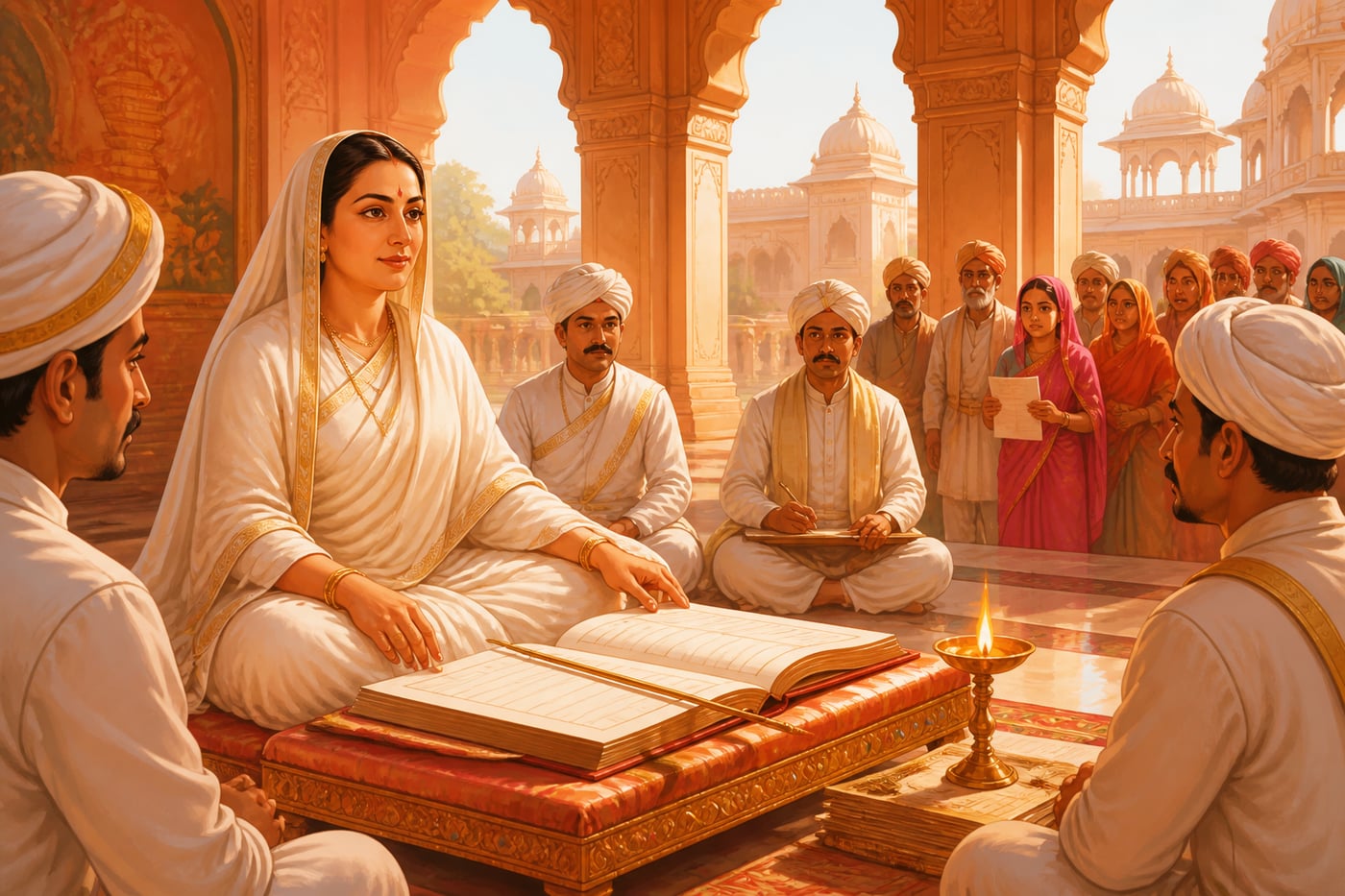
Ahilyabai Holkar administering Indore

Ahilyabai Holkar ruled Indore for 30 years after her husband and son died. She didn't just inherit, she administered, built, and expanded. Temples she commissioned dot India from Dwarka to Varanasi. She proves that women can own, manage, and grow wealth.

Temple inscriptions across South India record women as donors, landowners, and patrons. They gave from their own wealth, recorded in their own names, evidence that women's property ownership was normal, not exceptional.

Draupadi's Question

In the dice game at Hastinapura, Yudhishthira wagered and lost Draupadi. She was dragged into the court, where Dushasana attempted to disrobe her. In that moment of crisis, Draupadi asked a question that silenced the court:

'If the king had already lost himself, he was no longer a free man. How then could he wager me?'

This was not just about her personal situation. Draupadi was challenging the very concept that a woman could be property. The court's silence was its answer, they knew she was right. Treating a woman as property is adharma.

Draupadi questioning the Hastinapura court in red and gold silks

The Modern Restoration

The Hindu Succession (Amendment) Act of 2005 restored what had been taken away during the colonial period. It gave daughters equal coparcenary rights in ancestral property, the same rights sons have by birth.

This wasn't foreign imposition. It was India recognizing that the restrictions on women's property rights were a distortion of dharma, not its fulfillment.

From Legal Right to Living Practice

The law exists. But law alone doesn't change families. What transforms families is the recognition that giving daughters their share is not generosity, it's justice.

Across India, families are now actively choosing to divide property equally. Some are going further, teaching daughters about investments, including them in business decisions, ensuring they have financial literacy.

These families understand: a daughter with property is a daughter with choices. Economic independence gives her the power to walk away from abuse, to support her own family in crisis, to make decisions from strength rather than desperation.

The Karma of Justice

When you give your daughter her rightful share, you receive her blessings and the satisfaction of dharma fulfilled. When you deny her, you carry the weight of injustice, and often, the consequences follow.

Families that deny daughters their rights often find the 'saved' wealth dissipates anyway. Sons fight over it. Bad decisions waste it. The karma of injustice has a way of balancing itself.

Families that give equally often find their wealth grows. Daughters contribute their skills, their networks, their efforts. The karma of justice multiplies.

What You Can Do Today

A modern Indian family signs equal property documents

If you are a parent: Make your will today. Include your daughters equally. Don't wait for them to ask, they shouldn't have to.

If you are a daughter: Know your rights. The 2005 Amendment gives you equal rights in ancestral property. You don't need to be 'given' anything, you already have the right.

If you face family pressure: Remember that accepting injustice against yourself is not virtue. You are not keeping peace by giving up your rights, you are enabling adharma. Stand firm, not in anger, but in dharma.

Case studies

The 2005 Amendment: Restoring Daughters' Rights

Before 2005, daughters had no coparcenary rights in Hindu ancestral property, they could only inherit what their father specifically left them in a will. In 2005, the Hindu Succession (Amendment) Act changed this fundamentally, giving daughters the same rights sons have by birth. The law was challenged repeatedly, with claims that it would 'destroy families' and 'create conflict.'

The 2005 Amendment restored what the Dharmasutras had always recognized, women's independent property rights. Stri-dhan was protected in ancient law. The restriction of women's inheritance rights was a colonial-era distortion, not Dharmic tradition. The amendment's opponents unknowingly argued against their own scriptures.

The Supreme Court's 2020 judgment in Vineeta Sharma clarified that the right is retrospective, daughters born even before 2005 have equal rights. Millions of women now have legal claim to ancestral property. Studies show family conflict has NOT increased; if anything, formalized equal rights have reduced disputes.

Legal recognition enables but doesn't guarantee justice. Families must actively choose to honor daughters' rights. The law provides the framework; dharmic practice provides the implementation.

Despite the 2005 Amendment and the 2020 Supreme Court clarification, most Indian families still exclude daughters from property conversations. Brothers informally 'settle' with sisters through token gifts or emotional pressure to sign away rights. The law exists on paper, but implementation requires families to actively choose fairness. Every family inheritance discussion is a live test of whether dharmic values or social inertia wins.

After the 2005 Amendment and 2020 clarification, property disputes involving daughters decreased in courts where families proactively included daughters in inheritance planning.

The Kedia Family Transformation: Business Inheritance

The Kedia family of Kolkata ran a successful trading business for three generations. When patriarch Rameshwar Kedia died in 2015, his will divided the business equally among his two sons AND two daughters, unprecedented in their business community. Initially, there was shock. Extended family members warned of 'disaster.' Some business associates questioned the decision.

Rameshwar Kedia had studied the Dayabhaga system of Bengal, which gave women greater property rights. He recognized that the exclusion of daughters from business inheritance was not Dharmic tradition but social practice that had calcified into 'custom.' He chose dharma over convention.

The Kedia business thrived after the equal division. One daughter brought marketing expertise, another brought international connections. The sons, freed from the pressure of being 'sole heirs,' took more strategic risks. By 2022, the business had grown 40%, more than comparable family businesses that had excluded daughters.

Equal inheritance is not just ethically right, it's often economically smart. Daughters bring skills, networks, and perspectives that exclusion wastes. The fear that 'including daughters will destroy the business' is not borne out by evidence.

Only 18% of Indian family businesses include daughters in succession planning, even though the data shows gender-diverse leadership grows revenue 1.4x faster. The Kedia example exposes a costly blind spot: excluding daughters is not just unfair, it is economically self-defeating. As more family businesses professionalize, the ones that bring daughters into ownership and leadership will outperform those clinging to sons-only inheritance.

A 2020 study by Bain and Company found that Indian family businesses with gender-diverse leadership (including daughters in ownership) grew revenue 1.4 times faster than those without. Only 18% of Indian family businesses include daughters in succession planning, despite evidence of better outcomes.

Coverture vs. Stri-Dhan: The Historical Reality

Under English common law's 'coverture' doctrine, a married woman ceased to exist legally. Her property became her husband's. She couldn't sign contracts, keep her earnings, or sue in court. This wasn't ancient history, it lasted until the Married Women's Property Acts of 1870 and 1882 in England. American women couldn't get credit cards in their own name until 1974. Meanwhile, the Yajnavalkya Smriti, compiled over 2,000 years ago, explicitly protected stri-dhan as a woman's sole property that her husband could not touch.

The contrast is stark: dharmic tradition recognized women's independent property rights millennia before the West. Stri-dhan included gifts at marriage, from parents, and earnings. Temple inscriptions from the Chola period show hundreds of women as property donors, in their own names. The restriction of women's property rights in colonial and post-colonial India was a deviation from, not continuation of, tradition.

Today, Western feminism sometimes positions itself as 'bringing' property rights to Indian women. The historical record shows the opposite: dharmic tradition protected what Western law denied. The 2005 Amendment is better understood as recovery of tradition than as adoption of Western values. India is returning to its roots, not importing foreign ideas.

Those who argue that women's property rights are 'Western' are historically illiterate. Stri-dhan predates Western women's property rights by over two millennia. The dharmic tradition got this right when the West was still treating married women as legal non-persons. We have nothing to learn from them here, only to remember what we knew.

American women could not get credit cards in their own name until 1974. Indian women had codified property rights over 1,500 years earlier through stri-dhan. When modern commentators frame women's property rights as a 'Western import,' they reveal historical ignorance. The 2005 Amendment was not India adopting foreign values. It was India recovering what colonialism had stripped away.

Coverture lasted in England until 1882, in parts of the US until the 1970s. Stri-dhan was codified in Yajnavalkya Smriti (c. 100-500 CE) and referenced in earlier Dharmasutras. The timeline is clear: dharmic tradition led by over 1,500 years.

Living traditions

The Hindu Succession (Amendment) Act 2005 gave daughters equal coparcenary rights in ancestral property, the same rights sons have by birth. The Supreme Court's 2020 judgment in Vineeta Sharma vs Rakesh Sharma clarified that this right is retrospective. Today, women legally own property across India, from farmland to businesses to ancestral homes.

Reflection

More in Protecting Our Daughters

All lessons in Protecting Our Daughters ยท Stri Shakti: A Woman's Dharma course