Mahatmya: Glory of Srimad Bhagavatam

Benefits of hearing

Suta Goswami concludes by glorifying the Srimad Bhagavatam. Whoever hears, recites, or honors this sacred text attains liberation. All the Vedas, all the holy places, all the fruits of dharma exist within the Bhagavatam. This is the ripened fruit of the Vedic tree, sweet at every taste.

The Sages' Final Question

As Suta Goswami concluded the narrative of King Parikshit's liberation, the assembled sages at Naimisharanya sat in profound silence. They had received the entire Srimad Bhagavatam - all twelve skandhas, eighteen thousand verses, hundreds of stories, teachings, prayers, and revelations. Their hearts were overflowing.
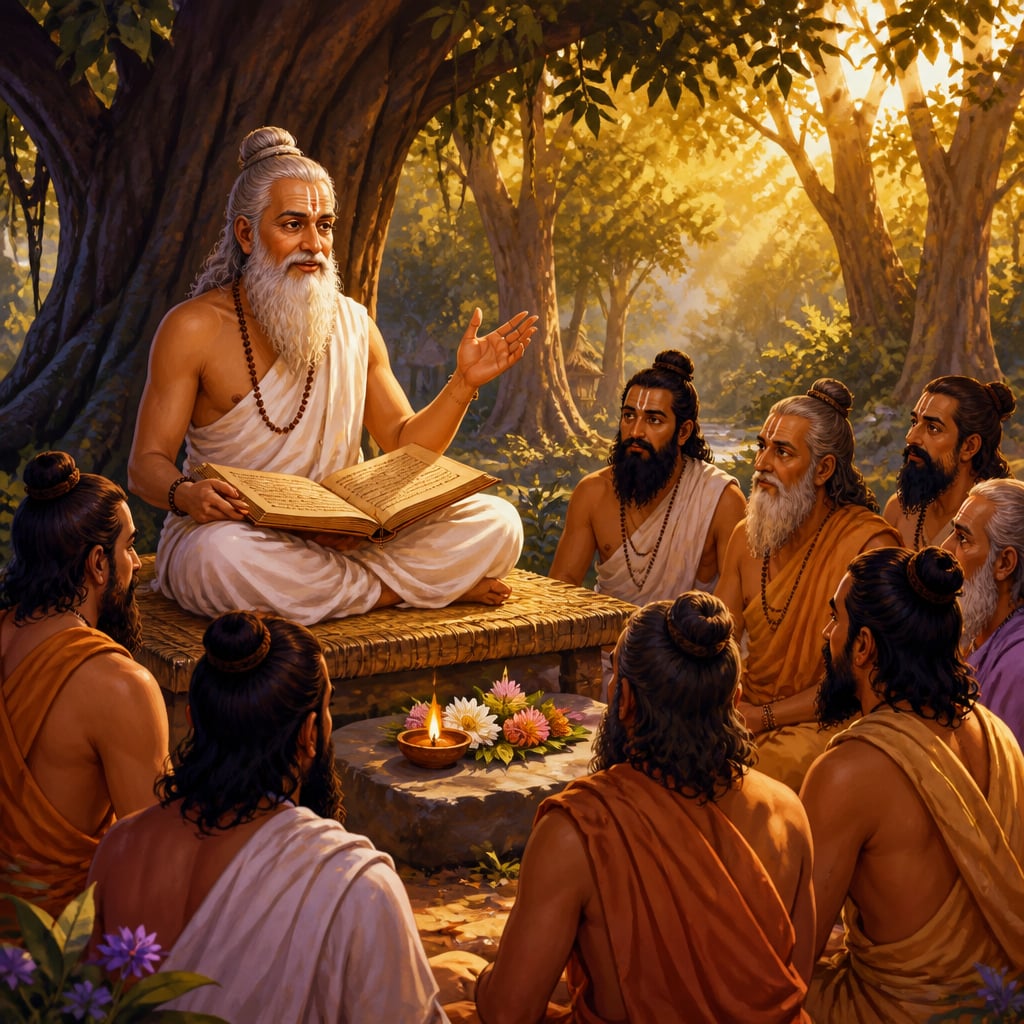
Suta Goswami speaking to sages at Naimisharanya

Finally, Shaunaka, the leader of the assembly, spoke:

"O Suta, you have given us the greatest treasure. But tell us more about this scripture itself. What is its glory? What merit accrues to those who hear it? What distinguishes it from other texts? How should future generations approach and honor the Bhagavatam?"

This question invited the final teaching - the Bhagavata Mahatmya, the glorification of the Bhagavatam itself. Suta's response would become a source of inspiration for countless readers across the ages.

The Ripened Fruit of the Vedic Tree

Suta began with the most celebrated verse describing the Bhagavatam's nature:
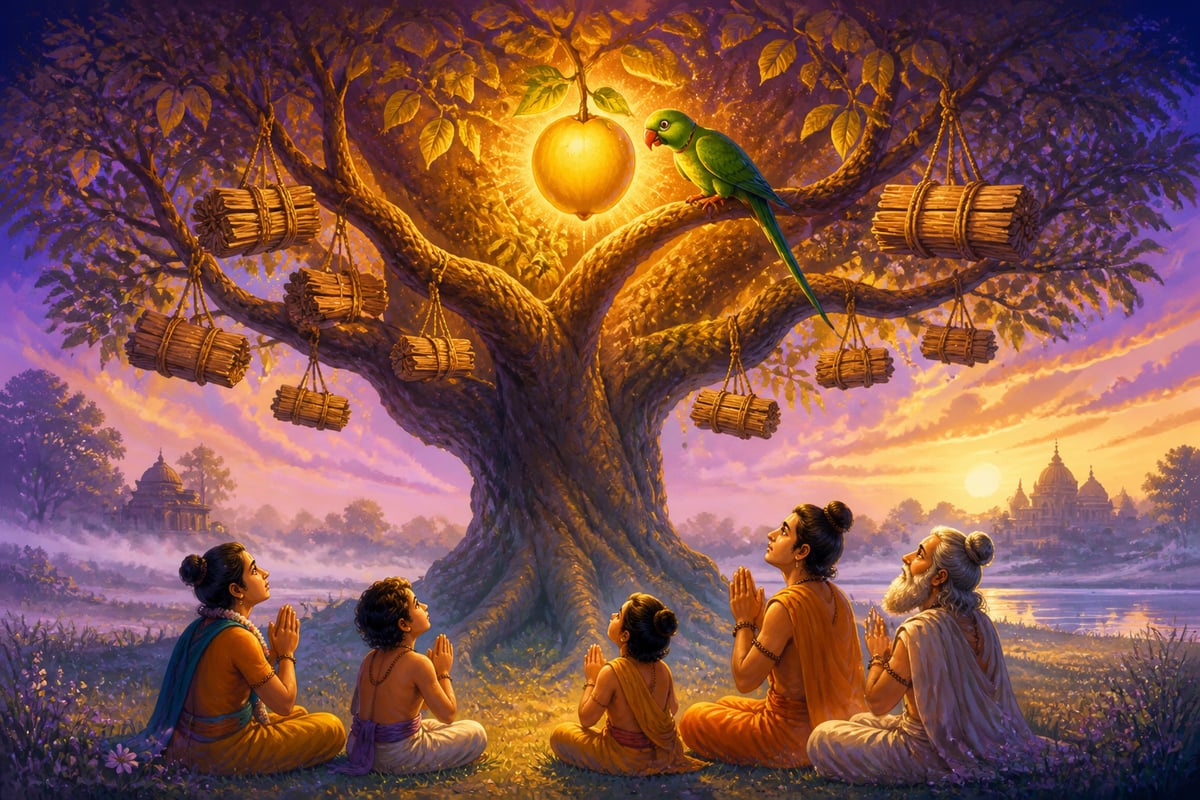
The Vedic desire-tree bearing the ripened fruit of the Bhagavatam

"The Srimad Bhagavatam is the ripened fruit of the desire-tree of Vedic literature. It has descended from the lips of Shukadeva Goswami. Therefore this fruit has become even more tasteful, although its nectarean juice was already sweet. All liberated souls, as well as those seeking liberation, should taste it with great relish."

This imagery tells us everything:

Element Meaning
Desire-tree The Vedas fulfill all desires; they contain knowledge of everything
Fruit The Bhagavatam is the culmination, the essence, the reward
Ripened Not raw or premature; fully mature and ready for consumption
From Shukadeva's lips Transmitted by a liberated soul, adding sweetness
Already sweet The content is nectarean; the transmission doubles the sweetness

Why the Bhagavatam is Supreme

Suta explained the Bhagavatam's unique position among scriptures:

Among the eighteen Mahapuranas, the Bhagavatam stands supreme because it focuses entirely on para-bhakti - pure devotion without material motivation. Other Puranas include sections on dharma, artha, and kama (religion, prosperity, and pleasure), but the Bhagavatam deals exclusively with the fourth goal: moksha through bhakti.

Among all paths to liberation, the Bhagavatam presents the easiest and sweetest. While jnana (knowledge) requires tremendous intellect, and yoga requires physical and mental discipline, bhakti requires only a willing heart. The Bhagavatam makes this heart-path accessible to all.

Among all devotional literature, the Bhagavatam is complete. It contains philosophy (Sankhya from Kapila, the Uddhava Gita), devotee stories (Prahlada, Dhruva, Gajendra), divine pastimes (Krishna lila), cosmic descriptions, ethical teachings, and the mechanics of liberation. No other text combines all elements so perfectly.

The Benefits of Hearing

Suta then enumerated the specific benefits awaiting those who engage with the Bhagavatam:

Immediate Purification

"By hearing even one verse of the Srimad Bhagavatam, by reading one chapter, by honoring the book, or by worshipping it, all sins accumulated over many lifetimes are destroyed."

The purificatory power of the Bhagavatam is not gradual but immediate. Unlike penances that slowly exhaust karma, hearing with faith cleanses the heart instantly. This is because the Lord's name and pastimes carry His presence - and in His presence, sin cannot remain.

Fulfillment of All Desires

Suta made a remarkable claim:

"Whatever merit is obtained by visiting all holy places, by performing all dharmic actions, by giving all charities, by undergoing all austerities, by studying all scriptures - that same merit is obtained simply by hearing the Srimad Bhagavatam with faith."

This is not hyperbole but the logical consequence of the Bhagavatam's content. The text describes all holy places, so hearing it grants their fruit. The text narrates all forms of dharma, so hearing it accomplishes their purpose. The text contains the essence of all scriptures, so hearing it grants their knowledge.

Liberation and Beyond

What is Attained How
Freedom from material bondage The stories dissolve attachment
Purification of consciousness The Lord's pastimes cleanse the mind
Awakening of devotion Hearing naturally evokes love
Direct connection with Krishna He is present in His names and stories
Entrance into His eternal pastimes The highest fruit of bhakti

How to Approach the Bhagavatam

Suta then provided guidance on properly receiving this scripture:

The Attitude of the Listener

"One should hear the Srimad Bhagavatam from a self-realized soul. One should hear with faith, attention, and a desire for liberation. One should hear with freedom from material desires. One should hear repeatedly, as each hearing reveals new depths."

The Bhagavatam is not a book to be read once and shelved. It is a living text that grows with the reader. What seems simple in first reading reveals profound philosophy on the tenth. What touches the emotions initially transforms the heart permanently with sustained exposure.

The Qualifications of the Speaker

Suta himself exemplified these qualities. Though not born a Brahmin, he had become the supreme speaker through his devotion and authentic transmission.

The Context of Hearing

Traditionally, the Bhagavatam is heard:

The Bhagavatam as Incarnation

Suta then revealed the most profound truth about the Bhagavatam:

"This Srimad Bhagavatam is the literary incarnation of Lord Krishna. It is non-different from Him. After Krishna departed from this world, He left behind the Bhagavatam as His representative. Those who could not see Him in person can associate with Him through this text."

This statement has enormous implications:

  1. The Bhagavatam is not about Krishna - it IS Krishna in literary form
  2. Reading is not study - it is darshan (sacred seeing)
  3. The book is not inanimate - it is the Lord's presence
  4. Proper honor is not optional - it is worship

The Bhagavatam treated as Krishna's literary incarnation

For this reason, devotees throughout India treat physical copies of the Bhagavatam with reverence - placing them on elevated seats, never putting them on the floor, offering flowers and incense, bowing before reading.

All Scriptures Rest in the Bhagavatam

Suta elaborated on the Bhagavatam's comprehensive nature:

"All the Vedas are present in the Bhagavatam. All the Upanishads dwell here. All the teachings of the Puranas reside within these pages. The essence of the Mahabharata, the spirit of the Ramayana, the philosophy of all systems - all rest in the Srimad Bhagavatam."

The Comparison to Sacred Rivers

What Rivers Do What the Bhagavatam Does
Flow from mountains Flows from the Supreme
Carry water to the sea Carries souls to liberation
Purify the body Purifies the consciousness
Nurture life Nurtures spiritual growth
Meet in the ocean Encompasses all teachings

Just as all rivers ultimately reach the ocean, all paths of knowledge ultimately reach the Bhagavatam's conclusion: pure devotion to the Supreme Lord.

The Promise to Future Generations

Suta concluded with words of assurance for those who would come after:

"As long as the sun and moon continue to shine, as long as the earth endures, as long as there are human beings seeking liberation - the Srimad Bhagavatam will remain. It is indestructible because it contains the Lord's eternal activities. Time cannot diminish it. Neglect cannot destroy it. It will always be available for those who seek."

This promise has proven true across millennia. Despite invasions, despite book burnings, despite the rise and fall of empires, the Bhagavatam has not only survived but spread to every corner of the world.

The Transmission Continues

Suta himself was a link in this chain:

Every reader of the Bhagavatam becomes part of this lineage. Every listener becomes a potential transmitter. The text creates its own guardians.

The Concluding Benediction

Suta's final words were a blessing and an invitation:

"May this Srimad Bhagavatam be heard by all beings. May it purify the hearts of those touched by Kali Yuga's contamination. May it lead all souls to the lotus feet of Lord Krishna. May the speaker and the hearer both attain the supreme destination."

"This scripture is the essence of all Vedanta. It is the natural commentary on the Brahma Sutra. It shines with the same light as the Absolute Truth. It is the beginning and end of spiritual knowledge. May it be victorious forever."

With these words, the outer frame of the Bhagavatam closes. The sages at Naimisharanya have received everything. The thousand-year sacrifice is now complete - not merely through fire offerings but through the reception of divine knowledge.

The Eternal Relevance

The Bhagavata Mahatmya is not ancient praise but present reality. Every day, millions around the world open this text seeking guidance. Every day, the promises Suta made are fulfilled in the lives of those who hear with faith.

The Bhagavatam does not simply describe the past - it creates the future. Those who absorb its teachings become transformed. Those who are transformed naturally share what they have received. And so the ripened fruit of the Vedic tree continues to nourish souls across the ages.

As we conclude this course on the Srimad Bhagavatam, we are not ending but beginning. The text now lives in us. The question is not what we learned but what we will become. The measure is not knowledge gained but love awakened.

May the blessings of Shukadeva, Suta, and all the sages be upon those who have heard. May the Bhagavatam continue its work in our hearts. And may we, like Parikshit, discover that what seemed like an ending was always a doorway to the eternal.

Living traditions

The Bhagavatam is now available in over 80 languages, with multiple translations and commentaries from various traditions. Digital versions allow instant access worldwide. Audio recordings and video classes make the text accessible to those who cannot read. Yet the tradition of hearing from a living speaker remains central - technology supplements but doesn't replace the human chain of transmission that Suta began at Naimisharanya.

Reflection

More in Skanda 12: Age of Deterioration

All lessons in Skanda 12: Age of Deterioration ยท Srimad Bhagavatham course