Kali Yuga: Symptoms of the Age
The age of quarrel described
Shukadeva describes the symptoms of Kali Yuga - declining lifespans, deteriorating dharma, corrupt rulers, and spiritual degradation. Yet he offers hope: in this age, simply chanting the Lord's name achieves what required elaborate rituals in previous ages. Kali Yuga is both the worst and best of times.
The Final Teachings Begin
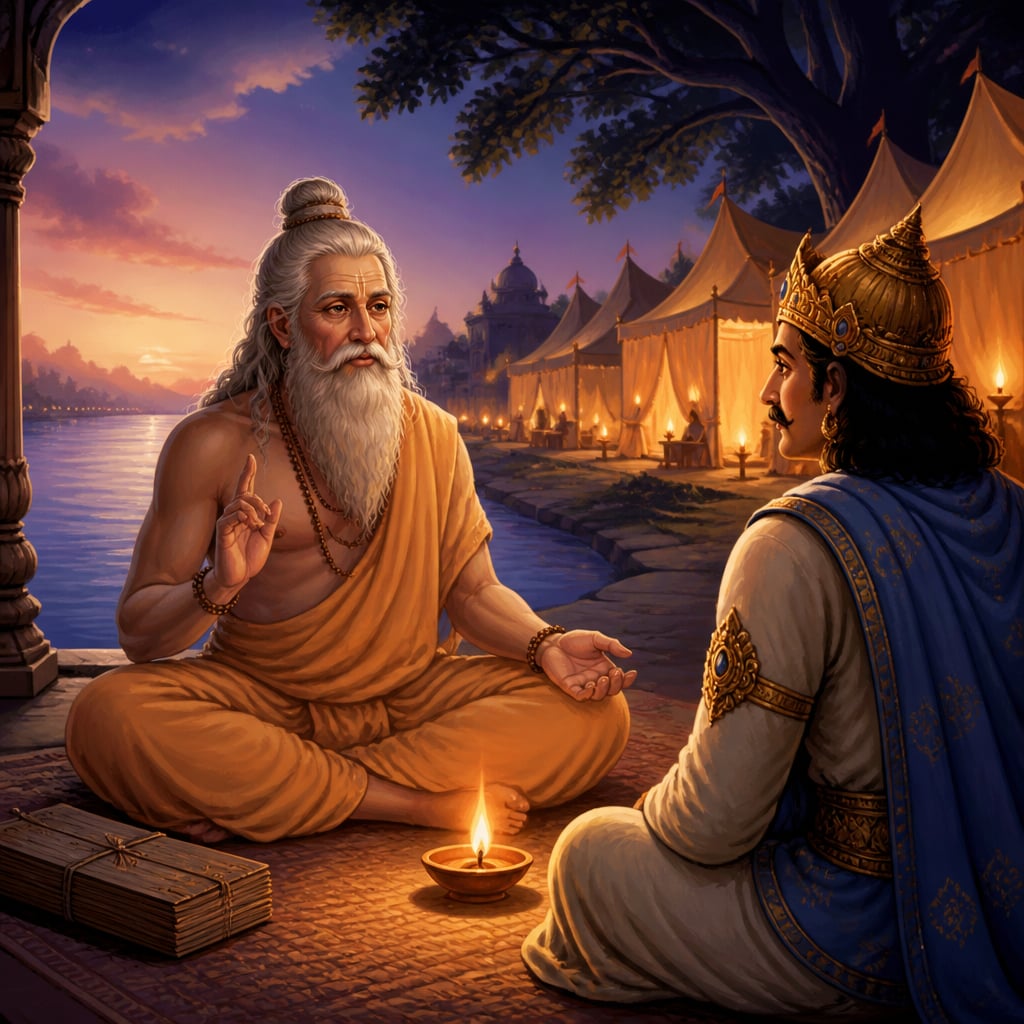
As King Parikshit's seven days drew to their close, Shukadeva Goswami turned to perhaps the most urgent subject of all: the nature of the age in which humanity would live after Krishna's departure. The king had asked where dharma would reside now that the Lord had left the world. Shukadeva's answer would span the entirety of Skanda 12 - but it began with a sober assessment of Kali Yuga, the age of quarrel and hypocrisy.
"O King, in the age of Kali, people's lives, strength, and intelligence will diminish day by day. Their memory, mercifulness, and good qualities will all deteriorate."
These were not words of despair but of diagnosis. A physician must name the disease before prescribing the cure. Shukadeva was preparing Parikshit - and through him, all future generations - to understand the challenges they would face.
The Characteristics of Kali Yuga
Declining Human Qualities
Shukadeva described how the four pillars of dharma - truthfulness (satya), austerity (tapas), cleanliness (shaucha), and compassion (daya) - would gradually weaken. In Satya Yuga, all four pillars stood firm. In Treta Yuga, one weakened. In Dvapara Yuga, two remained. But in Kali Yuga, only one pillar would barely survive - truthfulness - and even that would be under constant assault.
| Yuga | Duration (years) | Dharma Remaining |
|---|---|---|
| Satya | 1,728,000 | 100% - all four pillars |
| Treta | 1,296,000 | 75% - three pillars |
| Dvapara | 864,000 | 50% - two pillars |
| Kali | 432,000 | 25% - one pillar |
The sage enumerated the specific degradations:
- Lifespans would shorten to a maximum of 100 years, with most dying much younger
- Physical strength would diminish; people would become weak and diseased
- Memory would fail; ancient wisdom would be forgotten
- Patience and tolerance would become rare virtues
Social Deterioration

Shukadeva painted a vivid picture of social decay:
"In Kali Yuga, wealth alone will be considered the sign of good birth, proper behavior, and fine qualities. Law and justice will be applied only on the basis of one's power."
The traditional markers of spiritual advancement - character, learning, austerity - would be replaced by a single criterion: money. Those with wealth would be honored regardless of their character; those without would be despised regardless of their virtue.
Marriage would deteriorate from a sacred samskara to a transaction based on mutual attraction or financial arrangement. The bond between husband and wife would weaken, with divorce becoming common.
Family structure would collapse. Children would disrespect parents. Elders would be neglected. The guru-shishya relationship would become commercialized - knowledge sold rather than reverently transmitted.
Religious Degradation
Perhaps most alarming were the predictions about religious life:
- External marks would replace inner transformation - wearing religious dress without practice
- Hypocrisy would flourish; people would criticize others' faults while hiding their own
- Holy places would lose their sanctity through commercialization
- Brahmanas (priests and teachers) would become greedy, abandoning their duties
- Spiritual practice would be performed for show rather than genuine purification
A person's spirituality would be judged by external displays - elaborate rituals, impressive robes, large followings - rather than actual transformation of heart.
Political and Economic Collapse
The sage described how rulers would become plunderers rather than protectors:
"The citizens will suffer greatly from cold, wind, heat, rain, and snow. They will be further tormented by quarrels, hunger, thirst, disease, and severe anxiety."
Kings would act like thieves, taxing their subjects mercilessly while providing no protection. The concept of raja-dharma - the sacred duty of rulers to serve their people - would be forgotten. Leaders would pursue personal pleasure rather than public welfare.
Economically, people would be overwhelmed by debt. Agriculture would fail due to environmental degradation. Cities would become centers of crime. The village system that sustained dharmic life would collapse as people migrated seeking survival.
Future Kings and the Decline of Dynasties
Shukadeva then prophesied the specific rulers who would govern in Kali Yuga. He named dynasties that would rise and fall:
- The Magadha kings would rule for many generations
- The Shungas would take power through treachery
- The Kanvas would succeed them
- Finally, the Andhras would establish their kingdom
Each dynasty would be more degraded than the last. The concept of kshatriya dharma - ruling with righteousness - would progressively disappear. By the end of Kali Yuga, Shukadeva prophesied, rulers would be indistinguishable from robbers.
"The kings of Kali Yuga will be like mlecchas in their behavior. They will kill innocent animals and murder holy men. They will be without mercy."
The Paradoxical Gift of Kali Yuga
Just when the picture seemed unbearably dark, Shukadeva revealed the remarkable paradox that makes Kali Yuga the most fortunate of ages for sincere seekers:
"My dear King, although Kali Yuga is an ocean of faults, there is one great quality about this age: simply by chanting the names of Krishna, one can become free from material bondage and be promoted to the transcendental kingdom."
This single verse transforms everything. In Satya Yuga, liberation required lifetimes of meditation. In Treta Yuga, elaborate fire sacrifices were needed. In Dvapara Yuga, detailed temple worship was the prescribed path. But in Kali Yuga, the maha-mantra - the great chant of deliverance - accomplishes what all these complex practices achieved:

Hare Krishna, Hare Krishna, Krishna Krishna, Hare Hare Hare Rama, Hare Rama, Rama Rama, Hare Hare
Why Nama Sankirtana Works
The sage explained why the holy name holds such power in this age:
- Accessibility: Anyone can chant, regardless of birth, gender, education, or material circumstances
- No qualification required: Unlike Vedic rituals requiring precise pronunciation and elaborate preparation, the name is merciful to imperfect practitioners
- Anytime, anywhere: No special place or time is required
- Collective power: Group chanting (sankirtana) multiplies the effect exponentially
Because dharmic infrastructure would collapse in Kali Yuga - temples desecrated, gurus corrupted, scriptures misinterpreted - the Lord provided a path that depends on nothing external. The name itself carries full potency.
The Sages' Aspiration
Shukadeva concluded this section with a remarkable statement:
"Those who are actually advanced in knowledge are able to appreciate the essential value of this age of Kali. Such enlightened persons worship Kali Yuga because in this age, simply by chanting, one can attain liberation."
Sages in higher ages, despite their longer lifespans and greater facilities, actually envied those born in Kali Yuga. The path was more difficult, yes - but the grace was more freely given. The bar for achievement was lower; the reward remained unchanged.
This teaching inverted the king's despair. He had asked where dharma would reside after Krishna's departure. The answer: dharma would reside in the holy name itself. Those who took shelter of nama sankirtana would find that the Lord had never truly departed.
Preparing for the Journey
As Parikshit absorbed these teachings, he understood that Shukadeva was not merely describing an abstract future. He was preparing the king for death - and through him, preparing all of humanity for life in the darkest age.
The symptoms of Kali Yuga serve as signposts. When we see these conditions manifesting in our world - declining dharma, corrupt leaders, spiritual confusion - we need not despair. These are the very conditions that the Bhagavatam predicted. And for these very conditions, the remedy was provided: take shelter of the holy name.
King Parikshit, facing death from a serpent's bite, found this teaching liberating. He no longer feared the darkness ahead. He had been given the lamp that would never be extinguished.
The final Skanda had begun. In the remaining lessons, Shukadeva would share the vision of Markandeya, the conclusion of Parikshit's own story, and the eternal glory of the Srimad Bhagavatam itself. But the foundation was laid here: Kali Yuga, for all its terrors, was pregnant with possibility for those who knew how to access it.
Living traditions
The Kali Yuga teachings have spawned a global spiritual movement. Srila Prabhupada's ISKCON alone has distributed over 500 million books and established temples on every continent. The maha-mantra has been featured in major Western music (George Harrison's 'My Sweet Lord'), performed at Woodstock, and now resonates in yoga studios, meditation apps, and homes across the globe. What the Bhagavatam prescribed 5,000 years ago for Kali Yuga has become a living reality.
- Hare Krishna Maha-mantra Chanting: The congregational chanting of the 16-word mantra 'Hare Krishna Hare Krishna Krishna Krishna Hare Hare, Hare Rama Hare Rama Rama Rama Hare Hare' - the yuga-dharma practice for Kali Yuga
- Japa Meditation: Personal chanting on 108-bead tulsi malas, typically 16 rounds (1,728 names) daily as a minimum spiritual discipline
- ISKCON Mayapur: Global headquarters of the Hare Krishna movement and birthplace of Chaitanya Mahaprabhu. Home to the Temple of the Vedic Planetarium (TOVP) - the largest temple in the world under construction - dedicated to spreading the Kali Yuga solution of sankirtana
- ISKCON Temple Network: The International Society for Krishna Consciousness maintains temples worldwide specifically to implement the Bhagavatam's prescription: making nama-sankirtana accessible to everyone regardless of birth or background
Reflection
- The Bhagavatam says wealth alone will determine status in Kali Yuga. In what ways do you see this prediction manifesting in today's world, and how do you personally navigate the tension between material success and spiritual values?
- Shukadeva says sages in higher ages actually envied those born in Kali Yuga. What does this suggest about the relationship between difficulty and spiritual opportunity?
- The prescribed practice for Kali Yuga is collective chanting (sankirtana) rather than individual meditation. Why might community-based practice be particularly suited to this age?