Mahima: Krishna's Glory Summarized

Unlimited pastimes briefly told

As Skanda 10 concludes, Shukadeva acknowledges that Krishna's pastimes are limitless. He summarizes key events not covered in detail: Shishupala's liberation through hatred, the Bhagavad Gita's gift to humanity, and Krishna's pivotal role in the Mahabharata. The glory of hearing these pastimes brings liberation and love.

The Ocean Without Shore
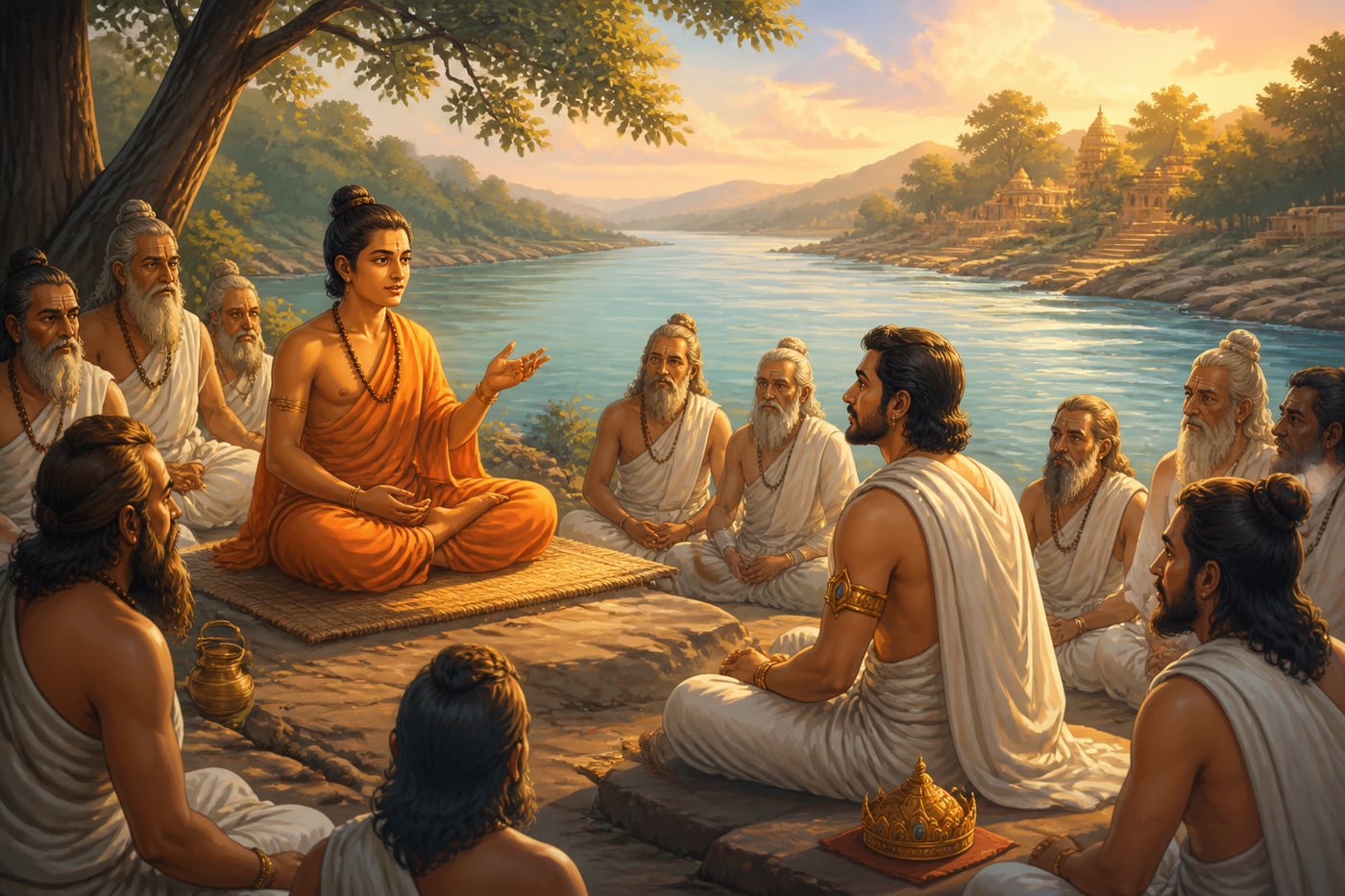
Shukadeva Goswami narrating the Bhagavatam to King Parikshit on the Ganga

As Shukadeva Goswami approached the end of Krishna's earthly narrative, he paused. King Parikshit had listened without rest, without food, with death approaching in seven days. The sage had narrated Krishna's birth, childhood in Vrindavan, youth in Mathura, and reign in Dwaraka. But something remained unsaid - not from forgetfulness, but from necessity.

"O King, the pastimes of Lord Krishna are like an ocean without shore. Even if I spoke for the lifespan of Brahma, I could not exhaust them. What I have told you is like a handful of water from that infinite sea."

The Bhagavatam's tenth Skanda contains ninety chapters - the longest section of the entire text. Yet even this vast account acknowledges its incompleteness. Krishna's lila (divine play) continues eternally; what appears in scripture is merely what human words can carry.

What Was Not Told

Shukadeva summarized several significant episodes that he could not narrate in full detail:

The Liberation of Shishupala
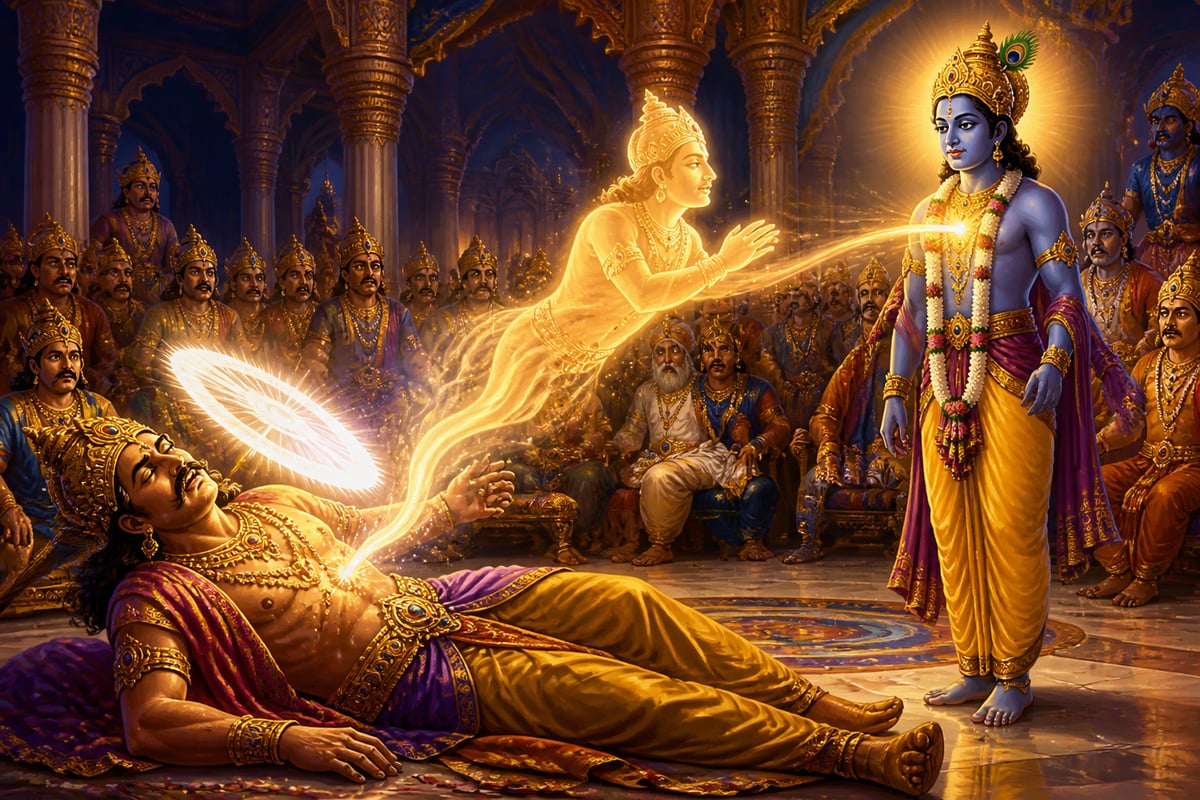
Shishupala's soul merging with Krishna at the moment of paradoxical liberation

Shishupala, king of Chedi, was Krishna's cousin and sworn enemy. At Yudhishthira's Rajasuya sacrifice, when Krishna was honored as the chief guest, Shishupala could contain himself no longer. He stood before the assembled kings and sages and hurled abuse at Krishna - one insult after another, defaming his character, questioning his worthiness, mocking his childhood as a cowherd.

Krishna listened silently. The assembled guests grew uncomfortable, then outraged. Some reached for their weapons. But Krishna raised his hand, calming them.

The story behind his tolerance was known to few: Shishupala's mother, Krishna's aunt, had once extracted a promise from him. "My son has been born with extra arms and three eyes," she had pleaded. "The omens say he will die at your hands. Promise me you will forgive his offenses - as many as possible."

Krishna had promised to forgive one hundred offenses. As Shishupala raged, the count approached its limit. At the hundredth insult, without anger but with perfect precision, Krishna released his Sudarshana Chakra. The divine discus severed Shishupala's head.

The Paradox The Deeper Teaching
Shishupala hated Krishna His hatred was constant meditation on Krishna
He was killed by Krishna Death at Krishna's hands is liberation
He seemed cursed He was actually blessed by his intense focus
His end seemed violent A brilliant light merged into Krishna's form

"Even enmity toward the Lord, when it involves constant remembrance, can lead to liberation. Such is the power of connection with the Divine - even negative connection bears positive fruit."

This teaching is profound and frequently misunderstood. It does not recommend hatred as a spiritual path. Rather, it demonstrates that Krishna's power to liberate is so great that even those who approach him through opposition receive benefit. How much more, then, do those who approach through love receive!

The Gift of the Bhagavad Gita

Shukadeva reminded Parikshit that Krishna's greatest teaching came not through playful pastimes but through direct instruction. On the battlefield of Kurukshetra, when Arjuna laid down his bow in despair, Krishna delivered the Bhagavad Gita - seven hundred verses containing the essence of all spiritual knowledge.

Krishna delivers the Bhagavad Gita to Arjuna between the two Kurukshetra armies.

"The Gita cannot be summarized here," Shukadeva explained, "for every word carries infinite depth. But know this: in that teaching, Krishna revealed himself as the Supreme Person, the source of all, the goal of all paths. He taught that action in devotion surpasses both action and inaction; that yoga means union with him; that surrender to him is the highest path."

The Gita's teachings include:

"Whatever one's situation, whatever one's capacity, the Gita offers a path. It is Krishna's gift to all humanity, available to anyone who opens its pages with sincere inquiry."

Krishna in the Mahabharata

The Srimad Bhagavatam focuses on Krishna's personal pastimes, but his role in the Mahabharata war shaped the destiny of civilization. Shukadeva sketched this role briefly:

The paradox of Krishna in the Mahabharata is that he never fought personally - yet he was the decisive factor. His mere presence, his counsel, his friendship turned the tide. When Arjuna was paralyzed, Krishna spoke. When Bhima was overwhelmed, Krishna signaled. When Yudhishthira was despairing, Krishna counseled.

"The Lord of the Universe," Shukadeva explained, "could have ended the war with a thought. Instead, he chose to be the friend, the guide, the charioteer. He empowered others to act rather than acting alone. This is his nature: to raise others, not to overshadow them."

The Power of Hearing

Shukadeva then spoke of why these pastimes matter - not as historical curiosities but as active spiritual medicine:

"One who hears these pastimes of Krishna with faith develops devotion. One who develops devotion attains the Lord. There is no knowledge more purifying, no practice more sanctifying, no meditation more liberating than hearing and remembering the activities of the Supreme Person."

The Bhagavatam tradition emphasizes shravanam (hearing) as the first and foundational practice of bhakti. Why hearing? Because hearing bypasses intellectual obstacles. A child can hear stories of Krishna without understanding philosophy. A skeptic can hear while suspending disbelief. A devotee can hear and go deeper with each repetition.

What Hearing Does

It Purifies the Heart: The accumulated dust of material existence - the layers of selfish desire, of ignorance, of forgetfulness of our true nature - is gradually washed away through consistent hearing.

It Creates Attraction: As we hear of Krishna's qualities - his beauty, his kindness, his playfulness, his wisdom - natural attraction develops. We cannot force ourselves to love, but we can expose ourselves to what is lovable.

It Plants Seeds: Even if we do not immediately transform, hearing plants seeds that will flower in time. Stories heard in childhood return in old age. Impressions deposited in the heart activate when conditions are right.

It Connects Generations: The tradition of hearing and retelling creates an unbroken chain of transmission. Shukadeva heard from Vyasa; Vyasa compiled from eternal sources; Parikshit heard from Shukadeva; we hear from those who heard from those who heard. This chain connects us to the original telling.

The Summary of Glory

As the tenth Skanda approached its conclusion, Shukadeva offered a summary - not of events, but of meaning:

Krishna is the Source: All avatars, all deities, all aspects of divinity find their origin in Krishna. He is not one god among many but the source from which all gods emanate.

Krishna's Pastimes Are Eternal: What he performed on earth continues in the spiritual realm. The flute playing, the dancing, the friendship, the love - these are not past but perpetual. Those who attain his abode join these pastimes forever.

Krishna's Love Is Unlimited: He loves each devotee as if that devotee were the only one. The Gopis felt his exclusive attention; so did Sudama; so did Arjuna. He multiplied himself to dance with each Gopi individually. His capacity for personal relationship is infinite.

Krishna Responds to Devotion: Not to birth, not to learning, not to wealth. Sudama was poor; Vidura was of low birth; the Gopis were simple village women. Krishna valued their devotion above the offerings of kings.

Krishna Grants What Is Truly Good: Sometimes this means material blessings; often it means something better. Sudama received wealth but received devotion more. The Gopis received separation but received purified love through it. Krishna knows what we need better than we do.

The Endless Song

Shukadeva concluded with a reflection that applies not only to Parikshit but to all who would hear:

"O King, the glories of Krishna cannot be completed by speech, cannot be exhausted by time, cannot be measured by mind. What I have offered is an invitation to the ocean. The full glory awaits those who plunge in through devotion."

The Bhagavatam does not end so much as it opens outward. Having heard, the listener is invited to remember, to chant, to worship, to serve - to continue the story in their own life. Krishna's pastimes become the listener's meditation; Krishna's qualities become the listener's aspiration; Krishna's love becomes the listener's home.

Why This Matters

For Parikshit, facing death in seven days, these teachings were literal preparation for the final journey. His question - "What should a person about to die hear and do?" - found its answer in the Bhagavatam's entirety, but especially in the tenth Skanda's Krishna-katha.

For us, facing death at an unknown but certain future time, the same teaching applies. The glory of Krishna, heard with faith, purifies the consciousness. Purified consciousness, at the moment of death, rises naturally to Krishna's abode. This is not superstition but spiritual science: consciousness shaped by constant meditation determines the next state of being.

"Whatever one remembers at the moment of death determines one's next existence. One who remembers Krishna attains Krishna. Therefore, remember Krishna always - and fight."

This, the essence of the Gita's teaching, is also the essence of the Bhagavatam's purpose. The elaborate stories, the detailed philosophies, the many characters and events - all serve one aim: to fill the mind with Krishna so that at life's end, and at every moment before, Krishna is present.

The mahima (glory) of Krishna is summarized not in words but in effect: the transformed heart of one who has truly heard.

Living traditions

The Bhagavatam's message that Krishna's glory is infinite and hearing about him is transformative has shaped modern devotional movements worldwide. ISKCON's founder, Srila Prabhupada, spent his final years completing a multi-volume translation and commentary on the Bhagavatam, considering it his most important work. Digital platforms now make Bhagavatam recitations available globally, with millions streaming daily discourses. The text's psychological insights about consciousness, emotion, and transformation are being studied by researchers interested in contemplative traditions. The Bhagavatam's model of oral transmission continues through podcast versions, audio books, and video lectures, adapting the ancient tradition of shravanam to modern technology.

Reflection

More in Skanda 10 Part 3: Krishna's Later Pastimes

All lessons in Skanda 10 Part 3: Krishna's Later Pastimes ยท Srimad Bhagavatham course