Kurukshetra: Reunion with Gopis

The solar eclipse meeting

During a solar eclipse at Kurukshetra, all of Vrindavan comes. After years of separation, the Gopis finally meet Krishna. Their love, unchanged and supreme, demonstrates the highest devotion. Krishna assures them they are never separated, for true love transcends physical presence.

The Sacred Eclipse
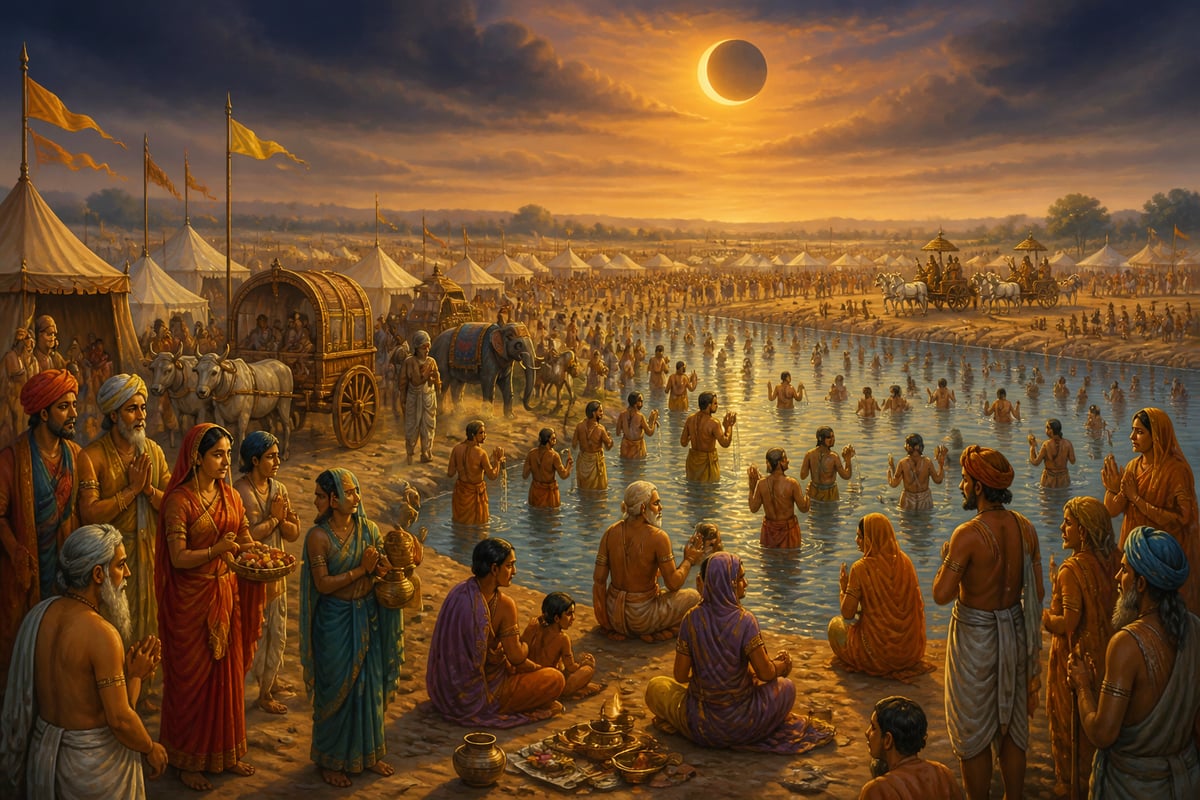
The vast solar eclipse pilgrimage gathering on the plain of Kurukshetra

When a solar eclipse was predicted, all of India prepared for pilgrimage. The ancient tradition held that bathing in sacred waters during an eclipse neutralized sins and multiplied spiritual merit. Kurukshetra - the field of dharma, the land where the great war would later be fought - became the gathering point for millions.

From every direction they came: sages from their ashrams, kings from their palaces, merchants from their cities, farmers from their fields. Among them came the residents of Dwaraka - Krishna with his queens, Balarama, and the Yadava nobles.

And from the eastern lands, traveling with hearts that had never stopped yearning, came the people of Vrindavan.

Those Who Remained

Nanda and Yashoda, Krishna's foster parents, had not seen their son in years. When Krishna left for Mathura in his youth, following Akrura's chariot, he had promised to return. But Kamsa was killed, then Jarasandha attacked repeatedly, then Dwaraka was built, and the years stretched into decades.

Nanda and Yashoda had grown old. Their hair had whitened. Their bodies had weakened. But their love for Krishna had only deepened, like a river that digs ever deeper channels as it flows.

"Not a day passed that Yashoda did not prepare butter for Krishna. Not a morning that Nanda did not look to the road, hoping to see his son's chariot returning."

With them came the cowherd boys - now men - who had played with Krishna in the forests. They remembered every game, every prank, every moment of laughter.

And the Gopis came.

The Gopis' Journey

The Gopis of Vrindavan occupied a unique place in devotional literature. These were the milkmaids who had loved Krishna with complete abandon during his childhood and youth. Their love was not the measured devotion of ritual practitioners but the wild, consuming passion of souls who had found their eternal beloved.

When Krishna left, they did not die - but they did not truly live either. Their bodies performed daily tasks; their souls remained fixed on Krishna. Every moment was meditation on him:

| Gopis in Vrindavan | How They Remembered | |--------------------|--------------------|| | Churning butter | Remembered churning with Krishna | | Walking to the river | Recalled walking with Krishna | | Hearing flute music | Wept, remembering his flute | | Seeing blue clouds | Saw his complexion | | Seeing peacock feathers | Saw his crown |

For years, they had lived in this state of constant remembrance, constant longing, constant love. Now, finally, they would see him again.

The First Sight

When the Vrindavan party arrived at Kurukshetra, they found a vast encampment. Thousands of tents, royal pavilions, the bustle of pilgrims from across the subcontinent. Somewhere in this sea of humanity was Krishna.

The Gopis' hearts raced. Would he remember them? Would he look different? Would he have changed, surrounded now by queens and courtiers rather than cows and forests?

Then they saw him.

Krishna - but not as they remembered. No longer the cowherd boy in forest garb. He was dressed as a king now, adorned with jewels, surrounded by the splendor of Dwaraka. His queens walked beside him, beautiful and regal. Guards attended him. Ministers consulted him.

Yet when his eyes met theirs across the crowd, everything else dissolved.

"In that instant of recognition, years of separation collapsed into a single moment. It was as if no time had passed - and as if eternity had passed. They stood frozen, tears streaming, hearts exploding with love that had never diminished."

Krishna meets the Gopis again at Kurukshetra after long years of separation.

The Meeting

Krishna came to them. Not with the formal greeting of a king to subjects, but with the overflow of one who had longed for this moment as much as they had.

Krishna kneeling in reunion before his aged foster parents Yashoda and Nanda

First he met Nanda and Yashoda. The elderly couple held him, weeping, unable to speak. Yashoda touched his face, his hands, his hair - assuring herself he was real, that this was truly her child returned.

"Mother," Krishna said, his own voice thick with emotion, "Father - forgive me for not coming sooner. The circumstances... the responsibilities..."

"Hush," Yashoda whispered. "You are here now. That is enough. That is everything."

Then Krishna met the cowherd men, embracing each one, recalling specific moments from their shared childhood. "Do you remember when we stole butter from Garga's house?" "Do you remember the demon Bakasura?" Memory after memory, friendship renewed.

With the Gopis

Finally, Krishna came to the Gopis. The Bhagavatam describes this meeting with profound reverence, for it represents the highest form of devotion encountering its object.

The Gopis did not bow formally or speak prescribed greetings. They simply looked at him - and in that look was everything: the love, the longing, the pain of separation, the joy of reunion, the confusion of seeing him as a king rather than a cowherd, and beneath it all, the unchanging flame of devotion that had burned undiminished through all the years.

Krishna understood perfectly. He spoke to them not as a king but as their beloved:

"Do you think I ever forgot you? Do you imagine that because my body is in Dwaraka, my heart is not in Vrindavan? You are always with me. In truth, we have never been separated - for true love knows no distance, and the soul's connection transcends the body's location."

The Philosophy of Separation

This reunion at Kurukshetra became the setting for one of the Bhagavatam's most profound teachings on love and separation.

The Gopis asked, essentially: "If you love us, why did you leave? Why have you stayed away? How can love exist across such distance and time?"

Krishna's response illuminated the nature of divine love:

Physical presence is not the measure of love. Just as the sun illuminates the earth even from vast distance, true love operates through inner connection, not physical proximity.

Separation can deepen love. The Gopis' devotion had not weakened during the years apart - it had intensified. The pain of longing had refined their love into its purest form. In Vaishnava theology, this viraha (separation) is considered an advanced stage of bhakti, sometimes more precious than union.

The beloved is always present in the heart. The Gopis had meditated on Krishna constantly. In a real sense, they had been with him more intensely than if he had remained physically present. Their every thought, every action, every breath had been an offering to him.

"Those who love me with all their hearts," Krishna taught, "are never separated from me, nor am I from them. I remain in their hearts, and they in mine. This is the secret of devotion that transcends time and space."

The Gopis' Response

But the Gopis, in their profound love, made a subtle complaint that revealed an even deeper understanding:

"You speak philosophy to us, Krishna. You tell us that love transcends distance. But we are not jnanis (knowledge-seekers) - we are simple village women. We do not want philosophical union; we want you. We want your physical presence, your smile, your voice, your touch."

"In Vrindavan, you played with us in the forests. Here at Kurukshetra, you are surrounded by chariots and queens. Even when we see you, we don't truly have you. Take us back to Vrindavan. Dance with us again under the autumn moon. Let us hear your flute once more in the groves where we first loved you."

This is the perfection of the Gopis' devotion: they want not liberation, not philosophical understanding, not even the bliss of divine vision - they want Krishna himself, in the intimate setting where their love first blossomed.

Krishna's Tenderness

Krishna did not dismiss their plea as spiritually immature. He did not lecture them on detachment or the illusory nature of physical presence. Instead, he responded with tender acknowledgment:

"Your love is the highest achievement of consciousness. The sages perform austerities for lifetimes to attain what you have naturally - pure, unmotivated love for the Divine. If I have not returned to Vrindavan, it is not because I have forgotten or because I love you less. The world's affairs have required my presence elsewhere. But know this:"

"Wherever I am, Vrindavan is. Because you carry Vrindavan in your hearts - and I never leave the hearts of those who love me purely. In truth, I am dancing with you now, in the eternal Vrindavan that exists beyond time."

This teaching points to the Vaishnava understanding of the nitya-lila - the eternal pastime. Even as Krishna's earthly body performed various activities, his eternal form continued to dance with the Gopis in the spiritual Vrindavan that exists forever.

The Depth of Their Love

The Bhagavatam emphasizes that the Gopis' love was not selfish desire but the purest form of prema (divine love). Evidence of this:

This is why Vaishnava tradition holds the Gopis as the supreme examples of devotion, surpassing even the greatest sages. The sages love God for liberation; the Gopis love Krishna for Krishna.

Reunion's Gift

The meeting at Kurukshetra was brief in worldly time but eternal in spiritual significance. The Gopis returned to Vrindavan; Krishna returned to Dwaraka. The physical separation continued.

But something had been confirmed and deepened: the love that connected them was real, undiminished, and transcendent. They had seen each other. They had spoken. They had touched. And they had understood that even when they could not see, speak, or touch, the connection remained.

For devotees who meditate on this episode, it offers profound comfort: distance from the beloved is not absence of the beloved. The Lord who seems far may be nearer than our own hearts. And the longing we feel for divine presence is itself a form of presence - the beloved dwelling in our yearning.

The Eternal Message

As the Bhagavatam narrates, when the Gopis finally parted from Krishna again, they did so with transformed understanding:

"We go, but we do not leave you. You stay, but you do not leave us. In the space between breath and thought, you dwell. In the silence between heartbeats, you dance. We are never alone, for you are our Self. We are never separated, for we are your love."

This is the teaching of Kurukshetra: love that has touched the Divine is never truly broken. Separation is a veil, not a wall. And the Lord who seems distant is as close as our next act of remembrance.

Living traditions

The Kurukshetra reunion has profoundly influenced Indian emotional and spiritual vocabulary. The concept of viraha as purifying love has shaped poetry, music, and film across South Asia. Modern devotional movements, particularly ISKCON, teach the Gopis' mood as the highest aspiration of spiritual life. The idea that separation can deepen rather than diminish love has been explored by contemporary spiritual teachers addressing issues of death, distance, and longing. In psychological terms, the Gopis' experience describes what might be called 'secure attachment' - love that doesn't require constant reassurance because it rests on deep inner connection. The teaching that we are never truly separated from what we love offers comfort to those grieving or experiencing physical distance from loved ones.

Reflection

More in Skanda 10 Part 3: Krishna's Later Pastimes

All lessons in Skanda 10 Part 3: Krishna's Later Pastimes ยท Srimad Bhagavatham course