Parvata Mata: Mountain Mothers

Vaishno Devi and Naina Devi - the Himalayan guardians

Trek to two of India's most visited Shakti Peethas. Discover Vaishno Devi's cave shrine in Katra where Sati's arms fell, and Naina Devi in Bilaspur where her eyes fell. Learn about the 12km trek, the three pindis, and why millions undertake this arduous pilgrimage annually.

The Call of the Mountains

Every year, over 10 million pilgrims undertake one of India's most demanding journeys, a 12-kilometer trek up the Trikuta mountains to reach a small cave 5,200 feet above sea level. They walk through the night, calling out "Jai Mata Di!" as they climb. The elderly are carried in palanquins. Children walk beside parents. The rich and poor climb together.

They are answering the call of Vaishno Devi, the Virgin Goddess, the Mountain Mother, one of the most visited pilgrimage sites on Earth.

Not far from here, in the hills of Bilaspur, another Mother watches from her mountain perch. Naina Devi, the Goddess of Eyes, sits atop a hill overlooking the Gobind Sagar lake, where Sati's eyes fell as Shiva carried her lifeless body across the sky.

These are the Parvata Matas, the Mountain Mothers of the Himalayas. Their temples are not easily reached. The Goddess makes you climb to her.
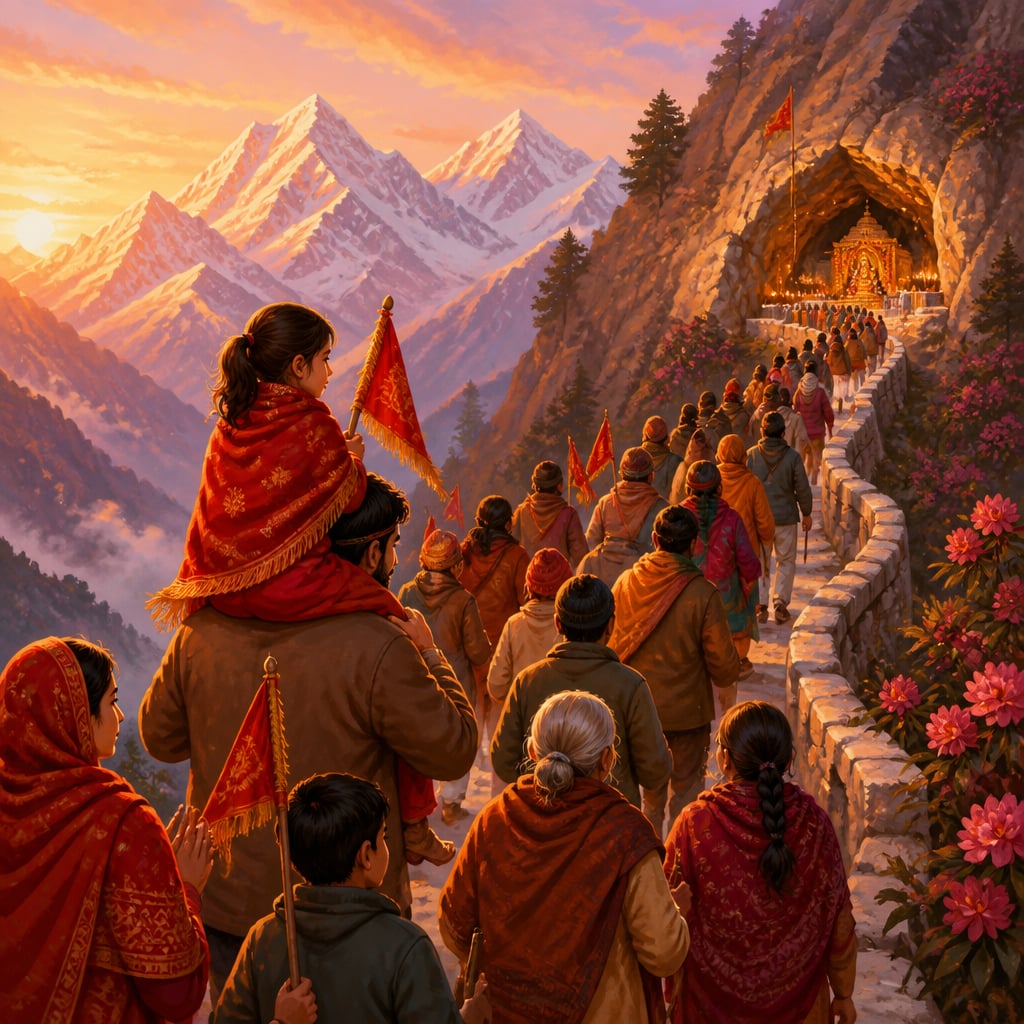
Pilgrims ascending Trikuta mountain path to Vaishno Devi at dawn

Where the Arms Fell: The Vaishno Devi Legend

The Trikuta Parvat (Three-Peaked Mountain) in Jammu is where Sati's arms fell according to the Shakti Peetha tradition. But the Vaishno Devi mythology includes a unique local legend that gives the pilgrimage its distinctive character.

According to this legend, a young girl named Vaishnavi was born to a devout family, an incarnation of Adi Shakti herself. She was devoted to Vishnu and sought to remain a virgin (kumari), dedicating her life entirely to spiritual practice. The sage Gorakhnath, founder of the Nath tradition, heard of her powers and sent his disciple Bhairavnath to test her.

Bhairavnath became obsessed with Vaishnavi and pursued her relentlessly. To escape, she fled from her home to the Trikuta mountains. During her flight, she performed several miracles:

Finally, she entered a small cave at the mountain's peak. When Bhairavnath found her, she took the form of Mahakali and beheaded him. But in his dying moment, Bhairavnath realized his error and begged forgiveness. The compassionate Goddess granted him a boon: no pilgrimage to her shrine would be complete without first visiting his temple.

This is why devotees stop at Bhairavnath Temple before or after visiting the main cave. The pursuer became the guardian. The enemy became the devotee.

The Three Pindis: One Goddess, Three Forms

The sanctum of Vaishno Devi is a narrow natural cave called the Garbh Joon (Holy Womb). Inside are three natural rock formations called pindis, sacred stones that represent three aspects of the Goddess:

The three pindis of Mahakali Mahalakshmi Mahasaraswati in the cave

Pindi Goddess Form Color
Left Maha Kali Destroyer/Transformer Black
Center Maha Saraswati Wisdom/Knowledge White
Right Maha Lakshmi Prosperity/Abundance Red

These three pindis are not carved idols but natural rock formations, the Goddess revealed herself through the mountain itself. The narrow cave requires pilgrims to walk through water and squeeze through tight passages, symbolizing the journey through the birth canal into the presence of the Divine Mother.

To enter the cave of Vaishno Devi is to be reborn. The narrow passage, the darkness, the cold water at your feet, and then, suddenly, the three Mothers, lit by lamps, waiting as they have waited for millennia.

The theological significance of the three pindis is profound. The Goddess is not one form but all forms. She creates (Saraswati), she sustains (Lakshmi), she transforms (Kali). At Vaishno Devi, pilgrims encounter the complete Shakti, the full spectrum of divine feminine power.

The Pilgrimage Journey

The journey to Vaishno Devi begins at Katra, a bustling town at the base of the Trikuta mountains. From here, pilgrims undertake the 12-kilometer trek (now partially covered by ponies, palanquins, and a helicopter service for those unable to walk).

The traditional route passes through several sacred sites:

1. Ban Ganga (2 km) The stream created by Vaishnavi's arrow. Pilgrims wash their hands and feet here, beginning the process of purification.

2. Charan Paduka (3 km) A rock bearing the Goddess's footprints. A reminder that she walked this path herself, that you are following in her steps.

3. Adhkuwari (6 km) The "Half-Womb", a narrow cave where Vaishnavi hid for nine months. Pilgrims crawl through this 15-foot passage on hands and knees, symbolically entering and exiting the Goddess's womb.

4. Sanjichhat (8 km) A plateau where pilgrims rest before the final ascent. Helicopter service lands here.

5. Bhawan (12 km) The final destination, the cave shrine housing the three pindis. Here, after hours of climbing, pilgrims have darshan of the Mother.

The journey takes 5-8 hours for most pilgrims. Many walk through the night, reaching the cave at dawn. The path is lit throughout, and food stalls provide refreshment at every stage.

Naina Devi: Where the Eyes Fell

Naina Devi temple overlooking Gobind Sagar lake

In the Bilaspur district of Himachal Pradesh, atop a triangular hill overlooking the Gobind Sagar lake (formed by the Bhakra Dam), sits Naina Devi, the Goddess of Eyes.

Here, Sati's eyes fell as Vishnu's discus severed her body. The temple houses the sacred eyes as its primary object of worship, giving the site its name: Naina (eyes) + Devi (goddess).

The Naina Devi temple is ancient, mentioned in the Skanda Purana and other texts as one of the original 51 Shakti Peethas. Unlike Vaishno Devi's cave, this temple has a traditional structure with a shikhara (spire), mandapa (hall), and garbhagriha (sanctum). But like Vaishno Devi, reaching it requires climbing, a hill with hundreds of steps that pilgrims ascend while calling the Goddess's name.

The Bhairava of this peetha is Unmukha Bhairava, the "Upward-facing" or "Open-faced" Bhairava, whose temple sits near the main shrine.

The Teaching of the Mountain

Why did the Goddess choose to dwell in mountains that are hard to reach? Why must pilgrims climb for hours, enduring physical hardship, to have her darshan?

The Parvata Mata tradition teaches that effort is part of the offering. The journey is not merely transportation to the destination, the journey IS the pilgrimage. Each step is a prayer. Each bead of sweat is an offering. The physical struggle prepares the mind for the spiritual encounter.

Consider what happens on the trek to Vaishno Devi:

By the time pilgrims reach the cave, they have been transformed. The hours of walking have stripped away the mental noise of everyday life. They arrive empty, and in that emptiness, the Goddess can fill them.

The mountain does not come to you. You must go to the mountain. This is the first teaching of the Parvata Mata: the sacred makes demands of the seeker.

The Kumari Principle

Vaishno Devi is called the Virgin Goddess, Kanya Kumari, the Eternal Virgin. This is not about physical virginity in any narrow sense but about a deeper principle: the Goddess who belongs entirely to herself, who is complete without another, who is her own source and fulfillment.

In Hindu theology, this principle is called Atmabhava, self-sufficiency, self-completeness. The Kumari represents Shakti that is not defined by relationship to Shiva, not dependent on a consort, but sovereign in herself.

This teaching has profound implications. It suggests that wholeness does not require completion by another. The deepest spiritual power comes from being fully oneself, fully present, fully sovereign. The Mother who grants boons to millions is herself complete, needing nothing, giving everything.

The Eyes That See All

At Naina Devi, the teaching centers on sight, both physical and spiritual.

The eyes that fell here represent Jnana Shakti, the power of knowledge, perception, and wisdom. Eyes see without possessing. Eyes illuminate without burning. Eyes take in the world without being diminished.

For the Tantric practitioner, Naina Devi represents the development of divya drishti, divine sight, the ability to see the sacred in all things. The Goddess's eyes are not merely watching us; they are teaching us how to see.

The pilgrimage to Naina Devi is traditionally understood as a prayer for clarity, to see one's path, to understand one's dharma, to perceive truth through the fog of illusion. Devotees come here when they are confused, when they need guidance, when they cannot see the way forward.

The Twin Pilgrimage

Many devotees undertake both Vaishno Devi and Naina Devi as a single pilgrimage circuit. Though separated by several hundred kilometers, they are linked by theme:

Vaishno Devi Naina Devi
Arms (Bhuja) Eyes (Netra)
Action, strength Vision, knowledge
The power to do The clarity to see
Mountain cave Hill temple
10M+ annual visitors 500K+ annual visitors

Together, they represent Kriya Shakti (power of action) and Jnana Shakti (power of knowledge), two essential aspects of the complete Goddess. One climbs Vaishno Devi to gain strength; one climbs Naina Devi to gain wisdom. Both require effort. Both reward the persistent seeker.

The Bhairava at Each Site

Both peethas have their Bhairava guardians:

Bhairavnath (at Vaishno Devi): The pursuer who became the guardian. His temple is near the main shrine, and tradition holds that pilgrimage is incomplete without visiting him. He represents the transformation of desire into devotion, of obsession into service.

Unmukha Bhairava (at Naina Devi): The "Open-faced" or "Upward-looking" Bhairava. His name suggests one who looks up, toward the divine, toward transcendence. He guards the site where the eyes fell, himself representing the upward gaze.

Modern Pilgrimage Infrastructure

Vaishno Devi is managed by the Shri Mata Vaishno Devi Shrine Board, established in 1986. It has transformed the pilgrimage into one of the best-organized in India:

Naina Devi is administered by the Himachal Pradesh government and receives less infrastructure investment but has good road access and a ropeway (cable car) for those who cannot climb.

Despite modern conveniences, most pilgrims still choose to walk. The effort is not an obstacle to be engineered away but an essential part of the pilgrimage's meaning.

From the Mountain to Your Life

The Parvata Matas teach us:

First, that what matters often requires effort. The Goddess does not dwell in the plains where access is easy. She waits in the mountains for those willing to climb. Your deepest growth, your most meaningful achievements, your spiritual realizations, these rarely come without sustained effort.

Second, that the journey transforms the destination. You are not the same person at the top of the mountain as you were at the bottom. The trek changes you. Similarly, the effort you put into any meaningful goal changes you in ways that make you worthy of achieving it.

Third, that sovereignty is strength. The Kumari principle, completeness in oneself, is not selfishness but spiritual maturity. From this fullness, you can give. From this independence, you can truly love. From this self-sovereignty, you can serve.

The Mountain Mothers wait in their high places. They have waited for thousands of years. They will wait for thousands more. The question is not whether they are there but whether we will make the climb.

Living traditions

Vaishno Devi has become a model for pilgrimage management, with the Shrine Board's operations studied by religious site administrators worldwide. The pilgrimage contributes significantly to Jammu & Kashmir's economy and has resisted disruption even during periods of regional instability. Naina Devi remains a major site in the Himachal pilgrimage circuit, often combined with visits to other hill temples. Both sites have inspired diaspora temples in the UK, USA, and Canada, where devotees who cannot make the physical journey can connect with the Mountain Mothers.

Reflection

More in Maha Peethas: Pillars of the Goddess Tradition

All lessons in Maha Peethas: Pillars of the Goddess Tradition ยท The Shakti Peethas course