Avantika: The Ujjain Circuit
Harsiddhi and the Mahakaleshwar connection
Visit Harsiddhi Temple in Ujjain where Sati's elbow fell. Understand the deep connection between this Shakti Peetha and the Mahakaleshwar Jyotirlinga, the Simhastha Kumbh pilgrimage, and why Ujjain is considered the navel of India's sacred geography.
The Navel of Sacred India
Our journey through the Maha Peethas concludes at one of India's most ancient and revered cities, Ujjain, known in sacred geography as Avantika. This city on the banks of the Shipra River is not merely a pilgrimage destination; it is a cosmological center, the point from which India's sacred geography radiates outward.
Ujjain is one of the Sapta Puri, the seven sacred cities where death grants liberation. It is one of the four sites of the Kumbh Mela, the world's largest religious gathering. And uniquely, it houses both a Jyotirlinga (Mahakaleshwar) and a Shakti Peetha (Harsiddhi) within its ancient precincts.
At Harsiddhi, the goddess who grants siddhis (accomplishments, powers) completes our pilgrimage through the major peethas. Here, we discover how Shakti worship integrates with Shaiva traditions, tantric practices, and astronomical science in ways found nowhere else.
Harsiddhi: The Granter of Powers
Where the Elbow Fell
According to the Shakti Peetha tradition, Sati's kūrpara (elbow) fell at Ujjain. The elbow is the joint that gives the arm its power to act, without the elbow's hinge, the arm cannot lift, strike, embrace, or work. The elbow falling at Ujjain signifies this as a place where Shakti's power to act in the world is especially accessible.
The goddess here is called Harsiddhi, a name that combines 'Hara' (Shiva) with 'Siddhi' (accomplishment/power). She is thus "She who accomplishes through Shiva" or "She who grants accomplishments to Shiva." The name itself encodes the Shiva-Shakti unity that defines Ujjain's spiritual character.
The Temple of Lights
The Harsiddhi Temple is renowned for its two massive deepmalas, lamp-pillars that stand at the entrance. Each pillar holds hundreds of oil lamps (diyas), which are lit during Navaratri, transforming the temple into a blazing constellation of fire.
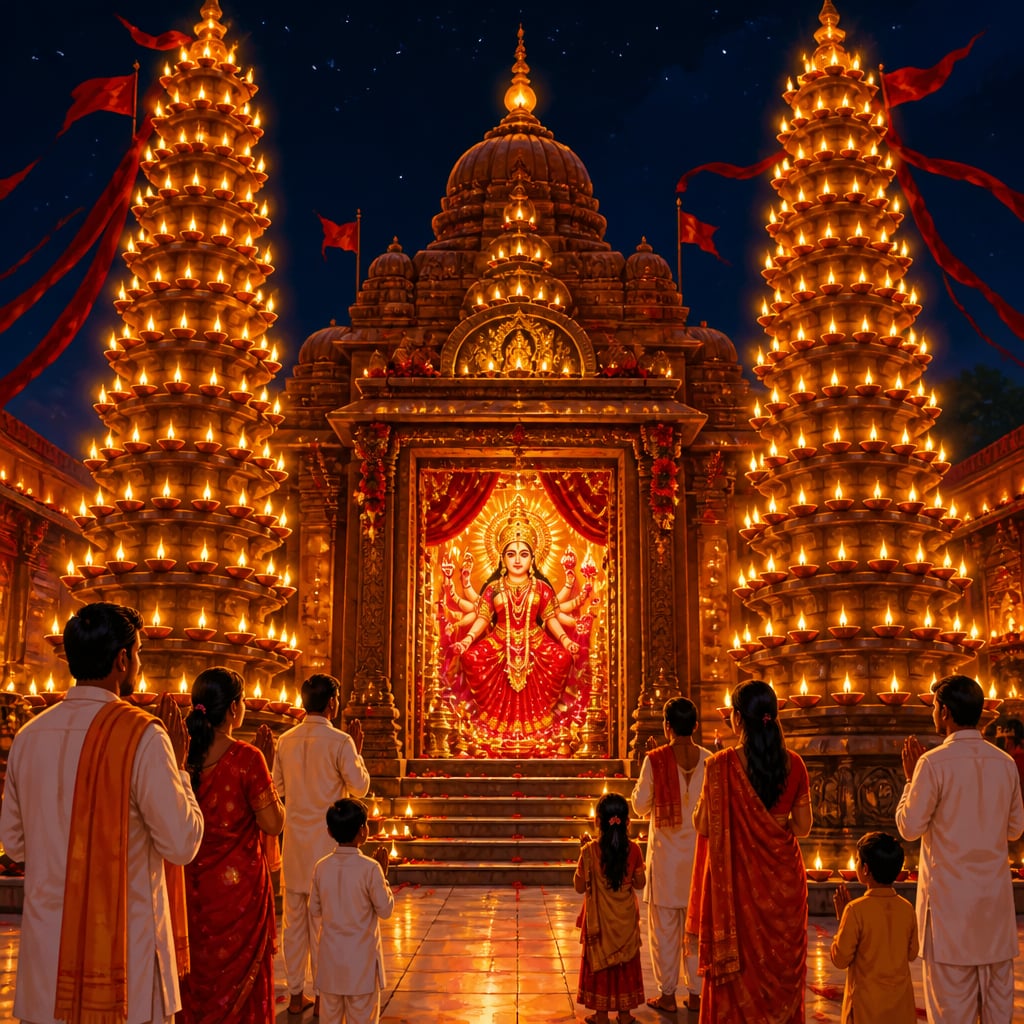
This tradition of the deepmalas is unique to Harsiddhi. While many temples light lamps, nowhere else do towering pillars of flame greet the devotee. The visual impact is overwhelming, the goddess seems to emerge from a sea of sacred fire.
The deepmala tradition connects to the tantric understanding of tejas (luminosity) as the visible form of shakti. The lamps are not merely decorative; they are offerings of light to the Light, visible fire to the fire that animates all existence.
The Goddess's Form
Harsiddhi is worshipped in the form of Annapurna, the goddess who provides food and sustenance. Her image shows her seated peacefully, ready to nourish her devotees. Flanking her are two smaller images of Mahalakshmi and Mahasaraswati, prosperity and wisdom attending the central power.
This trinity represents complete shakti: Annapurna provides material sustenance (survival), Mahalakshmi provides abundance (flourishing), and Mahasaraswati provides knowledge (meaning). The devotee who worships all three receives a complete blessing, not just survival, not just wealth, but wisdom to use both properly.
The Tantric Dimension
Ujjain has been a center of tantric sadhana since ancient times. The Harsiddhi Temple is associated with practices that aim at siddhi, supernatural accomplishments that result from intensive spiritual practice.
The siddhis mentioned in yogic and tantric texts include powers like clairvoyance, telekinesis, and control over natural elements. But the tradition consistently warns that these are byproducts of spiritual development, not goals in themselves. The true siddhi is Self-realization; the goddess grants the power to achieve ultimate liberation.
Devotees seeking worldly accomplishments, success in business, victory in competition, achievement of difficult goals, also worship Harsiddhi. The goddess does not discriminate between spiritual and worldly aims; she grants the power to accomplish whatever is sincerely sought.
The Mahakaleshwar Connection
The South-Facing Jyotirlinga
Less than a kilometer from Harsiddhi stands Mahakaleshwar, one of the twelve Jyotirlingas and the only one that faces south. In Shaiva tradition, south is the direction of death (associated with Yama's realm) and transformation. A south-facing deity is thus a deity of death and transcendence.
Mahakaleshwar means "Lord of Great Time" or "Lord of Death." Shiva here is worshipped as the power that transcends time itself, the consciousness that remains unchanged while all phenomena arise and pass away.
The Bhasma Aarti

Mahakaleshwar is famous for its pre-dawn Bhasma Aarti, a ritual where the deity is worshipped with ashes from the cremation ground. This practice, found nowhere else among the major temples, emphasizes the tantric teaching that life and death are not opposites but aspects of a single reality.
The bhasma (ash) represents the ultimate state of all material things, everything becomes ash eventually. By worshipping with ash, devotees contemplate their own mortality and the impermanence of worldly attachment. The ritual is intensely powerful, performed in near-darkness, creating an atmosphere of profound otherworldliness.
Shiva and Shakti in Ujjain
The proximity of Mahakaleshwar and Harsiddhi creates a unique spiritual geography. Devotees traditionally visit both temples, worshipping the masculine and feminine aspects of the divine in a single pilgrimage.
The theological relationship between the two temples reflects the Shaiva-Shakta synthesis that characterizes medieval Hinduism. Shiva without Shakti is pure consciousness without the power to manifest; Shakti without Shiva is blind force without awareness. Together, they are complete reality.
Ujjain's architecture embeds this teaching in space. The devotee who walks from Mahakaleshwar to Harsiddhi literally traverses the path from Shiva to Shakti, from transcendent consciousness to active power, from the Lord of Time to the Granter of Accomplishments.
Ujjain: The Cosmological Center
The Zero Meridian of Ancient India
Ujjain lies almost exactly on the Tropic of Cancer. Ancient Indian astronomers recognized this and established Ujjain as the prime meridian for Indian calculations, the zero point from which longitudes were measured.
This was not arbitrary. The Tropic of Cancer is the northernmost latitude where the sun is directly overhead at the June solstice. Ujjain's position on this line gave it cosmological significance, it was the point where heaven and earth most directly connected.
The astronomical observatory (Vedha Shala) built by Raja Jai Singh II in the 18th century still stands, demonstrating the sophisticated astronomical knowledge that centered on this city for millennia.
The Kumbh Connection

Every twelve years, Ujjain hosts the Simhastha Kumbh Mela, one of the four Kumbh gatherings where millions bathe in sacred rivers to wash away sins. The Simhastha occurs when Jupiter is in the sign of Leo (Simha), creating an astrologically auspicious window.
During Simhastha, Ujjain transforms. The small city of half a million becomes a temporary metropolis of tens of millions. Sadhus from across India converge, akharas (monastic orders) establish camps, and the air fills with the chanting of mantras.
The goddess at Harsiddhi is especially worshipped during Kumbh. Devotees seek her blessing before bathing in the Shipra, understanding that external purification must be complemented by internal transformation, which only Shakti can grant.
The Vikramaditya Legacy
Ujjain was the capital of the legendary King Vikramaditya, whose court included the "nine gems" (navaratna), scholars, poets, and sages including the mathematician Varahamihira and the poet Kalidasa. The Vikram Samvat calendar, still widely used, dates from Vikramaditya's reign.
Vikramaditya was a devotee of both Mahakaleshwar and the goddess. Stories describe him receiving boons from Harsiddhi, suggesting that royal power derived from the goddess's grace. This political theology, the king as servant of Shakti, parallels what we saw at Kolhapur and elsewhere.
The Theology of Ujjain
Time and Power
Mahakaleshwar presides over Time; Harsiddhi grants Power. Together, they offer a complete teaching about action in the world.
Time is the arena in which all action unfolds. Nothing can be accomplished outside time's flow. Yet time also limits and eventually destroys all accomplishments. The greatest empire crumbles; the most powerful body ages and dies.
The Ujjain teaching is that effective action requires both: alignment with time (knowing when to act) and access to power (having the shakti to accomplish). The devotee worships Mahakaleshwar to understand time's rhythms and Harsiddhi to receive the power to act within them.
Accomplishment Without Attachment
The siddhis that Harsiddhi grants carry a warning embedded in her location. She stands in the shadow of the Death Lord. Every accomplishment is temporary; every power eventually fades.
This is not pessimism but liberation. When we understand that all siddhis are transient, we can pursue accomplishment without desperate attachment. We act fully, accomplish powerfully, and release gracefully. The goddess grants both the power to achieve and the wisdom to let go.
The Integrated Pilgrimage
A complete Ujjain pilgrimage includes:
- Mahakaleshwar: Contemplation of time, mortality, transcendence
- Harsiddhi: Seeking power to act, accomplish, transform
- Shipra Snan: Purification through sacred bathing
- Kal Bhairav: Worship of the fierce protector
This circuit integrates Shaiva, Shakta, and general Hindu elements into a coherent spiritual journey. The devotee confronts death, receives power, is purified, and is protected, emerging transformed.
Living Traditions
The Navaratri Illumination
Harsiddhi Temple's deepmalas are fully lit during Navaratri, creating one of India's most spectacular religious displays. The two pillars blaze with hundreds of flames, visible from across the city. Devotees gather by the thousands, singing, chanting, and absorbing the shakti that the flames represent.
This illumination represents the teaching that darkness is dispelled not by fighting it but by lighting lamps. The goddess's power is not destructive (though she can destroy); it is illuminating. She brings light to darkness, clarity to confusion, achievement to effort.
The Daily Rhythm
Harsiddhi Temple maintains elaborate daily worship that parallels the famous rituals at Mahakaleshwar. The goddess receives multiple artis (worship with lamps), bhog (food offerings), and shringar (adornment). Each ritual moment has its significance:
- Morning: Awakening the goddess, offering her day's first light
- Midday: Offering food, acknowledging her as Annapurna
- Evening: Lighting the deepmalas, celebrating her as illumination
- Night: Putting the goddess to rest, offering final prayers
This rhythm of daily worship has continued for centuries, maintained through political changes, invasions, and social transformations. The tradition persists because the goddess continues to respond, devotees experience her presence and her blessings.
The Pilgrimage Economy
Like other major temple cities, Ujjain's economy revolves around pilgrimage. Hotels, restaurants, shops selling puja items, priests offering ritual services, all depend on the steady stream of devotees. During Kumbh, this economy explodes; temporary businesses spring up everywhere.
This pilgrimage economy is itself a form of the goddess's blessing. The wealth that flows to Ujjain is redistributed through the local economy, supporting families who might otherwise have no livelihood. The goddess provides for her devotees not just spiritually but materially.
Conclusion: The Complete Circuit
Our journey through the Maha Peethas concludes at Ujjain, where the goddess Harsiddhi grants the power to accomplish what the previous peethas have prepared us for.
- At Jwalamukhi, we encountered the eternal fire of divine speech
- At Vaishno Devi and Naina Devi, we learned the mountain path of devotion
- At Vindhyavasini, we met the guardian of boundaries and transitions
- At Srisailam and Kanchi, we witnessed Shakti integrated with Shaiva traditions
- At Ambaji and Kolhapur, we received heart's courage and eyes' clarity
Now at Harsiddhi, we receive the power to accomplish, the siddhi that transforms understanding into action, devotion into achievement, potential into reality.
The Maha Peethas together form a complete circuit of Shakti's major manifestations in India. Pilgrimage to all of them, whether physical or contemplative, grants the devotee a comprehensive experience of the divine feminine. Each peetha offers its unique blessing; together, they offer transformation.
Harsiddhi, standing near Mahakaleshwar, reminds us that accomplishment exists within time's embrace. We receive power not to escape the world but to act effectively within it. The goddess grants siddhis so that we might serve, create, and eventually transcend, all in the fullness of time.
Living traditions
Ujjain remains one of India's most important pilgrimage cities, drawing millions annually even outside Kumbh years. The city's economy is built on devotion, temples, dharamshalas, and pilgrimage services sustain the local population. The astronomical heritage is preserved at the Vedha Shala, where students still learn traditional calculation methods. The Vikram University, named for the legendary king, continues Ujjain's scholarly traditions. Both Harsiddhi and Mahakaleshwar are administered by trusts that run educational and charitable programs.
- Harsiddhi Temple
- Mahakaleshwar Temple
- Kal Bhairav Temple
- Vedha Shala (Observatory)
Reflection
- Harsiddhi grants siddhis, accomplishments and powers, to her devotees. What accomplishment are you currently seeking? What inner or outer powers would you need to achieve it? Are you willing to pay the price of disciplined practice?
- Ujjain houses both the Lord of Time (Mahakaleshwar) and the Granter of Accomplishments (Harsiddhi). How do you relate to time in your own life? Do you feel you have enough time? Do you work with time's rhythms or against them?
- The deepmala tradition shows that many small flames create magnificent illumination. Where in your life might you be trying to be the sole source of light when you could be one lamp among many? How might collective effort transform your endeavors?