मिथ्याप्रतीति (Mithyāpratīti): Gaslighting & Pathological Lying
When Truth Is Weaponized
The most insidious manipulation makes you doubt your own perception of reality. Like Dhritarashtra's willful blindness, you are made to unsee what you know is true.
The First Line of Attack
Before an enemy can control your actions, they must first control your perception. Before they can take your wealth, they must convince you it was never yours. Before they can erase your history, they must make you doubt it ever happened.
This is the foundation of psychological warfare: attack reality itself.
The Yoga Sutras identify five kleshas, root afflictions that cause all suffering. The first and most fundamental is Avidya, not mere ignorance, but misperception. Taking the unreal for real. Taking darkness for light. Taking the impermanent for permanent.
When someone deliberately induces Avidya in you, when they systematically make you doubt what you saw, what you remember, what you know, they are wielding a weapon older than any sword.
Dhritarashtra's Blindness: A Study in Willful Avidya
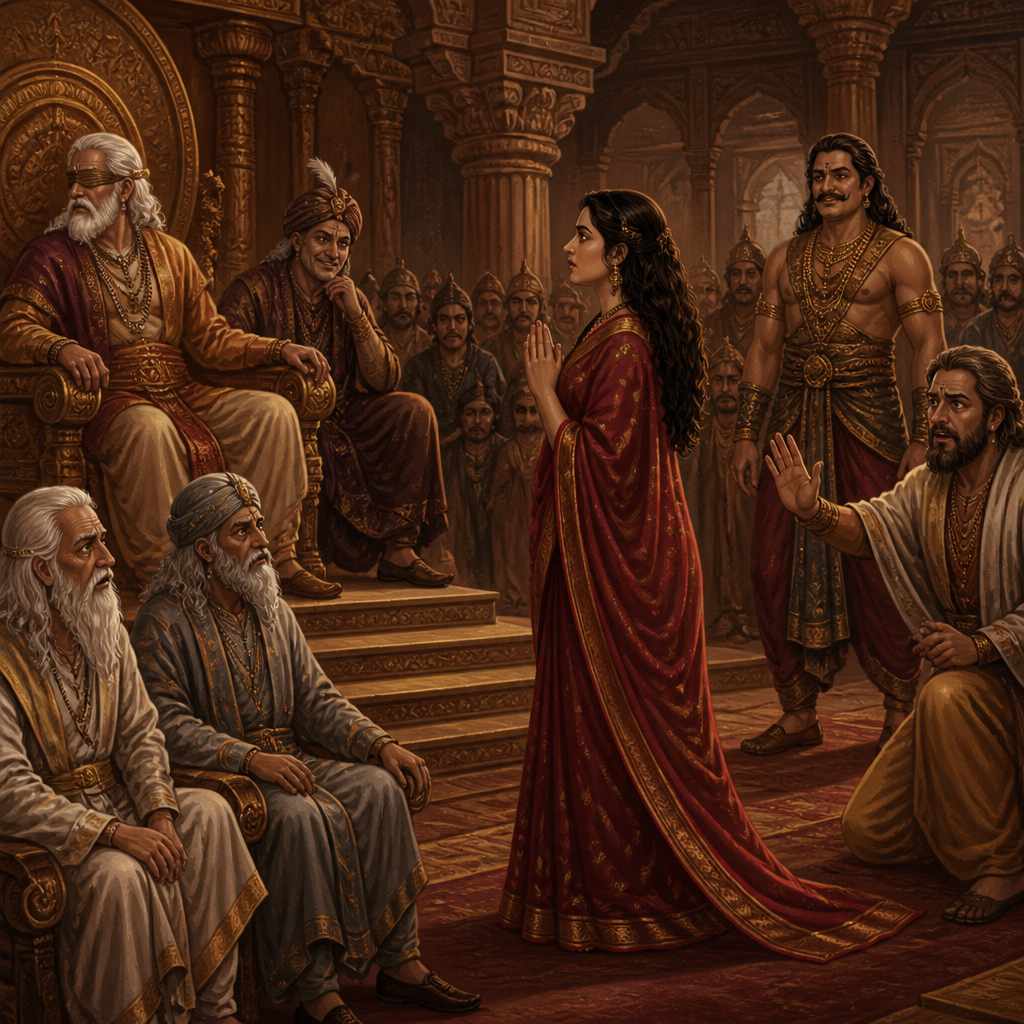
Consider Dhritarashtra, the blind king of Hastinapura. His physical blindness is well known. But his more dangerous blindness was chosen.
When Draupadi was dragged into the court, Dhritarashtra heard her cries. When Vidura warned him of the consequences, Dhritarashtra heard the wisdom. When his own conscience told him this was adharma, Dhritarashtra heard the truth.
Yet he chose to unsee.
"What can I do? These are my sons. They must have their reasons."
This is the template of willful blindness: knowing the truth, yet constructing elaborate justifications to not know it. When Sanjaya narrates the war, Dhritarashtra repeatedly asks questions whose answers he already knows, the performance of ignorance masking the reality of complicity.
The Mahabharata shows us that the most dangerous blindness is not of the eyes, but of the conscience.
Tactic 1: Gaslighting, Rewriting What You Remember

Gaslighting is the systematic attempt to make someone doubt their own memory, perception, and sanity. The term comes from a 1944 film where a husband manipulates his wife into believing she is going insane, but the technique is ancient.
Gaslighting operates through several mechanisms:
Denial: "That never happened. You're imagining things."
Minimization: "You're overreacting. It wasn't that bad."
Diversion: "Why are you bringing up the past? You're the real problem here."
Counter-accusations: "How dare you accuse me? I'm the victim here."
Reframing: "You misunderstood. What I actually meant was..."
The goal is not merely to lie, but to make you distrust your own judgment. Once you no longer trust yourself, you become dependent on the gaslighter to tell you what is real.
Shakuni was a master gaslighter. He did not merely cheat at dice, he created an atmosphere where questioning the game seemed unreasonable. "The Pandavas agreed to play. They lost fairly. Why are you creating drama?" The rigging of the game was hidden behind a performance of normalcy.
Tactic 2: Pathological Lying, Consistent False Narratives
Pathological lying differs from ordinary lying in its consistency, boldness, and strategic purpose. A pathological liar does not simply tell individual lies, they construct and maintain entire false narratives over time.
Characteristics include:
Confidence: The lie is told with complete conviction, making the listener doubt their own knowledge.
Consistency: The false narrative is repeated so often it becomes familiar, and familiarity breeds acceptance.
Social proof: Multiple sources repeat the same lie, creating the illusion of consensus.
Institutional backing: The lie is given credibility through academic, media, or governmental authority.
Exhaustion: When questioned, the liar drowns the questioner in details, citations, and counter-questions until the questioner gives up.
The most effective pathological lies are not obvious, they contain enough truth to seem credible, enough complexity to discourage investigation, and enough institutional backing to seem authoritative.
The Klesha Connection: Avidya as Weapon
Yoga Sutra 2.5 defines Avidya:
Anityāśuci-duḥkhānātmasu nitya-śuci-sukhātma-khyātir avidyā
Avidya is taking the impermanent for permanent, the impure for pure, suffering for happiness, and the non-self for self.
When this misperception happens naturally through ignorance, it is a klesha to be overcome through practice. But when it is deliberately induced by another, it becomes a weapon.
The gaslighter induces Avidya by making you:
- Take their false narrative (impermanent construct) for reality (permanent truth)
- Take their corrupted version of events (impure) for the actual events (pure)
- Take your confusion and self-doubt (suffering) for sophisticated nuance (happiness)
- Take their voice in your head (non-self) for your own judgment (self)
This is why gaslighting is so devastating, it weaponizes the fundamental architecture of human perception.
Recognizing the Attack
How do you know when you are being gaslighted?
Your memories are constantly questioned: "That's not what happened. Are you sure you remember correctly?"
You feel confused after conversations: Interactions leave you doubting yourself rather than clarifying things.
Your emotions are dismissed: "You're too sensitive. You're being emotional. You're overreacting."
Evidence is reframed: When you present proof, it's explained away, contextualized into irrelevance, or turned against you.
You're isolated from validation: Others who might confirm your perception are discredited or kept away.
You begin sentences with apologies: "I might be wrong, but..." "Sorry if I'm misremembering, but..."
The deepest sign of successful gaslighting is when you no longer trust your own perception, when you automatically defer to others to tell you what is real.
The Dharmic Defense: Viveka
The antidote to Avidya is Viveka, discriminative wisdom, the capacity to distinguish real from unreal, eternal from temporary, self from non-self.
Viveka is not merely intellectual, it is a cultivated capacity of perception. Just as physical eyes can be trained to see details that untrained eyes miss, the eye of Viveka can be developed through:
Smriti (Memory): Maintain clear records, written notes, conversations confirmed by others, documented evidence. Gaslighting exploits the malleability of memory; documentation defeats it.

Satsanga (Truth Community): Stay connected to those who validate your perception honestly. Gaslighters isolate their victims. Truth communities protect against manipulation.
Svadhyaya (Self-Study): Know your own patterns, biases, and weaknesses. A self-aware person is harder to manipulate because they can distinguish between genuine self-correction and induced self-doubt.
Shraddha (Discerning Trust): Trust should be earned, not demanded. Be willing to change your mind based on evidence, but be suspicious of those who demand trust without evidence.
Dhritarashtra had access to Vidura's wisdom, Bhishma's guidance, and his own conscience. He chose to ignore all three. The Viveka was available, he refused to use it.
Media gaslighting operates by:
- Selective footage: Showing only portions that support a predetermined narrative
- Framing language: Using loaded terms that prejudge events ('riot' vs 'protest,' 'mob' vs 'crowd')
- Expert authority: Bringing in commentators who explain why your direct experience was 'incomplete'
- Repetition: Repeating the preferred narrative until your memory of the actual event fades
- Social consensus: Creating the impression that 'everyone' sees it the way they present it
Apply Viveka: Trust your direct perception (pratyaksha) over mediated interpretation. Document what you witness, photos, notes, timestamps. Seek multiple sources, especially those present at the event. Remember that institutional authority does not equal truth. Maintain connection with others who witnessed the same events.
Academic gaslighting operates by:
- Credential gatekeeping: Only those with specific degrees can speak on topics, regardless of lived experience
- Jargon barriers: Complex terminology that obscures rather than illuminates, making simple truths inaccessible
- Citation circles: Papers cite other papers in closed loops, creating the appearance of consensus
- Dismissal categories: 'Anecdotal,' 'unscientific,' 'nationalist,' 'fundamentalist', labels that dismiss without engaging
- Moving goalposts: When evidence is provided, standards suddenly change
Remember that Shruti and Smriti, direct revelation and cultural memory, are valid pramanas (means of knowledge). Academic interpretation is secondary to primary sources. An academic theory that contradicts thousands of years of continuous tradition bears a heavy burden of proof. Credentials indicate training, not truth.
Digital gaslighting operates at unprecedented scale through:
- Algorithmic manipulation: What you see is curated, creating filter bubbles or, conversely, flooding you with opposing content
- Fact-check authority: Third-party 'fact-checkers' become arbiters of truth, often with their own biases
- Content disappearance: Information can be memory-holed, removed from platforms, deindexed from search
- Coordinated narratives: Multiple platforms simultaneously promote identical framings, creating false consensus
- Manufactured social proof: Bot accounts, paid promoters, and coordinated campaigns make minority views seem majority
Digital platforms are not neutral infrastructure, they are environments controlled by entities with interests. Practice information sovereignty: save important content offline, use multiple platforms, maintain email lists independent of social media, and build communities on platforms you control.
Case studies
The Aryan Invasion Theory: Gaslighting a Civilization
In the 1850s, when Max Müller and other European scholars needed to explain how Sanskrit, clearly an ancient and sophisticated language, existed in India, they faced a problem. Admitting that Vedic civilization was indigenous would contradict the colonial narrative of bringing civilization to a 'primitive' land. The solution was the Aryan Invasion Theory: Indo-European speaking 'Aryans' invaded India around 1500 BCE, bringing the Vedas with them and subjugating the native 'Dravidians.' This hypothesis, based on linguistic speculation with no archaeological evidence, was then taught in colonial schools, embedded in textbooks, and repeated until it became 'common knowledge.' The gaslighting was comprehensive: **When Indian scholars pointed to the Saraswati River in Vedic texts** (dried up around 1900 BCE, predating the supposed invasion): *'You're misinterpreting the texts.'* **When no archaeological evidence of invasion was found**: *'Absence of evidence is not evidence of absence.'* **When genetic studies showed no significant population replacement around 1500 BCE**: *'The theory has evolved to migration, not invasion.'* **When the Harappan civilization was discovered, showing urban sophistication predating the 'invasion'**: *'The Harappans were pre-Aryan Dravidians.'* The theory kept shifting, from invasion to migration to 'cultural transmission', but the core narrative remained: Vedic civilization came from outside. Indian civilizational memory of continuity was 'myth.' Generations of Indians were educated to distrust their own textual traditions, dismiss their oral histories, and defer to Western scholarship on their own past. This is civilizational gaslighting, making a people doubt their own memory.
The AIT case shows how institutional authority can maintain a false narrative for generations. The defense is the same as against individual gaslighting: trust your own sources (Vedic texts, archaeological evidence), maintain community memory (oral traditions, scholarly challenges), and document inconsistencies in the gaslighter's story.
Generations of Indians internalized the belief that their civilization was derivative, not indigenous. School textbooks across India taught AIT as fact well into the 21st century. This created a deep psychological fracture: an entire civilization trained to see itself through the colonizer's lens, doubting its own continuity. The theory also seeded the North-South racial divide narrative, a political tool still weaponized today. Only with advances in archaeogenetics and satellite imaging of the dried Saraswati riverbed has the mainstream begun to question what was presented as settled science for over 150 years.
When a theory keeps shifting its claims to survive new evidence, that is not science evolving. It is a narrative protecting itself. Track the goalpost moves: invasion became migration, migration became 'cultural diffusion.' The hypothesis changed; the conclusion never did. That pattern is the tell.
The AIT pattern continues today whenever indigenous knowledge is dismissed as 'myth' while colonial-era interpretations are treated as 'scholarship.' Recognizing this pattern helps identify when institutional authority is being used to gaslight rather than illuminate.
A 2019 study published in Cell by Vagheesh Narasimhan et al., analyzing ancient DNA from 523 individuals across South and Central Asia, found no evidence of a large-scale population replacement in India around 1500 BCE, contradicting the core claim of AIT.
The Toolkit Document: Coordinated Gaslighting Exposed
In February 2021, during the farmers' protests in India, climate activist Greta Thunberg accidentally shared a 'toolkit' document on social media. The document outlined a coordinated campaign to shape international perception of India, hashtags to trend, narratives to push, timings to coordinate, and media contacts to activate. The document was evidence of organized perception management, what intelligence agencies call 'information operations.' It showed that seemingly organic international concern was actually coordinated, with specific talking points and amplification strategies. The gaslighting operated at multiple levels: **First, the coordination itself**: International voices presenting scripted narratives as authentic spontaneous concern. Indian citizens were told their own understanding of domestic events was wrong, and international 'experts' knew better. **Then, the denial**: When the toolkit was exposed, the response was immediate: *'It's just a template, not evidence of coordination.'* *'Activists share resources, this is normal.'* *'India is attacking a child activist to distract from farmer issues.'* *'This is what fascist governments do, attack dissent.'* The people who had just been caught coordinating a gaslighting campaign responded by... gaslighting about the existence of the gaslighting. Most revealing was how quickly international media adopted defensive talking points. Rather than investigating the coordination, they attacked those who pointed it out. The messenger became the story, not the message.
The toolkit case shows that gaslighting now operates at industrial scale through international networks. Individual perception is attacked by what appears to be global consensus, but the consensus is manufactured. Viveka requires recognizing that coordination can make the artificial seem organic, and that 'international opinion' can be as scripted as a Shakuni dice game.
The toolkit's accidental exposure created a rare moment of visibility into how perception campaigns work. Indian citizens who had sensed coordination now had proof. Yet the exposure itself was quickly buried. International media pivoted to defending Thunberg rather than investigating the coordination. The toolkit's architects faced zero consequences, and the same template was deployed again in subsequent Indian controversies. The incident did, however, permanently shift awareness among digitally literate Indians about manufactured 'international concern.'
When 'organic concern' from dozens of international voices follows the same talking points, uses the same hashtags, and activates within the same 48-hour window, you are not witnessing consensus. You are witnessing a campaign. Check the timestamps, compare the scripts, and follow the coordination.
This pattern repeats in every major Indian controversy. Coordinated hashtags trend 'organically.' International media simultaneously publish similar framings. 'Concerned citizens' read from similar scripts. Recognizing coordination patterns is essential for 21st-century Viveka.
The toolkit document outlined a step-by-step campaign with specific dates, pre-written tweets, and a list of influencers to activate. Within 72 hours of its release, over 100 million tweets were posted using the coordinated hashtags, making it one of the fastest-growing manufactured campaigns on Twitter's record.
Fact-Checker Gaslighting: When Arbiters of Truth Have Agendas
Fact-checking emerged as a response to misinformation. In principle, independent verification should help distinguish truth from falsehood. In practice, many fact-checking organizations have become instruments of gaslighting. The pattern is consistent: **Selective rigor**: Claims supporting Hindu narratives face intense scrutiny, with demands for academic citations and statistical proof. Claims attacking Hindu narratives pass with minimal verification, often citing other media reports as 'sources.' **Double standards on evidence**: An Indic archaeologist's findings require Western peer review to be credible. A Western journalist's assertion about India requires no verification at all. **Framing as fact-checking**: Opinion is disguised as verification. 'Mostly False' ratings often disagree with interpretation, not facts. 'Missing Context' adds context that changes narrative, not accuracy. **Platform power**: Social media algorithms amplify fact-checker ratings. Content labeled 'false' reaches fewer people. Those who control fact-checking effectively control visibility. The gaslighting is sophisticated: when you see something accurate labeled 'false,' you're told the problem is your understanding. When you notice the double standard, you're told you're 'paranoid' or 'can't handle truth.' The arbiters of truth have themselves become gaslighters. Organizations like Alt News in India have been documented showing stark disparities in how they treat similar claims from different political positions. The veneer of neutrality makes the bias more insidious, it's harder to question someone presenting themselves as an objective referee.
Fact-checkers are not Shruti, they are not revealed truth, but human institutions with interests. Apply the same Viveka to fact-checkers that you would to any other source: Who funds them? What are their patterns of coverage? Do they apply consistent standards? The label 'fact-checker' does not confer infallibility.
Platform-embedded fact-checking created a two-tier information system. Content labeled 'false' by these organizations saw reach reduced by up to 95% on Facebook alone, effectively silencing voices without formal censorship. Hindu and Indic perspectives were disproportionately affected. Meanwhile, Meta's decision in January 2025 to move away from third-party fact-checkers in the US (while retaining them in India) revealed the system's political nature. The damage, however, was already done: years of suppressed content, shadow-banned pages, and delegitimized Hindu voices had reshaped the information landscape.
Apply the same critical scrutiny to the referee that you apply to the players. Check who funds the fact-checker, what patterns emerge in their rulings, and whether they apply the same evidentiary standards to all sides. A biased arbiter is more dangerous than an openly biased advocate, because the arbiter wears the mask of neutrality.
Every major social media platform now relies on third-party fact-checkers to label content. Understanding the biases and limitations of these gatekeepers is essential for navigating the modern information environment. Trusting fact-checkers blindly is simply transferring your Avidya from one source to another.
A 2023 analysis by the Disinfo Lab found that India's most prominent fact-checking organizations checked claims critical of one political side 3-4 times more frequently than equivalent claims from the other side, while rating identical claims with different severity based on who made them.
Reflection
- Think of a time when someone made you doubt your own memory or perception of an event. What specific techniques did they use? How did it feel in the moment? Looking back, can you now see the manipulation more clearly?
- Dhritarashtra had access to truth through Vidura's counsel, Bhishma's warnings, and his own conscience. Why do you think he chose willful blindness? What made the false comfort of not-seeing more attractive than the painful clarity of seeing?
- If Avidya, misperception, is the root of all suffering, and gaslighting deliberately induces Avidya, is gaslighting one of the greatest possible harms one person can inflict on another? Why or why not?