अर्धसत्य (Ardhasatya): Selective Disclosure & Information Overload

Half-Truths and Drowning in Noise

A half-truth is more dangerous than a lie because it contains enough truth to seem credible. When you can't hide something, you drown it in noise until the signal is lost.

The Veil of Maya

In the previous lesson, we explored direct attacks on your perception, gaslighting that denies what you saw, pathological lying that creates false narratives. But the most sophisticated manipulators rarely need such crude tools.

Why tell an obvious lie when a half-truth works better? Why deny something entirely when you can simply bury it in noise?

Advaita Vedanta describes Maya, often translated as 'illusion,' but more precisely meaning 'that which measures out,' 'that which creates the appearance of division.' Maya does not operate through outright falsehood. It operates through partial revelation, showing you enough to create a picture, but not enough to see the whole.

This is the tactic of the sophisticated manipulator: not lying, but strategically not-telling.
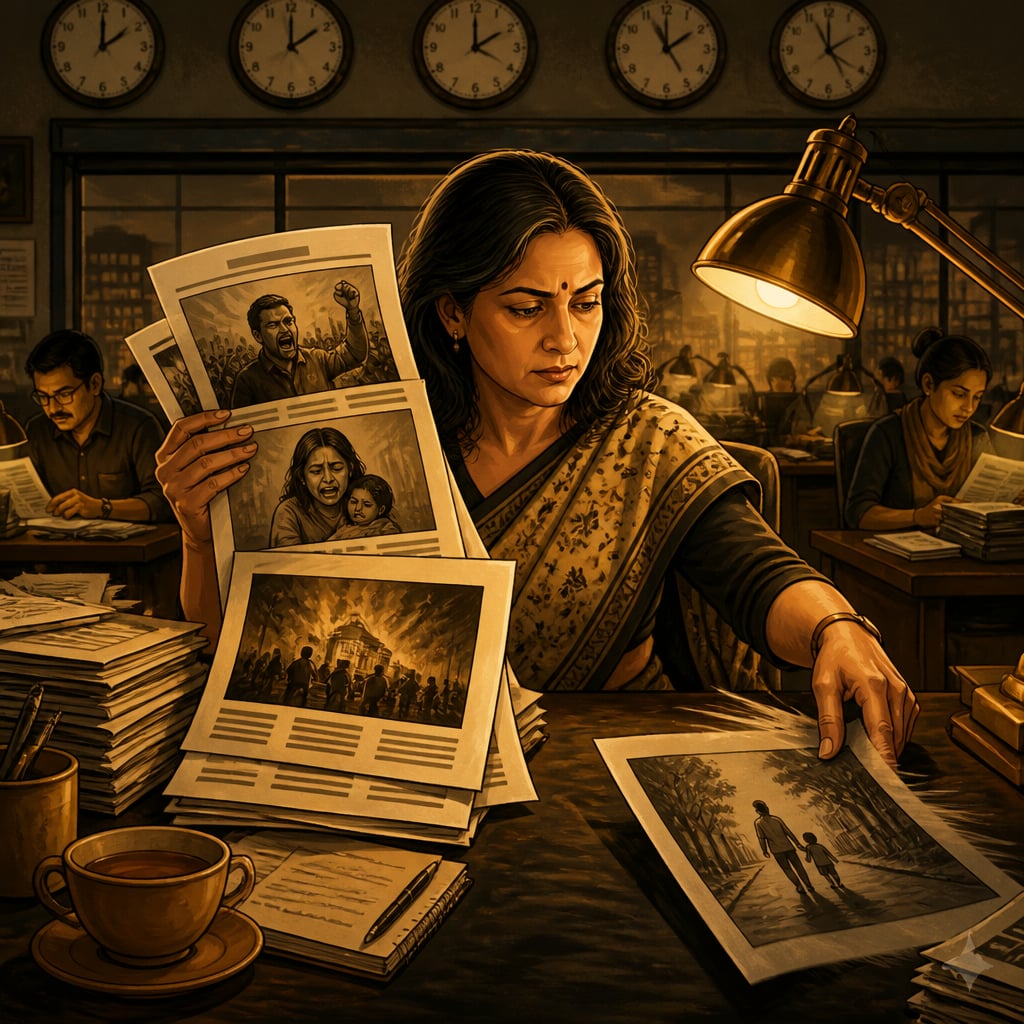
Newspaper editor sliding an uncomfortable proof page into shadow

Tactic 1: Selective Disclosure, The Art of the Half-Truth

Selective disclosure is the practice of revealing partial truths strategically. Every statement may be technically accurate, yet the overall impression is completely false.

Consider the structure:

Fact A is true. (Present this prominently) Fact B is true. (Present this with emphasis) Fact C is also true. (Present this loudly) Fact D, which completely changes the meaning of A, B, and C, is also true. (Omit this entirely)

The result: You have been told only truths. Every statement can be verified. Yet you have been deceived more completely than if you had been told an outright lie, because you believe you have been told the truth.

This is why half-truths are more dangerous than lies. A lie can be caught; a half-truth creates confidence in misunderstanding.

How Selective Disclosure Works

The Frame: Certain facts are presented as the complete story. The frame determines what counts as 'relevant' and what can be ignored.

The Emphasis: Some facts are repeated, highlighted, and emotionally charged. Others are mentioned once, quietly, in passing.

The Omission: Crucial context is simply absent. The listener doesn't know what they don't know.

The Implication: Facts are arranged so the listener draws 'obvious' conclusions, conclusions the manipulator wants, but never explicitly stated.

The Defense: When challenged, the manipulator can honestly say, 'I never said that. I only stated facts. You drew your own conclusions.'

This is why selective disclosure is favored by those who face scrutiny, journalists, academics, politicians. Everything they say may be technically true. The deception is in what they choose not to say.

Tactic 2: Information Overload, Drowning Truth in Noise

Indian teenager drowning in notifications

When you cannot suppress information entirely, you can achieve the same effect by overwhelming it.

Information overload works through several mechanisms:

Volume: Flood the information space with so much content that the important signal gets lost in noise.

Complexity: Make the topic so technically complicated that ordinary people give up trying to understand it.

Distraction: When one topic becomes dangerous, create a new controversy to shift attention.

Equivalence: Treat all claims as having equal weight, so that truth becomes just one 'perspective' among many.

Exhaustion: Keep the debates going so long that people become tired and disengage.

The goal is not to convince you of a false narrative, it is to make you give up on finding the true one.

In a world of information overload, the manipulator's advantage is that they know what matters. You, drowning in noise, do not.

The Maya Connection: Partial Knowledge as Complete Ignorance

Yoga Sutra 2.5 warns:

Avidyā is taking the impermanent for permanent, the impure for pure...

But there is a subtler form of Avidya: taking partial knowledge for complete knowledge.

When you have read three articles on a topic, you feel informed. When you have read thirty, carefully selected to create a particular impression, you feel expert. But if those thirty articles all omit the same crucial fact, your 'expertise' is an elaborate form of ignorance.

Maya operates exactly this way. It shows you enough of reality to feel that you are seeing reality. The illusion is not in what is shown, but in the completeness you assume.

The academic who has read all the approved literature but none of the primary sources; the journalist who has interviewed all the official spokespeople but no witnesses; the analyst who has seen all the data selected for them but not the data excluded, each believes they have done their research. Each is confident in their understanding. Each is trapped in sophisticated Avidya.

Recognizing Selective Disclosure

How do you know when you are receiving half-truths?

The narrative is too clean: Real events are messy. If the story has perfect heroes and villains, clear causes and effects, obvious morals, it has been curated.

Counterarguments are absent or caricatured: If you never encounter strong versions of opposing views, you are in an information bubble.

Key questions go unasked: In any complex situation, there are obvious questions. If they are never addressed, ask why.

Sources are uniform: If all your information comes from the same type of source, same political alignment, same institutional position, same methodology, you are seeing one slice of reality.

You feel certain: Certainty often indicates incomplete information. The more you know about complex topics, the more nuance you usually see. If a complex topic feels simple, something has been simplified for you.

Recognizing Information Overload

How do you know when truth is being drowned in noise?

Every conversation requires expertise you don't have: The topic has been made so technical that laypeople cannot participate in the discussion.

There are endless 'sides' to consider: Every fact has a counter-fact, every claim has a counter-claim, and resolution seems impossible.

The goalposts keep moving: Just when you think you understand, new information emerges that complicates everything.

Fatigue sets in: You feel exhausted by the topic and want to disengage, which is exactly the intended effect.

Caring becomes difficult: With so many claims and counter-claims, you begin to doubt whether truth can be found at all.

The Dharmic Defense: Viveka in the Information Age

The same faculty that protects against gaslighting, Viveka, discriminative wisdom, also protects against selective disclosure and information overload.

But in the age of information abundance, Viveka requires specific practices:

Scholar cross-referencing primary sources in a library

Seek Primary Sources: Secondary interpretation is where manipulation enters. Whenever possible, read original documents, watch full speeches, review raw data. The manipulator's power is in deciding what to show you; primary sources bypass the filter.

Ask 'What Would Change My Mind?': If you cannot imagine evidence that would change your position, you are not reasoning, you are defending. True Viveka includes the capacity to be wrong.

Notice What's Missing: Every narrative has gaps. Train yourself to ask: What is not being said? Who is not being heard? What question is not being asked?

Value Depth Over Breadth: In an age of information overload, the old strategy was to read more. The new strategy is to read deeper. One well-researched source is worth a hundred headlines.

Cultivate Information Patience: The manipulator wants you to react immediately, before you can think. Practice waiting, for more information, for calmer analysis, for the full picture to emerge.

The Signal in the Noise

The ultimate defense against selective disclosure and information overload is knowing what matters.

When you have clear values, when you know what is worth defending, what questions are worth answering, what truths are worth finding, the noise loses its power. You can ignore most of the information flood because most of it is irrelevant to what you actually care about.

This is why Dharmic education has always emphasized clear purpose (lakshya), discernment (viveka), and detachment (vairagya). Not because information is bad, but because without these anchors, information becomes a weapon against you rather than a tool for you.

The manipulator has an advantage: they know what they want you to believe. Match this with clarity about what you want to know, and the contest becomes more equal.

Selective disclosure in news operates through:

  1. Headline framing: The same event described as 'protest' or 'riot' creates different impressions before you read a word
  2. Source selection: Who is quoted as expert, who is quoted as 'claim,' who is not quoted at all
  3. Context inclusion/exclusion: What history is provided, what is assumed known, what is omitted
  4. Image selection: Which photos are used, from what angles, showing what moments
  5. Placement and emphasis: Front page or buried, extensive or brief, repeated or mentioned once

Practice Anvikshiki: systematic cross-referencing and source verification. Read coverage from multiple perspectives, but more importantly, seek primary sources, official documents, full speeches, raw data. When outlets disagree on facts, investigate the facts, not just the disagreement.

Social media information overload operates through:

  1. Velocity: Speed favors reaction over reflection; the first narrative often dominates
  2. Volume: Signal is drowned in noise; important facts disappear in scroll
  3. Emotional amplification: Outrage spreads faster than nuance; moderate positions are invisible
  4. Fragmentation: Full context is impossible in short formats; partial quotes dominate
  5. Manufactured consensus: Coordinated amplification creates illusion of majority opinion

Practice Pratyahara, withdrawal of the senses from their objects. You do not need to have an opinion immediately. You do not need to engage with every controversy. The urgency is manufactured; your attention is the resource being exploited.

Case studies

The Kashmir Hindu Exodus: Drowning Tragedy in 'Context'

In January 1990, hundreds of thousands of Kashmiri Hindus, Pandits who had lived in the Kashmir Valley for millennia, fled their homeland after targeted killings, threats broadcast from mosques, and a campaign of terror. The events are documented: the lists of Hindu homes circulated for targeting, the announcements from loudspeakers ordering Hindus to leave or die, the murders of community leaders, the exodus of an entire population from their ancestral land. Yet observe how information overload operates: **When victims speak**: *'Yes, but you must understand the context of the insurgency. The situation was complex. There were human rights abuses on all sides.'* **When numbers are cited**: *'The exact figures are disputed. Some say 100,000, some say 500,000. Without accurate numbers, how can we discuss this?'* **When the term 'ethnic cleansing' is used**: *'That's a strong term. Scholars debate whether it technically qualifies. Let's not use inflammatory language.'* **When systematic nature is noted**: *'There were multiple factors. Political failures, governance issues, external actors. It's reductive to blame one community.'* Each of these responses contains some truth. The situation was complex. Numbers are debated. Terms are contested. Multiple factors existed. But notice the effect: the core reality, that an indigenous population was terrorized and expelled from their homeland, disappears under layers of 'nuance.' The victim's experience is drowned in academic complexity. The simple truth becomes unspeakable because it hasn't been properly 'contextualized.' This is information overload as weapon: not denying the event, but burying it so deep in qualifications that it loses moral weight.

When complexity is deployed selectively, when some events require endless context while others are reported simply, it is not neutral analysis. It is selective disclosure through complexity. The dharmic response is to ask: whose suffering requires 'context' before it can be acknowledged, and whose does not?

Over three decades later, Kashmiri Pandits remain displaced. Their ancestral properties were occupied or destroyed. Temples fell into ruin. A civilization that had survived in the Valley for thousands of years was uprooted in weeks. Despite the scale, the exodus received no international humanitarian intervention, no UN resolution, and no sustained global media campaign. The 2019 abrogation of Article 370 reopened the conversation, but most displaced Pandits never returned. An entire generation grew up in refugee camps in their own country, their suffering buried under 'complexity.'

When genuine complexity is used to delay acknowledging suffering indefinitely, complexity has become a weapon, not an analytical tool. The test is simple: does the 'context' eventually lead to acknowledgment, or does it replace acknowledgment? If years of 'nuance' produce zero accountability, the nuance is serving the perpetrator.

The pattern continues whenever inconvenient atrocities are discussed. Note how some events are reported as simple facts while others require paragraphs of context before the basic facts appear. The asymmetry reveals the manipulation.

The Kashmiri Pandit population in the Valley dropped from approximately 300,000-600,000 in 1990 to fewer than 3,000 by 2016. This represents a 95-99% population collapse of an indigenous community, yet no major international human rights organization has classified it as ethnic cleansing.

Academic Jargon: When Complexity Becomes a Weapon

Consider a simple claim: *'Temple X was destroyed by Ruler Y in Year Z, as recorded in his court chronicle.'* This is a claim that can be verified: find the chronicle, check the translation, examine the archaeological evidence. Any educated person can participate in evaluating it. Now observe academic processing: *'The textuality of medieval court chronicles must be understood within their genre conventions. The claims made therein reflect the ideological positioning of court historians operating within patronage networks. The notion of 'destruction' itself requires unpacking, did material destruction occur, or are we witnessing textual tropes of conquest? Furthermore, the use of this evidence in contemporary discourse reveals more about present anxieties than medieval realities. A postcolonial reading suggests...'* Notice what happened: **The simple question is never answered.** Was the temple destroyed or not? **Complexity replaced inquiry.** Instead of examining evidence, we examine 'textuality,' 'genre conventions,' and 'ideological positioning.' **The questioner is displaced.** You were asking about historical fact; you're now told you're revealing 'present anxieties.' **New credentials are required.** You thought you could read a chronicle; now you need training in 'postcolonial reading.' **The expert becomes gatekeeper.** Only those with proper academic formation can participate in the conversation. This is information overload through complexity. The facts are buried not by denying them, but by making their discussion require such specialized vocabulary and methodology that ordinary people, the people whose heritage is being discussed, are excluded from the conversation.

Vidya (knowledge) should illuminate, not obscure. When expertise makes simple things incomprehensible rather than complex things understandable, it has become a tool of power, not enlightenment. The dharmic response is to insist on clarity: if an expert cannot explain their position in plain language, their position may not be as sound as their jargon suggests.

Academic gatekeeping has effectively locked ordinary Hindus out of conversations about their own history. Temple destruction, a verifiable archaeological fact documented by the destroyers themselves, became a topic requiring 'specialized training' to discuss. Indian scholars who challenge Western frameworks face career consequences, while Western scholars who reinforce colonial-era narratives receive institutional support. The result is a closed loop: the academy produces the 'experts,' the experts produce the conclusions, and the conclusions happen to protect the academy's prior commitments. Communities whose heritage is at stake have been reduced to spectators of their own story.

If an expert cannot state their conclusion in one clear sentence, be suspicious. Jargon that obscures rather than illuminates is not sophistication. It is a power move. Demand plain language. If the simple version of their argument sounds absurd, the complex version is just the same absurdity in a better disguise.

Observe any academic field where conclusions happen to align with institutional interests. Note how complexity increases precisely when the simple conclusion would be inconvenient. This pattern, weaponized complexity, is ubiquitous in contemporary academic discourse on sensitive topics.

A 2020 study of South Asian Studies departments in the top 50 US universities found that over 85% of faculty working on Hinduism-related topics had no formal training in Sanskrit, Hindi, or any Indian language, yet their English-language interpretations were treated as authoritative over native scholarship.

Farm Laws 2020-21: Half-Truths at Global Scale

In 2020-21, protests erupted against agricultural reform laws in India. The international coverage became a case study in selective disclosure. **What was prominently reported:** - Large protest camps at Delhi borders - Farmers opposing the laws - Government 'crackdown' on protesters - Celebrity support (Rihanna, Greta Thunberg) - 'World's largest democracy' facing farmer anger **What was systematically omitted:** - The protests were primarily from two states (Punjab and Haryana), not nationwide - Farmers' unions representing larger agricultural populations supported the reforms - Multiple rounds of negotiations where government offered amendments - Documented presence of Khalistani separatist flags and slogans at protest sites - The 'toolkit' document (covered in previous lesson) showing coordinated international amplification - Economic analysis suggesting reforms benefited most farmers - The protesters' refusal to accept any compromise short of full repeal Each fact reported was true. The protests were real. Farmers did oppose the laws. The camps existed. But the omissions created a false picture: a united nation of farmers fighting an oppressive government. The reality, a politically motivated protest from specific regions, with documented foreign support and separatist infiltration, opposed to reforms that majority stakeholders supported, was invisible. **The half-truth structure:** True: Farmers protested at Delhi borders. Omitted: Most Indian farmers weren't protesting. True: International celebrities supported the protesters. Omitted: These celebrities knew nothing about Indian agriculture and were reading from coordinated scripts. True: Some protesters died. Omitted: One death involved an assault on police; others involved protesters ignoring safety warnings. The coverage was not 'false' in any checkable sense. It was half-true in a way that created complete misunderstanding.

Selective disclosure at scale requires coordinated effort. When multiple international outlets simultaneously report the same facts while omitting the same context, it suggests coordination rather than independent journalism. Apply Anvikshiki: ask what all sources are not telling you, not just what they are.

The government eventually repealed the farm laws in November 2021, citing inability to convince protesting farmers. The repeal was celebrated as a democratic victory. But the deeper outcome was strategic: a template was validated. Coordinated international amplification of a regional grievance, combined with systematic omission of context, successfully pressured a sovereign government to reverse policy. The same playbook has since been observed in coverage of CAA protests, Article 370, and other Indian policy decisions. Meanwhile, Indian agriculture remains unreformed, and the farmers the laws would have helped continue operating under the same exploitative middleman system.

Half-truths are more dangerous than lies because they cannot be fact-checked into falsehood. Every claim in isolation is true. The manipulation lives in what is left out. When evaluating any controversy, ask not just 'Is this true?' but 'What true things are being omitted, and does the omission change the picture?'

This pattern repeats with every major Indian controversy. The template is consistent: find a genuine grievance, amplify it while hiding context, coordinate international coverage, and create the impression of crisis. Recognizing the template helps identify when it's being deployed.

Of India's 150 million farming households, the protest camps were estimated to contain 200,000-300,000 participants at peak, primarily from Punjab and Haryana. This represents roughly 0.1-0.2% of Indian farmers, yet international coverage consistently described it as 'Indian farmers' rising against the government.

Temple Attacks: What Gets Covered and What Doesn't

Between 2020 and 2024, Hindu temples in the United States, Canada, United Kingdom, and Australia faced numerous attacks: vandalism, arson, graffiti with anti-Hindu slurs, and physical intimidation of worshippers. **Documented incidents include:** - Swaminarayan temples vandalized in multiple US states - 'Hinduphobic' graffiti on temples in California and New York - Arson attempts on temples in Canada - Attacks on Durga Puja celebrations in Bangladesh (with diaspora temples targeted in solidarity protests) - Systematic vandalism during religious festivals **The coverage pattern:** When a mosque or synagogue faces attack, the coverage typically includes: - Immediate national news coverage - Expert analysis on rising hate crimes - Political condemnation from officials - Community response stories - Investigation updates When a Hindu temple faces similar attack: - Local news only, if covered at all - No expert analysis on anti-Hindu hate - Political silence or delayed, tepid statements - No follow-up on investigations - Framing often focuses on 'community tensions' rather than hate crime **The selective disclosure:** The events are the same category, religious sites attacked, communities threatened. The coverage is radically different. This difference is itself information: it reveals whose suffering is newsworthy and whose is background noise. When hate crime data is discussed, Hindu victims are often absent from the conversation, not because attacks don't happen, but because they're not covered, not tracked, and not included in the narrative of 'rising religious hatred.' This is selective disclosure through omission: attacks on some communities are 'hate crimes' requiring national attention; attacks on others are local incidents barely worth mentioning.

Coverage disparity reveals editorial values, not event significance. When similar events receive vastly different coverage based on which community is affected, the media has become a participant in selective disclosure rather than an observer of events. Track not just what is reported, but what similar events go unreported.

The coverage gap created a permission structure for escalation. When attacks go unreported, perpetrators face no social consequences. When politicians stay silent, communities feel abandoned. Hindu Americans began organizing their own documentation efforts, creating databases of anti-Hindu incidents that mainstream trackers ignored. Organizations like the Hindu American Foundation started publishing annual Hinduphobia reports. But the fundamental asymmetry persists: attacks on Hindu sites still receive a fraction of the coverage that comparable attacks on other religious sites receive, normalizing anti-Hindu hate as background noise.

Coverage disparity is not accidental. It reflects editorial decisions about whose suffering counts. When you notice that similar events produce radically different coverage based on which community is affected, you are seeing selective disclosure in action. Track the asymmetry. Document it. The pattern is the evidence.

This pattern extends beyond temple attacks to all coverage of Hindu communities in Western media. Positive stories about Hindu festivals, achievements, or community contributions are rare; negative stories about 'Hindu nationalism' or caste receive prominent coverage. The imbalance creates a systematically distorted image of the community.

The FBI's 2022 hate crime statistics recorded only 236 anti-Hindu incidents in the US, but the Hindu American Foundation documented over 500 incidents in the same period. The gap exists because many Hindu victims do not report to police, and police departments often misclassify anti-Hindu hate crimes under broader 'anti-other religion' categories.

Reflection

More in Reality Manipulation

All lessons in Reality Manipulation · Satrubodha: The Science of Enemy Awareness course