मिथ्यैक्य (Mithyaikya): False Consensus & Benevolent Control

Manufacturing Agreement

"World opinion condemns..." "Scholars agree..." "International community believes..." Artificial consensus replaces genuine inquiry while control is framed as protection.

The Voice of Everyone

In the previous lesson, we explored how institutions are captured. But captured institutions don't simply issue commands, that would be too obvious. Instead, they manufacture something far more powerful: consensus.

"Scholars agree..." "World opinion condemns..." "The international community believes..." "Experts have determined..."

These phrases carry enormous psychological weight. They suggest that the speaker is not expressing a mere opinion, but channeling universal agreement. To disagree is not to have a different view, it is to stand against everyone.

This is Mithyaikya, false unity, manufactured consensus. The appearance of agreement where none genuinely exists, created to make dissent seem not just wrong but socially impossible.
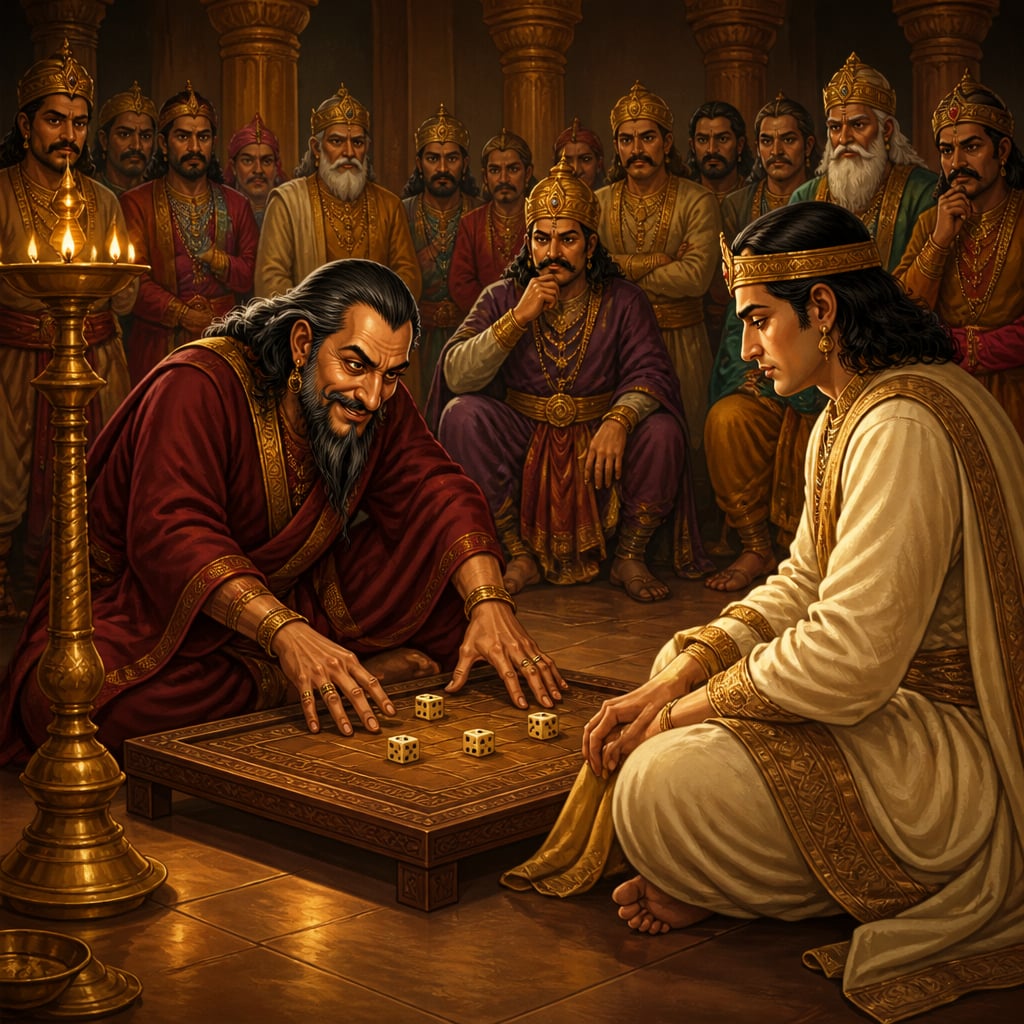
Shakuni crouched over loaded ivory dice in the Kuru sabha with a knowing smile

The Anatomy of False Consensus

False consensus operates through several mechanisms:

1. Coordination Disguised as Independence

When ten news outlets report the same story with the same framing, it appears to be independent confirmation. But if those ten outlets share ownership, ideology, or talking points, the apparent consensus is manufactured.

The consumer sees: "Everyone is reporting this, it must be true." The reality is: "One source is being amplified through multiple channels."

2. Definitional Gatekeeping

By controlling who counts as a "scholar," "expert," or member of the "international community," the consensus-manufacturer controls the consensus itself.

"Scholars agree that X" may mean: "People we recognize as scholars, who agree with us on most things, agree on this too."

Scholars who disagree are not counted as scholars. The consensus is achieved by definition.

3. Selective Amplification

In any large population, you can find voices supporting any position. False consensus works by amplifying certain voices while suppressing others.

A few protesters become "massive demonstrations." A few academics become "scholarly consensus." A few nations become "the international community."

Meanwhile, larger numbers on the other side are invisible, uncounted, or delegitimized.

4. Authority Laundering

An assertion gains credibility by passing through authoritative-seeming institutions.

An activist group makes a claim → A journalist reports it → An academic cites the report → A government references the academic → The original claim is now "established fact."

At each step, the claim gains legitimacy. The circular citation creates the appearance of independent verification.

Tactic 1: False Consensus, The Illusion of Universal Agreement

False consensus exploits a deep human instinct: we are social creatures who use social proof as a heuristic for truth. If everyone believes something, it's probably true. If experts agree, who am I to disagree?

This instinct served us well in small communities where we knew who "everyone" was. It fails catastrophically when "everyone" is manufactured.

The Manufacturing Process:

Step 1, Create the Nucleus: Establish a small group with shared ideology in key positions (media, academia, NGOs, international organizations).

Step 2, Coordinate Messaging: Develop common talking points, shared frameworks, aligned terminology. This doesn't require conspiracy, shared education and social networks naturally produce alignment.

Step 3, Cross-Reference: Each node cites others as independent confirmation. The academic cites the journalist who cites the NGO report written by someone who trained with the academic.

Step 4, Exclude Dissent: Those who question the consensus are not engaged but dismissed, as biased, as unqualified, as motivated by bad faith. Their exclusion reinforces the appearance of consensus.

Step 5, Present as Universal: The small coordinated group now speaks for "scholars," "experts," "the world." Their positions are presented not as one perspective but as the only legitimate perspective.

Tactic 2: Benevolent Control, Oppression Wearing a Smile

A clay vessel of milk laced with a hidden thread of poison

Once false consensus establishes what "everyone agrees" is true, benevolent control establishes what "everyone agrees" is good for you.

"We're here to help." "This is for your own protection." "You'll thank us later." "We know what's best for you."

Benevolent control is the framing of domination as assistance. The controller presents themselves not as taking power but as generously providing guidance to those who cannot guide themselves.

The Structure of Benevolent Control:

Macaulay drafting the Minute on Indian Education in his Calcutta study

The Deficit Frame: The target population is defined as lacking something, education, civilization, proper values, correct understanding. This deficit justifies intervention.

The Helper Identity: The controller presents themselves as selflessly providing what is lacking. Their intervention is not self-interested but charitable.

The Resistance Pathology: If the target resists, this proves the deficit. "They don't know what's good for them." "They've been taught to reject help." "Their resistance shows how much they need us."

The Success Definition: Success is defined by the controller's standards. If traditional practices disappear, that's "progress." If communities become dependent, that's "development."

The Gratitude Expectation: The target is expected to be grateful. Ingratitude proves the original deficit, they don't even recognize help when they receive it.

The Vidura Warning: Hidden Masters

Vidura Niti contains a crucial warning about advisors who serve hidden masters:

One who speaks sweetly while working for another's benefit Should be recognized as dangerous as a snake in the house.

The benevolent controller speaks the language of help while serving their own agenda. The NGO that "educates" communities into abandoning traditions serves the funder's ideology, not the community's interest. The international body that "protects" minorities defines who counts as a minority and what counts as protection.

Vidura's wisdom: Always ask who benefits. When "help" consistently moves resources, authority, or legitimacy from the "helped" to the "helper," it is not help, it is extraction wearing help's mask.

The Dharmic Framework: Satya vs. Mithya

Dharmic epistemology distinguishes between Satya (truth, reality, what is) and Mithya (that which appears but is not ultimately real).

False consensus is Mithya in social form. It appears to be agreement, but the agreement is manufactured. It appears to be universal, but the universe has been artificially restricted. It appears to be independent, but the independence is coordinated.

The challenge is that Mithya is not simply "false", it has apparent reality. The coordinated articles exist. The academic papers are published. The international statements are issued. The appearance is real; only the underlying unity is illusory.

Recognizing Mithyaikya requires seeing through appearance to structure. Not just what is being said, but how the appearance of consensus was created.

Why False Consensus is So Effective

False consensus works because of deep psychological mechanisms:

Social Proof: We evolved to use others' beliefs as evidence. If the tribe believes the berries are poisonous, you don't need to test them yourself. This heuristic, essential for survival, becomes vulnerability when "the tribe" is manufactured.

Authority Deference: We evolved to defer to those with expertise we lack. This reasonable deference becomes vulnerability when "expertise" is captured and weaponized.

Conformity Pressure: We experience genuine psychological discomfort when we disagree with apparent consensus. This discomfort, designed to maintain social cohesion, becomes a tool for manufacturing compliance.

Cognitive Ease: Processing information that aligns with apparent consensus is easier than processing dissent. Our minds prefer the path of least resistance.

Identity Protection: Disagreeing with consensus risks social identity. We may unconsciously adjust our beliefs to protect our social position.

Signs of Manufactured Consensus

How do you recognize false consensus?

Uniformity of Language: When diverse sources use identical phrases, talking points have been coordinated. Genuine independent agreement produces varied expression.

Missing Dissent: In any genuine debate, credible voices exist on multiple sides. If only one perspective appears, others are being suppressed, not absent.

Circular Citation: Follow the sources. If they ultimately point to each other rather than to independent evidence, the consensus is manufactured.

Reaction to Questions: Genuine consensus welcomes inquiry, it has nothing to hide. Manufactured consensus attacks questioners, the appearance must be protected.

Asymmetric Standards: The consensus position requires no evidence; challenging it requires extraordinary proof. This asymmetry reveals protection of a position, not pursuit of truth.

Timing Coordination: When multiple outlets simultaneously adopt new framing or terminology, coordination has occurred. Organic shifts happen gradually and unevenly.

Signs of Benevolent Control

How do you recognize help that is actually control?

The Deficit Definition: Are you being defined as lacking something? Who defined the lack? Do you agree you lack it?

The Helper's Benefit: Does the "help" increase your autonomy or decrease it? Does it build your capacity or your dependence?

The Exit Question: Can you refuse the help? What happens if you do? Genuine help can be declined; control cannot.

The Gratitude Demand: Are you expected to be grateful regardless of outcomes? Genuine help is satisfied with results; control demands recognition.

The Resistance Pathology: When you push back, is your resistance treated as evidence that you need more "help"? This circular logic is a hallmark of benevolent control.

The Outcome Pattern: Does the "help" consistently erode your traditions, your autonomy, your self-determination, while presenting this erosion as progress?

Manufactured consensus relies on several vulnerabilities:

Social proof exploitation: We trust what 'everyone' believes Authority deference: We defer to 'experts' Conformity pressure: We avoid standing against apparent majority Citation chains: Circular references create appearance of verification

Apply Anvikshiki, critical investigation, to the consensus itself:

Source Tracing: Who originally made this claim? How did it spread?

Connection Mapping: Are the apparently independent sources actually connected through funding, training, ideology, or citation?

Voice Inventory: Who is included in 'everyone'? More importantly, who is excluded?

Interest Analysis: Who benefits from this consensus existing? Whose interests does it serve?

Dissent Search: What do credible voices who disagree say? Why might they be excluded from 'consensus'?

Benevolent control operates through:

Deficit framing: You are defined as lacking what the controller provides Gratitude expectation: You should be thankful regardless of outcomes Resistance pathology: Your objections prove you need more 'help' Exit blocking: Refusing help has consequences Success definition: The controller decides what counts as success

Apply the Seva Test: Genuine seva (service) empowers; control disguised as seva creates dependence.

The Autonomy Question: Does this 'help' increase our capacity to help ourselves, or does it increase dependence on the helper?

The Exit Question: Can we decline this help without consequences? Genuine help can be refused; control cannot.

The Definition Question: Who defines what we need? Do we agree with that definition, or is it imposed?

The Benefit Question: Where do resources flow, toward us or toward the 'helper'?

The Representation Question: Are we speaking for ourselves, or are we being spoken for?

Manufactured consensus has structural advantages:

Distribution networks: Major media reach millions Authority positioning: Credentialed institutions carry weight First-mover advantage: Initial framing shapes all subsequent discussion Coordination capacity: Multiple voices amplify each other

Challenging manufactured consensus requires strategic patience. You cannot match their infrastructure immediately, but you can:

Document Patterns: Systematic documentation of coordination, selectivity, and double standards builds long-term credibility.

Build Alternative Networks: Connect truth-tellers across platforms, institutions, and geographies. A network of thousands can counter a coordinated hundred.

Develop Indigenous Expertise: Train your own scholars, journalists, and analysts. Reduce dependence on captured institutions.

Leverage New Platforms: Legacy media is captured; new platforms offer opportunities. Early presence on emerging platforms matters.

Long-term Vision: Manufactured consensus took decades to build. Counter-consensus requires similar patience. Think in generations, not news cycles.

Case studies

Colonial 'Protection': Control Dressed as Kindness

The British Raj perfected the art of benevolent control. Every mechanism of domination was presented as assistance to Indians who couldn't help themselves. **The Pattern of 'Protection':** **1. Regulation of Sati (1829)** The narrative: *'We are protecting Hindu women from barbaric Hindu men.'* The reality: Sati was already rare and declining. The regulation gave British authorities power to intervene in Hindu religious practices, establishing precedent for control. More Hindu women died from famine under British policies than from sati in centuries, but this went unprotected. **2. The Age of Consent Act (1891)** The narrative: *'We are protecting Hindu girls from Hindu marriage practices.'* The reality: The law gave British courts authority over Hindu family matters. 'Protection' of women became the wedge for dismantling Hindu family law autonomy. The same British who oversaw mass starvation were positioned as protectors of Indian girls. **3. Temple Endowment Acts (1863 onwards)** The narrative: *'We are protecting temple properties from mismanagement.'* The reality: Hindu religious institutions came under state bureaucratic control. 'Protection' meant capture. The 'mismanagement' being corrected was often simply management by Hindus. **4. The Criminal Tribes Act (1871)** The narrative: *'We are protecting society from hereditary criminals.'* The reality: Entire communities were criminalized, their movement restricted, their children taken. 'Protection' of society meant persecution of communities the British couldn't control. **The Benevolent Control Structure:** In each case, the pattern is identical: 1. **Define a problem** in the target community 2. **Position yourself as protector** against that problem 3. **Implement control mechanisms** under protection's banner 4. **Frame resistance as proof** of the original problem 5. **Expand control** as 'protection' proves 'successful' The genius of this approach is that it's self-reinforcing. If Hindus accepted the laws, it proved they needed British guidance. If they resisted, it proved they needed British correction. There was no response that didn't justify continued control. **The Language Patterns:** Note the consistent framing: - 'Reform' (not control) - 'Protection' (not restriction) - 'Progress' (not cultural destruction) - 'Civilization' (not subjugation) - 'Education' (not indoctrination) This language made British domination palatable not just to Indians but to the British themselves. They weren't colonizers, they were benefactors. They weren't extracting wealth, they were developing a backward region. They weren't destroying a civilization, they were civilizing barbarians. The manufacture of this consensus, that British rule was benevolent, was essential to imperial legitimacy both in India and in Britain.

Colonial 'protection' teaches us to examine the structure of help. Who defines the problem? Who implements the solution? Who benefits from the 'protection'? When 'help' consistently increases the helper's power over the helped, it is not help, it is control with a pleasant face.

The British 'protection' framework achieved something remarkable: it made the colonized cooperate in their own subjugation. Hindu elites internalized the narrative that their traditions needed external reform. This internalization persisted well after independence, producing a post-colonial ruling class that continued colonial policies toward Hindu institutions. The same 'protective' language now powers international NGO interventions, FCRA-funded activism, and external 'human rights' monitoring that selectively targets India while ignoring comparable or worse conditions elsewhere.

The most dangerous form of control does not announce itself as control. It arrives as help, concern, or reform. Test every offer of 'protection' with one filter: after implementation, does the community have more power over its own affairs, or less? If less, the protection is a mask.

The colonial pattern persists in modern forms. International bodies 'protect' human rights while applying standards selectively. NGOs 'develop' communities while creating dependence. Foreign governments 'support' democracy while funding ideologically aligned groups. The language of protection remains the preferred disguise for control.

Between 2006 and 2018, India received over Rs 1.75 lakh crore in foreign contributions under FCRA. A significant portion funded organizations working on religious conversion and advocacy against Hindu cultural practices, all under the banner of 'development' and 'human rights.'

Manufacturing 'World Opinion': The International Media Consensus Machine

When international media covers India, a remarkable pattern emerges: diverse outlets in different countries, with different ownership, simultaneously produce nearly identical framings. This apparent consensus is manufactured. **The Manufacturing Process:** **1. The Source Ecosystem** A small network of organizations generates the raw material: - A handful of NGOs produce 'reports' - A network of academics provides 'expert' commentary - A cluster of journalists serve as primary sources for each other - A few think tanks provide policy framing These nodes are interconnected: the NGO head studied with the academic who advises the think tank that funds the journalist who quotes the NGO report. The circle is small, but it produces content consumed by millions. **2. The Citation Chain** A typical manufactured consensus story: 1. An NGO releases a 'report' (often written by activists, not researchers) 2. A sympathetic journalist writes about the report 3. Wire services pick up the story 4. Multiple outlets publish versions 5. Academics cite the coverage as evidence 6. The coverage is cited to prove 'world opinion' At no point does independent verification occur. The original claim, however flawed, gains legitimacy through repetition. **3. The Expert Selection** When media needs 'expert' comment on India: - Hindu organizations are rarely consulted - Government positions are dismissed as propaganda - Diaspora voices are filtered for ideological alignment - Only certain academics are recognized as experts The 'expert' pool is pre-filtered to ensure consensus. Genuine diversity of opinion exists; it simply isn't represented. **4. The Framing Synchronization** Observe coverage of any major Indian event: - Identical phrases appear across outlets ('World's largest democracy,' 'Hindu nationalist,' 'secular fabric') - The same adjectives modify the same nouns - Certain facts are universally included; others universally excluded - Timelines start at the same convenient point This synchronization isn't coincidental. It reflects shared training, shared sources, and shared assumptions about what the story 'really is.' **5. The Consensus Declaration** Once sufficient coverage exists, the consensus is declared: *'International observers are concerned...'* *'World leaders have expressed alarm...'* *'The global community is watching...'* The 'international community' is actually a small network amplified to appear universal. The 'world opinion' is manufactured opinion given global distribution. **Case Pattern: Any Major Indian Event** Pick any controversy, farm laws, CAA, Article 370, temple movements, and observe: - International coverage appears within hours, with identical framing - Sources are the same familiar names - Indian government positions are presented as 'claims' while critics' assertions are presented as facts - Dissenting Indian voices are absent or delegitimized - The Hindu perspective is either missing or represented only by those who critique it - 'World condemns' headlines appear before any world has had time to consider This is Mithyaikya at industrial scale.

Media consensus teaches us to trace sources. When 'the world' speaks with one voice, ask: Who is actually speaking? How are they connected? What voices are not included? The appearance of universal agreement often conceals a small coordinated network. 'World opinion' is often a small opinion with world distribution.

Manufactured consensus shapes real policy. During India's CAA debate, identical framing appeared across BBC, NYT, Washington Post, and Al Jazeera within 48 hours, all sourced from the same cluster of NGOs and academics. This 'world opinion' then became leverage for diplomatic pressure, USCIRF designations, and foreign government statements. The cycle is self-fulfilling: media creates the consensus, then reports on the consensus it created. Indian voices offering context or correction are buried beneath the coordinated wave, leaving millions of global readers with a pre-packaged conclusion.

When 'the world' speaks with one voice on a complex issue within hours, that speed itself is evidence of coordination, not consensus. Trace the sources. Count the original nodes. Real agreement is slow and messy. Fast unanimity is almost always manufactured.

This pattern continues with every major India story. Recognizing the manufacturing process doesn't mean every criticism is false, but it means criticism that appears to have global consensus should be examined for coordination. When the 'whole world' seems to agree, that unanimity itself should trigger skepticism.

A 2019 analysis of international coverage during the Article 370 revocation found that over 70% of 'expert' quotes in major Western outlets came from fewer than 15 individuals, most affiliated with just 4 universities and 3 think tanks. The same names appeared across outlets that claimed independent editorial judgment.

Reflection

More in Institutional Warfare

All lessons in Institutional Warfare · Satrubodha: The Science of Enemy Awareness course