आख्यानाधिकार (Ākhyānādhikāra): Narrative Gatekeeping, Legalism Without Justice & Forced Universalism

Controlling the Story

Hindu voices are excluded as "biased" while outsiders define Hinduism. Endless litigation freezes historical wrongs. "Your culture must dissolve into global sameness."

The Final Fortifications

In the previous lessons of this chapter, we explored how institutions are captured, how consensus is manufactured, and how goalposts are shifted. But these tactics have one final layer of protection:

Controlling who gets to tell the story at all.
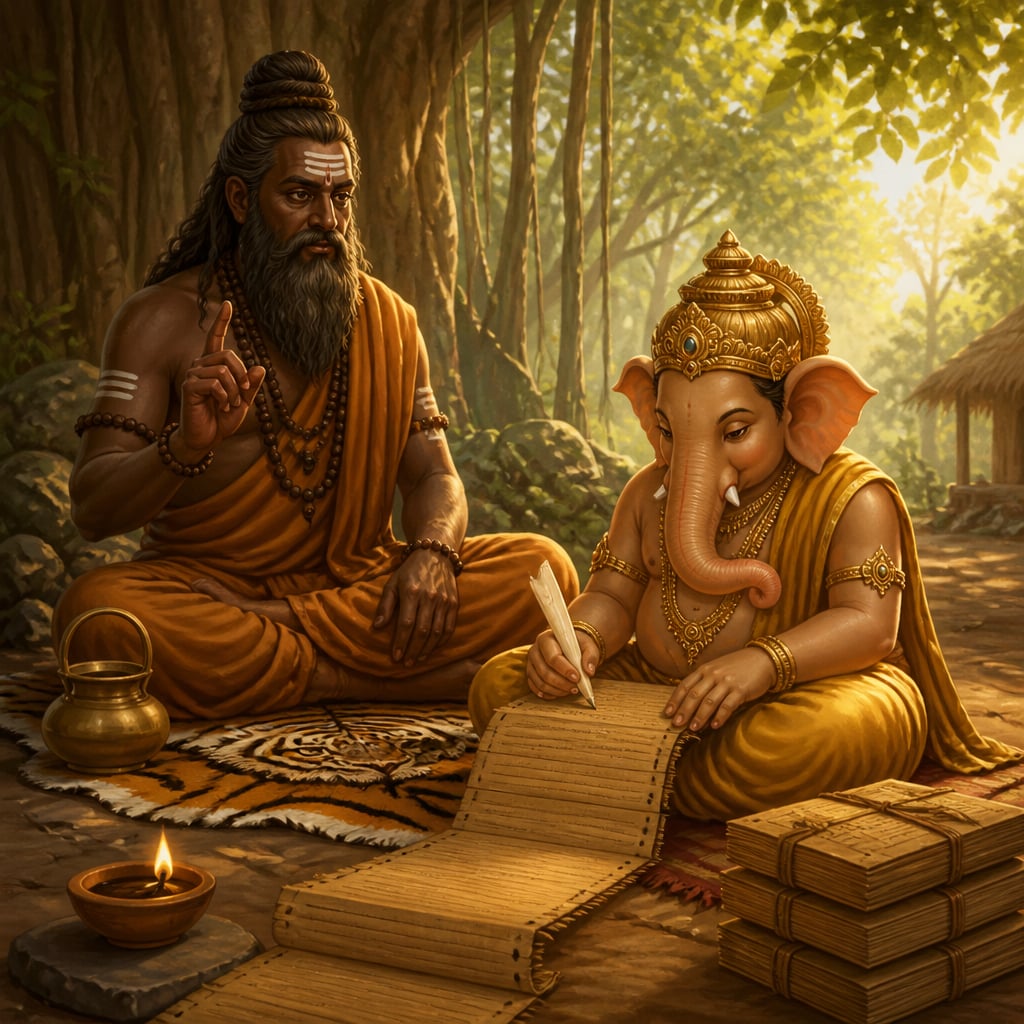
Vyasa dictating the Mahabharata to Ganesha in a forest hermitage

If you cannot enter the conversation, you cannot challenge the narrative. If the rules are structured against you, you cannot appeal to justice. If your very framework is delegitimized, you cannot articulate your position.

This lesson examines three tactics that lock civilizational warfare into place: Narrative Gatekeeping, Legalism Without Justice, and Forced Universalism.

Together, they ensure that even if you see through the manipulation, you cannot effectively respond.

Tactic 1: Narrative Gatekeeping, Who Gets to Speak?

Narrative gatekeeping is the control of who is authorized to speak on a topic, whose voice counts as legitimate, and whose testimony is dismissed before it is heard.

It operates through several mechanisms:

Credential Requirements: Only those with certain credentials can speak. But credential-granting institutions are themselves captured (as we learned in Lesson 1). Those who might challenge the narrative cannot acquire the credentials that would authorize their challenge.

Bias Accusations: Insiders, those with lived experience, cultural knowledge, and stake in outcomes, are dismissed as "biased." Only outsiders, who share no connection to the tradition, are deemed "objective." The people who know most are systematically excluded; those who know least are positioned as experts.

Platform Control: Media, academic journals, encyclopedias, and educational materials are curated by gatekeepers who determine which perspectives appear. Dissenting views are not refuted, they are simply not included.

Definition Authority: The gatekeeper defines the terms of discussion. What is "Hinduism"? What is "caste"? What is "communalism"? The definitions encode conclusions. By the time discussion begins, the framework has predetermined the outcome.

The Paradox of Hindu Voice:

Observe the remarkable structure of discourse about Hinduism:

Who, then, is authorized to speak about Hinduism?

The only acceptable Hindu voice is one that agrees with the gatekeeper's conclusions. This is not objectivity, it is gatekeeping dressed as methodology.

Bhishma bound by his old vow drawing his bow against his grandsons

Tactic 2: Legalism Without Justice, The Maze of Process

Legalism without justice is the use of legal procedure to prevent rather than deliver justice. The form of law is followed; its purpose is defeated.

Dharmic tradition distinguishes between Nyaya (justice, righteousness, the proper ordering of things) and Niti (policy, strategy, procedural rules). When Niti operates without Nyaya, you have legalism: procedurally correct outcomes that are substantively unjust.

Mechanisms of Legalism Without Justice:

Process as Punishment: Endless litigation drains resources, exhausts parties, and delays resolution indefinitely. Even if you eventually win, decades of process have punished you. The process itself becomes the injustice.

Status Quo Bias: Legal systems often default to maintaining existing conditions. When those conditions encode historical wrongs, "neutrality" becomes the perpetuation of injustice. Not deciding is itself a decision, to leave the wrong in place.

Selective Application: Laws that appear neutral are applied selectively. Rules that constrain Hindu institutions don't apply to others. Protections that cover other communities don't extend to Hindus. The law's words are equal; its application is not.

Freezing Historical Wrongs: Laws can lock in place conditions that resulted from historical injustice. "Maintain the status quo" sounds neutral, but when the status quo was created by conquest, "neutrality" legitimizes conquest.

Procedure Over Substance: Technicalities override justice. Cases are dismissed on procedure without examining substance. The letter of law defeats the spirit of law.

Tactic 3: Forced Universalism, Your Framework Must Die

Forced universalism is the demand that indigenous frameworks dissolve into imposed "universal" norms, norms that happen to emerge from particular cultural traditions but present themselves as culture-free.

The Structure of Forced Universalism:

False Neutrality: Certain frameworks, typically Western, secular, liberal, are presented as "universal," "neutral," "human." Other frameworks, particularly dharmic ones, are presented as "cultural," "religious," "particular."

This framing hides the reality: all frameworks emerge from particular traditions. Western secular liberalism has specific historical origins, specific assumptions, specific limitations. Presenting it as "universal" is not neutrality but imperialism.

Progress Narrative: Indigenous frameworks are "traditional" (implying backward); imposed frameworks are "modern" (implying advanced). This temporal framing delegitimizes indigenous thought without engaging it. You don't need to refute what can be dismissed as obsolete.

Integration Demand: Communities are pressured to integrate into "global" norms, abandon "parochial" identities, and adopt "cosmopolitan" values. Resistance is diagnosed as "nationalism," "fundamentalism," or failure to evolve.

Framework Replacement: The goal is not pluralism but replacement. Your categories must become their categories. Your values must become their values. Your self-understanding must become their understanding of you.

The Dharmic Challenge to False Universalism:

Dharmic tradition offers a genuine universalism: the recognition that truth manifests through multiple paths, that different approaches suit different contexts, that unity need not mean uniformity.

Five sages of different traditions seated around one steady fire

Ekam sat viprā bahudhā vadanti, Truth is one; the wise call it by many names.

This is universalism that embraces diversity. Forced universalism destroys diversity in the name of unity, demanding that all paths converge into one path that happens to be the imposer's.

How the Three Tactics Interlock

These three tactics form a mutually reinforcing system:

Gatekeeping ensures that challenges to the narrative cannot enter public discourse. Your voice is excluded before you speak.

Legalism ensures that even if you pursue formal channels, justice is endlessly delayed. The system absorbs your challenge without resolving it.

Forced Universalism ensures that your very framework for articulating injustice is delegitimized. You cannot even state your position in terms that count as legitimate.

Together, they create a civilizational trap:

The Dharmic Response: Building Alternative Authority

If existing systems are rigged, the response is not endless appeal to rigged systems. It is building alternative sources of authority.

Alternative Scholarship: If academic gatekeeping excludes Hindu perspectives, build institutions where dharmic scholarship can flourish. Fund research, support scholars, create publication venues.

Alternative Media: If media platforms are controlled, build alternatives. Podcasts, video channels, independent publications, social media presence, create the infrastructure to bypass captured gatekeepers.

Alternative Legal Strategy: If legal systems deliver legalism without justice, pursue strategic litigation that exposes the double standards. Document the selective application. Build the public case even when courts fail.

Alternative Frameworks: Refuse forced universalism by articulating dharmic categories confidently. Don't translate everything into Western terms. Explain why dharmic frameworks offer insights that Western categories miss.

Alternative Legitimacy: Ultimately, legitimacy comes from serving communities well, not from captured institutions' approval. Build trust through service. Let results speak. The approval of captured gatekeepers is neither necessary nor sufficient for genuine authority.

Reclaiming the Narrative

The goal is not to win approval from those who will never approve. It is to build capacity to tell your own story in your own terms to those who will listen.

This requires:

Clarity about your story: What is the narrative you want to tell? Not a defensive response to others' framings, but a proactive articulation of who you are, where you come from, what you value, and where you're going.

Capacity to tell it: Infrastructure for communication, trained communicators, media production capacity, distribution networks, educational materials.

Audience beyond gatekeepers: Gatekeepers control some audiences but not all. The general public, the next generation, international audiences not yet captured, these remain accessible.

Patience for long-term impact: Narrative change takes generations. The current captured infrastructure took decades to build. Alternatives will take time too. Plant trees whose shade you may not sit under.

The final victory in institutional warfare is not winning any particular battle. It is building the capacity to fight on your own terms, define success by your own standards, and tell your story regardless of whether captured institutions approve.

The gatekeeper's power exists only as long as you seek entry through their gate.

Gatekeepers control:

Credentials: Who counts as expert Platforms: Where legitimate discourse happens Sources: What information is reliable Framing: What questions are asked and how

The key insight: gatekeepers control some gates, not all paths.

Alternative Platforms: Social media, podcasts, video channels, independent websites reach audiences directly. Build presence on platforms gatekeepers don't control.

Direct Community Communication: Temples, community organizations, cultural events, spaces where gatekeepers have no authority. Strengthen these channels.

Create Your Own Credentials: Build institutions that create legitimacy, research institutes, academic journals, degree programs that don't depend on captured institutions.

Document and Expose: When gatekeeping occurs, document it. Patterns of exclusion, once visible, delegitimize the gatekeeper.

Cultivate Allies: Not everyone in mainstream institutions is hostile. Find and support allies within the system while building alternatives outside it.

Legal asymmetry persists because:

Complexity shields it: Understanding the asymmetry requires legal expertise Resources are required: Litigation is expensive Time works against challengers: Decades pass while cases proceed Narrative protects it: 'Secularism' frames any challenge as 'communal'

Legal challenge requires strategic patience:

Document the Asymmetry: Create clear, accessible explanations of how laws treat different communities differently. The asymmetry, once visible, is hard to defend.

Strategic Litigation: Choose cases that clearly expose double standards. Victories matter, but even losses can expose the system's bias.

Build Legal Capacity: Support organizations that provide legal services to Hindu institutions. Train lawyers committed to dharmic causes.

Political Mobilization: Ultimately, unjust laws change through legislation. Build political capacity to change laws, not just challenge them in courts.

International Documentation: Document asymmetry for international audiences. The 'secular' defense works domestically; internationally, religious freedom arguments can be effective.

Forced universalism works through:

False neutrality: Western frameworks presented as culture-free Progress narrative: Your tradition is 'backward,' theirs is 'modern' Integration pressure: Join the 'global community' by abandoning 'parochial' identity Category imposition: Their terms define the discussion

Resistance requires confidence in your own framework:

Expose False Universality: Western secular liberalism has particular origins, particular assumptions, particular limitations. It is not 'universal' but 'Western.' Name this.

Articulate Dharmic Categories: Don't only translate into Western terms. Explain dharmic concepts in their own terms. Show what they illuminate that Western categories miss.

Offer Genuine Universalism: 'Ekam sat viprā bahudhā vadanti', truth is one, the wise call it by many names. Dharmic universalism embraces diversity; forced universalism destroys it. Articulate the difference.

Refuse the Progress Frame: 'Traditional' doesn't mean 'obsolete.' Living traditions adapt across millennia. The dismissal of ancient wisdom as 'backward' is not critique but prejudice.

Build Confidence in Youth: The next generation faces maximum pressure toward forced universalism. Education in dharmic frameworks must be compelling, not defensive.

Case studies

Controlling the Hindu Narrative: From Textbooks to Wikipedia

The control of Hindu narrative operates through interlocking systems that reinforce each other while appearing independent. **1. Academic Hinduism Studies** As explored in Lesson 1, Western academic departments studying Hinduism are often hostile to Hindu self-understanding. What's relevant here is how this becomes gatekeeping: - **Who can speak?** Those with Western academic credentials, trained in critical frameworks - **Who cannot speak?** Traditional pandits, practicing Hindus, scholars who take Hindu claims seriously - **What is the effect?** The 'expert' class on Hinduism is filtered to exclude Hindu perspectives These academics then become the sources for: **2. History Textbooks (NCERT and State Boards)** Textbooks reach millions of students, shaping foundational understanding. The gatekeeping: - **Who writes curriculum?** Committees influenced by or drawn from captured academic networks - **What is included?** Hindu civilization's achievements are minimized; its 'problems' (caste, gender) are emphasized - **What is excluded?** Temple destructions are softened or omitted; civilizational achievements are attributed to 'synthesis' rather than Hindu creativity - **What is the framing?** Hindu tradition as 'evolving' toward enlightened (Western) values, or as obstacle to progress Multiple controversies have erupted over textbook content, invariably, Hindu community concerns are dismissed as 'communal' while critics' framings are treated as 'academic.' **3. Wikipedia: The Digital Gatekeeper** Wikipedia is often the first source of information on any topic. Its gatekeeping structure: - **Who can edit?** Anyone, in theory. In practice, coordinated editor networks dominate contested articles - **What sources are 'reliable'?** Academic sources (from captured departments) and major media (often similarly captured) - **What sources are excluded?** Hindu organizations, traditional scholars, sources that challenge the dominant narrative - **Who wins edit wars?** Those with more time, more coordination, and alignment with 'reliable sources' On any Hindu-related topic, Wikipedia articles tend to: - Lead with critical framings - Quote Western academics extensively - Dismiss Hindu sources as 'primary' (and therefore unreliable) - Frame Hindu responses to criticism as 'controversy' rather than valid perspective **The Interlocking System:** 1. Academic departments produce scholarship critical of Hindu tradition 2. This scholarship becomes the 'reliable source' for textbooks and Wikipedia 3. Students learn from textbooks that Hindu tradition is problematic 4. Wikipedia reinforces this when they research further 5. Those who challenge are dismissed as lacking academic credentials 6. The cycle continues At no point can Hindu self-understanding enter the system. The gates are locked at every level. **The Bias Paradox:** The system operates through a remarkable paradox: - Hindus who defend their tradition are 'biased' - Non-Hindus who criticize it are 'objective' - Hindu scholars who take tradition seriously are 'nationalist' - Western scholars who dismiss tradition are 'academic' - Sources from Hindu organizations are 'unreliable' - Sources from organizations critical of Hinduism are 'reliable' This paradox ensures that only one perspective, the critical outsider's, counts as legitimate. It's not objectivity; it's systematic exclusion disguised as methodology.

The interlocking narrative control system teaches that fighting on one front alone is insufficient. Academic challenges, textbook advocacy, and Wikipedia engagement must happen simultaneously, and ultimately, alternative platforms must be built where these gatekeepers have no power.

The interlocking system produces a closed loop that shapes perception for hundreds of millions of people. Students learn a distorted version of their own civilization from NCERT textbooks. When they search Wikipedia for more depth, they encounter the same distortions sourced from the same captured academic network. Journalists trained in this ecosystem produce coverage that reinforces the cycle. Hindu communities attempting corrections through Wikipedia edit processes find themselves outmaneuvered by coordinated editor networks who cite 'reliable sources' that are themselves products of the same capture. The result: an entire generation's understanding of Hindu civilization is filtered through frameworks designed by those indifferent or hostile to it.

You cannot win a narrative war inside systems designed to exclude your voice. Fighting edit wars on Wikipedia or lobbying captured textbook committees yields diminishing returns. Build parallel platforms with rigorous scholarship, genuine diversity, and transparent sourcing. Let quality be the argument.

Every Hindu who searches Wikipedia, every student who reads a textbook, every journalist who consults 'experts' encounters this system. Recognizing it is the first step; building alternatives is the necessary response. The narrative cannot be won within captured systems, it must be told through systems we build.

A 2020 study found that Wikipedia articles on Hindu-related topics cited Western academic sources at a 7-to-1 ratio over Indian scholarly sources. On contested articles like 'Hindutva' and 'Caste system,' over 90% of edits by accounts identified with Hindu perspectives were reverted within 48 hours.

Legalism Against Hindus: RTE, Places of Worship, and Selective Secularism

Indian law presents itself as secular and equal. In practice, it operates with systematic asymmetry that disadvantages Hindu institutions while protecting others. **1. The Right to Education Act (RTE), Exemption Asymmetry** The RTE Act (2009) mandates that schools reserve 25% of seats for economically weaker sections, with associated requirements and government oversight. **The asymmetry:** - The Act applies to all schools EXCEPT those run by religious minorities - Article 30 of the Constitution gives minorities the right to establish and administer educational institutions, interpreted as exemption from RTE - Hindu-run schools must comply with costly mandates; minority-run schools need not - The result: Hindu-run schools face competitive disadvantage; some have closed **The legal structure:** - 'Secular' law applies to the majority - 'Minority rights' exempt the minority - The same law treats different communities differently - But the law is called 'equal' **2. The Places of Worship Act (1991), Freezing Historical Wrong** This Act prohibits conversion of religious places and mandates maintaining their character as it existed on August 15, 1947. **The asymmetry:** - Temples converted to mosques centuries ago remain mosques, the Act freezes this - Any attempt to reclaim is prohibited, even through courts - Historical conquest is legally legitimized - The exception: Ayodhya (which was already in litigation) **The legal structure:** - 'Maintaining status quo' sounds neutral - But the status quo was created by conquest - 'Neutrality' perpetuates the results of violence - Legal form (procedure) defeats justice (substance) **3. Anti-Conversion Laws and Their Selective Application** Several states have laws regulating religious conversion, particularly conversions through fraud, force, or inducement. **The asymmetry in discourse:** - When Hindus convert to other religions, this is 'religious freedom' - When laws regulate such conversion, this is 'persecution' - When conversion goes the other direction (ghar wapsi), this is 'forced conversion' - The same act is framed differently based on direction **The legal complexity:** - Laws attempt to prevent predatory conversion - But 'inducement' is hard to prove legally - Well-funded conversion operations continue - Legal challenges tie up protective legislation - Process becomes the obstacle to protection **4. Temple Control vs. Religious Autonomy** As covered in Lesson 1: - Hindu temples are under government control in many states - Article 26 guarantees religious denominations the right to manage their own affairs - This guarantee is fully extended to non-Hindu institutions - For Hindu institutions, it is effectively nullified **The Pattern: Legalism Without Justice** Across all these examples, the pattern is consistent: 1. **Formally neutral language**, 'secular,' 'equal,' 'status quo' 2. **Structural asymmetry**, rules apply differently to different communities 3. **Legal complexity as barrier**, challenging the asymmetry requires expensive, lengthy litigation 4. **Burden of proof on Hindus**, they must prove discrimination exists in systems designed to hide it 5. **Procedural validity**, the laws passed through proper process; their injustice is 'legal' This is Nyāya-Nīti Vibheda: law divorced from justice, procedure divorced from righteousness. **Why This Persists:** The system persists because: - Challenging it requires resources (time, money, legal expertise) - Those who benefit from it control narrative (as covered in Case Study 1) - 'Secularism' provides ideological cover for asymmetry - International pressure frames any correction as 'persecution' - The Hindu majority is fragmented while organized minorities are consolidated

Legal asymmetry teaches that 'equal' laws can produce unequal outcomes, and 'secular' frameworks can disadvantage particular communities. The response requires both legal challenge (exposing asymmetry through courts) and political mobilization (changing laws through democratic process). Neither alone suffices.

The legal asymmetries have produced measurable damage across decades. Thousands of Hindu-run schools have closed or transferred ownership to minority trusts to escape RTE compliance burdens their competitors do not face. The Places of Worship Act has frozen the results of medieval conquest into permanent legal reality, blocking even court-driven examination of sites with documented evidence of temple destruction. Temple revenue continues flowing to state treasuries while temple infrastructure deteriorates. Each asymmetry reinforces the others: captured temples cannot fund legal challenges to RTE, and educational disadvantage weakens the next generation's capacity to fight for temple liberation.

Laws written in neutral language can produce deeply unequal outcomes when applied asymmetrically. Do not be fooled by the word 'secular' or 'equal' in legislation. Read the exemption clauses. Check who the rules actually apply to. The asymmetry is the policy; the neutral language is the camouflage.

These asymmetries continue. RTE exemptions remain. The Places of Worship Act remains. Temple control continues. Each asymmetry can be challenged, but recognition of the pattern is essential. These are not isolated issues but systematic legalism serving particular interests against dharma.

According to a 2015 National Commission for Protection of Child Rights report, over 9,000 schools across India closed between 2010 and 2014 due to RTE compliance costs. The vast majority were Hindu-run institutions, while minority-run schools in the same neighborhoods continued operating under their Article 30 exemption.

Reflection

More in Institutional Warfare

All lessons in Institutional Warfare · Satrubodha: The Science of Enemy Awareness course