विषममान (Viṣamamāna): Moral Asymmetry & the Inversion of Tolerance
The Double Standard
Hindu actions are moralized. Others' actions are psychologized. Hindu intolerance is fascism. Others' intolerance is resistance. Welcome to the final chapter: recognizing the deepest manipulation.
The Unequal Measure
Throughout this course, we have examined manipulation tactics: emotional weaponization, institutional capture, social fracturing, and diplomatic deception. But underlying all these tactics is a foundational asymmetry, a double standard so pervasive that it becomes invisible, like air.
Vishamamana, the unequal measure, is the application of different standards to identical actions based on who performs them. It is the deepest manipulation because it operates at the level of moral perception itself. Before you can debate whether an action is right or wrong, the double standard has already determined how that action will be framed.
This is the final lesson of Satrubodha: Enemy Awareness. It addresses the asymmetry that underlies all other tactics, and points toward the dharmic response.
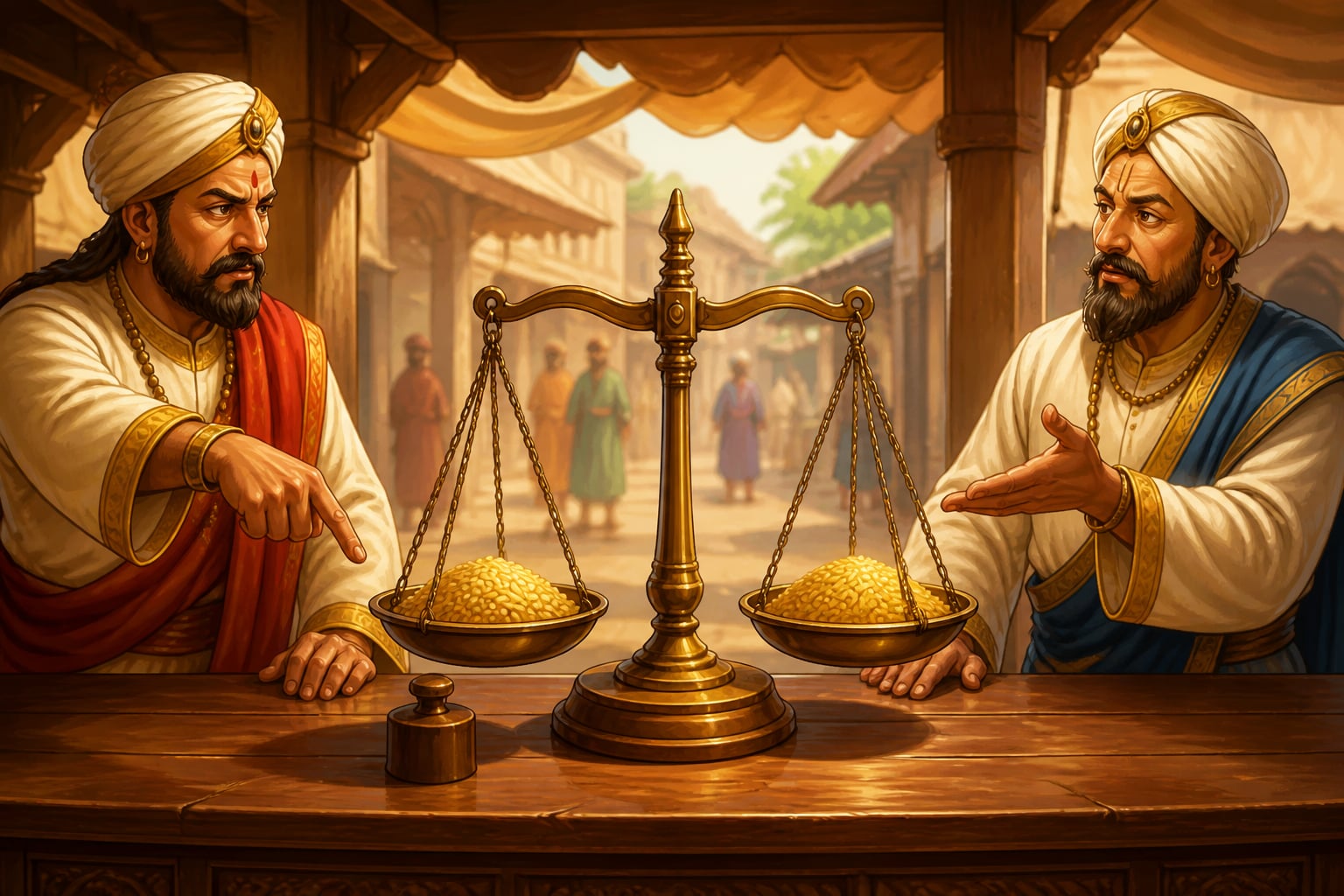
The Four Faces of Vishamamana
Double standards operate through four primary mechanisms:
1. Moral Asymmetry: Who Gets Moralized
When identical actions are performed by different groups, they receive entirely different moral treatment:
Hindu actions are moralized: A Hindu procession is a 'provocation.' A Hindu political leader is 'dangerous.' Hindu cultural assertion is 'Hindu nationalism' (pejorative). Hindu self-defense is 'communalism.' Hindu religious practice is 'Brahmanical oppression.'
Others' actions are psychologized or contextualized: A riot is 'understandable frustration.' Violence is 'reaction to marginalization.' Religious assertion is 'community identity.' The same action, let's say, a religious procession through a mixed neighborhood, is either 'peaceful expression of faith' or 'deliberate provocation' depending entirely on who is processing.
The asymmetry operates through language itself:
- 'Militant' vs. 'freedom fighter'
- 'Fundamentalism' vs. 'devoutness'
- 'Communalism' vs. 'community solidarity'
- 'Casteism' vs. 'social justice'
- 'Hindu supremacy' vs. 'minority rights'
The same phenomenon receives different words, and words shape perception.
2. Victimhood Monopoly: Who Gets to Suffer
Certain groups are recognized as victims; others are not, regardless of actual suffering:
Recognized victims: Their suffering is documented, commemorated, and forms the basis of policy and narrative. Their victimhood is permanent, past suffering justifies present claims indefinitely.
Unrecognized victims: Their suffering is minimized, contextualized, or erased. 'Both sides suffered.' 'That was long ago.' 'They provoked it.' 'The numbers are disputed.' Even when suffering is acknowledged, it doesn't generate the same moral claims.
The Kashmiri Hindu exodus, Partition's Hindu victims, temple destruction's multi-generational trauma, ongoing persecution in South Asia, these don't generate the same response as comparable suffering elsewhere. This is victimhood monopoly: the implicit claim that only certain suffering 'counts.'
3. Inversion of Tolerance: The Asymmetric Demand
Tolerance is demanded asymmetrically:
Hindus are expected to tolerate: insults to deities, mockery of practices, denigration of traditions, academic distortion, media misrepresentation, and even violence, all in the name of 'secularism,' 'free speech,' or 'criticism.'
Others are protected from offense: The same 'free speech' advocates become defenders of 'religious sensitivity' when other religions are involved. The same 'criticism' that is routine for Hinduism becomes 'hate speech' or 'phobia' when directed at others.
The paradox of tolerance is weaponized: the tolerant must tolerate the intolerant, while the intolerant face no such requirement. The tolerant community is asked to prove its tolerance by accepting ever-more-asymmetric treatment.
4. Psychological Secularization: What Counts as Legitimate
Hindu practices are pathologized:
- Rituals are 'superstition'
- Traditions are 'regressive'
- Beliefs are 'mythology'
- Social structures are 'oppression'
- Sacred texts are 'patriarchal'
Others' practices are respected:
- Rituals are 'cultural heritage'
- Traditions are 'community identity'
- Beliefs are 'faith' (sacred, beyond critique)
- Social structures are 'community practices'
- Sacred texts are 'scripture' (requiring respectful treatment)
The same phenomenon, let's say, gender segregation in religious spaces, is either 'discrimination' or 'religious tradition' depending on which religion practices it.
The Klesha Connection: Asmita and the Manipulated Self
Why do people accept asymmetric treatment? The Yoga Sutras point to Asmita, the false identification, the constructed sense of self that accepts external definitions:
dṛg-darśana-śaktyor ekātmatā iva asmitā (YS 2.6)
'Asmita is the apparent identity of the power of seeing and the power of being seen.'
Asmita is the confusion between the Self (Purusha) and the mind-body complex (Prakriti). When Asmita dominates, we accept others' definitions of who we are. We see ourselves through others' eyes, and if those eyes apply double standards, we internalize the asymmetry.
Internalized asymmetry looks like:
- 'Maybe they have a point about our traditions being regressive.'
- 'We should be more tolerant, tolerance is our tradition.'
- 'Both sides have problems, we should focus on our own issues.'
- 'Our suffering isn't as important as theirs.'
- 'We shouldn't be so sensitive about insults.'
These statements might be true in specific contexts. But when they become automatic responses that always favor asymmetric treatment, Asmita is operating. The false self has accepted that it deserves different treatment.
The Mechanism: How Double Standards Become Invisible
Double standards persist because they become naturalized:
1. Institutional Embedding: When schools, media, and academia apply double standards consistently, the asymmetry becomes 'just how things are.' Children grow up seeing Hindu practices criticized and others' respected; this seems normal.
2. Vocabulary Control: The words available shape perception. If 'fundamentalism' is only applied to Hindus, 'Hindu fundamentalism' seems like a real category while the equivalent in others doesn't exist linguistically.
3. Moral Exhaustion: Constant asymmetric criticism exhausts the targeted group. They stop noticing the double standard because noticing it is tiring and produces no change.
4. Social Reinforcement: Those who point out double standards are labeled 'whataboutists,' 'defensive,' or 'unable to take criticism.' The social cost of naming asymmetry reinforces silence.
5. Complicit Insiders: Members of the target group who accept and enforce the asymmetry gain social rewards. They become the 'good' members of the group, reasonable, self-critical, not like those other ones.

The Dharmic Response: Viveka Without Rage
The response to Vishamamana is not rage but Viveka, discrimination, the capacity to perceive clearly what is actually happening.

Rage is counterproductive for several reasons:
It validates the narrative: Angry Hindus 'prove' that Hindus are dangerous, which justifies the asymmetric treatment.
It clouds judgment: Rage replaces analysis. An enraged person cannot strategize effectively.
It exhausts energy: Sustained rage depletes the individual. The manipulators can outlast the enraged.
It alienates potential allies: Those who might recognize the asymmetry are pushed away by rage's appearance of irrationality.
The dharmic alternative is recognition without rage, clear seeing that doesn't depend on others' validation or change.
What Viveka Looks Like
Naming asymmetry calmly: 'The same action is being treated differently based on who performs it. Here are the examples. This is the pattern.'
Declining asymmetric terms: 'I don't accept that my tradition requires special tolerance while others don't. Same standard for all.'
Building independent strength: Instead of seeking validation from systems that apply double standards, build institutions, scholarship, and community that don't depend on that validation.
Strategic engagement: Engage where change is possible; don't waste energy where asymmetry is structural and unchangeable.
Transmitting awareness: Ensure the next generation recognizes double standards without being consumed by resentment.
Course Conclusion: The Awakened Stance
Throughout Satrubodha, we have examined how manipulation operates:
Chapter 1: The Enemy Within, how our own Kleshas make us vulnerable
Chapter 2: Emotional Warfare, how emotions are weaponized through guilt, shame, trauma, and grievance
Chapter 3: Institutional Capture, how systems meant to serve become tools of manipulation
Chapter 4: Social Fracturing, how divide-and-rule operates through identity, generation, and class
Chapter 5: The Complicit Within, how internal actors enable external manipulation
Chapter 6: Diplomatic Deception, how promises, silence, fear, and double standards operate
The common thread: manipulation succeeds by exploiting our vulnerabilities while remaining unrecognized.
The Viveka Response
Viveka, discriminating awareness, is the foundation of dharmic response:
Recognize patterns, not just incidents: Individual manipulations can be explained away. Patterns cannot. Once you see the pattern, you cannot unsee it.
Understand the mechanism: Know how gaslighting works, how DARVO operates, how double standards naturalize. Understanding the mechanism reduces its power.
Maintain equanimity: Neither the rage that validates the enemy's narrative nor the resignation that accepts defeat. The middle path is clear-eyed engagement.
Build from strength: A thriving community, educationally, economically, culturally, spiritually, is the best response to those who would diminish it. Their manipulation depends on weakness; your strength defeats it.
Transmit wisdom: This knowledge must reach the next generation, who will face the same patterns in new forms. Satrubodha, enemy awareness, is not paranoia; it is civilizational immune system.
The Awakened Stance
The graduate of Satrubodha stands differently in the world:
They recognize manipulation when it occurs, gaslighting, DARVO, grooming, double standards, without being consumed by it.
They understand that their own vulnerabilities, the Kleshas of Avidya, Asmita, Raga, Dvesha, Abhinivesha, are the entry points for manipulation, and they work to address these internally.
They maintain clarity and equanimity, refusing both the rage that empowers enemies and the despair that surrenders to them.
They act strategically, building institutions, transmitting culture, strengthening community, rather than merely reacting to the latest provocation.
They stand in Dharma, not the dharma of 'tolerance' that tolerates its own destruction, but the dharma of discrimination that knows what to protect and how.
This is not the path of hatred. It is the path of clarity. Not the path of victimhood. The path of strength. Not the path of isolation. The path of strategic engagement.
The enemy who operates in darkness depends on your blindness. Open your eyes, and the darkness itself becomes visible. This is Satrubodha. This is awakening.
Double standards are defended through several dismissal tactics:
'Whataboutism' Accusation: Pointing out asymmetric treatment is labeled deflection, even when the asymmetry is the point.
Context Inflation: Different context is claimed for why identical actions merit different responses, with 'context' expanded until comparison seems impossible.
Power Differential Claim: 'You can't compare because one has power and one doesn't', even when power dynamics are actually reversed in the specific situation.
Historical Burden: 'Your community's history means you don't get the same standing', past wrongs (real or claimed) remove present voice.
Tone Policing: 'The way you're pointing this out is the problem', focus shifts from the asymmetry to your tone in noticing it.
Apply Viveka through structured analysis:
Isolate the action: What exactly was done? Strip away identity markers.
Apply the same standard: How would this be described/judged if the identities were reversed?
Document the pattern: One instance can be explained; patterns cannot. Collect examples.
Communicate precisely: 'I'm not deflecting; I'm pointing out that the same action receives different treatment. Here are examples. This is the pattern. I'm asking for consistent standards.'
Maintain equanimity: The goal is clarity, not winning arguments. If the other party can't see asymmetry, your clarity doesn't depend on their recognition.
Asymmetric treatment persists because:
Acceptance: The target community accepts asymmetric terms, often having internalized them.
Exhaustion: Fighting asymmetry constantly is exhausting; people give up.
Social Cost: Those who point out asymmetry face social consequences.
Institutional Embedding: Asymmetry is built into systems; individual pushback seems futile.
Strategic Patience of the Manipulator: Those who apply double standards can outlast individual protest.
The Viveka response integrates recognition with strategic action:
Decline asymmetric terms: Don't accept frameworks that disadvantage you. 'I don't accept that my community must be held to a different standard.'
Build independent strength: Institutions, scholarship, media, community, whatever doesn't depend on asymmetric systems providing fairness.
Strategic engagement: Where change is possible, engage. Where asymmetry is structural and unchangeable, invest energy elsewhere.
Document and transmit: Ensure the next generation recognizes double standards without being consumed by resentment. Awareness + equanimity = sustainable response.
Model the alternative: Demonstrate what equal standards look like by applying them yourself to all communities, including your own.
Awareness without integration creates problems:
Hypervigilance: Seeing manipulation everywhere, even where it doesn't exist.
Chronic Resentment: Awareness of injustice without outlet leads to bitterness.
Paralysis: So much is wrong; where do you even start?
Isolation: Those who don't see what you see seem naive; connection becomes difficult.
Victimhood Identity: Awareness of being targeted becomes primary identity.
The awakened stance integrates awareness with equanimity:
Sthitaprajna (Steady Wisdom): See clearly, remain stable. Like the ocean receiving rivers, recognize what enters without being disturbed.
Karma Yoga: Act from duty, not from outcome anxiety. Your job is to act dharmatically; results are not in your control.
Viveka in Service of Dharma: Discrimination is not for accumulating grievances but for effective action. Viveka serves life, not bitterness.
Community Connection: Share awareness with those who understand. You are not alone; this is civilizational work.
Personal Practice: Spiritual practice (whatever form resonates) provides grounding that prevents manipulation awareness from becoming your entire world.
Case studies
The Language of Asymmetry: How Words Encode Double Standards
Double standards are encoded in the very words available to describe events: **Religious Expression**: - Hindu procession: 'provocation,' 'assertion,' 'display of majoritarian power' - Others' procession: 'celebration,' 'cultural expression,' 'community gathering' **Political Participation**: - Hindu political party: 'Hindu nationalist' (pejorative), 'right-wing,' 'fundamentalist' - Religion-based parties of other communities: 'community voice,' 'minority representation' **Religious Criticism**: - Criticism of Hinduism: 'scholarship,' 'progressive critique,' 'reform movement' - Criticism of other religions: 'hate speech,' 'phobia,' 'bigotry' **Violence**: - Violence by Hindus: 'pogrom,' 'communal violence,' 'majoritarian aggression' - Violence against Hindus: 'clashes,' 'tensions,' 'cycle of violence,' 'both sides' **Religious Practice**: - Hindu practices: 'ritual,' 'superstition,' 'Brahmanical,' 'regressive' - Others' practices: 'tradition,' 'faith,' 'heritage,' 'community custom' **The Mechanism**: 1. **Vocabulary Availability**: Certain words exist for Hindu phenomena that don't exist for equivalents elsewhere. 'Saffron terror' was coined; no equivalent for other religious colors. 2. **Connotation Building**: Through repeated use, words acquire connotations. 'Hindu nationalist' acquires danger connotations through association with negative coverage. 3. **Category Creation**: Categories are created that apply only to one group. 'Communalism' in Indian discourse overwhelmingly means Hindu-Muslim tension but functionally applies moral burden primarily to Hindus. 4. **Euphemism/Dysphemism**: Harsh words for one, soft words for another. Hindu 'fundamentalists' vs. others' 'conservatives.' Hindu 'mob' vs. others' 'crowd.' **The Function**: Language shapes perception before analysis begins. If the only words available to describe Hindu political activity are negative, Hindu political activity will be perceived negatively. The double standard is built into the vocabulary, making it invisible.
Viveka must extend to language itself. Before accepting a frame, 'this is Hindu nationalism', ask: what word would be used if another group did this? Is the framing equal? When you notice consistent asymmetric vocabulary, you've identified embedded Vishamamana. Naming this asymmetry is the first step to breaking it.
The asymmetric vocabulary has become so embedded that most people use it without awareness. A Hindu procession is instinctively described as 'provocative' while an identical procession by another community is a 'celebration.' This linguistic encoding shapes perception before conscious analysis even begins. Journalists, academics, and policymakers absorb these word-to-concept mappings and reproduce them automatically. The double standard becomes invisible precisely because it operates at the level of language itself, below the threshold of deliberate thought. Breaking the pattern requires first making it visible, which means documenting the vocabulary gap systematically.
Language is infrastructure, not decoration. The words available to describe an event determine how that event is perceived. When one community's political activity can only be described with negative vocabulary while another's uses neutral or positive terms, the bias is structural, not accidental. The first step to countering a double standard encoded in language is to name it and document it with paired examples.
Pay attention to vocabulary choices in media and discourse. When you notice different words for similar phenomena, document the pattern. Eventually, the vocabulary itself becomes the data revealing the double standard.
The term 'saffron terror' was coined and entered mainstream media vocabulary in India, despite the absence of any equivalent color-coded term for terrorism linked to other religious communities. A search of major English-language Indian publications shows thousands of uses of the phrase, while no parallel construction ('green terror,' for example) achieved comparable mainstream adoption, even for groups with documented, convicted terrorist networks.
The Permitted Victim: Whose Suffering Counts
Not all suffering is equal in public discourse: **Recognized Victimhood** (characteristics): - Suffering is documented extensively and commemorated annually - Victims' testimonies are treated as authoritative - Numbers are accepted, not disputed - Victimhood is transferable to descendants - Victimhood generates ongoing moral claims - Questioning the narrative is morally suspect **Unrecognized Victimhood** (characteristics): - Suffering is minimized or disputed ('the numbers are contested') - Victims' testimonies are 'one perspective' - Context is provided ('both sides suffered') - Time limits apply ('that was long ago') - No ongoing moral claims permitted - Discussing the suffering is 'playing victim' **Comparative Examples**: **Kashmiri Hindu Exodus (1989-90)**: - 300,000-500,000 displaced - Temples destroyed, targeted killings documented - No international recognition day - Rarely called 'ethnic cleansing' or 'genocide' - 'Disputed,' 'complex,' 'both sides' **Partition Hindu Victims (1947)**: - Millions displaced, hundreds of thousands killed - Women abducted, families destroyed - No memorial equivalent to other genocides - 'Both communities suffered equally' framing - Not a basis for ongoing claims **Ongoing Persecution (Bangladesh, Pakistan)**: - Documented population decline - Temple attacks, forced conversions, land seizures - Treated as 'local incidents' - 'Internal matter' of those countries - Hindu refugees don't generate the same response as other refugees **The Mechanism**: 1. **Attention Allocation**: Media and academic attention is finite. Some suffering is prioritized; other suffering is not covered. 2. **Framing Choices**: Same event can be 'genocide' or 'communal violence.' The choice of frame determines the moral weight. 3. **Commemoration Infrastructure**: Some events have memorial days, museums, curricula. Others have none. 4. **Moral Claim Permission**: Some victimhood generates the right to ongoing claims and special protections. Other victimhood does not. **The Function**: Victimhood monopoly determines who can make claims and who must remain silent. If your suffering doesn't count, you cannot appeal to it. If your suffering is 'equally distributed with the aggressor,' you cannot distinguish yourself from the aggressor. The monopoly on victimhood is a monopoly on moral standing.
Viveka recognizes that victimhood distribution is a political act, not an objective assessment. Document your history. Transmit your memory. Don't accept that your suffering counts less because others have decided it does. But also: don't become consumed by victimhood. Remember in order to learn, not in order to be forever wounded.
The victimhood hierarchy operates with real consequences. Communities whose suffering is internationally recognized receive memorial days, museum funding, curriculum inclusion, and ongoing moral claims that translate into political and financial support. Communities whose suffering is not recognized receive none of this. Kashmiri Hindus, Partition refugees, and persecuted Hindus in Bangladesh and Pakistan exist in this recognition gap. Their suffering is documented but not commemorated, real but not 'official.' The practical effect is that their claims carry less weight in international forums, their displacement generates less humanitarian response, and their history is more easily rewritten or erased.
If the world does not recognize your suffering, build the recognition infrastructure yourself. Document, commemorate, and transmit your history through your own institutions. Do not wait for permission from systems that have already demonstrated they will not grant it. But use memory as fuel for strength, not as a permanent wound. Remember in order to learn and to build, not in order to remain forever broken.
Create and maintain your own commemoration infrastructure. If international bodies don't recognize your suffering, create recognition within your community. Memory is resistance against erasure. But memory should empower, not paralyze.
The Hindu population of Pakistan declined from approximately 15% at Partition in 1947 to under 2% today. In Bangladesh, it dropped from about 22% to roughly 8%. These demographic collapses represent millions of displaced people across seven decades. Despite this scale, there is no equivalent of a Holocaust Memorial Museum, no internationally recognized remembrance day, and no dedicated UN resolution addressing this ongoing persecution.
The Paradox Weaponized: Tolerance as One-Way Street
The philosopher Karl Popper identified the 'paradox of tolerance': unlimited tolerance leads to the disappearance of tolerance, because the intolerant will exploit it. This paradox has been weaponized: **The Tolerance Trap**: 1. **Hindus are told**: Tolerance is your tradition. You must be tolerant. 2. **When Hindus express offense**: They are told they are intolerant, betraying their tradition. 3. **When others express offense**: Their offense is legitimate; sensitivity is required. 4. **Result**: Hindus must tolerate what others need not tolerate. Their tolerance becomes their vulnerability. **Examples**: **Artistic Expression**: - Controversial art about Hindu deities: 'Freedom of expression,' 'artistic license' - Similar art about other religions: 'Hate speech,' 'offense to religious sentiments' **Academic Critique**: - Critical scholarship on Hinduism: 'Academic freedom,' 'necessary critique of power' - Similar scholarship on other religions: 'Colonial gaze,' 'Orientalism,' 'cultural insensitivity' **Comedy/Satire**: - Mocking Hindu practices: 'Punching up,' 'satirizing the majority' - Mocking others' practices: 'Punching down,' 'bigotry' **Religious Assertion**: - Hindu assertiveness: 'Majoritarianism,' 'threat to minorities' - Others' assertiveness: 'Community identity,' 'self-determination' **The Mechanism**: 1. **Majority/Minority Frame**: Hindus are defined as 'majority' even in contexts where they are not powerful, making their concerns 'oppression' and others' concerns 'resistance.' 2. **Historical Guilt**: Colonial-era critiques of caste and practice are used to delegitimize contemporary Hindu voice. Historical wrongs (real or exaggerated) remove present standing. 3. **Tolerance as Identity**: 'Your tradition is tolerant' becomes 'you must tolerate everything, including intolerance toward you.' 4. **Power Inversion**: In discourse, Hindus are always positioned as powerful even when demonstrably vulnerable (Kashmir, Bangladesh, academic spaces). The framing ensures they cannot claim victim status. **The Function**: The asymmetric tolerance demand creates a situation where Hindus can never win: assert themselves and they're 'intolerant'; remain passive and they're exploited. The trap is designed to be inescapable, except through the recognition that it is a trap.
True tolerance is mutual; one-directional 'tolerance' is submission. The dharmic response is Samadarshana, equal standard for all. 'I will extend to you the same courtesy you extend to me. I will not accept for my tradition what you would not accept for yours.' This is not intolerance; this is the precondition for genuine tolerance.
The asymmetric tolerance demand has created a lose-lose position for Hindus in public discourse. Assert cultural identity, and the label 'intolerant' or 'majoritarian' follows immediately. Remain passive, and cultural ground is lost without resistance. The trap is designed to be inescapable within its own framework. The only exit is recognizing that the framework itself is the weapon. Communities that have broken this trap did so by insisting on reciprocity: 'I will extend to you the same standards you extend to me.' This reframes the conversation from one-directional tolerance to mutual respect, which is the actual precondition for genuine pluralism.
One-directional tolerance is not tolerance. It is a demand for submission wrapped in the language of virtue. When someone invokes your tradition of tolerance to demand that you tolerate intolerance toward yourself, they are weaponizing your values against you. The counter is simple and principled: insist on reciprocity. True pluralism means equal standards for all. Anything less is a power play disguised as a moral argument.
When asked for tolerance, ask: is this mutual? Is the same being asked of the other party? If tolerance is demanded only from you, it's not a call for tolerance, it's a demand for submission. True pluralism requires reciprocity.
Karl Popper articulated the paradox of tolerance in 1945: unlimited tolerance of the intolerant leads to the destruction of tolerance itself. Yet in practice, the paradox is routinely inverted. Controversial art depicting Hindu deities is defended as 'freedom of expression,' while similar treatment of other religions triggers immediate legal and social consequences. In India, hundreds of cases have been filed under blasphemy and hate speech provisions for speech about non-Hindu religions, while criticism of Hinduism is rarely prosecuted under equivalent statutes.
Reflection
- Think of a time when you held yourself to a standard you didn't expect from others, or when you accepted criticism you wouldn't have tolerated from an ally. Why did you accept the asymmetry? What would applying the same standard to all look like in that situation?
- Krishna teaches that the sage is like an ocean, unmoved by what enters. But he also teaches action against adharma. How do you reconcile inner equanimity with active response? Is it possible to see clearly, feel peace, and still act firmly against injustice?
- If double standards are invisible to those who benefit from them, how can dialogue change perception? Is pointing out asymmetry futile, or is there a way to communicate that creates recognition? What would effective communication of Vishamamana look like?