भयनिर्माण (Bhayanirmāṇa): Fear Mongering

The Fear Factory

"India will Balkanise." "Hindu resurgence will cause genocide." Catastrophic predictions paralyze defensive action and justify pre-emptive restrictions.

The Mind-Killer

Frank Herbert wrote in Dune: 'Fear is the mind-killer.' This ancient insight appears throughout dharmic literature. Fear does not simply create discomfort, it paralyzes discrimination, suspends reason, and makes people accept what they would otherwise reject.

Bhayanirmana, fear manufacturing, is the deliberate creation of apocalyptic scenarios to achieve specific goals: paralyzing defensive action, justifying pre-emptive restrictions, or mobilizing populations toward war. It is among the most powerful manipulation tactics because it targets our deepest instinct: survival.
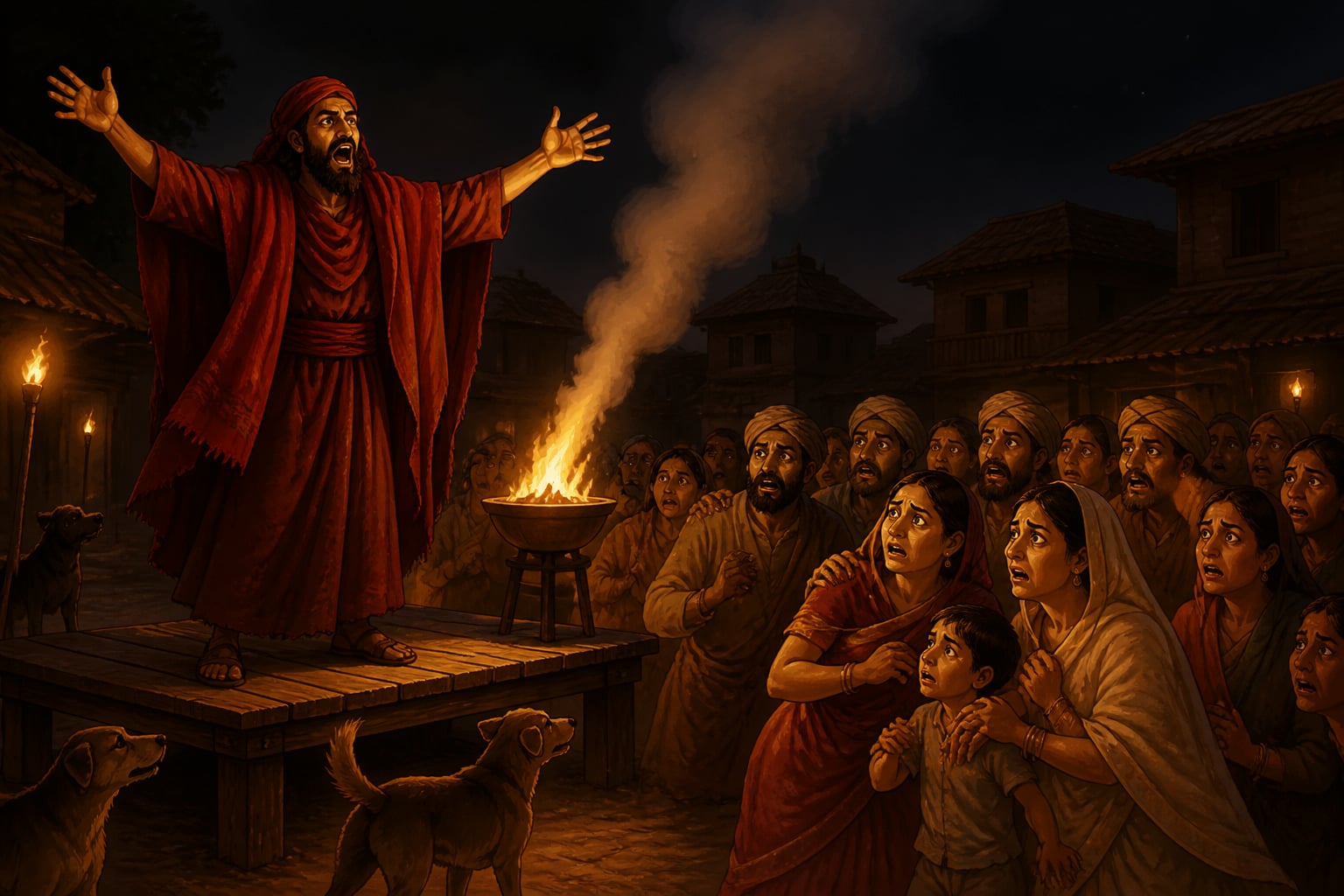
A herald manufacturing fear in a torchlit night square

The Anatomy of Fear Mongering

Manufactured fear follows predictable structures:

The Catastrophic Prediction: A terrible outcome is predicted with apparent certainty. 'If X happens, disaster will follow.' The prediction is specific enough to be frightening, vague enough to resist falsification.

The Imminent Threat: The disaster is always imminent, not someday, but soon. Urgency prevents careful analysis. 'We must act now; there's no time to deliberate.'

The Credentialed Authority: The prediction comes from 'experts,' 'intelligence sources,' or 'those who know.' Credentials substitute for evidence.

The Manufactured Consensus: Multiple outlets repeat the same fear. The repetition creates the impression of independent confirmation, when often it's coordinated messaging.

The Unfalsifiable Framing: If the disaster doesn't occur, it's because preventive action worked (validating the fear). If it does occur, the prediction was right (also validating the fear). Either way, the fear-monger wins.

Two Functions of Fear

Manufactured fear serves two primary purposes:

1. Paralyzing Defense (Fear of Consequences)

'If you defend yourself, worse things will happen.'

This fear is directed at potential victims. Examples:

The function: Keep victims passive. Any defensive action is framed as more dangerous than the original harm. The victim is taught to fear their own response more than the aggression.

2. Justifying Aggression (Fear of the Other)

'They are an existential threat. We must act first.'

This fear is directed at potential aggressors or bystanders. Examples:

The function: Justify pre-emptive action. If the threat is existential, any response is proportionate. Fear overrides moral constraints.

The Klesha Connection: Abhinivesha

The Yoga Sutras identify Abhinivesha as the deepest klesha, the primal fear of annihilation that exists even in the wise:

sva-rasa-vāhī viduṣo 'pi tathārūḍho 'bhiniveśaḥ (YS 2.9)

'Flowing by its own momentum, established even in the wise, is Abhinivesha.'

Abhinivesha is not ordinary fear of specific threats. It is the existential terror of non-existence, the survival instinct at its deepest level. This is what fear-mongering exploits:

Identity Annihilation: 'Your culture, your way of life, will be destroyed.'

Physical Annihilation: 'Your people will be killed, genocided, eliminated.'

Value Annihilation: 'Everything you believe in will be erased.'

When fear-mongering successfully triggers Abhinivesha, normal discrimination collapses. The mind enters survival mode, where careful analysis is overridden by urgent self-preservation. This is why manufactured fear is so effective, it bypasses reason entirely.

The Dharmic Framework: Multiple Responses

Dharmic literature provides multiple frameworks for understanding and countering fear:

A forest sage cultivating the opposite at dawn

The Yoga Sutra: Pratipaksha Bhavana

vitarka bādhane pratipakṣa-bhāvanam (YS 2.33)

'When disturbed by disturbing thoughts, cultivate the opposite.'

Pratipaksha Bhavana is not denial of fear but systematic cultivation of its opposite. When fear says 'everything will be destroyed,' the practice is to cultivate 'what is eternal in me cannot be destroyed.' When fear says 'I am powerless,' the practice is to recognize 'I have agency, capacity, and choice.'

The Bhagavad Gita: Action Despite Fear

Krishna addresses Arjuna's fear directly. Arjuna's paralyzing anxiety before battle, fear of consequences, fear of sin, fear of killing his teachers, is met not with dismissal but with reframing:

kleśo 'dhikataras teṣām avyaktāsakta-cetasām (BG 12.5)

'Greater is the difficulty for those attached to the unmanifest.'

Arjuna paralyzed in his chariot as Krishna stays calm

The Gita's teaching: Fear of abstract catastrophe is often greater than facing concrete present duties. Arjuna fears 'what might happen' so intensely that he cannot do 'what must be done.' Krishna's counsel is to focus on present dharma, not projected catastrophe.

The Arthashastra: Strategic Analysis of Fear

Kautilya understood fear as a political tool, both its deployment and its counter:

On deploying fear strategically (for defense): 'Sama, Dana, Danda, Bheda', conciliation, gifts, punishment, and division are all political tools. Fear of consequences (Danda) has legitimate defensive uses.

On countering manufactured fear: Intelligence gathering to verify threats. Independent assessment rather than relying on interested parties. Maintaining calm when others urge panic.

Recognizing Manufactured Fear

How do you know when fear is being manufactured rather than representing genuine threat?

Track Record: Do predictions from this source come true? Fear-mongers often have long histories of unfulfilled apocalyptic predictions. 'India will Balkanize by X year', did it?

Cui Bono: Who benefits from this fear? Does the fear happen to justify actions the fear-monger wanted anyway?

Asymmetric Coverage: Is fear about this threat covered while comparable or greater threats are ignored? Selective fear-mongering reveals agenda.

Urgency Without Evidence: Is the threat 'urgent' and 'obvious' yet evidence is classified, unavailable, or 'cannot be shared'? Genuine threats can usually be documented.

Historical Analogies: Are tenuous historical comparisons deployed? 'This is like 1930s Germany' applied to situations that bear minimal resemblance to Nazi Germany.

Emotional Intensity vs. Logical Substance: Is the message heavy on emotional triggers (vivid images, loaded language, appeals to children) but light on verifiable facts?

The Fear-Paralysis Cycle

Manufactured fear creates a vicious cycle:

  1. Threat Amplification: A potential threat is presented as certain, imminent, and catastrophic.

  2. Paralysis: The target audience becomes afraid to act, speak, or defend themselves.

  3. Actual Harm: While the victim is paralyzed, actual harm continues or escalates.

  4. Blame Assignment: When the victim finally responds, their response is cited as proof that they were the threat all along.

  5. Further Fear: 'See, we warned you about them. Now they're responding aggressively.'

The cycle is designed to be unbreakable: passivity permits harm; response 'proves' the original fear narrative.

Breaking the Cycle

The dharmic response integrates all three frameworks:

From Yoga: Recognize Abhinivesha when it's triggered. The very intensity of fear is a sign that you may be operating from survival instinct rather than discrimination. Pause. Breathe. Ask: 'What would I think about this if I weren't afraid?'

From Gita: Focus on present dharma, not projected catastrophe. The future is uncertain; present duty is clear. Fear manufactures abstract futures to paralyze concrete present action.

From Arthashastra: Verify independently. Assess who benefits. Maintain strategic capability regardless of fear narratives. Those who would paralyze you through fear should not control your assessment of threats.

Memory as Weapon: Document unfulfilled predictions. Track the record. When 'experts' with histories of false alarms raise new alarms, their track record matters.

Personal fear-paralysis operates through:

  1. Catastrophic Imagination: The mind generates vivid worst-case scenarios that feel more real than probability warrants.

  2. Inaction Blindness: The costs of not acting are invisible (opportunities missed, situations worsening, self-respect eroding), while the imagined costs of acting are vivid.

  3. Perfectionism: 'I'll act when conditions are perfect', conditions never become perfect.

  4. Social Fear Amplification: Others' doubts and warnings validate your own fears.

  5. Regret Avoidance Misfire: You fear regretting action, but inaction also produces regret, usually greater regret in the long run.

Apply all three frameworks:

Yoga Sutra (Pratipaksha Bhavana): When fear generates 'everything could go wrong,' cultivate 'I have handled difficulties before. I can handle what comes. Not acting has its own costs.'

Gita (Karma Yoga): Focus on the action itself, not imagined outcomes. Your duty is to act rightly; outcomes are beyond your control regardless. Not acting is also a choice with consequences.

Arthashastra (Strategic Assessment): Analyze concretely. What actually is the worst-case scenario? How likely is it? What are the actual costs of inaction? Move from emotional fear to concrete assessment.

Public fear-mongering operates through:

  1. Repetition: The same fear message across multiple outlets creates impression of consensus.

  2. Authority Leverage: 'Experts warn...' credentials substitute for evidence quality.

  3. Vivid Scenarios: Specific, emotionally charged scenarios are more compelling than statistics.

  4. Urgency Framing: 'No time for debate; we must act now.' Urgency prevents analysis.

  5. Social Proof: 'Everyone is concerned about this.' If you're not afraid, something's wrong with you.

Apply Arthashastra-informed assessment:

Track Record: Has this source predicted accurately before? Have similar warnings materialized?

Cui Bono: Who benefits from this fear? Does the fear justify actions the fear-source wanted anyway?

Evidence Quality: Is there verifiable evidence, or emotional appeals? Can claims be independently confirmed?

Alternative Perspectives: What do sources with different interests say? Is the fear shared across the political spectrum or concentrated?

Time Test: Wait before responding. Genuine threats remain threatening after a week; manufactured urgency dissipates.

Community-level fear-mongering operates through:

  1. External Definition: Others define your community as dangerous; the definition becomes something you must disprove.

  2. Preemptive Guilt: You're held responsible for catastrophes that haven't happened and may never happen.

  3. Expression Suppression: To avoid 'confirming' the feared narrative, community members suppress normal cultural/political expression.

  4. Internal Fragmentation: Some community members accept the fear narrative and police other members.

  5. Defensive Posture: Energy goes to disproving accusations rather than constructive community building.

Reject the Frame: You are not obligated to disprove predictions of your future bad behavior. The burden of proof is on the accuser, not the accused.

Document Track Record: Maintain records of failed predictions. 'You said X would happen by Y. It didn't. Why should we believe the new prediction?'

Continue Expression: Suppressing identity to avoid 'confirming' narratives concedes the frame. Your cultural and political expression is not evidence of danger; it is normal community life.

Build Strength: A confident, thriving community is the best response to fear narratives. Focus energy on positive building rather than defensive posturing.

Strategic Communication: When engaging broader audiences, present your community's actual nature, not defenses against accusations. Let reality counter narrative.

Case studies

The 'Hindu Fascism' Prediction: Manufacturing Fear to Paralyze

For three decades, a consistent fear narrative has warned of imminent catastrophe from 'Hindu nationalism': **The Predictions (Documented)**: 1. **'India's Balkanization'**: Repeatedly predicted since the 1990s, that Hindu assertion would cause India to fragment like Yugoslavia. As of 2025, India remains territorially intact and, by most measures, more integrated than ever. 2. **'Genocide of Muslims'**: Academic papers, media articles, and political statements have warned that Hindu political power would lead to genocide of Indian Muslims. India's Muslim population has grown at rates exceeding the Hindu population throughout this period. 3. **'Nazi Germany Parallels'**: Comparisons to 1930s Germany have been routine, predicting concentration camps, systematic extermination, and totalitarian control. None have materialized despite three decades of warnings. 4. **'End of Democracy'**: Each Indian election has been framed as potentially the last democratic election. Elections continue, with regular transfers of power. **The Track Record**: The most notable feature of these predictions is their consistent non-materialization: - India has not Balkanized - No genocide has occurred - Muslim population has grown in absolute and relative terms - Democratic elections continue - Religious minorities continue practicing freely - Courts function, press operates, opposition parties exist This doesn't mean India is perfect or that no Hindu-Muslim tensions exist. It means that **apocalyptic predictions of imminent catastrophe** have been consistently wrong. **The Function of the Fear**: 1. **Paralyze Hindu Assertion**: Any Hindu cultural or political expression is framed as precursor to genocide, making such expression inherently suspect. 2. **Justify External Intervention**: 'Dangerous' India requires international monitoring, pressure, and management. 3. **Asymmetric Standards**: Hindu assertion is treated as uniquely dangerous; similar assertion by other communities is normalized. 4. **Guilt Induction**: Hindus who participate in their own cultural or political expressions are made to feel complicit in imminent atrocity. **The Mechanism**: 1. **Selective Evidence**: Any negative incident involving Hindus is treated as confirmation of the pattern. Incidents involving other communities are 'isolated.' 2. **Historical Analogies**: Nazi comparisons bypass evidence by invoking emotional associations. 3. **Unfalsifiability**: If catastrophe doesn't occur, it's because vigilance prevented it. If incidents occur, they confirm the prediction. Either way, the fear narrative wins. 4. **Credentialed Sources**: The predictions come from academics, journalists, and 'experts,' lending authority to what would otherwise be recognized as consistent predictive failure.

Track record matters. Predictions that have consistently failed for three decades should not generate the same fear response as predictions with demonstrated accuracy. The Arthashastra teaches assessing sources by their reliability; a source with a history of false alarms loses credibility. Apply this to fear narratives: who predicted what, when, and was it accurate?

After three decades of apocalyptic predictions, India has not Balkanized, no genocide has occurred, Muslim population has grown both in absolute numbers and relative share, democratic elections continue with regular power transfers, courts function, and religious minorities practice freely. The predictions have a perfect record of failure. Yet each new iteration is treated with the same urgency as the first, and the failed track record is never acknowledged. The fear narrative succeeded not in predicting reality but in shaping discourse: Hindu cultural and political expression remains uniquely stigmatized in ways that equivalent expression by other communities is not.

Track record is the most reliable test for any prediction. When the same sources have predicted catastrophe for 30 years and been wrong every time, their latest prediction deserves skepticism, not alarm. A source that consistently generates false alarms loses credibility in any rational framework. Apply the same standard to fear narratives that you would apply to a weather forecaster who predicted hurricanes every month for three decades while none arrived.

This pattern applies to any fear narrative. Ask: what is the track record of these predictions? Have the catastrophes materialized? If not, why should the latest iteration be more credible? Genuine threat assessment incorporates track record; manufactured fear ignores it.

India's Muslim population grew from approximately 138 million in 2001 to over 200 million by 2023, making India home to one of the largest Muslim populations in the world. This growth occurred during the same period in which 'imminent genocide' was repeatedly predicted by academics, journalists, and international commentators. The demographic data directly contradicts the central claim of the fear narrative.

WMD and Iraq: Fear as Pretext for Aggression

The 2003 invasion of Iraq provides a textbook case of fear manufacturing: **The Fear Manufactured**: 1. **Weapons of Mass Destruction**: Iraq was claimed to possess chemical, biological, and potentially nuclear weapons that threatened the world. 2. **Imminent Threat**: The threat was presented as urgent. 'We don't want the smoking gun to be a mushroom cloud' (Condoleezza Rice). 3. **Connection to 9/11**: Though no connection existed, the fear narrative linked Iraq to the recent trauma of terrorist attack. 4. **45-Minute Warning**: British intelligence claimed Iraq could deploy WMDs within 45 minutes. **The Mechanism**: 1. **Credentialed Sources**: Colin Powell presented 'intelligence' at the UN. The authority of the position substituted for the quality of the evidence. 2. **Consensus Manufacturing**: Multiple governments, intelligence agencies, and media outlets repeated the claims, creating the appearance of independent confirmation. 3. **Dissent Suppression**: Those who questioned the evidence were labeled as 'naive,' 'pro-Saddam,' or 'anti-American.' 4. **Emotional Urgency**: Post-9/11 trauma was weaponized to override careful analysis. **The Reality**: 1. **No WMDs Found**: After invasion, exhaustive searches found no weapons of mass destruction. 2. **Intelligence Fabrication**: Subsequent investigations revealed that intelligence was manipulated, exaggerated, and in some cases fabricated. 3. **Consequences Catastrophic**: The invasion led to hundreds of thousands of deaths, regional destabilization, the rise of ISIS, and ongoing chaos. 4. **No Accountability**: Despite the manufactured fear leading to catastrophic consequences, no major figure faced accountability for the deception. **The Pattern**: 1. **Existential Threat Claimed**: The threat is framed as existential, 'they could attack us with WMDs.' 2. **Evidence Insufficient but Emotions Sufficient**: The actual evidence was weak, but the emotional climate post-9/11 made questioning seem unpatriotic. 3. **Urgent Action Required**: There's 'no time' for careful verification. 'We must act now.' 4. **Critics Marginalized**: Those who questioned the narrative were sidelined. 5. **Catastrophic Outcome**: The action taken based on manufactured fear produced outcomes worse than the alleged threat. This is Bhayanirmana deployed for aggression: manufactured fear justifying pre-emptive war.

The Gita teaches focusing on present duty, not projected catastrophe. The Iraq case shows why: projected catastrophe (WMD attack) was false, but present duty (truthful assessment, avoiding unnecessary war) was abandoned. Always ask: is the 'urgent threat' independently verified? Is there time for proper assessment? Who benefits from the fear?

No weapons of mass destruction were found in Iraq after the invasion. The Iraq Survey Group confirmed this after exhaustive searches. The war produced over 200,000 civilian deaths, displaced millions, destroyed Iraq's state infrastructure, and created the power vacuum that gave rise to ISIS. Regional destabilization spread across Syria, Libya, and beyond. Despite this catastrophic outcome based on fabricated evidence, no major decision-maker was held legally accountable. Colin Powell, who presented the false intelligence at the UN, later called it a 'blot' on his record. The word 'blot' for a deception that killed hundreds of thousands captures the accountability gap perfectly.

When someone demands immediate action based on an 'imminent existential threat,' that urgency itself is a red flag. Genuine threats can withstand the time it takes to verify evidence. Manufactured threats require speed specifically because they cannot survive scrutiny. The greater the pressure to act now without verification, the more important it is to verify first.

This pattern, manufactured fear justifying aggression, recurs in international relations. When any actor claims 'imminent existential threat' requiring immediate action without time for verification, the Iraq precedent should be remembered. Genuine threats can withstand scrutiny; manufactured fears require urgency to prevent analysis.

Colin Powell's 2003 UN presentation claimed Iraq had mobile biological weapons labs, aluminum tubes for nuclear centrifuges, and stockpiles of chemical weapons. Every specific claim was later proven false. A 2015 survey showed 42% of Americans still believed WMDs were found in Iraq, demonstrating that manufactured fear can outlast its own debunking by over a decade.

The 'Blowback' Narrative: Victim-Blaming Through Fear

After terrorist attacks, a consistent narrative emerges framing the attack as predictable 'blowback': **The Pattern**: 1. **Terror Attack Occurs**: Civilians are killed in an act of terrorism. 2. **Initial Response**: Brief condemnation, followed quickly by 'contextualization.' 3. **'Blowback' Framing**: The attack is explained as a predictable response to victim's actions, foreign policy, domestic policy, or mere existence. 4. **Implicit Warning**: The framing contains a threat, 'if you continue [defending yourself/existing as you are], more attacks will follow.' 5. **Defensive Paralysis**: The victim is placed in a bind: respond and risk 'more blowback,' or accept attacks passively. **Examples**: **Post-9/11**: Within days, articles appeared explaining the attacks as 'blowback' for US Middle East policy. The implicit message: change your policy or expect more attacks. **Mumbai 2008**: The attack was 'contextualized' with references to Kashmir, Gujarat, and 'Muslim alienation.' The implicit message: India's actions caused this. **Temple/Procession Attacks in India**: Violence is explained as 'reaction' to Hindu assertion. The implicit message: Hindu expression causes violence, so suppress it. **The Mechanism**: 1. **Victim Responsibility**: The victim is subtly made responsible for the attack. 'What did you do to provoke this?' 2. **Future Fear**: If this attack was caused by your behavior, future attacks will follow unless you change. 3. **Paralysis**: Any defensive action risks 'more blowback.' The safest course appears to be passivity. 4. **Aggressor Normalization**: The attacker's violence is 'explained' (and thereby partially excused) as natural reaction. **The Inversion**: The 'blowback' narrative inverts moral reasoning: - **Normal logic**: 'You attacked innocents. This is wrong. You must stop.' - **Blowback logic**: 'You were attacked. What did you do to cause this? How will you change to prevent future attacks?' The victim is responsible for preventing their own victimization by modifying their behavior. The aggressor's responsibility is diffused into 'context.' **The Function**: 1. **Paralyze Defense**: If defense causes 'blowback,' defense becomes dangerous. 2. **Suppress Identity**: If identity expression causes 'blowback,' identity must be suppressed. 3. **Justify Aggression**: The aggressor was merely 'reacting.' Their violence is natural, predictable, almost justified. 4. **Transfer Moral Burden**: The victim must explain, justify, and modify. The aggressor simply exists in their violence.

The Gita teaches that inaction is itself action, and has consequences. The 'blowback' narrative makes action terrifying but ignores the cost of inaction. Terrorism continues not because of blowback but because it works, because victims are paralyzed by fear of 'provoking' more. Breaking the cycle requires recognizing that passivity has never prevented aggression; it has only rewarded it.

The blowback narrative has achieved its intended effect: victims routinely self-censor, suppress cultural expression, and accept defensive paralysis as the 'responsible' position. Hindu processions are curtailed to 'avoid provoking' violence. Security operations against terrorism are questioned not on effectiveness but on whether they might 'create more terrorists.' The moral framework has been inverted so thoroughly that the victim's behavior is scrutinized for provocation while the aggressor's violence is treated as a natural phenomenon, like weather, to be accommodated rather than confronted. The narrative rewards aggression by making its continuation the victim's responsibility to prevent.

When you are attacked and the first question is 'what did you do to provoke this,' the framing is the weapon. Genuine analysis assigns agency to the aggressor. Blowback framing erases the aggressor's agency and transfers moral responsibility to the victim. Reject any framework that makes your existence the explanation for someone else's violence. Passivity has never prevented aggression. It has only made aggression cheaper.

Watch for 'blowback' framing whenever violence occurs. Ask: is the victim being asked to explain/justify their existence? Is the aggressor's agency being erased by 'contextualizing' their violence as mere reaction? The blowback narrative is a form of Bhayanirmana that targets victims specifically.

After the 2008 Mumbai attacks that killed 166 people, major international publications ran 'contextualization' pieces within days linking the attack to Kashmir, Gujarat, and 'Muslim alienation.' A content analysis of post-attack coverage shows that victim-blaming 'root cause' narratives appeared in leading outlets within 72 hours of the attack, before investigations into the Pakistani state's role had even concluded.

Reflection

More in Diplomatic Deception

All lessons in Diplomatic Deception · Satrubodha: The Science of Enemy Awareness course