The Wrist Holds the Vow

Raksha sutra, the temple thread, and Raksha Bandhan: how a single coloured cord on the wrist became the oldest documented protective technology in human civilisation, and how the same wrist-thread now sells on Etsy as an intention bracelet

A priest ties a red and yellow thread on a soldier's wrist before he leaves for battle. A sister ties the same thread on her brother's wrist on the full moon of Shravana. A devotee ties a small piece of silk on the iron grille of a Sufi dargah and on the trunk of a peepal tree at a Vaishnava temple. The thread is the same thread. The vow is different at each tying. The lesson opens the raksha sutra, the temple-and-tree thread, and Raksha Bandhan, and shows how the Baudhayana Grihya Sutra's soldier-and-traveller protection thread became the world's most distributed protective technology, and how the Kabbalah Centre, the Buddhist Sai Sin tradition, and the Etsy intention bracelet are all in lineage with a wrist-thread protocol the Atharva Veda prescribed three thousand years before any of them appeared.

A Priest at a Temple Gate, Tying a Thread on a Driver's Wrist
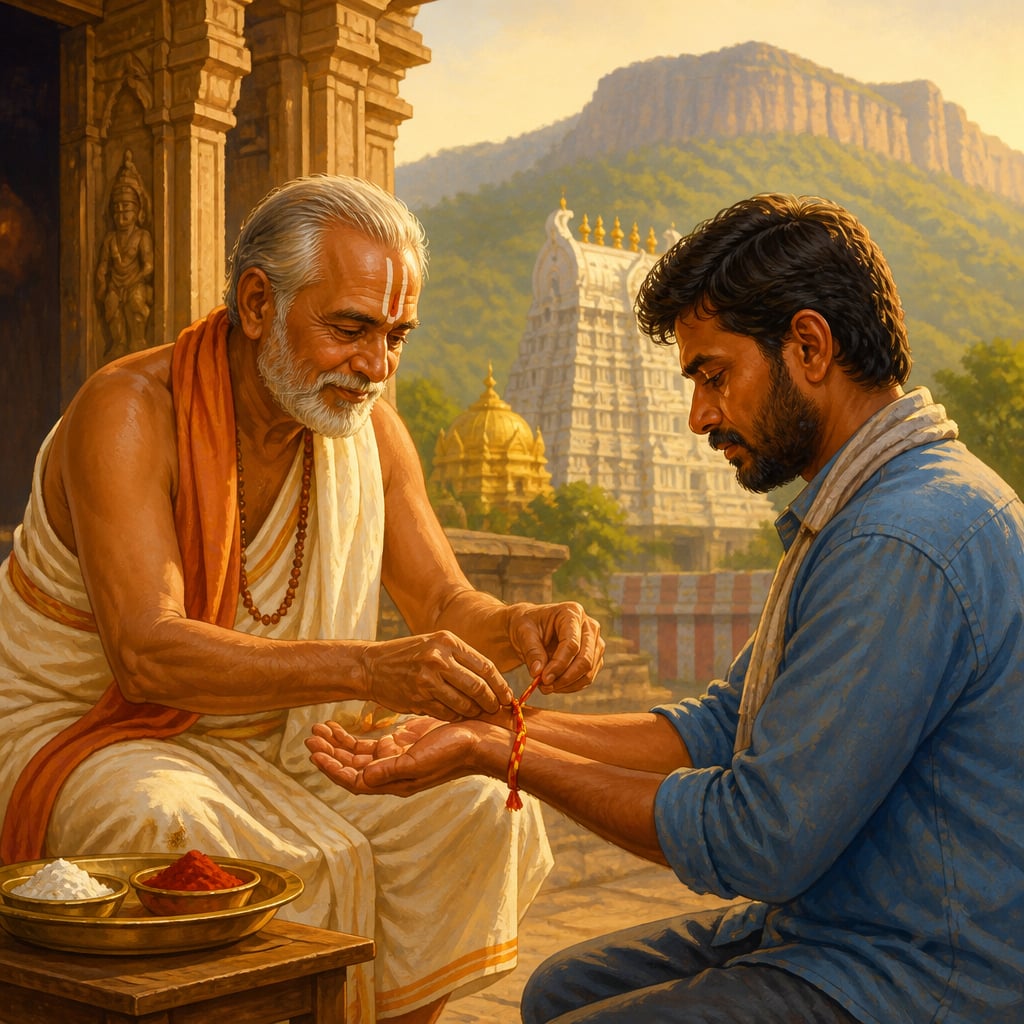
A Tirumala priest tying the raksha sutra on a lorry driver's wrist

At the Tirumala foothills in Andhra Pradesh, on a Tuesday morning in 1998, a long-distance lorry driver named Subramanyam stops at the Govindaraja Swamy temple at Tirupati before beginning the ascent up the seven hills. He is forty-two years old, a Telugu Vaishnava, and has been driving cement consignments between Chennai and Vijayawada for eighteen years. He has stopped at this temple before every long trip for the last eleven years. He removes his slippers, walks to the small priest at the side gate, presses a five-rupee coin into the priest's palm, and holds out his right wrist.

The priest takes a length of red and yellow cotton cord from a small basket. The cord is the colour of turmeric and kumkum mixed. It has been blessed at the morning archana. The priest ties the cord around Subramanyam's right wrist with three loose knots, murmuring a single line in Sanskrit. Yena baddho bali raja. Danavendro mahabalah. Tena tvam anubadhnami. Raksha ma chala ma chala. By the binding of which Bali, the demon king of great strength, was bound, by that same binding I bind you. Protection, do not move, do not move. The driver bows, places his hands on his eyes, and walks back to his lorry. He will not remove the thread. The thread will fade and fray over the next four to six months until it falls off on its own, at which point the next trip's stop at the temple will produce the next thread. He has worn this thread continuously, in successive instances, for eleven years.
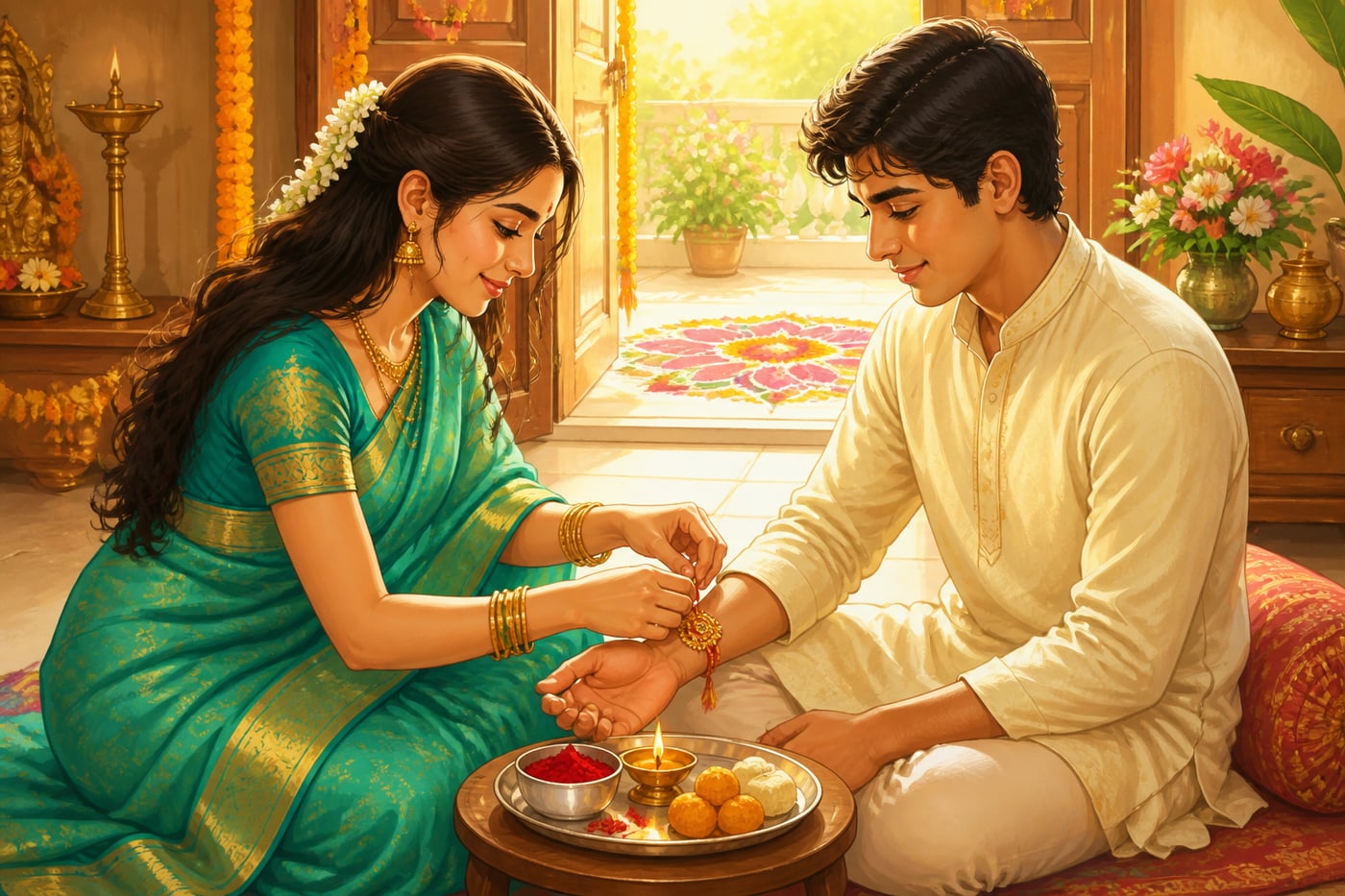
A sister tying the rakhi thread on her brother's wrist at Raksha Bandhan

Four months later, on the full moon of the lunar month Shravana in August, his sister Lakshmi ties a different thread on the same wrist. The thread is silk, woven with small beads, sometimes with a small flower or a tiny brass charm. She has come from her marital home in Vellore for the festival. She places a small tilak on his forehead, performs an arati with a brass plate, feeds him a piece of sweet, and ties the thread with the same single line spoken differently. I tie this thread on my brother's wrist. May it protect him. May he, in turn, protect me. Subramanyam gives her an envelope with money and a sari. She takes them and leaves. The Raksha Bandhan thread will sit alongside the Tirupati priest's raksha sutra on the same wrist until both fade and fall.

In 2017, his nephew, a software engineer in Bengaluru, will see a celebrity wear a Kabbalah red string on Instagram and will read that Madonna pays five hundred dollars for the annual ceremony at the Kabbalah Centre in Los Angeles. The nephew will look at his uncle's faded Tirupati thread and his older Raksha Bandhan thread, both still on the wrist, and will, without saying anything, understand the receipts.

Three Threads, One Continuous Protocol

The Hindu wrist holds three principal threads, each with its own scriptural lineage, ritual protocol, and modern echo. The first is the raksha sutra, the protection thread, tied by a priest at a temple, at a yajna, at the start of a journey, before a battle, before an examination, before a child's first day at school. The second is the temple-and-tree thread, a small piece of red, yellow, or saffron cloth tied at the iron grille of a sanctum, at the trunk of a peepal or banyan tree, at the steps of a wishing shrine, marking a vow whose fulfilment will return the devotee to untie the thread. The third is the Raksha Bandhan thread, tied by a sister on her brother's wrist on the full moon of Shravana, the festival that has carried, into the modern Indian calendar, the entire wrist-thread tradition in its most universally practised form.

Each of these is the same thread in a different ritual frame. The cord is cotton or silk, dyed red, yellow, saffron, or a combination. The knot count is three or seven. The Sanskrit invocation is the same root verse with regional variations. The thread stays on the wrist until it falls off naturally, after which the ritual repeats. The Hindu wrist is therefore not casually adorned. It is the household member's longest-running continuous identity-anchoring marker, replenished as it fades, present from the early years of childhood until death.

None of this is decorative. The thread is, in the Vedic frame, a mantra-charged object. The Sanskrit invocation transfers the protective intention into the cord; the priest's tying transfers the priest's authority into the act; the knot-count grounds the intention in a counted gesture. In the modern frame, the thread is an identity anchor, a daily reminder of a vow, a social-bond marker, and, as the 2015 Holt-Lunstad meta-analysis on social bonding documented, a continuous behavioural cue with measurable effects on mortality, immune function, and stress reactivity. The classical sources operated on the basis of the protective effect. The modern sources image the mechanism. Both name the same protocol.

The Practice, Across India

The raksha sutra runs through every major life occasion in the Hindu household. At the start of a yajna, the priest ties the kalava (the household-Hindi term for the raksha sutra) on the wrists of every person seated for the ritual; the thread will not be removed for the duration of the ritual cycle, which may last one day or eleven, depending on the yajna's specification. At the start of a wedding, the priest ties the kalava on the wrists of the bride, the groom, and the principal family members; the thread remains for the duration of the wedding rites and is removed by the priest at the conclusion. At the start of a long journey, especially in the older lorry-and-pilgrim economy, the traveller stops at a temple and receives the priest's thread for the journey. At the start of a child's first day at school, the parents tie a kalava on the child's wrist and recite a small protective mantra. At the start of an examination season, the child is taken to the family deity's shrine and the kalava is renewed. The thread carries the household's accumulated vows on the body of every member, simultaneously, every day.

Vow-threads tied along an ancient peepal tree in a temple courtyard

The temple-and-tree thread is the visible evidence of vows seeking fulfilment. At the iron grilles of the Tirupati Govindaraja temple, of the Vaishno Devi shrine in Jammu, of the Ajmer Sharif Sufi dargah, of the Velankanni church basilica in Tamil Nadu, of every village goddess's open-air shrine, thousands of small threads hang in dense layers, each a vow placed by a devotee. The vow is tied with the thread. If the child recovers, I will return. If the marriage is granted, I will return. If the litigation is decided in our favour, I will return. When the vow is fulfilled, the devotee returns to untie the thread, often replacing it with a small offering, and the cycle closes. The trees outside major temples, especially peepals and banyans, carry the same threads at their trunks, their lower branches, their iron-grille bases. The thread is the household's outsourced memory of a vow placed before the divine.

Raksha Bandhan is the festival in which the entire wrist-thread tradition arrives, once a year, in its most domesticated and most universally practised form. On the full moon of Shravana, every observant Hindu sister ties a thread on every observant Hindu brother's wrist. The thread is, in modern practice, often elaborately woven, with beads, small charms, and decorative motifs; it is sold by the millions in Indian markets in the weeks leading up to the festival. The brother gives the sister a gift in return, traditionally money or a sari. The mutual obligation is named in a single line: the sister ties the thread, asking for the brother's protection across the year; the brother accepts the thread, accepting the obligation. The festival has, in the modern era, expanded beyond strict siblings to include cousins, friends, and adopted-sibling relationships; the thread is now also tied between Hindu sisters and the soldiers at the border, between female political figures and protective male political figures, and, in some traditions, between the goddess Yamuna and her brother Yama in the founding mythology of the festival.

The Scripture Says

The Atharva Veda is the foundational source. Book 6, Hymn 81 of the Atharva Veda is a hymn called Pratisara, the bound-thread, in which the seer asks the Manidhara, the bearer of the protective bead-thread, to bind around the wearer's body the protections of the gods. The hymn names the cord by its protective function and prescribes its tying with mantra. The Atharva Veda's Book 19, Hymn 35 contains the Manibandha, the wrist-binding, in which the protection-thread is explicitly tied around the right wrist with a mantra invoking Indra, Agni, and the Adityas as the binders. These two hymns together establish the wrist-thread as a Vedic protection technology, with the cord, the right wrist, the knot, and the mantra all named in classical Sanskrit by 1200 BCE.

The Baudhayana Grihya Sutra, dated to between the eighth and the third centuries BCE, prescribes the raksha sutra explicitly for travellers and soldiers as a priest-tied protective amulet. The text names it as the oldest documented protective thread ritual with a defined institutional occasion (the start of a journey or a battle) and a priest-prescribed protocol (the tying by an authorised priest with a specified mantra). The Baudhayana Grihya Sutra, the Apastamba Grihya Sutra, and the Manava Grihya Sutra all carry parallel prescriptions, demonstrating that the soldier-and-traveller raksha sutra was a documented institutional practice across the late Vedic and post-Vedic periods.

The Bhavishya Purana and the Skanda Purana carry the foundational mythology of Raksha Bandhan in two parallel narratives. The Bhavishya Purana account places the festival at the moment when Indra was about to lose the battle against the asuras, and his consort Sachi, on the advice of the Brahmaspati, tied a protective thread on his wrist with a mantra of victory; the thread held; Indra prevailed. The Skanda Purana account places the festival at the moment when Yamuna tied a protective thread on her brother Yama's wrist; Yama, moved by the gesture, granted that any brother on whose wrist a sister tied a similar thread on this day would be protected and granted long life. Both Puranic narratives establish the thread as a protective technology with a divine sanction, and both name the full moon of Shravana as the canonical day for the tying.

The Mahabharata, in the Aranyaka Parva, contains an episode in which Krishna tears a piece of cloth from his own pitambara to bind a wound on Draupadi's finger when she has cut herself; Draupadi, in return, vows to protect Krishna from his enemies, and Krishna later honours this vow by saving her at the Kaurava court when Duhshasana attempts to disrobe her. The episode is widely cited in popular Raksha Bandhan literature as an extension of the brother-sister thread protocol from biological siblings to chosen siblings, expanding the festival's scope from the literal family to the chosen kinship of dharmic affiliation.

The canonical mantra for the raksha sutra tying, invariant across regional traditions, is the verse beginning yena baddho bali raja. The verse names the tying of the demon king Bali by the dwarf-incarnation Vamana as the cosmic prototype of the protective binding. The thread on the wearer's wrist is the household's small participation in the same cosmic act of binding-as-protection.

The Symbolism

The wrist is not chosen by accident. The wrist is the meeting place of three nadis (the ida, the pingala, and the sushumna in the Tantric framework), the location where the pulse is most accessible, and the only point on the body where a tied thread can be seen by the wearer multiple times every day in the course of ordinary activity. The thread on the wrist is therefore a self-reminding object. The wearer cannot fail to see it. Every washing of the hand, every meal, every gesture brings the thread back into view, and the thread brings the vow back into mind. The Vedic wrist-thread is, in modern habit-formation language, an environmental cue of the highest order, deployed on the most visible surface of the body.

The colour palette of the thread carries its own symbolism. Red is the colour of Shakti, of the female divine, of the protective energy that wards off harm. Yellow is the colour of turmeric, of Lakshmi, of auspiciousness and material prosperity. Saffron is the colour of the renunciant, of the sannyasi, of the dedication to a higher purpose. The standard kalava combines red and yellow, binding the protective and the auspicious in a single cord. The temple thread at certain Shaiva shrines is white or grey, the colour of vibhuti, the sacred ash. The Raksha Bandhan thread is now often more elaborately coloured and ornamented, but the foundational palette of red, yellow, and saffron remains dominant.

The knot count carries the third layer. Three knots invoke the three gunas (sattva, rajas, tamas), the three lokas (bhuh, bhuvah, svah), and the three principal deities (Brahma, Vishnu, Shiva) as protectors of the wearer. Seven knots, used in some shrine traditions, invoke the seven rishis, the seven horses of Surya's chariot, and the seven matrikas (the divine mothers). The number is not arbitrary. It grounds the protective intention in a counted physical gesture that the wearer carries on the wrist for the duration of the thread's life.

Why the Body Responds

Layer four, habit architecture. The raksha sutra is one of the most elegant identity-anchoring objects in any tradition. The thread is small, light, and unobtrusive, but it is permanently visible. The wearer sees it every day, dozens of times. Each viewing is a small re-anchoring of the underlying vow. James Clear's Atomic Habits describes identity-based habits as those held in place by a continuous reminder of who one is and what one has committed to. The kalava on the wrist of the Hindu householder, replenished every yajna, every wedding, every Raksha Bandhan, every Tirupati visit, is the most distributed and most continuous identity-anchoring technology any civilisation has produced.

The social bonding layer is documented by modern research. Holt-Lunstad and colleagues, in a 2015 meta-analysis published in Perspectives on Psychological Science, examined data from over three million participants across multiple longitudinal studies and found that strong social bonding reduces mortality risk by twenty-nine per cent, an effect comparable to that of quitting smoking and substantially larger than that of moderate exercise. Cohen and colleagues, in a 2004 study published in Psychosomatic Medicine, demonstrated that high-social-connection individuals were forty-five per cent less likely to develop clinical infection when deliberately exposed to rhinovirus, with the immune protection mediated by inflammatory and stress-hormone pathways. The Raksha Bandhan thread, the temple thread, and the priest's raksha sutra are all, in addition to their ritual function, physical markers of social bonds; the body's continuous awareness of these bonds, mediated by the visible reminder on the wrist, has measurable physiological effects on stress reactivity, immune function, and mortality.

The vagal tone effect is the third layer. The act of being tied with a thread by a trusted other (the priest, the sister, the parent, the elder) is a documented activator of the parasympathetic nervous system. Porges's polyvagal theory, developed across the 1990s and 2000s, describes the vagal nerve as the body's principal social-engagement system, activated by face-to-face interaction with safe and trusted others. The kalava-tying ritual is structurally a face-to-face engagement: the priest's hand on the devotee's wrist, the sister's gaze on the brother's eyes, the parent's voice in the child's ear. The physiological effect is the activation of the social-engagement vagal pathway and the stabilisation of the body's autonomic balance. The thread itself, on the wrist, then anchors this activation across the days and weeks that follow.

What the Labs Found

The research record on social bonding and protective ritual is now substantial. The Holt-Lunstad 2015 meta-analysis, citing data from three hundred thousand participants across one hundred and forty-eight studies, established that lacking strong social relationships is comparable in mortality risk to smoking fifteen cigarettes a day and is greater than the risk associated with obesity or physical inactivity. The Cohen 2004 study quantified the immune effect: subjects with high social connection were forty-five per cent less likely to develop a respiratory infection when deliberately exposed to rhinovirus. The mechanism includes both psychological resilience and direct physiological pathways through cortisol regulation, inflammatory cytokine modulation, and parasympathetic activation.

The wrist-thread, as a physical marker of a social bond, occupies a specific niche in this literature. It is not a generic talisman. It is a continuously visible reminder of a specifically named bond (the priest's vow, the sister's protection, the deity's grace), maintained on the body for months at a time, replenished as it fades. The behavioural-anchor function of such markers has been studied in adjacent domains: wedding rings, military identity tags, religious medals worn by Catholics, and the Buddhist Sai Sin thread tied by Thai monks. In each case, the visible marker functions as a continuous identity cue, with measurable effects on behaviour, decision-making, and self-perception.

The vagal-tone effect of the tying ritual itself has been studied less directly but has clear analogues in the touch-and-trust literature. Studies by Field and colleagues on therapeutic touch, by Uvnas-Moberg on oxytocin release in mother-infant bonding, and by Porges on the polyvagal social engagement system together establish that being touched on the wrist, on the head, or on the upper back by a trusted other in a ritual context produces measurable parasympathetic activation, cortisol reduction, and oxytocin release. The kalava-tying ritual operates within these documented pathways.

The deeper finding is that the raksha sutra is not, as a casual modern observer might suppose, a superstition. It is a structured social-bonding technology with measurable physiological and psychological effects. The classical Vedic sources operated on the basis of the protective outcome (the thread protects the wearer; the wearer thrives; the household prospers). The modern sources image the mechanisms (social bonding, vagal activation, cortisol regulation, immune function). Both name the same protocol.

What the World Calls It Now

The modern echoes are precise.

The Kabbalah red string, popularised by the Kabbalah Centre in Los Angeles from the 1990s onward and adopted by celebrities including Madonna, Britney Spears, Demi Moore, and Lindsay Lohan, sells at twenty-six dollars per string from the official Kabbalah Centre store. The Centre's marketing copy describes the string as a protection against the evil eye and as a marker of spiritual commitment. The string is tied with seven knots on the left wrist. The protocol is, beat for beat, the raksha sutra: a coloured cord, tied with a counted knot, on a specific wrist, accompanied by an invocation, intended for protection. The Kabbalah Centre's literature traces the practice to the tomb of Rachel near Bethlehem and to a kabbalistic interpretation of the biblical Genesis 35:11. The Centre does not cite the Atharva Veda, the Baudhayana Grihya Sutra, or the Hindu raksha sutra tradition.

The Buddhist Sai Sin thread (สายสิญจน์), tied by Thai and Lao Theravada monks on the wrists of the laity at temple ceremonies, is structurally identical to the raksha sutra. The thread is white cotton, tied with three knots on the right wrist, accompanied by a Pali chant. The protocol descends from the same broader Indic protective-thread tradition that produced the raksha sutra, and the Pali chant is itself derived from Sanskrit prototypes. The Theravada tradition acknowledges its Indic origin in general terms but typically does not cite the Atharva Veda directly.

The Etsy intention bracelet market, including the global "red string" and "protection bracelet" segments, exceeded thirty million dollars in annual sales by 2022, with thousands of independent sellers offering hand-knotted threads at five to forty-five dollars per piece. The marketing copy invokes diverse traditions (Kabbalah, Tibetan Buddhism, Native American medicine, generic "manifestation" frameworks) but rarely cites the Hindu source. The product is the same product. The lineage is fragmented across the marketplace.

The "intention bracelet" wellness segment, including products from brands like Lokai, Pura Vida, and Mala Collective, has grown into a multi-hundred-million-dollar industry, with the wrist marker as the central product form. Lokai's silicone bracelets sold at twelve dollars each generated revenues over fifty million dollars annually at peak. Mala Collective's prayer-bead bracelets, with explicit references to Buddhist and Hindu tradition, sell at fifty to two hundred dollars per piece. The wrist as the locus of the intention-anchor object is now an established consumer category. The Atharva Veda named the locus three thousand years ago.

What to Call It Yourself

From this lesson onward, when the celebrity Instagram shows the Kabbalah red string, name the older lineage. Raksha sutra. When the Buddhist temple ceremony shows the Sai Sin thread, name the older origin. Manibandha. When the Etsy intention bracelet promises protection, name the older protocol. Kalava. The Hindu wrist has held the vow continuously for three thousand years. The thread does not require the names. The wearer does. The household member who pours the morning glass of copper-stored water and ties the kalava on the child's wrist before the first day of school is, without saying it, running the most distributed protective-bonding technology any civilisation has produced. The course names the protocol so the practitioner can carry it deliberately.

Key figures

Sachi

Consort of Indra; the foundational tier of the raksha sutra in the Bhavishya Purana account of Raksha Bandhan; the divine prototype of the protective-thread sister. · Vedic mythological figure; the foundational Raksha Bandhan account is preserved in the Bhavishya Purana, redacted between c. 500 CE and 1200 CE.

Sachi, also called Indrani, is in Vedic mythology the consort of Indra, the king of the devas. The Bhavishya Purana's account of Raksha Bandhan places its origin at the moment when Indra was about to lose the war against the asuras. On the advice of the Brahmaspati, the priest of the gods, Sachi tied a protective thread on Indra's wrist with a mantra invoking victory and protection. The thread held; Indra prevailed. The Bhavishya Purana names this moment as the foundational event of the protective-thread tradition and the cosmological prototype of every subsequent priestly and sisterly tying. Sachi is therefore the archetypal raksha-sutra-tier, the divine female figure whose protective gesture is reproduced every Shravana Purnima by every Hindu sister and every priest at every yajna.

Every contemporary tying of the kalava, the temple thread, or the Raksha Bandhan rakhi is in lineage with Sachi's foundational gesture. The Hindu reading is that the thread on the wrist of the contemporary householder is the small descendant of the cosmic thread Sachi tied on Indra's wrist before the asura battle. The modern echo is in the Kabbalah Centre's red string, the Etsy intention bracelet, and the Buddhist Sai Sin thread, none of which name Sachi. The course names the lineage so the practitioner can hold the depth of the older source against the surface of the modern brand.

Yamuna

River goddess and sister of Yama, the lord of death; the foundational sister-figure in the Skanda Purana's account of Raksha Bandhan; the divine prototype of the brother-sister protective bond. · Vedic and Puranic mythological figure; the Skanda Purana account of Raksha Bandhan is preserved in the redaction span c. 600 CE to 1300 CE.

Yamuna is, in Vedic and Puranic tradition, the goddess of the Yamuna river and the sister of Yama, the lord of death and the judge of the dead. The Skanda Purana's account of Raksha Bandhan places its origin at Yamuna's tying of a protective thread on Yama's wrist as a gesture of sisterly affection. Yama, moved by the gesture, granted that any brother on whose wrist a sister tied a similar thread on this day would be protected from death and granted long life. The Skanda Purana names this moment as the foundational event of the brother-sister Raksha Bandhan tradition. Yamuna is therefore the archetypal sister-tier, the divine female figure whose protective gesture established the festival's reciprocal structure between siblings.

Every contemporary Raksha Bandhan tying between a Hindu sister and brother is in lineage with Yamuna's foundational gesture toward Yama. The festival's reciprocal structure (the sister ties the thread, asking for the brother's protection across the year; the brother accepts the thread, accepting the protective obligation; the sister is granted long life and welfare in return) descends from the divine exchange between Yamuna and Yama. The modern commercial expansion of the festival, with elaborately ornamented threads sold by the millions, has not displaced the foundational mythology. The course names the lineage.

Julianne Holt-Lunstad

American social psychologist; professor of psychology at Brigham Young University; lead author of the 2015 Perspectives on Psychological Science meta-analysis on social bonding and mortality risk; the modern documenter of the physiological effects of social bonds. · Born c. 1976; active 2010 to present.

Julianne Holt-Lunstad and her colleagues, in a 2015 meta-analysis published in Perspectives on Psychological Science under the title Loneliness and Social Isolation as Risk Factors for Mortality: A Meta-Analytic Review, examined data from over three million participants across one hundred and forty-eight longitudinal studies. The meta-analysis established that lacking strong social relationships increases mortality risk by approximately twenty-nine per cent, an effect comparable to that of smoking fifteen cigarettes a day and substantially larger than that of moderate exercise or obesity. The work has become a foundational reference in the contemporary social-psychology and public-health literatures on social bonding, and it has been cited over five thousand times since publication. Holt-Lunstad's subsequent work has extended the findings to specific bonding mechanisms, including the role of physical markers of bonds (wedding rings, religious medals, friendship objects) as continuous identity-anchoring cues.

The Holt-Lunstad 2015 meta-analysis is the modern echo's most rigorous receipt for the protective-bonding function of the raksha sutra. The classical Vedic sources prescribed the wrist-thread on the basis of the protective effect (the thread protects the wearer; the wearer thrives; the household prospers). The Holt-Lunstad meta-analysis imaged the mechanism (social bonding, mediated by inflammatory and stress-hormone pathways, reduces mortality risk by twenty-nine per cent). The two vocabularies are different framings of the same observation. The Atharva Veda and the Holt-Lunstad meta-analysis name the same protective protocol across three thousand years.

Case studies

The Baudhayana Grihya Sutra's Soldier and Traveller Raksha Sutra: The Oldest Documented Institutional Protective-Thread Ritual

The Baudhayana Grihya Sutra, dated by mainstream Indology to between the eighth and the third centuries BCE, is one of the foundational texts of Vedic household ritual. Its prescriptions cover the full range of the householder's life: birth ceremonies, child-rearing rites, education ceremonies, marriage, death rites, and the protective rituals that surround major life transitions and risky undertakings. Among its most institutionally specific prescriptions is the raksha sutra protocol for travellers and soldiers. The text specifies that before a journey, especially a long-distance journey through unfamiliar territory, and before a battle, especially a campaign that will take the soldier away from his home village, a priest is to tie a protective thread on the soldier's or traveller's right wrist with a specific mantra. The thread is to be cotton, dyed in red and yellow. The knot count is three. The mantra invokes Indra, Agni, and the Adityas as the divine protectors of the soldier and the traveller. The thread is to be left in place until the soldier or traveller returns home, at which point the priest removes it in a closing ritual. The Baudhayana Grihya Sutra is the world's earliest documented protective-thread protocol with a defined institutional occasion (departure for a journey or a battle), a defined ritual functionary (a priest of the family or the lineage), and a defined procedural specification (the cord, the colour, the wrist, the knot count, the mantra). Parallel prescriptions appear in the Apastamba Grihya Sutra and the Manava Grihya Sutra, demonstrating that the soldier-and-traveller raksha sutra was a documented institutional practice across the late Vedic and post-Vedic periods. The contemporary kalava-tying ritual at every Indian temple before a long-distance journey, the priest-tied raksha sutra at every yajna, and the family-priest-tied thread on a child's wrist before an examination are all in continuous lineage with the Baudhayana Grihya Sutra's two-and-a-half-thousand-year-old institutional protocol.

In the Vedic reading, the raksha sutra is not a charm. It is a mantra-charged object operating within a defined institutional framework. The priest's authority transfers through the tying. The mantra's protective intention transfers through the recitation. The cord's specific colour and knot count ground the abstract protective intention in a counted physical gesture. The traveller's or soldier's continuous awareness of the thread on his wrist (the visible reminder of the priest's vow on his behalf) provides the identity-anchoring effect that modern habit-formation research has now documented. The Baudhayana Grihya Sutra's prescription is therefore not a folk charm. It is a structured ritual technology with the priest-functionary, the institutional occasion, and the procedural specification all named in classical Sanskrit. The same structure has been carried, with regional variations, through every subsequent grihya tradition into the contemporary household.

The Baudhayana Grihya Sutra's raksha sutra protocol is the documentary ancestor of every priest-tied protective thread in the contemporary Hindu household. The kalava on the wrist of the lorry driver at the Tirupati temple, the rakhi tied by the sister on the brother's wrist, the temple thread tied at the Vaishno Devi shrine, the wedding kalava on the bride's and groom's wrists, the yajna kalava on every participant in a household ritual: all of these are operational descendants of the Baudhayana Grihya Sutra's institutional prescription, transmitted unbroken across two and a half millennia through the unbroken priestly and household ritual tradition.

A documented protective ritual with a defined institutional occasion, a defined functionary, and a defined procedural specification, transmitted unbroken across two and a half millennia, is an unusual artefact in the world's ritual histories. The Hindu raksha sutra is one of the strongest case studies of continuous ritual lineage available. The modern wellness market's red-string and intention-bracelet products are fragments of this lineage rediscovered without source attribution. The lesson is not grievance; it is naming. The classical sources operated through institutional protocol; the modern sources operate through commercial product. Both involve the same wrist, the same cord, the same protective intention. The course names the older lineage.

Every contemporary kalava-tying at every Indian temple before a major journey is a small institutional descendant of the Baudhayana Grihya Sutra's two-and-a-half-thousand-year-old soldier-and-traveller protocol. The course names this lineage so that the practitioner, encountering both the Tirupati priest's thread and the Kabbalah Centre's red string, can hold the depth of the older Indian source against the surface of the modern global brand.

Baudhayana Grihya Sutra, c. 800 to 300 BCE, raksha sutra prescription for travellers and soldiers; parallel prescriptions in the Apastamba Grihya Sutra and the Manava Grihya Sutra. Atharva Veda Book 6, Hymn 81 (Pratisara) and Book 19, Hymn 35 (Manibandha), c. 1200 BCE, Vedic foundations.

The Holt-Lunstad 2015 Meta-Analysis and the Cohen 2004 Rhinovirus Study: Modern Vindication of the Protective-Bonding Function

In 2015, Julianne Holt-Lunstad, Timothy B. Smith, Mark Baker, Tyler Harris, and David Stephenson published in Perspectives on Psychological Science a meta-analysis titled Loneliness and Social Isolation as Risk Factors for Mortality: A Meta-Analytic Review. The study aggregated data from over three million participants across one hundred and forty-eight longitudinal studies and examined the relationship between social bonding (measured through indices of loneliness, social isolation, and social-network size) and all-cause mortality. The findings were striking. Strong social bonding reduced mortality risk by approximately twenty-nine per cent, an effect comparable to that of quitting smoking and substantially larger than that of moderate exercise or obesity. The mechanism, traced through subsequent work, includes inflammatory cytokine modulation, cortisol regulation, parasympathetic nervous system activation, and direct effects on immune function. Earlier work by Sheldon Cohen and colleagues at Carnegie Mellon, published in 2004 in Psychosomatic Medicine under the title Sociability and Susceptibility to the Common Cold, had demonstrated the immune effect at the level of a controlled experiment. Healthy volunteers were deliberately exposed to rhinovirus and observed for clinical infection. Subjects with high social-connection scores were forty-five per cent less likely to develop a respiratory infection than those with low scores, with the protective effect mediated by reduced cortisol response to the viral challenge. The two studies together establish that social bonding is not merely a psychological asset; it is a measurable physiological protective system, with effects on mortality, immune function, and stress reactivity that are quantifiable in mainstream research methodology. The raksha sutra, the kalava, the Raksha Bandhan thread, and the temple-and-tree thread are, in this frame, all physical markers of social bonds. The continuous awareness of these markers on the wearer's wrist, mediated by their visible reminder of the underlying bond (the priest's vow, the sister's protection, the deity's grace), operates within the same protective pathway the Holt-Lunstad meta-analysis quantified. The classical Vedic sources prescribed the wrist-thread on the basis of the protective outcome. The 2015 meta-analysis imaged the mechanism.

The Vedic frame named the protective effect through the language of mantra-charged objects, divine sanction, and the household's accumulated meritorious bonds (kula-bandhana). The Atharva Veda's Manibandha hymn invokes a hundred years of life, hundred-fold strength, and a hundred-year span as the protective effects of the wrist-thread. The Baudhayana Grihya Sutra's soldier-and-traveller protocol invokes Indra, Agni, and the Adityas as the divine protectors. The Bhavishya Purana's Raksha Bandhan account invokes Indra's victory over the asuras through Sachi's protective thread. The modern frame names the same effects through the language of mortality-risk reduction, immune-function enhancement, and parasympathetic activation. The two frames are different vocabularies for the same observation. The Indian household, across all of recorded history, has operated the protocol on the basis of the protective outcome. The 2015 meta-analysis vindicates the outcome by quantifying the mortality-risk effect.

The Holt-Lunstad 2015 meta-analysis has been cited over five thousand times since publication and is now a foundational reference in the contemporary social-psychology, public-health, and longevity literatures. The Cohen 2004 study is a foundational reference in the social-immunology literature. Together they have shifted the public-health understanding of social bonding from a soft psychological factor to a quantifiable medical determinant, on a par with cardiovascular risk factors. The classical Indian protective-thread tradition has not, however, entered the citation network of these papers. The mechanism is named; the older source is not.

The wrist-thread tradition that the Atharva Veda prescribed in 1200 BCE is now vindicated, in mortality-risk and immune-function vocabulary, by 2015 and 2004 papers that did not cite the Atharva Veda. This is the canonical pattern of modern wellness research vis-a-vis the Indian source. The mechanism is not denial. The mechanism is friction. Western psychological and public-health research operates within a citation network that does not include classical Vedic primary sources, and the absence is not noticed because the absence is structural. The course is the bridge. The kalava on the wrist anchors the bond. The Holt-Lunstad meta-analysis quantifies the protective effect of the bond. Both name the same protocol.

When a 2024 health-and-longevity podcast prescribes strong social bonding to extend lifespan, the underlying claim has been imaged in the Holt-Lunstad 2015 meta-analysis. The kalava on the wrist of the Hindu householder is a continuously visible reminder of social bonds that the meta-analysis has quantified as a twenty-nine per cent mortality-risk reduction. The course is the bridge that names both the modern mechanism and the older Indian source the modern brand has not always cited.

Holt-Lunstad, J., Smith, T.B., Baker, M., Harris, T., Stephenson, D., 2015, Perspectives on Psychological Science, Loneliness and Social Isolation as Risk Factors for Mortality: A Meta-Analytic Review. Cohen, S., Doyle, W.J., Skoner, D.P., Rabin, B.S., Gwaltney, J.M., 2004, Psychosomatic Medicine, Sociability and Susceptibility to the Common Cold.

The Kabbalah Centre Red String at Twenty-Six Dollars and the Etsy Intention Bracelet at Thirty Million Dollars: A Three-Thousand-Year-Old Wrist-Thread Rebranded

In the early 1990s, the Kabbalah Centre, headquartered in Los Angeles and led by Philip Berg, began popularising a red string protective bracelet through celebrity endorsements. Madonna, who studied at the Centre from 1996 onward, became the most visible wearer of the red string, with paparazzi photographs of her wrist (and Britney Spears's, Demi Moore's, Lindsay Lohan's, and Ashton Kutcher's) appearing across global media throughout the late 1990s and 2000s. The Kabbalah Centre's official literature describes the red string as a protection against the evil eye and as a marker of spiritual commitment, traced to a kabbalistic interpretation of the biblical narrative of Rachel near Bethlehem. The string is sold at the official Centre store at twenty-six dollars per piece. The Centre's annual revenue from red-string sales alone reached an estimated eight to ten million dollars by the early 2000s. The product is, structurally, the raksha sutra: a coloured cord, tied with seven knots, on a specific wrist (the left, in the Kabbalah protocol; the right in the Hindu protocol), accompanied by a protective invocation. The Buddhist Sai Sin thread (the Thai and Lao Theravada white-cotton wrist-thread tied by monks at temple ceremonies) is structurally identical, descended from the same broader Indic protective-thread tradition. The Etsy intention-bracelet market, which exceeded thirty million dollars in annual sales by 2022, includes thousands of independent sellers offering hand-knotted protective threads at five to forty-five dollars per piece, with marketing copy invoking diverse traditions (Kabbalah, Tibetan Buddhism, Native American medicine, generic manifestation frameworks) but rarely the Hindu source. The Lokai brand's silicone bracelets at twelve dollars apiece generated revenues over fifty million dollars annually at peak. The Mala Collective's prayer-bead bracelets at fifty to two hundred dollars per piece occupy a higher-end segment with explicit references to Buddhist and sometimes Hindu tradition. The wrist-as-the-locus-of-the-intention-anchor-object is now an established global consumer category, with annual sales across all variants approaching half a billion dollars. The Atharva Veda named the locus and prescribed the protocol three thousand years before any of these brands existed.

In the Hindu reading, the wrist-thread is not a wellness product. It is the household's daily participation in a protective-bonding protocol that the Atharva Veda codified three millennia ago. The Kabbalah Centre's red string is, structurally, the same object as the kalava; the Buddhist Sai Sin thread is, structurally, the same object as the kalava; the Etsy intention bracelet is, structurally, the same object as the kalava. To strip the lineage and sell the cord under a different mythology is to keep the geometry and lose the depth. The lineage matters. The lineage is the difference between a celebrity-endorsed accessory and a participation in a three-thousand-year wrist-thread tradition. The Tirupati priest tying the cord on the lorry driver's wrist for the equivalent of six cents is not less authoritative than the Kabbalah Centre selling the same cord for twenty-six dollars. He is, by three thousand years, more authoritative.

The global wrist-thread wellness market is not under threat from the Hindu lineage being named. The Kabbalah Centre continues to sell its red string. Lokai continues to operate. The Etsy intention-bracelet sellers continue to thrive. The course is not asking for a boycott. The course is asking for a name. When you wear a protective wrist-thread, knowing or not knowing the Atharva Veda, knowing or not knowing the Baudhayana Grihya Sutra, knowing or not knowing the contemporary kalava, you are participating in a tradition with a precise origin and a continuous lineage. Naming the lineage costs the wellness brand nothing and gives the practitioner everything.

Cooption is not always malice. The Kabbalah Centre genuinely descends from a kabbalistic interpretation of biblical narrative. The Buddhist Sai Sin thread genuinely descends from Theravada monastic tradition. The Etsy intention-bracelet sellers genuinely operate within their own product imaginations. None of these traditions, however, is older than the Atharva Veda's Manibandha hymn. The defence is naming. Use the older words. Raksha sutra. Kalava. Manibandha. The contemporary global market is allowed to flourish. We are allowed to remember whose protocol it is.

The next time you see a celebrity wearing a Kabbalah red string, a tourist returning from Thailand with a Sai Sin thread, or an Etsy listing for an intention bracelet, you will know two things the brand does not announce. The protocol has a 1200 BCE codification in the Atharva Veda. The vessels of its transmission (the priest, the kalava, the Tirupati gate, the Raksha Bandhan sister) have been continuously functioning for three thousand years. The course is the receipt. Carry it lightly. Use it when needed.

Kabbalah Centre red string, twenty-six dollars per piece, popularised through celebrity endorsements from the mid-1990s onward; estimated annual revenue from red-string sales eight to ten million dollars by the early 2000s. Buddhist Sai Sin thread, structurally identical Theravada protective wrist-thread tradition. Etsy intention-bracelet and red-string segment, over thirty million dollars in annual sales by 2022. Lokai silicone bracelets, peak annual revenue over fifty million dollars.

Historical context

Vedic to modern: c. 1200 BCE Atharva Veda Manibandha and Pratisara hymns; c. 800 to 300 BCE Baudhayana, Apastamba, and Manava Grihya Sutras codifying the soldier-and-traveller raksha sutra; c. 500 to 1300 CE Bhavishya and Skanda Puranas establishing the festival mythology of Raksha Bandhan; medieval and early modern Indian household consolidation of the kalava as universal priest-tied thread; 1990s CE Kabbalah Centre's red-string protocol; 2015 CE Holt-Lunstad meta-analysis on social bonding and mortality risk.

Living traditions

The raksha sutra, the temple thread, and the Raksha Bandhan rakhi are alive in tens of millions of Hindu households today, on every yajna participant's wrist, at every major temple's iron grille, on every observant brother's wrist on the full moon of Shravana, in every commercial market that supplies the festival's threads in the weeks before the full moon.

The kalava, the temple thread, and the Raksha Bandhan rakhi are alive in tens of millions of Hindu households today. Every yajna kalava, every temple iron grille thread, every Raksha Bandhan rakhi tied on a brother's wrist on the full moon of Shravana, is the system functioning exactly as designed. The vocabulary is the discipline. From this lesson onward, when you see a Kabbalah red string, name the older lineage. Raksha sutra. When you see a Buddhist Sai Sin thread, name the older protocol. Manibandha. When you see an Etsy intention bracelet, name the older household form. Kalava. The thread does not require the names. The wearer does.

Reflection

More in Drishti, Agni, Nada: Protection and Subtle Practice

All lessons in Drishti, Agni, Nada: Protection and Subtle Practice · Samskaras: The Sanatan Operating System course