The Fire That Purifies
Havan, Agnihotra, and dhoop: three fires that turn cow ghee, dried herbs, and a brass kund into the oldest continuously performed ritual on earth
Twice a day, at the seam of sunrise and sunset, a small copper kund holds a fire fed with cow dung cakes, cow ghee, and a pinch of unbroken rice. The fire is the oldest continuously performed ritual in human history. The Atharva Veda named its fuel and its timing twelve hundred years before Christ. A peer-reviewed paper in 2007 measured a ninety four percent reduction in airborne bacteria in a closed room twenty four hours after the same protocol. This lesson unpacks the three living fires of the Hindu home: the daily Agnihotra at sunrise and sunset, the larger havan at festivals and sankalpas, and the small daily dhoop and sambrani at the home altar. Scripture, symbolism, habit science, modern research, and an eighty thousand person Nevada festival that rediscovered havan and charged five hundred and seventy five dollars a ticket.
A Father at the Copper Kund, at Sunset in Pune
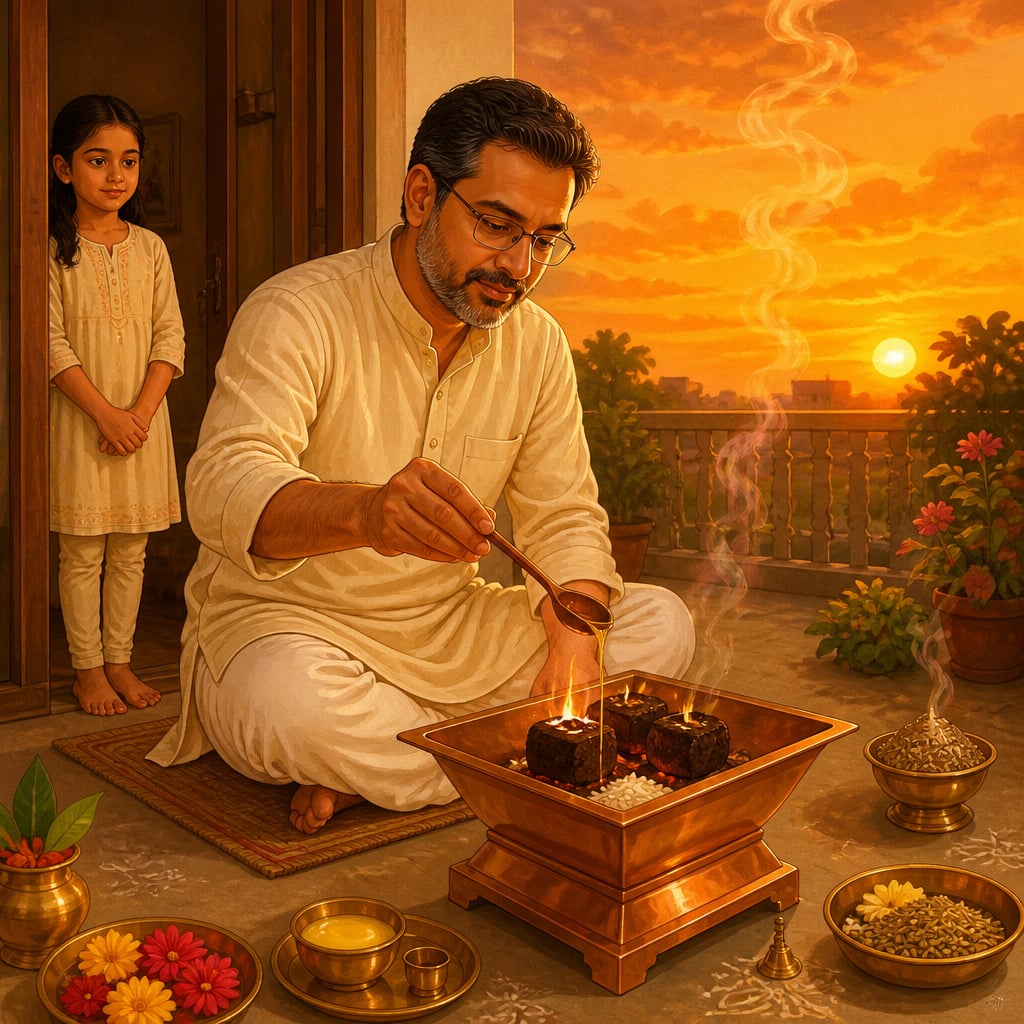
In a flat in Aundh, Pune, on a Wednesday evening in November, a forty seven year old man called Anand walks barefoot to the small balcony just before sunset. He carries a small copper kund, a pyramid-shaped vessel about the size of a large mango, and sets it on a stone slab. Inside the kund are three pieces of dried cow dung the size of his thumb, broken from a thicker uppla his mother sends him every quarter from the village near Wai. He places a small spoon, a copper achamani, beside the kund, and a brass tumbler holding a teaspoon of cow ghee.
His nine year old daughter is in the doorway, watching. She is not allowed to speak during the rite. She has been watching for two years.
Anand strikes a single match, holds it under a sliver of camphor placed at the centre of the dung pieces, and lights the fire. The dung catches with a soft crackle. He waits until the flame is steady. Then he sips water from the achamani three times, naming the deity with each sip. He looks at the western horizon, where the sun is just touching the line of the rooftops across the street. The instant the sun hits the horizon, he picks up the spoon, dips it in the ghee, and pours the ghee onto the fire while reciting a single half-line of Sanskrit.
अग्नये स्वाहा। अग्नय इदं न मम।
agnaye svāhā | agnaya idaṃ na mama
To Agni, svaha. This is for Agni, not for me.
The ghee hits the fire with a brief soft hiss. The flame leaps an inch. He pours a second offering, this time with a pinch of unbroken rice, and recites the same half-line for the deity Prajapati. Then he sits in silence as the fire burns down. Five minutes pass. The sun has set. He stands up, picks up the kund, and brings it back inside.
He has just performed Agnihotra, by the same instructions, with the same fuel, at the same timing, that the Atharva Veda specified twelve hundred years before the common era. The Greek mysteries are gone. The Egyptian temple cult is gone. The Roman state religion is gone. Anand's fire, in Aundh, on a Wednesday evening, is still burning.
The Practice, Across India
The Hindu fire is not one fire. It is three.
Agnihotra is the daily fire. It is performed at the exact seam of sunrise and sunset, when the sun's disc is touching the horizon. The fuel is specific: dried cow dung cakes, cow ghee, and unbroken rice. The vessel is a small pyramid-shaped copper kund. The mantras are the shortest in the Vedic corpus, two half-lines for sunset and two for sunrise. The complete rite takes approximately ten minutes. It is performed by householders across the Smarta, Brahmo, Arya Samaj, and traditional Vaidika lineages, with a continuous chain of practitioners from the late Vedic period to the present. The Maharashtra revival movement of Gajanan Maharaj of Akkalkot in the nineteenth century, and the international Homa Therapy movement of Vasant Paranjpe in the twentieth, have brought daily Agnihotra to households on every inhabited continent.

Havan (also called homa or yajna in older usage) is the larger fire, performed at festivals, weddings, sankalpas, and life-cycle samskaras. The kund is larger, often a square brass or earth pit with a sankalpa diagram drawn around it. The fuel adds samidha, sticks of specific woods (palasha, peepal, mango, sandalwood), and dravya, a herbal mixture of forty or more dried plants and resins. The mantras are longer, drawn from the Yajurveda and the relevant Sutra for the rite. A complete havan can run from forty minutes to several hours. The deity at the head varies: Ganapati for an opening, Agni for a Vedic rite, the kuladevata for a samskara, the Mrityunjaya form of Shiva for healing. Every Hindu wedding has a havan at its centre. Every Griha Pravesha has a havan at the threshold. Every Upanayana has a havan as the ground.
Dhoop and sambrani are the small daily fires of the home altar. Dhoop is dried herbal incense, often pressed into a stick or a cone. Sambrani is benzoin resin, burned on a small charcoal disc or, in the south, on a special clay holder warmed over a flame. The smoke is offered to the murti at the home altar at sunrise and sunset, at the start of cooking, after the bath, and after sweeping the house. The materials are humbler. The rite is shorter. The principle, fire and smoke as offering and as boundary, is the same.
The regional names track the same three fires. Agnihotra is universal. Yajna in classical Sanskrit, homa in Tamil, havan in the Hindi belt, homam in Andhra and Tamil Nadu. The fuel is samidha for the wood, dravya for the herbs, havya for the offered ghee. The Sanskrit holds across two thousand kilometres and three thousand years.
The Scripture Says
Agnihotra's earliest detailed description is in the Shatapatha Brahmana of the Yajurveda, with parallel descriptions in the Aitareya Brahmana of the Rigveda and the Atharva Veda in the Shaunaka recension. The Shatapatha Brahmana, in book two, prescribes the sunset and sunrise timing, the cow dung fuel, the cow ghee, the unbroken rice, and the mantra sequence. Twelve hundred years before the common era, a text in Sanskrit specified the same protocol that Anand is performing in Aundh on a Wednesday evening.
अग्निमीळे पुरोहितं यज्ञस्य देवमृत्विजम्। होतारं रत्नधातमम्॥
agnim īḷe purohitaṃ yajñasya devam ṛtvijam | hotāraṃ ratna-dhātamam
I praise Agni, the household priest, the deva of the yajna, the ritual officiant, the hotar, the granter of the most precious treasures.
Rigveda 1.1.1
This is the opening verse of the Rigveda. The first word the Hindu canon ever speaks is the name of the fire. Agni is named purohita, the one placed in front, before any other deity. The yajna, the fire rite, is the centre of the Vedic worldview. Every other ritual in the Hindu corpus is, in some sense, a downstream descendant of the yajna at the centre.
The havan's procedural code lives in the Grihya Sutras: the Apastamba, Bodhayana, and Ashvalayana Grihya Sutras for the household rite, and the Shrauta Sutras for the larger public rite. The Bhagavad Gita's chapter four, slokas twenty four through thirty three, contains the philosophical framing of the yajna as the model for all action: every act is a yajna, every consumption is an offering, every life is a fire fed.
The dhoop's seed verse is given in the Brahma Purana and recited at the moment of incense offering during home puja:
वनस्पतिरसोद्भूतो गन्धाढ्यो गन्ध उत्तमः। आघ्रेयः सर्वदेवानां धूपोऽयं प्रतिगृह्यताम्॥
vanaspati-rasodbhūto gandhāḍhyo gandha uttamaḥ | āghreyaḥ sarva-devānāṃ dhūpo'yaṃ pratigṛhyatām
Born of the sap of the forest, rich in fragrance, the highest of scents, fit to be inhaled by all the devas, this dhoop is offered, may it be received.
The Symbolism
The three fires together compose the Hindu day, the Hindu festival, and the Hindu altar.
| Fire | Cycle | Vessel | Fuel |
|---|---|---|---|
| Agnihotra | Twice daily | Small copper kund | Cow dung, cow ghee, unbroken rice |
| Havan | Festivals, samskaras | Brass or earth kund | Samidha wood, dravya herbs, ghee |
| Dhoop | Daily at home altar | Charcoal disc or clay holder | Dried herbs, benzoin, sandalwood |
The fire is not symbolic. The fire is the deity. Agni is the mukha, the mouth, of the devas. What is offered to the fire is delivered, in the Vedic reading, to the deity to whom the offering is named. The half-line "agnaye svaha, agnaya idam na mama" says the offering plainly: this is for Agni, not for me. The ego is reduced by the act. The household is fed by the same fire that feeds the deva.
The timing of Agnihotra is the secret. Sunset and sunrise are the sandhi, the seam, where the diurnal cycle is most thermodynamically active. The Vedic hypothesis is that an offering made at this exact instant has effects on the surrounding atmosphere that an offering made at any other time does not. The 2007 Nautiyal study, almost three thousand years later, would test this hypothesis directly.
The fuel is also not arbitrary. Cow dung is dry, slow-burning, and emits a thick aromatic smoke when combined with ghee. Cow ghee burns at a high temperature with minimal soot. The combination produces a sustained, hot, aromatic flame that disperses combustion products into the air over a wide radius. The Vedic sages chose, by trial and observation, the fuel combination that the laboratory would later classify as the most efficient combustion-aromatic system available from organic agricultural materials.
The havan's larger form, with samidha wood and dravya herbs, scales the same logic. The dhoop's smaller form, with charcoal and benzoin or sandalwood, miniaturises it for the home altar. Three fires. Three scales. One thermodynamic-aromatic-symbolic system.
Why the Body Responds
The habit architecture of the three fires is built on the densest possible cue stack.
Cue. The cue for Agnihotra is the sun itself, an unmissable event boundary that arrives every day without fail. The cue for havan is the festival or sankalpa on the calendar. The cue for dhoop is the daily puja schedule. All three cues are external, public, and impossible to forget. Wendy Wood at USC has shown that environmental cues anchor habits more durably than internal motivation. The Hindu fire is anchored on the most public cue available, the sun.
Routine. The routine is fixed. The kund, the spoon, the ghee, the dung, the rice, the mantras. Once the kit is laid out at home, the rite has nothing to decide. The decision was made by the Atharva Veda twelve hundred years before the common era.
Reward. Visual flame, olfactory smoke, somatic warmth, social and identity rewards stack. James Clear, in Atomic Habits, argues identity-based habits are the most durable. The Hindu Agnihotri is the identity-based habit at three thousand years of scale.
Embodied cognition. Lakoff and Johnson argue that physical movements shape conceptual categories. Pouring ghee into a fire while saying idam na mama, this is not for me, teaches the body that giving precedes keeping.
What the Labs Found

The most-cited peer-reviewed vindication of any Hindu ritual is the 2007 paper by Nautiyal and colleagues in the Journal of Ethnopharmacology, on havan smoke and airborne bacteria. The team performed a standard havan in a closed room, using the canonical fuel mixture of cow dung, cow ghee, and a forty-herb dravya blend. They measured airborne bacterial colony counts in the room before, immediately after, and at twenty four hours, seven days, and thirty days post-havan. The reduction at twenty four hours was ninety four percent. The reduction was maintained at thirty days. The havan, in functional terms, is a sustained-action atmospheric antimicrobial protocol.
A parallel study by Joshi and colleagues on Agnihotra ash demonstrated that the ash collected from a daily Agnihotra fire, when added to water, reduces coliform bacteria by over ninety percent within twenty four hours. The Hindu farming community in Maharashtra has used Agnihotra ash as a soil amendment for at least a hundred years. Replications by labs in Poland (Lukowski et al) and Slovakia (Heisig and colleagues) have confirmed the basic atmospheric finding. The protocol is consistent. The result is replicable.
The dhoop and sambrani have their own research record. Benzoin resin contains benzoic acid and vanillin, both with documented antimicrobial activity. Sandalwood contains alpha-santalol and beta-santalol, both with antimicrobial and anxiolytic effects documented in pharmacology journals. The home altar, with its small dhoop fire at sunrise and sunset, is, in the language of the lab, a passive aromatherapy and air-quality station.
What the World Calls It Now
Burning Man, the eighty thousand person festival held in the Nevada desert every September since 1986, runs an annual five hundred million dollar economy on a central ritual structure, the Temple Burn, that is, in its design, a havan at festival scale. A communal fire. The release of symbolic objects into the flame. A period of silence around the burn. Tickets sell for five hundred and seventy five United States dollars and up. The festival's official documentation traces its inspiration to neo-pagan and Native American ceremony. The Hindu havan, with three thousand years of unbroken practice and a peer-reviewed antimicrobial mechanism, is not in the citation list.
Sound bath and smoke cleansing retreats charge between two hundred and two thousand United States dollars per session for what is, in form, a havan miniaturised for a wellness studio. White sage, Palo Santo, and frankincense have replaced cow dung, ghee, and dravya. The same atmospheric effect is sold under a Native American or Mediterranean vocabulary. The Hindu havan, free at any temple, is rarely named.
Homa Therapy has carried the Agnihotra outward in its full Vedic form. Vasant Paranjpe took the daily Agnihotra from Maharashtra to Germany, Brazil, the United States, Australia, and Poland from the nineteen sixties onward. Today there are Homa Therapy farms in over seventy countries, all running the Atharva Veda's twelve-hundred-BCE protocol on the same evening.
What to Call It Yourself
From this lesson onward, when a wellness studio sells a smoke cleansing session, call it havan. When a festival burns a wooden temple, name the older protocol. When an aromatherapy boutique sells a sandalwood diffuser, use the older words. Agnihotra. Havan. Dhoop. Three fires, three scales, one Atharva Veda.
Modern Echoes
Nautiyal and colleagues at Defence Research and Development Establishment, Joshi and colleagues at the Indian Council of Agricultural Research, Lukowski in Poland, Heisig in Slovakia. Four laboratories on three continents documenting what Anand is doing on his Aundh balcony at sunset. The Atharva Veda named the fuel and the timing in the late Vedic period. The Shatapatha Brahmana wrote the procedure. The Rigveda opened with Agni's name. Vasant Paranjpe carried the Agnihotra to seventy countries. Burning Man rediscovered the form and charged five hundred and seventy five dollars a ticket. The cow dung in Anand's kund came from the village near Wai for three hundred rupees a quarter.
Back on the balcony in Aundh, the kund has cooled. Anand wraps it in a cotton cloth and brings it inside. His daughter, who has been watching for two years, asks her first question. She wants to know what the half-line means. He sits down with her on the floor and explains: this is for Agni, not for me. Tomorrow at sunrise, she will pour her first offering.
Key figures
Madhuchhandas Vaishvamitra
late Vedic period, c. 1500 to 1200 BCE
Vasant Paranjpe
1924 to 2008
Chandra Shekhar Nautiyal
born 1958
Case studies
Agnihotra in the Atharva Veda Shaunaka Recension
The Atharva Veda Shaunaka recension, dated by linguistic and astronomical evidence to roughly the twelfth century BCE, specifies the Agnihotra protocol in full: the sunset and sunrise timing keyed to the moment the sun's disc touches the horizon, the cow dung fuel dried into uppla cakes, the cow ghee from a cow on natural pasture, the unbroken white rice, and the half-line mantra sequence. Twenty first century practitioners in Maharashtra, in the lineage of Gajanan Maharaj of Akkalkot, perform the same timing-specific protocol from the same text, with no measurable change in fuel, vessel, or mantra.
The Atharva Veda is not folklore. It is a procedural manual. The fuel mixture, the vessel shape, the timing window, and the mantra sequence were specified by the Vedic rishis on the basis of millennia of accumulated observation. The protocol was tight enough to survive thirty two hundred years of transmission across the Indian subcontinent and to be exported to seventy countries in the twentieth century, with the same instructions intact.
Agnihotra is, by lineage documentation, the most continuously performed ritual on earth. The same instructions that Anand follows on his Aundh balcony in 2025 are the instructions that a householder in the late Vedic period followed in the Sapta Sindhu region in the twelfth century BCE.
The most continuously documented ritual in this course. Three thousand two hundred years of the same instructions.
The Hindu in Aundh and the Hindu in Bhrugu Aranya in Poland are running the same protocol on the same evening, twelve hundred years after the protocol was first written down.
Atharva Veda Shaunaka recension, c. 1200 BCE; Shatapatha Brahmana of the Yajurveda; Maharashtra revival of Gajanan Maharaj of Akkalkot, 19th century; Homa Therapy movement of Vasant Paranjpe, 20th century, in 70+ countries today.
Burning Man's Five Hundred Million Dollar Havan
Burning Man, the festival held in the Black Rock Desert of Nevada every September since 1986, attracts over eighty thousand annual attendees and runs an estimated five hundred million dollar economy. The festival's central rite is the Temple Burn, a communal fire into which participants release symbolic objects, observe a period of silence, and report transformative and cathartic effects. Tickets retail at five hundred and seventy five United States dollars and up. The festival's official documentation traces its inspiration to neo-pagan and Native American ceremony. The Hindu havan is not in the citation list.
The havan, by the Grihya Sutras and the Yajurveda, is precisely a communal fire into which symbolic objects are released, a period of silence is observed, and a transformative effect is sought. The havan has three thousand years of unbroken practice and a peer-reviewed antimicrobial mechanism. The form Burning Man rediscovered is the Hindu form, miniaturised in many Hindu homes every evening for free.
Burning Man continues to grow. Attendance and ticket prices both rise year on year. The havan continues to be performed at every Hindu wedding, every Griha Pravesha, every Upanayana, every festival, in temples and homes across the world, at no charge.
An eighty thousand person festival rediscovered havan and charged five hundred and seventy five dollars a ticket. The havan is free at any Hindu temple.
The next time a wellness influencer recommends a Burning Man Temple Burn for transformation, the older protocol is the havan at the local Ganesha temple, with the same form and three thousand years more lineage.
Burning Man, founded 1986, Black Rock Desert, Nevada; 80,000+ annual attendees; $500M+ annual economy; Temple Burn ticket price $575+ per person.
The Nautiyal Paper: Ninety Four Percent in Twenty Four Hours
Nautiyal and colleagues, writing in the Journal of Ethnopharmacology in 2007, performed a standard havan in a closed room using the canonical fuel mixture of cow dung, cow ghee, and a forty-herb dravya blend. They measured airborne bacterial colony counts before, immediately after, and at twenty four hours, seven days, and thirty days. The reduction at twenty four hours was ninety four percent. The reduction was maintained at thirty days. Replications by Lukowski in Poland and Heisig in Slovakia confirmed the basic finding. A parallel study by Joshi and colleagues showed that Agnihotra ash, when added to water, reduces coliform bacteria by over ninety percent within twenty four hours.
The Atharva Veda specified the fuel and the timing without explaining the antimicrobial mechanism. The Vedic frame was that the fire is the mukha of the devas and the offering travels through it to its named recipient. The atmospheric purification is the side effect of the offering, not the point. The lab work has now described the side effect in microbial colony counts.
The Nautiyal paper is, by citation count, the most-cited peer-reviewed vindication of any Hindu ritual in the academic literature. It is the foundation citation for ongoing replications in agriculture, hospital air quality, and post-disaster sanitation.
The most-cited peer-reviewed vindication of a Hindu ritual in the academic literature.
Every Hindu home that performs a daily havan or Agnihotra is running, in atmospheric terms, a peer-reviewed antimicrobial protocol with thirty days of measurable effect on airborne bacterial counts.
Nautiyal CS, Chauhan PS, Nene YL, Journal of Ethnopharmacology, 2007, on medicinal smoke reduction of airborne bacteria; Joshi et al on Agnihotra ash water purification; Lukowski et al, Slovak and Polish replications.
Historical context
From the late Vedic period (c. 1500 to 1200 BCE) through the Brahmana texts (c. 1000 to 800 BCE) and the Sutra period (c. 600 to 300 BCE) to the present global revival
Living traditions
Use the original names. Agnihotra for the daily fire. Havan or homa for the larger fire. Dhoop for the home altar smoke. Sambrani for the benzoin resin. The Burning Man Temple Burn and the wellness studio smoke cleansing are selling fragments. The Hindu home and temple are running the whole protocol, free, for three thousand years.
- Akkalkot, Solapur district, Maharashtra: The samadhi of Gajanan Maharaj of Akkalkot, the nineteenth century saint whose lineage carried the daily Agnihotra into the modern revival. Devotees still perform Agnihotra at the samadhi at sunrise and sunset, in continuous practice for over a hundred and fifty years.
- Bhrugu Aranya, Mazury, Poland: The European headquarters of the Homa Therapy movement founded by Vasant Paranjpe. A working Agnihotra farm in northern Poland, where daily Agnihotra has been performed at sunrise and sunset for over forty years, in unbroken extension of the Maharashtra lineage to European soil.
- Kashi Vishwanath Temple, Varanasi: The havan and aarti at Kashi Vishwanath are among the most continuously performed temple fire rituals in India. The Mangala Aarti at four AM, the Bhog Aarti, the Sandhya Aarti, and the Shringar Aarti carry the havan and dhoop offerings in unbroken practice across centuries of foreign invasion and temple destruction.
Reflection
- Have you witnessed an Agnihotra or havan? What did your body do, on its own, while the fire was burning? Was there an effect that did not need to be argued for?
- Why might a civilisation choose to begin its oldest scripture, the Rigveda, with the name of the fire, rather than the name of a more obvious deity like Indra or Surya? What does this tell you about how the Vedic mind read the cosmos?
- If a Burning Man attendee paid five hundred and seventy five dollars for a Temple Burn and a Hindu householder performed the same form of fire ritual at home for the cost of three hundred rupees of cow dung, what has each one received and what has each one missed?