Samskriti Dharma: Cultural Transmission
Passing On What Matters
Beyond modeling daily behavior, there is a deeper teaching duty: passing on the culture itself. Languages, rituals, stories, recipes, practices - these are the inheritance that money cannot buy. This lesson explores the Vyasa-Shuka parampara of knowledge transmission, what happens when cultural chains break, and how to keep the living tradition alive for future generations.
The Grandmother Who Became a Stranger
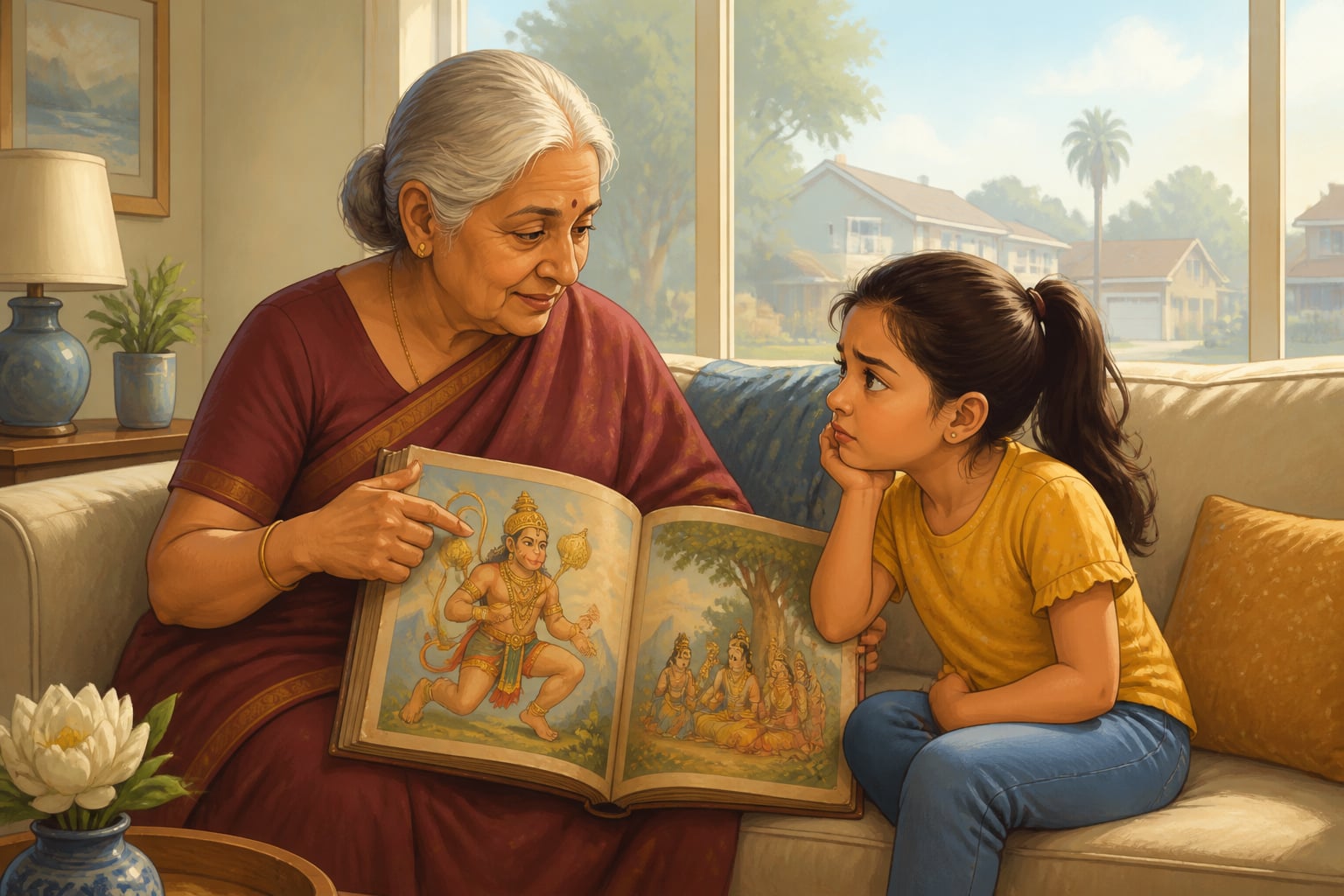
Scene 1: Chennai to California
Padmini Paati had waited three years for this moment. Her granddaughter Ananya, born in California, was visiting India for the first time. Nine years old, bright-eyed, curious about everything.
Padmini had prepared for months. She'd collected stories, planned temple visits, bought silk pavadais. She imagined conversations stretching into the night - the same way she'd talked with her own grandmother decades ago.
The first evening, she tried to share a story from the Ramayana - how Hanuman lifted the mountain to save Lakshmana.
"Paati, what's a Hanuman?" Ananya asked.
Padmini explained - the monkey god, devoted to Rama, capable of incredible feats.
"But monkeys can't talk. That's not real," Ananya said, returning to her iPad.
Padmini tried Tamil. The words her mother sang to her, that her grandmother sang to her mother - lullabies passed down through centuries.
"What language is that?" Ananya asked. "Can you say it in English?"
Padmini realized: her granddaughter didn't speak Tamil. Couldn't read the kolam at the entrance. Didn't know why they removed shoes before entering the puja room. The silk pavadai hung unworn - "It's scratchy, Paati."
For two weeks, Padmini and Ananya lived in the same house, speaking different languages - not just Tamil and English, but different cultural vocabularies. When Ananya left for California, Padmini wept. Not from missing her - from losing her. The chain that stretched back generations had been broken.
Scene 2: Varanasi - The Gharana That Ended
Pandit Rameshwar Pathak came from seven generations of dhrupad singers. His father taught him. His grandfather taught his father. Back and back, an unbroken chain of raga and tala, stretching centuries.
Rameshwar had one son, Vikrant, talented and trained. But Vikrant wanted to be an engineer. "Papa, I can't make a living from this. I'll support you, but I can't carry it forward."
Rameshwar understood. Music didn't pay. He didn't force. He accepted.
Vikrant became successful - IIT, then Silicon Valley. He sent money regularly, visited when he could. He was a good son.
When Rameshwar died at 78, the gharana died with him. Seven generations of oral tradition, the subtle variations that no recording could capture, the way his teacher had placed his hand on his shoulder to correct his breathing - gone.
Vikrant played a recording of his father's singing at the funeral. It was beautiful. But it was a fossil, not a living thing.
What Dies When Tradition Dies?
It's not just nostalgia. Something real is lost.
When a language dies, we don't just lose words. We lose:
- Concepts that have no translation
- Ways of seeing the world encoded in grammar
- Proverbs that carry centuries of wisdom
- The ability for grandchildren to understand their ancestors' writings
When a musical tradition dies:
- The living transmission - the breath control, the microtonal adjustments - dies with the last practitioner
- Recordings capture sound but not the embodied knowledge
- The connection to a lineage of seekers disappears
When family rituals die:
- Children lose the rhythm of sacred time
- The markers that made seasons meaningful disappear
- The sense of being part of something larger fades
When recipes die:
- Not just food, but the chemistry of regional health
- The knowledge of which spices help which ailments
- The physical memory of watching grandmother's hands
संस्कृति (Samskriti) literally means "that which has been refined over time."
Centuries of trial and error, of accumulated wisdom, of slow perfection. When we let it die in one generation, we lose what took hundreds of generations to create.
What the Scriptures Say
The Parampara Principle
एवं परम्पराप्राप्तमिमं राजर्षयो विदुः Evaṁ paramparāprāptam imaṁ rājarṣayo viduḥ "Thus received through succession, the royal sages knew this." , Bhagavad Gita 4.2
Krishna explains to Arjuna that knowledge isn't invented fresh each generation - it's received, refined, and passed on. The parampara (succession) is how wisdom survives time.
The Oral Tradition
श्रुति स्मृति पुराणानां विरोधो यत्र दृश्यते। तत्र श्रौतं प्रमाणं तु तयोर्द्वैधे स्मृतिर्वरा॥ Śruti smṛti purāṇānāṁ virodho yatra dṛśyate "Where contradiction appears between heard and remembered..." , Traditional hierarchy of knowledge
The tradition distinguishes between shruti (what is heard directly from teacher) and smriti (what is remembered/written). Shruti has primacy because living transmission carries what text cannot.
The Sound Carries Meaning
ॐ इति ब्रह्म। ॐ इतीदं सर्वम्। Oṁ iti brahma. Oṁ itīdaṁ sarvam. "Om is Brahman. Om is all this." , Taittiriya Upanishad 1.8
The Upanishads insist that the sound itself carries meaning - not just the semantic content. When we lose the living pronunciation, we lose something of the meaning itself.
The Clear Position
YOU ARE THE LINK. THE CHAIN PASSES THROUGH YOU - OR BREAKS WITH YOU.
This isn't about museum-piece preservation or rigid conservatism. Cultures evolve. Languages change. Traditions adapt.
But there's a difference between:
- Evolution: The tradition changes while remaining alive and connected
- Death: The tradition is simply dropped, forgotten, not transmitted
Evolution happens when each generation receives, internalizes, and then contributes their own understanding before passing it on.
Death happens when a generation simply doesn't transmit - whether from neglect, embarrassment, or the belief that "the children won't be interested."
Every chain is broken by someone. Make sure it's not you.
Dharmic Guidelines
✅ DO
| Action | Why It Matters |
|---|---|
| Speak your mother tongue at home, even if children respond in English | Language carries culture; bilingual children have cognitive advantages |
| Teach family stories and traditions, even in simplified forms | Something transmitted imperfectly is better than nothing transmitted at all |
| Learn from elders while they're alive - record their stories, recipes, practices | Once they're gone, the knowledge is gone forever |
| Celebrate festivals with meaning, not just ritual | Explain the "why" so children understand, not just perform |
| Connect children to extended family and ancestral places | Roots provide stability; knowing your history creates identity |
| Adapt traditions for modern life rather than abandoning them | A shorter puja is better than no puja |
❌ DON'T
| Action | The Karma You Create |
|---|---|
| Speak only English at home because "children need it for success" | You create fluent English speakers who are strangers to their heritage |
| Skip festivals because "we're too busy" or "children don't care" | Children learn what you prioritize; you're teaching them festivals don't matter |
| Let grandparents die without recording their stories and knowledge | You can't retrieve what you never collected |
| Feel embarrassed by "traditional" practices in front of modern peers | Your embarrassment teaches children that heritage is shameful |
| Assume children will "find their roots later if they want" | They won't. The seed has to be planted. |
| Treat culture as a burden rather than an inheritance | Your attitude transmits more than your content |
The Karma Angle
What you don't pass on, dies with you.
Padmini Paati will die someday. When she does, her Tamil lullabies - the same ones her grandmother sang, and her grandmother's grandmother before that - will die with her. Ananya won't be able to sing them to her children because she never learned them.
This is not Padmini's fault alone. Ananya's parents made choices: to speak only English at home, to skip visits to India, to treat Tamil as "grandma's language" rather than "our language." Each choice seemed small. Together, they severed a chain that had held for centuries.
The accumulated wisdom of your ancestors exists in you - but only if you choose to carry it.
Your great-great-grandparents knew things. How to read the sky for weather. Which herbs treated which ailments. Stories that encoded moral wisdom. Songs that soothed sorrows. This knowledge passed through generations, distilled and refined, until it reached your parents.
Did it reach you? Will it reach your children?
You're not just deciding for yourself. You're deciding for all who come after.
Lessons by Age
For Children (8-12 years)
You're like a bridge between your grandparents and your future children.
Imagine you know a really cool secret - a story, a song, a special way of making something. If you don't tell anyone, that secret disappears when you're gone. But if you share it with your kids someday, and they share it with their kids, the secret lives for hundreds of years!
Your grandparents know amazing things - stories, recipes, songs, words in languages you might not speak fluently. These are treasures more valuable than money because once they're gone, no amount of money can bring them back.
Ask questions while you can. Learn while they're here.
For Teenagers (13-17 years)
You might feel like your traditions are "uncool" or "old-fashioned."
That's normal. Every generation feels that way for a while.
But here's what nobody tells you: the "cool" stuff changes every few years. The traditions that seem old-fashioned have survived centuries precisely because they contain something valuable.
You don't have to practice everything exactly as your grandparents did. But you should:
- Learn it properly first
- Understand why it exists
- Then decide how to adapt it for your life
Rejecting without understanding is ignorance. Understanding and then adapting is wisdom.
The irony: By the time you're 30, you'll probably wish you'd learned more. Don't wait.
For Adults (18+ years)
You are now the transmission link. The responsibility is yours.
If your children don't learn your mother tongue, it's because you didn't speak it at home. If they don't know family stories, it's because you didn't tell them. If they can't cook a single traditional dish, it's because you didn't teach them.
Yes, life is busy. Yes, children resist. Yes, it's easier to let them watch screens.
But this is the work that only you can do. Schools teach subjects. Culture is taught at home.
The window closes. Parents age, grandparents die. What you don't capture now may be lost forever.
Start a recording project. Write down recipes. Ask questions. Create opportunities for transmission.
Case Studies
Case Study 1: The Lost Language
Modern Scenario:
The Menon Family immigrated to Toronto in 1985. First-generation parents Raghavan and Lakshmi spoke Malayalam at home, but wanted their children to succeed in English-speaking Canada.
"We shouldn't confuse them with two languages," Raghavan decided. "English only."
Their children, Arun and Deepa, grew up fluent in English, comfortable in Canadian culture. They visited Kerala occasionally - awkward visits where they couldn't understand their cousins or grandparents beyond basic greetings.
Thirty years later, Lakshmi has dementia. She's forgotten her English, reverting to Malayalam - the language of her childhood, her deep memories. She calls out for her mother, sings old songs, tells stories.
Arun and Deepa sit by her bedside, unable to understand a word their mother says. She reaches for them, speaking urgently, and they have no idea what she's trying to communicate.
"We should have learned," Deepa weeps. "She's right here, and we can't understand her."
The Dharmic Lens:
नाम वा ऋग्वेदो यजुर्वेदः सामवेदः "Name indeed is Rigveda, Yajurveda, Samaveda..." , Chandogya Upanishad 7.1.1
The Upanishads begin with the primacy of language - specifically, named knowledge that has been transmitted orally. When Lakshmi's Malayalam goes unheard, her entire mental universe becomes inaccessible to her own children.
The Transformation:
Deep in grief, Arun made a decision. He enrolled his children in Malayalam classes, hired a tutor, started watching Malayalam films with them. It was hard - his children resisted, his pronunciation was embarrassing.
But slowly, words returned. His daughter learned enough to understand Lakshmi's songs. His son recorded the stories, even imperfectly understood.
When Lakshmi passed, they could sing to her in her language. It wasn't full fluency - but it was connection.
Case Study 2: The Broken Gharana
Historical/Modern Scenario:
The Dagar family of dhrupad singers traces their lineage to Swami Haridas, guru of Tansen, in the 16th century. For 400+ years, the tradition passed from father to son, uncle to nephew, in an unbroken chain.
In the 20th century, the family faced a crisis. Modern India offered little patronage for dhrupad. Sons needed careers. Some studied engineering, medicine, business. The number of family members who could carry the tradition shrank.
The senior Dagars made a radical decision: they would teach outside the family. For the first time in centuries, non-Dagars would learn the gharana's secrets. It was a controversial choice - some said it diluted the tradition. Others said it saved it.
The Dharmic Lens:
The Dagar family embodied the Vyasa-Shuka parampara principle - but they also adapted it. Vyasa didn't just teach his son Shuka; he taught many disciples. The criterion wasn't blood but dedication.
परम्परायाः विच्छेदे संस्कृतेः नाशः "When parampara breaks, culture is destroyed."
The Dagars chose cultural survival over family exclusivity. They kept the tradition alive by widening who could carry it.
The Outcome:
Today, dhrupad is experiencing a revival. Students from Japan, Germany, America learn from Dagar masters. The gharana survives - not through blood, but through commitment to transmission.
The lesson: when biological lineage fails, spiritual lineage can continue. The chain doesn't have to be genetic to be real.
Case Study 3: The Recipe Book That Was Never Written
Modern Scenario:
Saraswathi Amma was legendary in her Kerala village for her pickles. Her mango pickle, her lime pickle, her prawn pickle - people came from neighboring villages to buy them for special occasions.
Her daughter Parvathy moved to Bangalore after marriage. "I'll learn the recipes later, Amma. I'm busy now."
Her granddaughter Meena visited occasionally. "Ammamma, your pickle is amazing! You should write down the recipe."
"What's to write?" Saraswathi would say. "A little of this, a little of that. You have to feel it."
Meena always meant to sit with her grandmother, to watch carefully, to record the process. But there was always something - exams, then work, then children.
Saraswathi died at 84. At her funeral, everyone talked about her pickles. "That taste - we'll never have it again."
Meena searched the house for written recipes. There were none. Saraswathi's knowledge was in her hands, her nose, her tongue - and all of that was gone.
Meena tried to recreate the recipes from memory. "A little of this, a little of that." But the proportions were wrong. The fermentation time was guesswork. The pickle was edible, but it wasn't Ammamma's pickle.
The Dharmic Lens:
The Manusmriti describes food preparation as a form of yajna - sacred offering. Traditional recipes encoded not just taste but health principles, regional wisdom, seasonal knowledge. When Saraswathi's recipes died, generations of culinary-medical wisdom died with them.
The Transformation:
Meena couldn't bring back Ammamma's exact recipes. But she started a different project: recording everyone else's.
She visited aunts, great-aunts, elderly neighbors. "Teach me your special dish. Let me video you making it." She created a YouTube channel: "Grandmothers' Kitchen."
Some recipes she captured just in time - the cook died within months. Each video preserves not just ingredients but the hands, the confidence, the stories told while cooking.
"I lost Ammamma's pickles," Meena says. "But maybe I can help others not lose their treasures."
Case Study 4: The Forgotten Rituals
Modern Scenario:
The Sharma family of Jaipur had observed certain rituals for generations: a specific form of morning puja, a particular way of celebrating Diwali, monthly observances that marked the lunar calendar.
Prakash Sharma, educated in Delhi and working in tech in Bangalore, found these rituals "outdated." His wife Nandini agreed - "We're spiritual, not religious."
They raised their children Arjun and Aditi without regular rituals. Diwali was about sweets and lights, not the puja. No one woke early for Sandhya Vandana. Festivals were holidays, not holy days.
The children grew up successful - good grades, good colleges, good jobs. But both struggled with anxiety. Both felt, in their words, "ungrounded." Aditi, at 25, went through a spiritual crisis: "I don't know who I am or where I came from."
She started exploring - yoga retreats, meditation apps, Buddhism books. Helpful, but something was missing.
On a visit to Jaipur, she found her grandfather's old puja items in a trunk. "Dadaji, what are these? What did you used to do?"
Her grandfather, 85, spent hours explaining. The rhythm of daily practice. The meaning behind each gesture. Why certain days mattered. How the rituals connected them to ancestors going back centuries.
"Why didn't Papa teach us any of this?" Aditi asked.
"He thought it was old-fashioned," Dadaji said quietly. "He wanted you to be modern."
The Dharmic Lens:
Rituals aren't superstition - they're technology for psychological and spiritual grounding. The morning puja creates a container for the day. Festival observances mark time in meaningful ways. Without these structures, the mind lacks anchors.
The Transformation:
Aditi began learning from her grandfather, racing against time. She started a simplified morning practice - not the full traditional ritual, but adapted for her life. She observes major festivals with intention.
Her anxiety hasn't disappeared, but it has context now. She knows where she comes from. She has a daily practice that connects her to something larger than her individual concerns.
"I had to go find what my parents threw away," she says. "My children won't have to search. I'll give it to them."
Applied Wisdom
Wisdom 1: The Vyasa-Shuka Parampara
Ancient Source:
Vyasa compiled the Vedas, wrote the Mahabharata, composed the Puranas. He is called "Veda Vyasa" - the one who organized the Vedas. But his greatest act of transmission was personal: teaching his son Shuka.
Shuka was an unusual student - born enlightened, he had no interest in worldly knowledge. Yet Vyasa insisted on the transmission. And it was Shuka who later taught the Bhagavata Purana to King Parikshit in the seven days before the king's death.

Explanation: Vyasa understood that knowledge must be embodied in a person to survive. Books can be lost, burned, forgotten. But a person who has internalized the teaching can recreate it, adapt it, pass it on.
Modern Application: Don't just give children books or recordings. Sit with them. Teach them directly. Let them see your hands move, hear your voice, feel your presence. That embodied transmission carries what no recording can.
Wisdom 2: Shruti Over Smriti
Ancient Source:
Indian tradition distinguishes between Shruti ("that which is heard" - direct oral transmission) and Smriti ("that which is remembered" - texts and writings). Shruti has higher authority because it carries the teacher's presence, not just their words.
Explanation: When a guru teaches, they transmit more than content. They show how to hold the text, when to pause, which words to emphasize. They answer questions, correct misunderstandings, model the life that the teaching produces. Written text is necessary but insufficient.
Modern Application: Recordings, books, and videos are valuable for preservation but cannot replace living transmission. If you want your children to carry the tradition, you must BE their teacher - not just point them toward resources.
Wisdom 3: The Adapted Tradition Lives
Ancient Source:
The Vedas themselves show evolution. The Rig Veda was composed over centuries, with newer hymns added alongside older ones. The Upanishads reinterpreted Vedic ritual in philosophical terms. The Bhagavad Gita synthesized multiple streams. Tradition was never static.
Explanation: "Traditional" doesn't mean frozen. It means connected to tradition while remaining alive. A living tradition adapts to new circumstances while maintaining its essential core.
Modern Application: You don't have to practice exactly as your grandparents did. A 10-minute morning practice is better than abandoning practice entirely. Speaking Tamil at home even if children respond in English maintains the sound-world. Celebrating Diwali simply but meaningfully beats elaborate rituals performed without understanding.
Living Traditions
Sites
| Name | Location | Connection |
|---|---|---|
| Varanasi Sangeet Gharanas | Varanasi, UP | Families that have transmitted musical knowledge for centuries, father to son, adapting to survive in the modern world |
| Tanjore Temple Families | Tanjore, Tamil Nadu | Hereditary temple performers whose devadasi tradition transformed into Bharatanatyam, keeping the art alive in new form |
| Nambudiri Veda Pathashalas | Kerala | Schools where Vedic chanting is taught exactly as it was millennia ago, maintaining the oral tradition |
| Pattachitra Villages | Odisha | Communities where scroll-painting tradition passes from parents to children, adapting subjects while keeping techniques |
Festivals & Practices
| Name | Timing | Connection |
|---|---|---|
| Guru Purnima | Full moon of Ashadha (July) | The day dedicated to honoring teachers and the transmission lineage |
| Pitru Paksha | Fortnight before Navratri | Fifteen days of honoring ancestors - acknowledging what we've received from those before us |
| Regional Harvest Festivals | Varies by region | Pongal, Onam, Lohri, Bihu - each carrying regional identity and agricultural wisdom |
Living Practices
| Practice | Description | Connection |
|---|---|---|
| Guru-Shishya Parampara | Direct teacher-student transmission in classical arts | The model for how all cultural knowledge should pass - person to person, embodied |
| Family Recipe Traditions | Heirloom dishes passed through generations | Each family's recipes encode regional knowledge, health wisdom, and taste preferences |
| Language Maintenance at Home | Speaking mother tongue at home regardless of external language | The most basic and most important cultural transmission |
Try This

Practice 1: The Elder Interview Project
Duration: One month to start, then ongoing
Description: Choose an elder in your family - parent, grandparent, great-aunt/uncle. Commit to a series of recorded conversations. Ask about:
- Their childhood - what daily life was like
- Family stories they were told
- Traditions they practiced
- Skills they learned
- What they want remembered
Record video if possible - faces and hands carry information too. Store recordings safely, make backups.
Purpose: Every elder who dies takes libraries with them. This project captures what can be captured while they're alive.
Practice 2: The Transmission Audit
Duration: One week of reflection
Description: Make four lists:
- Received: What did you learn from your parents/grandparents? (Languages, stories, skills, practices)
- Transmitting: What are you actively passing to the next generation?
- Lost: What do you wish you'd learned but didn't?
- At Risk: What do you know that might die with you if you don't transmit?
For category 4, make a plan. What can you teach this month?
Purpose: Awareness of what's flowing through you and what's stagnating.
Practice 3: The Recipe Capture
Duration: Ongoing, start with one recipe this week
Description: Ask a family elder to teach you one of their special dishes. But don't just cook together:
- Video the entire process
- Have them narrate - not just ingredients but WHY (health reasons, traditional significance)
- Record their hands, their judgment calls ("a little more oil when it looks like this")
- Write down the recipe AND the stories they tell while cooking
Purpose: Recipes are never just ingredients. Capturing the whole context preserves more than food - it preserves relationship, story, and wisdom.
Practice 4: The Language Hour
Duration: Ongoing, one hour daily or weekly
Description: If your children don't speak your mother tongue fluently, designate one hour per day (or week) as "mother tongue hour." During this time, all conversation happens in the heritage language. Start simple:
- Games in the language
- Stories and songs
- Conversation about daily things
Expect resistance. Persist anyway.
Purpose: Language is the carrier of culture. Children who speak the language can access the culture directly; those who don't remain permanent outsiders to their own heritage.
Fun Facts
| Fact | Category | Emoji |
|---|---|---|
| The Vedas were preserved entirely through oral transmission for over 3,000 years before being written down. The accuracy of this transmission has been verified through comparison of manuscripts across India - they're virtually identical. | History | 📜 |
| Bilingual children don't get "confused" - they develop stronger cognitive abilities, including better problem-solving and multitasking skills. The "English only" approach backfires even by its own logic. | Science | 🧠 |
| The oldest continuously performed dance form in the world is Kutiyattam from Kerala - it has been performed without break for at least 2,000 years, transmitted through hereditary families. | Culture | 💃 |
| Researchers studying traditional recipes have found that regional food combinations (like combining turmeric with black pepper) have scientific basis - the compounds enhance each other's absorption. Grandmothers' wisdom often precedes modern nutrition science. | Science | 🍲 |
The Final Word
"एक पीढ़ी सीखती नहीं तो सदियों का ज्ञान खो जाता है।" "If one generation doesn't learn, centuries of knowledge are lost."
You are not an isolated individual. You are a link in a chain stretching back thousands of years and forward into the future.
Behind you: ancestors who survived famines, wars, migrations. Who preserved knowledge through dark times. Who passed down languages, stories, practices, recipes, songs. Who made sure you exist and have something to inherit.
Ahead of you: descendants who will look back asking: "What did they preserve for us? What did they let die?"
You are the link between them. The chain passes through your hands.
Some things will inevitably change - that's evolution, that's life. But there's a difference between evolution and extinction. Between adapting and abandoning. Between simplifying and severing.
What will you transmit?
Your mother tongue, even if imperfectly spoken? Your family stories, even in summary form? Your traditional practices, even adapted for modern life? Your recipes, even just a few? Your connection to something larger than yourself?
The choice is yours. But it's not just about you.
Every ancestor who kept the chain alive did so hoping someone would carry it forward.
Be that someone.
Recordings and books are valuable for preservation but cannot replace living transmission. If you want children to carry tradition, you must BE their teacher - not just point them toward recordings. The YouTube video of grandmother cooking is valuable, but watching her hands in person is irreplaceable.
You don't have to choose between rigid preservation and complete abandonment. A simplified morning practice beats no practice. Speaking mother tongue at home even if imperfect maintains the sound-world. Celebrating festivals meaningfully but simply keeps the tradition alive. Adapt the form; preserve the essence.
Case studies
The Language That Became Silence
The Menon family's story: first-generation immigrants speaking Malayalam at home, deciding to switch to 'English only' for their children's success, and thirty years later, sitting by their mother's deathbed unable to understand her final words in the language of her childhood and memory.
The Chandogya Upanishad begins with 'नाम वा ऋग्वेदो' - language is the carrier of all knowledge. When Lakshmi reverted to Malayalam in dementia, she was returning to her deepest self - and her children couldn't follow her there.
Arun began teaching his own children Malayalam, racing against time. Imperfect transmission is better than none. His daughter learned enough to understand her grandmother's songs before she passed.
The 'English only' approach fails even by its own logic - bilingual children have cognitive advantages. But more importantly, it severs children from their deepest heritage. The window for language learning closes; by adulthood, it's much harder.
Heritage language loss accelerates with each generation of diaspora Indians and urbanizing families. Research shows bilingual children have stronger cognitive flexibility and cultural identity. Apps, weekend schools, and family language policies offer practical tools, but the window closes quickly. Children who lose their mother tongue by age 10 rarely recover fluency.
UNESCO reports that a language dies every two weeks. India alone has lost 220 languages since 1961, according to the People's Linguistic Survey of India. Of India's 780 living languages, 197 are classified as endangered.
The Vyasa-Shuka Chain: When Father Teaches Son
Vyasa compiled the Vedas, wrote the Mahabharata, composed the Puranas - arguably the most important literary figure in Indian civilization. He had one son, Shuka, born enlightened and uninterested in worldly matters. Vyasa could have let Shuka go his own way. But he insisted on transmission. He taught Shuka everything - not just texts, but the lived understanding behind them. Shuka later taught King Parikshit the Bhagavata Purana in seven days. The knowledge Vyasa preserved reached the king who would spread it to the world.
Krishna tells Arjuna: 'एवं परम्पराप्राप्तम' - thus received through succession. Vyasa understood that knowledge preserved only in text is fragile. Knowledge embodied in a dedicated practitioner can regenerate even if texts are lost.
The Bhagavata Purana became one of the most influential texts in Hindu devotional tradition. Shuka's teaching of Parikshit created a chain that continues today - millions still learn from what Vyasa transmitted to his son.
Personal transmission from teacher to student creates what texts alone cannot: living knowledge that can answer questions, adapt to circumstances, and regenerate across contexts. Vyasa's books survive, but it was his son who ensured the teaching remained alive.
In the age of YouTube tutorials and online courses, self-directed learning is booming. Yet research on skill acquisition consistently shows that direct mentorship produces deeper mastery than self-study alone. The guru-shishya model finds its modern parallel in apprenticeships, coaching relationships, and master classes that transmit tacit knowledge no textbook captures.
The Bhagavata Purana, transmitted from Vyasa to Shuka to King Parikshit, contains 18,000 verses across 12 cantos. It has been translated into over 80 languages and remains one of the most widely read texts in the Hindu tradition, with an unbroken oral recitation lineage spanning over 3,000 years.
The Recipe That Died
Saraswathi Amma's legendary pickles - mango, lime, prawn - known throughout her Kerala village. Her daughter too busy to learn, her granddaughter always meaning to 'someday.' No written recipes because 'you have to feel it.' When she died at 84, the recipes died with her.
Traditional cooking is described as a form of yajna - sacred offering. Recipes encode not just taste but health principles, seasonal wisdom, regional knowledge. When Saraswathi died, generations of culinary-medical wisdom died too.
Meena couldn't recover her grandmother's exact recipes. But she started a project recording other grandmothers' knowledge - 'Grandmothers' Kitchen' videos that capture not just ingredients but hands, stories, judgment calls. She couldn't save her own inheritance, but she helps others preserve theirs.
The window closes. Elders age and die. 'Someday' becomes 'too late.' Every family has knowledge that exists only in living memory. What are you waiting to learn? The time is now.
Every family holds irreplaceable knowledge: recipes, remedies, stories, craft techniques, agricultural practices. The smartphone generation has unprecedented tools to record and preserve this knowledge, from video to voice notes to digital archives. The barrier is not technology but urgency. Recording a grandparent's knowledge takes one afternoon; losing it is permanent.
A 2019 survey by the Indian Council for Cultural Relations found that 72% of Indian families had lost at least one traditional recipe within two generations. The average Indian grandmother holds an estimated 40-60 unique recipes, of which fewer than 15 are typically passed to the next generation.
The Gharana That Chose to Survive
The Dagar family of dhrupad singers traced their lineage through 400+ years, 20 generations. In the 20th century, the tradition faced extinction - family members needed modern careers, patronage disappeared. The senior Dagars made a controversial choice: teach outside the bloodline.
The parampara principle requires transmission - but doesn't specify blood relation. Vyasa taught disciples beyond his son. The Dagars chose cultural survival over genetic exclusivity, widening who could carry the tradition.
Today, dhrupad is experiencing global revival. Students from Japan, Germany, America learn from Dagar masters. The gharana survives through committed practitioners worldwide. The chain wasn't broken - it was extended.
When biological lineage fails, spiritual lineage can continue. The essential thing is not who carries the tradition, but that someone does. The Dagars adapted how transmission happened while keeping what was transmitted intact.
Classical Indian art forms, from Bharatanatyam to Hindustani music to Kalaripayattu, face the tension between tradition and survival. The Dagar model of opening transmission beyond biological lineage while maintaining quality standards is being adopted by gharanas, dance institutions, and craft guilds worldwide. Digital platforms now allow masters to reach students across continents.
The Dagar family's dhrupad lineage spans over 500 years and 20 generations. Dhrupad, once considered near-extinct with fewer than 50 practitioners in the 1970s, now has over 2,000 active students worldwide across 15 countries, largely due to the Dagars' efforts to open transmission beyond family lines.
Living traditions
- Guru-Shishya Parampara: The direct teacher-student transmission model used in all classical Indian arts - music, dance, martial arts, Sanskrit learning.
- Kula Devata Worship: Worship of the family deity, maintaining connection to ancestral spiritual practice.
Reflection
- What have you received from your parents and grandparents - languages, stories, skills, practices? Make a mental inventory. What from this inheritance are you actively passing forward?
- Is there an elder in your life whose knowledge might be lost when they die? What could you do this month to capture even part of what they know?
- If your great-grandchildren could ask you one question about your traditions, what do you hope they'd already know - and what are you doing to ensure they'll know it?
- What traditions did your parents or grandparents practice that you've abandoned? Was this conscious evolution or unconscious neglect? Is there anything worth reclaiming?