Gruha Shiksha: Teaching at Home

Children Learn What You Do, Not What You Say

The home is the first gurukul, and parents are the first gurus. This lesson explores the profound truth that children absorb values not through lectures but through observation. Every action a parent takes - from how they treat household staff to whether they cut queues - becomes a lesson etched in the child's character. The ultimate civic dharma is modeling good citizenship for the next generation.

Two Homes, Two Futures

Home 1: The Successful Father

Vikram Mehta is a respected businessman in Bangalore. His 12-year-old son Aarav watches everything.

At the dinner table, Vikram boasts to his wife: "The GST returns are filed, but you know - everyone underreports a little. It's practically expected. Saved us three lakhs this year."
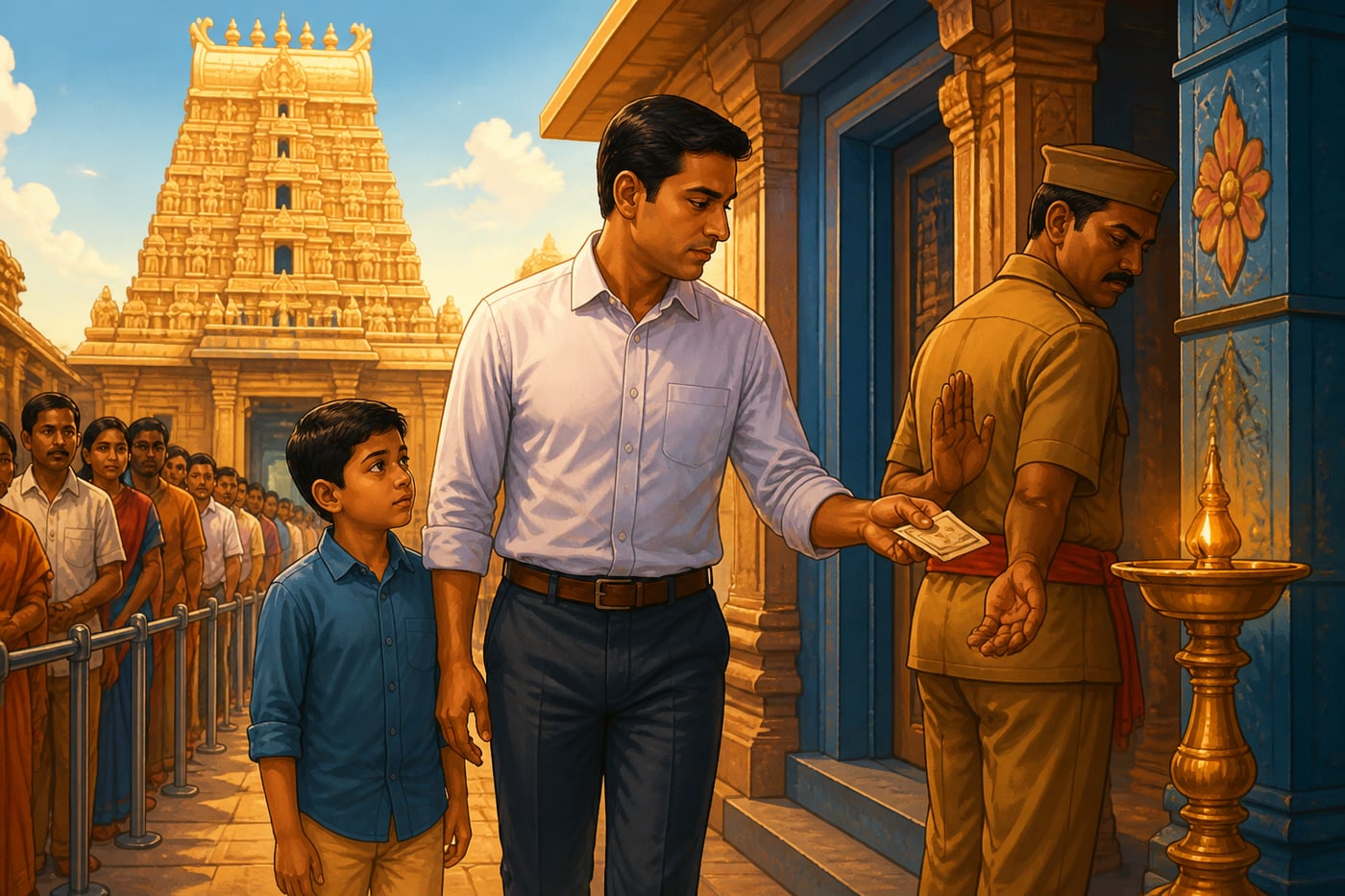
A father cutting a temple queue while his son watches

At the temple, Vikram walks past the darshan queue. "I've donated to this temple for years," he tells Aarav. "We don't need to wait like everyone else." He slips money to the pujari for faster access.

When the domestic help, Lakshmi, accidentally breaks a cup, Vikram shouts: "These people! No care for anything. What do you expect from her background?"

Aarav says nothing. But he watches. He learns.

Fifteen years later, Aarav is in college. He's caught cheating on an exam. When confronted, he says: "Everyone does it. It's practically expected."

He pushes ahead in the hostel mess line. "My father donates to this college. I shouldn't have to wait."

He speaks dismissively to the campus cleaning staff. "These people..."

Vikram is devastated. "Where did we go wrong? We gave him the best education, the best values..."

But Aarav learned exactly what he was taught. Not through words - through watching.

Home 2: The Ordinary Mother

Shanti is a school teacher in a small town in Tamil Nadu. Her income is modest. Her daughter Meera watches everything too.

When Shanti files her taxes, she declares everything. Her husband once suggested showing less income. Shanti refused: "The government builds the road I take to school. How can I use the road but not pay for it?"

At the ration shop, Shanti waits in the queue for two hours with Meera. A neighbor offers to get their ration faster through connections. Shanti declines: "These women have been waiting longer. Our hunger is not more important than theirs."

Shanti waits patiently in a ration shop queue with her daughter Meera in a small Tamil Nadu town

When their domestic help Selvi's daughter gets sick, Shanti not only gives her time off but sends food and medicine. "Selvi takes care of our home. The least we can do is care for her family."

Meera says nothing. But she watches. She learns.

Twenty years later, Meera is a district collector. Her office is known for its integrity. She stands in queues like everyone else. Her staff - including the peons and drivers - speak of her with respect and affection.

People ask her secret. She says: "I just do what my mother did."


The First Gurukul

The home is the original school. The parents are the original teachers.

Before formal education existed, children learned everything at home - not through textbooks, but through observation. They watched how adults treated each other, how they responded to difficulty, how they interacted with the world.

This hasn't changed. A child spends the first five years of life almost entirely at home, watching, absorbing, forming the neural pathways that will shape their character for life.

Research in developmental psychology confirms what our ancestors knew: children learn primarily through modeling, not instruction. A study at Stanford found that children were 8 times more likely to do what they SAW their parents do than what they HEARD their parents say.

The Sanskrit word for this is अनुकरण (Anukarana) - imitation. It's not a flaw; it's how humans are designed to learn. We are built to copy the behaviors of those we trust and depend on.

This is why your smallest actions matter enormously.

The child watching you cut a queue doesn't hear your justification ("Just this once, I'm in a hurry"). They see: Rules are optional for people like us.

The child watching you yell at the driver doesn't understand your stress. They learn: This is how we treat people who serve us.

The child overhearing you boast about tax shortcuts doesn't grasp the economics. They absorb: Honesty is for fools.


What the Scriptures Say

The Parent as God

मातृदेवो भव। पितृदेवो भव। Mātṛdevo bhava. Pitṛdevo bhava. "Be one for whom mother is god. Be one for whom father is god." , Taittiriya Upanishad 1.11

This famous verse is usually interpreted as a command to children: respect your parents as you would respect gods.

But consider the responsibility this places on parents: You are a god to your child. They look to you as the ultimate authority on how life works. Your behavior is their scripture.

What kind of god are you being? A just one? A hypocritical one? A loving one?

The Power of Example

यद्यदाचरति श्रेष्ठः तत्तदेवेतरो जनः। स यत्प्रमाणं कुरुते लोकस्तदनुवर्तते॥ Yadyadācarati śreṣṭhaḥ tattadevetaro janaḥ. Sa yat pramāṇaṁ kurute lokas tadanuvartate. "Whatever the best do, others follow. Whatever standard they set, the world follows." , Bhagavad Gita 3.21

Krishna speaks here of leaders setting examples for society. But in a child's universe, parents ARE the leaders. The "world" that follows their standard is their children, their grandchildren, generations yet unborn.

The Multiplier of Teaching

उपाध्यायान्दशाचार्यः आचार्याणां शतं पिता। सहस्रं तु पितॄन्माता गौरवेणातिरिच्यते॥ Upādhyāyān daśācāryaḥ ācāryāṇāṁ śataṁ pitā. Sahasraṁ tu pitṝn mātā gauravēṇātiricyate. "A teacher is ten times more venerable than a tutor. A father is a hundred times more than a teacher. A mother exceeds a thousand fathers." , Manusmriti 2.145

This hierarchy places parents above all other educators - because a parent teaches not just skills or knowledge, but how to be human.


The Clear Position

YOU ARE THE CURRICULUM. YOUR LIFE IS THE LESSON.

There is no "do as I say, not as I do" in parenting. Children are natural lie detectors. They see the gap between your words and actions - and they choose to copy the actions.

The sermon in your actions drowns out the sermon from your lips.


Dharmic Guidelines

✅ DO

Action Why It Matters
Model the behavior you want to see in your children Children learn through observation, not instruction
Treat household staff with dignity and respect Your child learns how to treat all people by watching you
Follow rules even when shortcuts are available Your integrity teaches them that rules apply to everyone
Admit your mistakes and apologize when wrong This teaches humility and that growth is lifelong
Include children in everyday dharmic acts (puja, charity, helping others) Participation teaches more than observation
Speak about ethics naturally in daily life Make dharma a living conversation, not abstract lecture

❌ DON'T

Action The Karma You Create
Cut queues, break traffic rules, or game the system in front of children You teach that rules are for others, not for us
Boast about tax evasion, bribes, or shortcuts You normalize dishonesty as "practical wisdom"
Speak disrespectfully of or to service workers You teach that human dignity depends on economic status
Say "do as I say, not as I do" You teach that hypocrisy is acceptable
Be glued to phones while ignoring children You teach that screens matter more than people
Argue violently or show contempt for spouse You teach that this is how relationships work

The Karma Angle

Your grandchildren will live with the values you model today.

When Vikram cut that temple queue, he wasn't just saving ten minutes. He was programming Aarav with a life algorithm: Rules don't apply to people with money and connections.

That algorithm will run for decades. Aarav will cut queues, game systems, treat "lesser" people with contempt. His children will watch and learn. Vikram's great-grandchildren will carry forward what he modeled that day.

This is the real karma of parenting - not punishment from gods, but consequences that echo through generations.

Conversely, when Shanti waited in that ration line, she was programming Meera with a different algorithm: Everyone's time matters. Our needs don't override others' needs.

That algorithm also runs for decades. And it creates a different kind of lineage.

Which lineage are you creating?


Lessons by Age

For Children (8-12 years)

Did you know? You're learning from your parents every second.

You might think you only learn at school. But actually, you learn the most important things by watching your mom and dad. How they talk to people. How they act when no one's watching. Whether they keep their promises.

Here's a secret: You can learn what to do AND what not to do. If you see something that doesn't feel right, you can decide: "I won't do that when I grow up."

And here's another secret: Your parents are learning too. They're not perfect. They're trying their best. You can help them be better by asking good questions: "Why did you do that?" Sometimes, your question will make them think.

For Teenagers (13-17 years)

You're at the age where you see your parents clearly - flaws and all.

This can be confusing. You were taught to respect them, but now you see they're not perfect. Maybe they do things that contradict what they taught you.

Here's the mature response: Learn from both their strengths and their mistakes.

You don't have to repeat their patterns. You're old enough to think critically about what you've been taught. Keep what's good. Consciously reject what isn't.

But also: have some compassion. Your parents were shaped by THEIR parents. They're doing better than they know how. One day, you'll be a parent, and your children will see your flaws too.

The chain of karma can be broken. You can be the one who chooses differently.

For Adults (18+ years)

If you have children, or plan to, this lesson is your most important one.

Every moment you spend with your children - and many moments you don't realize they're watching - you are teaching. The question is: what?

Take an honest inventory:

Your children see that gap. They always choose the lived values.

The good news: It's never too late to change the curriculum.

Start today. Model what you want them to become. They're still watching.


Case Studies

Case Study 1: The Smartphone Versus Presence

Modern Scenario:

The Sharma family sits at dinner every night - physically together, emotionally apart. Rajesh scrolls through business emails. Priya checks Instagram. Their 14-year-old Ria is on YouTube. Their 9-year-old Rohan plays mobile games.

Conversations happen in fragments: "Pass the dal." "Did you do homework?" "Mmm-hmm."

Rohan tries to share something that happened at school. "Papa, today in class - " "One second, beta." The second becomes five minutes. Rohan stops trying.

Years pass. Ria goes to college. She calls home once a month, conversations lasting three minutes. Rohan, now a teenager, spends all his time in his room, door closed, earphones in.

Priya complains: "These children don't communicate with us anymore."

The Dharmic Lens:

The Sharma children learned exactly what they were taught: screens are more important than faces. Notifications matter more than conversations. Presence is optional; connection is shallow.

शिशुर्वेत्ति पशुर्वेत्ति वेत्ति गानरसं फणी। "Even a child understands, even an animal understands."

Rohan understood perfectly. He learned that his stories weren't interesting enough to compete with a screen. He stopped offering them.

The Transformation:

After a family counseling session, Rajesh instituted a "no phones at dinner" rule - for EVERYONE, including himself. The first few dinners were awkward. Silence stretched.

Then, slowly, conversations began. Rohan shared a story about his friend. Ria complained about a teacher. Priya talked about her day.

It took months, but the family learned to be present with each other. Rohan still remembers the first time Papa put down his phone and said: "Tell me everything that happened."

"That was the day," Rohan later told a friend, "I knew I mattered more than email."


Case Study 2: The Tax Return Lesson

Modern Scenario:

CA Mahesh Kumar is known for his creative accounting. Over dinner, he often entertains the family with stories of "how we saved the Guptas twenty lakhs" and "the loophole the government doesn't know about."

His 16-year-old son Siddharth absorbs these stories. He hears the pride in his father's voice, the admiration from relatives. The message is clear: cleverness means finding ways around rules.

Ten years later, Siddharth is a software engineer in a large company. He's discovered a way to log extra hours without working them - a "loophole" in the attendance system. He does this regularly, padding his overtime pay.

When he's caught and fired, Siddharth is genuinely confused. "I didn't steal anything," he tells his father. "I just found a loophole."

Mahesh is devastated. But how can he argue? He taught his son that loopholes are clever, not wrong.

The Dharmic Lens:

Tax evasion is not a victimless crime. It steals from the common treasury that builds roads, hospitals, schools. When enough people evade, public services crumble, and the honest bear extra burden.

करं दत्त्वा स्वधर्मेण Karaṁ dattvā svadharmēṇa "Paying tax is one's own dharma." , Shanti Parva

Mahesh didn't just evade taxes; he taught his son that rules are obstacles for clever people to circumvent. Siddharth applied the lesson to his own context.

The Transformation:

After the incident, Mahesh did something unusual. He sat with Siddharth and said: "I taught you wrong. What I called cleverness was actually dishonesty. I'm sorry."

He then went to his own clients and had difficult conversations. Some left. Some respected him more. His income dropped, but he began sleeping better.

Siddharth, unemployed and humiliated, had time to think. He realized his father's apology was the first truly honest thing he'd heard at home. It became the foundation for his own change.


Case Study 3: The Domestic Help Mirror

Modern Scenario:

Deepa Aunty runs a well-organized household in Chennai. She speaks English at parties, quotes Rumi on Facebook, and considers herself progressive.

But her domestic help Kamala tells a different story. Deepa speaks to her only in sharp commands. There's a separate cup for Kamala's tea - not one of the "good" cups. When Kamala's son was sick, Deepa docked her pay for the day missed.

Deepa's daughter Ananya, 10 years old, watches all this. She sees the separate cup. She hears the tone.

At school, Ananya refuses to sit next to certain classmates - the ones from "different" backgrounds. She speaks dismissively to the school ayah. When asked why, she can't articulate it. She's absorbed it.

The Dharmic Lens:

सर्वे भवन्तु सुखिनः Sarve bhavantu sukhinaḥ "May all be happy."

The prayer says "all" - not "all who can afford good cups." When we create hierarchies of dignity in our homes, we teach children that human worth depends on economic status.

Kamala is a human being. She has dreams for her children, worries about her parents, days when she feels unwell. She deserves the same cup.

The Transformation:

Ananya's teacher called Deepa after noticing the behavior. At first, Deepa was defensive - "We treat everyone well." But the teacher's words stayed with her.

That evening, Deepa paid attention to herself. She noticed her tone with Kamala, the separate cup, the small cruelties she'd stopped seeing.

The next morning, she gave Kamala tea in a regular cup. She said "please" and "thank you." She asked about Kamala's son.

Kamala was startled. But over weeks, as the changes persisted, something shifted. And Ananya noticed that too.


Applied Wisdom

Wisdom 1: The Watching Mind

Ancient Source:

शिशुर्वेत्ति पशुर्वेत्ति वेत्ति गानरसं फणी। विद्वान् न वेत्ति गानरसं य आत्मानं न वेत्ति सः॥ "Even a child knows, even an animal knows, even a snake responds to music. The one who doesn't know is the learned one who doesn't know himself." , Sanskrit Subhashita

Explanation: This verse is often used in musical contexts, but its deeper meaning is about instinctive knowing. Children don't need to be taught formally - they KNOW, instinctively, what they're seeing. They process your behavior faster than your explanations.

Modern Application: Don't assume children don't notice or understand. They're processing everything, building mental models of "how the world works" and "how people like us behave." Your small actions are big data for their developing minds.


Yashoda binding baby Krishna to the mortar with loving discipline

Wisdom 2: The Yashoda Model

Ancient Source: Yashoda raised Krishna - the divine incarnation - with ordinary household dharma. She tied him to a mortar when he misbehaved. She scolded him for stealing butter. She gave him chores and boundaries.

The Lord of the Universe was raised with structure, discipline, and consequences - wrapped in unconditional love.

Explanation: Yashoda didn't know Krishna was divine. She treated him as a normal child who needed guidance. And that guidance - firm boundaries within loving acceptance - shaped even God's childhood.

Modern Application: Discipline is not cruelty. Boundaries are not oppression. Children need structure to feel safe. They need consequences to learn cause and effect. But all of this must happen within a container of unconditional love - "I correct you BECAUSE I love you, not instead of loving you."


Wisdom 3: The Dhritarashtra Warning

Ancient Source: Dhritarashtra's blindness was physical, but his greater blindness was moral. He saw Duryodhana's flaws clearly but loved him too much to correct him. When advisors warned him, he dismissed them. "He's just a child." "He'll grow out of it." "All boys are like this."

Duryodhana never grew out of it. His uncorrected entitlement grew into the destruction of his entire lineage.

Explanation: Vidura explicitly warned Dhritarashtra: "A father who doesn't correct his son's adharma is no father at all." But Dhritarashtra's blind love overrode his duty. The Mahabharata war - with its millions of deaths - was the karma of a father who couldn't say "no."

Modern Application: Love that never corrects is not love - it's indulgence. When you let misbehavior slide because "they're just kids," you're not being kind. You're being Dhritarashtra. The karma may not be a war, but it will be suffering - for your children and those they hurt.


Living Traditions

Sites

Name Location Connection
Traditional Agrahara Homes Tamil Nadu, Karnataka Extended families where children were raised by the entire community - multiple adults modeling dharma
Gurukul Remains at Takshashila Pakistan (ancient India) Where students lived with teachers, learning through daily observation of their guru's life
Santiniketan West Bengal Tagore's experimental school where learning happened through living, not just lecturing

Festivals & Practices

Name Timing Connection
Sandhya Vandana at Home Daily, sunrise/sunset When parents model daily prayer, children absorb spiritual discipline naturally
Kitchen as First Gurukul Daily Traditional practice of children helping in kitchen - learning service, patience, skill alongside parent
Family Puja Room Daily Children who see parents pray learn that there's something larger than self

Living Practices

Practice Description Connection
Joint Family System Multiple generations under one roof Children have multiple adults to observe, multiple models of adulthood
Storytelling at Bedtime Traditional tales told by grandparents Values transmitted through narrative, not lecture
Festival Preparations Together Cleaning, cooking, decorating as family Children learn that celebration requires effort, that family works together

Try This

Practice 1: The Behavior Audit

Duration: One week

Description: For one week, keep a private journal of moments when your children (or any child in your life) might have been watching you. Note:

Purpose: Most of our modeling happens unconsciously. This audit brings awareness to what you're actually teaching through daily actions. You may be surprised - pleasantly or unpleasantly - by what you discover.


Practice 2: The Shared Meal Conversation

Duration: Ongoing, start this week

Description: Institute one meal per week where:

Purpose: This creates a container for real communication and models that family members matter more than screens. It also shows children that parents are human, learning, imperfect - which paradoxically increases respect.


Practice 3: The "Caught You Being Good" Journal

Duration: One month, then ongoing

Description: Start a family journal where anyone can write down when they "caught" another family member doing something kind, honest, or brave. Read entries aloud weekly.

Purpose: This shifts family attention from criticism to appreciation. Children learn that good behavior is noticed and valued. Parents model noticing goodness. The journal becomes a family treasure.


Fun Facts

Fact Category Emoji
Children can recognize their mother's voice from birth, and their father's within weeks. Your voice is literally the first "teacher" they know. Science 🧒
A Stanford study found that children who saw parents donate money were 3x more likely to share their own resources with others - words about generosity made no difference. Psychology 🧠
In traditional Indian households, the kitchen was called "पाक शाला" (cooking school) because it was where children learned not just cooking but patience, service, and working with others. Tradition 🏠
The practice of children touching elders' feet wasn't just about respect - it was designed to create a physical ritual that reminded both generations of their connected roles. Culture 🙏

The Final Word

"जैसा बीज बोओगे, वैसा फल पाओगे।" "As you sow, so shall you reap."

This proverb is usually applied to individual karma. But in parenting, you're sowing seeds in someone else's garden - your child's character.

Every moment you spend with your children, you are planting. The question is: what?

Plant integrity, and they'll grow honest. Plant respect for all people, and they'll treat the world with dignity. Plant patience, and they'll learn to wait their turn. Plant love - real love, not indulgence - and they'll know how to love others.

You are the first and most important teacher your child will ever have.

Not because of the lessons you plan. Because of the life you live.

They're watching. Make it a lesson worth learning.

Never assume children don't understand. Their comprehension may be pre-verbal, but it's deep. When you treat the servant poorly, the child doesn't need to understand caste theory - they learn that some people deserve less respect. Their watching mind catches everything your explaining mind tries to hide.

Your home IS a gurukula. Your children are students in full-time residence. You cannot separate 'teaching time' from 'regular time' - they're learning from both. This is either terrifying or empowering: your entire life is curriculum.

Case studies

The Temple Queue Lesson

Vikram and his 10-year-old son Aarav visit the famous Siddhivinayak Temple in Mumbai. The queue stretches for two hours. Vikram knows someone who knows a temple official. Within fifteen minutes, they're at the front, getting VIP darshan. "See, beta," Vikram says proudly, "it's all about knowing the right people." Aarav watches the faces of people still in the queue - a family with a grandmother who can barely stand, a father with a sick child, devotees who took buses from villages. They've been waiting since dawn. Two years later, Aarav is caught cheating on his school exam. When confronted, he says: "Everyone manages things their way. I just knew the right answers to copy."

The Taittiriya Upanishad says 'मातृदेवो भव, पितृदेवो भव' - parents are like gods to children. Vikram was Aarav's god that day at the temple. And what did this god teach? That rules are for others. That connections trump dharma. That the grandmother who can barely stand doesn't deserve the same access to God as those with contacts.

After Aarav's cheating incident, a family counselor helped Vikram see the connection. 'You taught him that shortcuts are success,' she said. 'He applied the lesson.' Vikram was shaken. The next month, he took Aarav back to Siddhivinayak - and they waited three hours in the regular queue. 'This is the real darshan,' Vikram told his son. 'The waiting. The patience. The standing with everyone else.'

Children don't hear justifications; they see actions. 'VIP darshan' taught Aarav that some people deserve shortcuts and others don't - that dharma can be bypassed with the right connections. The real teaching happened not when Vikram cut the queue, but when he stood in it.

Children today observe parents navigating rules constantly: traffic signals, tax returns, school admission processes, queue etiquette. Research consistently shows that children absorb behavioral patterns more than verbal instructions. The parent who follows rules even when inconvenient is teaching integrity more effectively than any lecture.

A 2021 study in the Journal of Moral Education found that children who observed parents bending rules were 3 times more likely to cheat in structured settings. Developmental psychologists note that children form ethical frameworks primarily through observed behavior, not instruction, before age 12.

Yashoda's Mortar: Discipline as Love

Krishna, the child god, had been stealing butter - not just from his own home, but from neighbors' houses. The complaints reached Yashoda daily. This time, she caught him red-handed, mouth smeared with evidence. Yashoda didn't think: 'He's just a child' or 'Boys will be boys.' She knew that uncorrected behavior grows. She took a rope and tied Krishna to a heavy mortar - he would stay there until he understood. Krishna, the Lord of the Universe, who could have escaped with a thought, accepted the consequence. The mortar became famous in Hindu tradition as the Ukhal - a symbol of loving discipline.

Yashoda didn't know Krishna was divine. She raised him as a child who needed guidance. Her discipline wasn't cruelty - it was love taking responsibility for formation. The Bhagavata Purana presents this as an ideal: boundaries within unconditional acceptance, consequences within ongoing love.

Krishna later spoke of Yashoda with the deepest reverence. In the Bhagavad Gita, he never described his divine mother Devaki with such warmth. Yashoda's simple, earthy parenting - complete with scolding, consequences, and mortar-tying - shaped even God's human experience.

Discipline is not the opposite of love; it's the responsibility of love. Parents who never correct are not being kind - they're being Dhritarashtra. The mortar wasn't punishment; it was teaching. And Krishna, who could have untied himself, chose to accept the teaching.

Modern parenting discourse often frames discipline as harmful, conflating appropriate boundary-setting with punishment. Developmental psychology supports what Yashoda demonstrated: consistent, loving correction is essential for healthy development. Children without boundaries face higher rates of anxiety, entitlement, and social difficulty.

The Bhagavata Purana describes Krishna's childhood in Vrindavan across 90 chapters (Skandha 10), making it the longest narrative section. Yashoda is mentioned in more than 50 verses, with scholars noting that Krishna references his foster mother's discipline as foundational to his childhood.

The Blind King's Silence

From childhood, Duryodhana showed troubling signs. He pushed Bhima into a river, tried to poison him. He demanded what wasn't his, refused to share, viewed cousins as enemies. Each time, advisors warned Dhritarashtra. Bhishma counseled intervention. Vidura pleaded: 'Correct him now, or lose him forever.' Dhritarashtra listened and... did nothing. 'He's young,' he'd say. 'He'll outgrow it.' 'All boys are competitive.' 'You're too harsh on him.' The behavior didn't diminish; it escalated. Lakshagriha, where he tried to burn the Pandavas alive. The dice game, where he humiliated Draupadi. Each atrocity began with an uncorrected childhood transgression.

Vidura explicitly warned: 'A father who doesn't correct his son's adharma is party to that adharma.' Dhritarashtra's blindness - physical and moral - made him unable to see that his 'love' was actually indulgence, his 'acceptance' was enabling, and his silence was consent. The Mahabharata war killed millions. At its root was a father who couldn't say 'no' to his son.

Dhritarashtra lived to see all hundred sons die in the war. In his grief, he asked Vidura: 'Why did this happen?' Vidura's answer was simple: 'You were told. You were warned. You chose not to see.' The blind king's true blindness was never physical - it was the blindness of a parent who loved too much to discipline.

Love that never corrects is not love - it's attachment wearing love's mask. Dhritarashtra genuinely loved Duryodhana. But love that enables destruction destroys both the enabled and the enabler. Every parent who can't bear to correct their child should remember where Dhritarashtra's 'love' led.

Helicopter parenting, grade inflation, and shielding children from consequences are modern forms of Dhritarashtra's blindness. Parents who intervene to prevent their child from facing fair consequences at school, in sports, or in social situations are creating the same pattern: short-term comfort that produces long-term harm.

The Mahabharata records that advisors warned Dhritarashtra about Duryodhana's behavior at least 17 times across the text. Vidura alone delivered 5 major counseling sessions urging intervention, all of which the blind king acknowledged but failed to act upon.

Living traditions

Reflection

More in Adarsha Dharma - Modeling for Next Generation

All lessons in Adarsha Dharma - Modeling for Next Generation · Samaj Dharma: The Dharmic Citizen's Handbook course