Bhoga-Phala: Consumption and Consequence
Why the Rishis Never Separated Enjoyment from Its Effects
Exploring the Vedic understanding that consumption (bhoga) and consequence (phala) are inseparable, and how modern systems that hide consequences create unsustainable extraction.
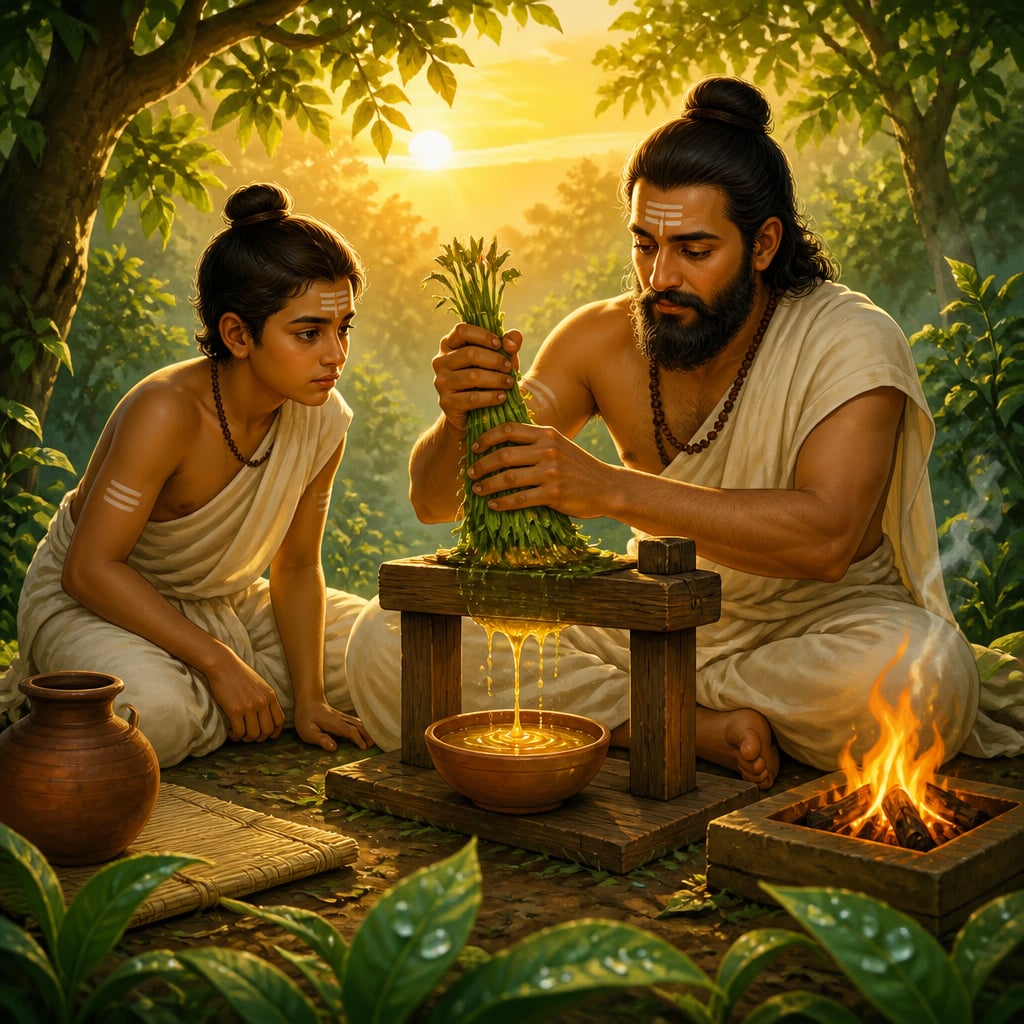
The young Brahmin watched as his teacher lifted the soma plant, freshly pressed, its golden liquid catching the morning light. "Before you drink," the guru said, "tell me: what will happen?"
The student knew the texts. "Clarity. Heightened perception. Connection to the divine."
"And then?"
The student paused. He had memorized the hymns praising soma's effects but not what followed. The guru smiled. "The Rishis never separated bhoga from phala, the enjoyment from its fruit. Every consumption has consequence. The wise consume with eyes open to both."
The Vedic Framework of Consequence
The Vedic worldview made a radical claim that modern economics has spent centuries trying to escape: there is no free lunch in the universe. Every bhoga (enjoyment, consumption, experience) produces phala (fruit, result, consequence). The two are not separate events but a single process viewed from different moments.
This was not moralism. The Rishis were not against enjoyment, the Vedas celebrate life, pleasure, prosperity. But they insisted on seeing the complete picture:
| Vedic Concept | Meaning | Modern Equivalent |
|---|---|---|
| Bhoga | Enjoyment, consumption, experience | Consumption, utility |
| Phala | Fruit, result, consequence | Externality, outcome |
| Bhoga-Phala | The unified cycle | Full-cost accounting |
A word of caution as we explore these teachings: the modern crisis of sustainability is fundamentally a crisis of separated bhoga-phala. We consume here; consequences appear there. We consume now; consequences appear later. We consume visibly; consequences accumulate invisibly. The Vedic framework offers both diagnosis and prescription: wherever consumption is separated from consequence, expect system breakdown. The solution is not to stop consuming but to reconnect consumption with its effects, through transparency, regulation, or ritual awareness.
The problem arises when systems allow bhoga while hiding phala, when consumption is separated from consequence. The Rishis had a word for this disconnection: moha (delusion).
What the Mantras Reveal
The Rig Veda addresses this directly in a striking verse:
"Mā no mahāntam uta mā no arbhakaṃ mā na ukṣantam uta mā na ukṣitam" "Harm not the great among us, nor the small, nor the growing, nor the grown."
This mantra from a hymn to the Maruts (storm gods) reveals awareness that actions ripple outward, affecting not just the actor but the community, not just the present but the growing future. Consequence is not individual but systemic.
Another verse makes the personal dimension explicit:
"Yad adya kac ca vṛtrahann udagā abhi sūryam" "Whatever today, O slayer of obstacles, rises toward the sun", implying that all actions, like smoke from the fire, rise and return transformed.
The Rishis understood what economists call "feedback loops", that consumption today shapes the conditions of tomorrow. The question was never whether consequences exist but whether we choose to see them.
Traditional Wisdom on Consumption
Sayanacharya, in his commentary on the soma hymns, emphasized that Vedic consumption practices were designed to maintain awareness of consequence. The elaborate preparation of soma, the pressing, the filtering, the chanting, the timing, prevented mindless consumption. By the time the soma reached the lips, the practitioner had contemplated its source, its processing, and its effects.
Sri Aurobindo interpreted bhoga-phala psychologically. In his reading, every experience we consume, sensory, emotional, intellectual, produces effects in consciousness. Unconscious consumption creates unconscious patterns. Conscious consumption creates conscious evolution. The Vedic rituals were technologies for maintaining consciousness through the process of consumption.

The Arthashastra, though later than the Vedas, applied this principle systematically. Kautilya understood that a kingdom's consumption of forests, water, and minerals would produce consequences for the kingdom's future. He didn't moralize about nature, he calculated: consume beyond regeneration, and the kingdom consumes itself.
Living This Today

In 2008, the Spanish company Inditex (owner of Zara) and later the Chinese platform Shein perfected a model that maximizes bhoga while hiding phala. Fast fashion delivers $5 dresses to consumers in days. The enjoyment is immediate and visible. The consequences are distant and hidden.
Hidden where? In Dhaka factories where workers earn $95 monthly. In rivers running with textile dyes. In landfills receiving 92 million tonnes of clothing annually. In microplastics now found in human blood. The phala exists, it's simply been displaced to where consumers can't see it.
This is the modern genius of extraction economics: separate the point of consumption from the point of consequence. The person who wears the dress never meets the person who sewed it in dangerous conditions. The person who discards the dress never sees the landfill. Bhoga and phala are surgically disconnected.
The Vedic framework would call this moha, delusion. Not because enjoyment is wrong, but because the enjoyment is incomplete. You're consuming half a cycle and calling it whole.
Contrast this with the emergence of "slow fashion" and full-cost accounting. Companies like Patagonia publish their entire supply chain. The consequence is visible alongside the consumption. When you buy a Patagonia jacket, you can trace the materials, the labor, the environmental impact. This is not marketing virtue, it's bhoga-phala made visible. The price reflects more of the true cost.
In India, the Khadi movement pioneered this reconnection. When you purchase handspun cloth, you see the spinner. The labor is not hidden. The consequence of your consumption, someone's livelihood, is present in the product. Gandhi understood that industrialization's efficiency came partly from hiding consequences that village production kept visible.
Research by psychologist Hal Hershfield shows that feeling connected to your future self changes present behavior. When people view their future self as continuous with their present self, they consume more sustainably. This is the psychology behind bhoga-phala: maintaining connection across time.
Patagonia's 'Don't Buy This Jacket' campaign made consequence visible at the point of purchase. Sales increased, not decreased, consumers responded to honesty about impact. Interface Carpets' 'Mission Zero' transformed the company by making environmental consequence visible in every decision.
Life Cycle Assessment (LCA) is the industrial practice of bhoga-phala, tracing products from raw material through disposal. Companies using LCA discover that 70-80% of environmental impact is often in phases invisible to the consumer. Making this visible changes design decisions.
Your Path Forward
You might object: I can't trace every consequence of every consumption. I'd be paralyzed.
The Rishis would agree, complete knowledge is impossible. But that's not the standard. The standard is: don't actively hide from consequences you could see.
The soma ritual didn't require knowing every atom of the plant's history. It required pausing before consumption, acknowledging the chain of causation, and proceeding with awareness rather than reflex.
Here's a practical application: Before your next significant purchase, pause. Ask:
- Who made this? Under what conditions?
- What resources were consumed? Can they regenerate?
- Where does this go when I'm done with it?
- Is the price I pay close to the true cost, or is consequence being hidden?
You may still purchase. The point is not asceticism but awareness. Conscious consumption creates different patterns than unconscious consumption. The Rishis knew this. Modern behavioral economics confirms it: people who pause before purchasing consume differently than those who don't.
In our next lesson, we'll explore kṛtajñatā, how gratitude itself functions as a regulatory mechanism, naturally limiting consumption by maintaining awareness of what we've received.
Case studies
Fast Fashion: The Architecture of Hidden Consequence
In 2023, Shein was valued at $100 billion, selling dresses for $5 and delivering them globally in days. The company releases 6,000 new items daily, compared to Zara's 500. Prices are possible because consequences are hidden: factory workers in Guangzhou earn as little as 3 cents per garment. 85% of textiles end in landfills. Synthetic fabrics release microplastics now found in human blood, breast milk, and placentas. The Citarum River in Indonesia, serving textile factories, is so polluted that fish have disappeared. None of this appears on the checkout page.
Fast fashion is the perfection of moha, delusion, as a business model. The bhoga (cheap trendy clothes, instant gratification) is maximized while the phala (environmental destruction, labor exploitation, health effects) is systematically hidden. The consumer sees the dress; they don't see the river. The Vedic framework would identify this as fundamentally unsustainable, not because enjoyment is wrong, but because hidden consequences accumulate and eventually surface. You can hide phala but not eliminate it.
By 2024, fast fashion faces mounting regulation. France passed laws requiring environmental impact labels. The EU's Extended Producer Responsibility requires brands to fund textile recycling. Shein's IPO was delayed amid labor practice investigations. The hidden phala is becoming visible, through regulation, through journalism, through accumulating environmental damage. The industry is discovering what the Rishis knew: eventually, consequence arrives.
Business models that profit by hiding consequence are inherently unstable. They depend on maintaining moha, collective delusion, and moha cannot be maintained indefinitely. Sustainable business requires designing for visible consequence, not hidden consequence. The extra cost of transparency is less than the eventual cost of accumulated hidden phala.
The rise of clothing resale platforms like ThredUp and Depop, along with EU regulations requiring fashion brands to disclose environmental costs, represents a market correction toward visible consequence. Consumers increasingly demand supply chain transparency, suggesting that the era of hidden phala in commerce is ending.
The fashion industry produces 10% of global carbon emissions and is the second-largest consumer of water. 92 million tonnes of textile waste are created annually. The average garment is worn 7 times before disposal. These are the hidden phala of $5 dresses.
Kautilya's Forest Governance: Institutionalizing Bhoga-Phala
In the 4th century BCE, Kautilya's Arthashastra established detailed regulations for forest use. Forests were categorized: some for timber extraction, some for elephant habitat, some completely protected. Extraction from permitted forests was limited to what could regenerate. Officials (Kupyadhyaksha) were appointed to track harvests and regeneration. Penalties for over-extraction were severe, not as punishment but as the institutional phala of violating limits. Critically, the system made consequence visible: quarterly reports compared extraction to regeneration.
Kautilya institutionalized bhoga-phala at state level. The Arthashastra didn't prohibit forest use (bhoga), it ensured that consequence (phala) was visible and immediate. By requiring regeneration tracking, the system prevented the moha that enables extraction. The official who approved timber harvest was also responsible for regeneration reports. Consumption and consequence were linked in the same role, preventing the separation that enables over-extraction.
Mauryan forests sustained intensive use, for construction, shipbuilding, elephant armies, for over a century. When the system was maintained, forests regenerated. Archaeological evidence shows dense forest cover during the Mauryan period despite substantial extraction. The system worked not through prohibition but through visibility. Later periods that abandoned this framework saw rapid deforestation.
Sustainable resource use requires institutional mechanisms that keep bhoga-phala connected. Kautilya understood that individual virtue was insufficient, systems were needed. Modern equivalents include environmental impact statements, carbon accounting, and extended producer responsibility. The ancient framework anticipated modern sustainability governance.
Modern environmental impact assessments, carbon taxes, and extended producer responsibility laws attempt to do what Kautilya did: make the consequences of resource use visible and proportional. The most effective environmental regulations are those that connect the act of consumption directly to its ecological cost, rather than hiding it in distant externalities.
Kautilya's Arthashastra prescribed that one-sixth of forest produce could be harvested (the royal share), while the remaining five-sixths were left for regeneration and wildlife. Mauryan-era archaeological sites show dense forest cover persisting near populated settlements for over a century.
Reflection
- Think of a regular consumption habit, food, shopping, media. What consequences does it produce that you prefer not to think about? What would change if you fully acknowledged those consequences?
- The Rishis designed elaborate rituals around consumption to prevent mindless consumption. What modern 'rituals' slow down your consumption and make you aware of what you're doing? What 'anti-rituals' speed it up and make you less aware?
- Modern economics treats 'externalities', consequences borne by others, as exceptions to be corrected. The Vedic view treats separated consequences as fundamental violations of ṛta. Which framing leads to better outcomes? Why?