Samatā: Balance Between Assertive and Adaptive Power
The Wisdom to Know Which Mode When
Explore the Vedic principle of samatā, not passive balance but dynamic integration. Learn to access both ojas (assertive power) and śakti (adaptive power), and develop the viveka (discernment) to know which mode each moment requires.
The dice had fallen. Draupadi, princess of Panchala, wife of five warrior kings, had been wagered and lost like chattel. Now Dushasana dragged her by the hair into the assembly hall, her garments stained, her dignity assaulted.
Watch what happens next, it reveals the art of samatā.
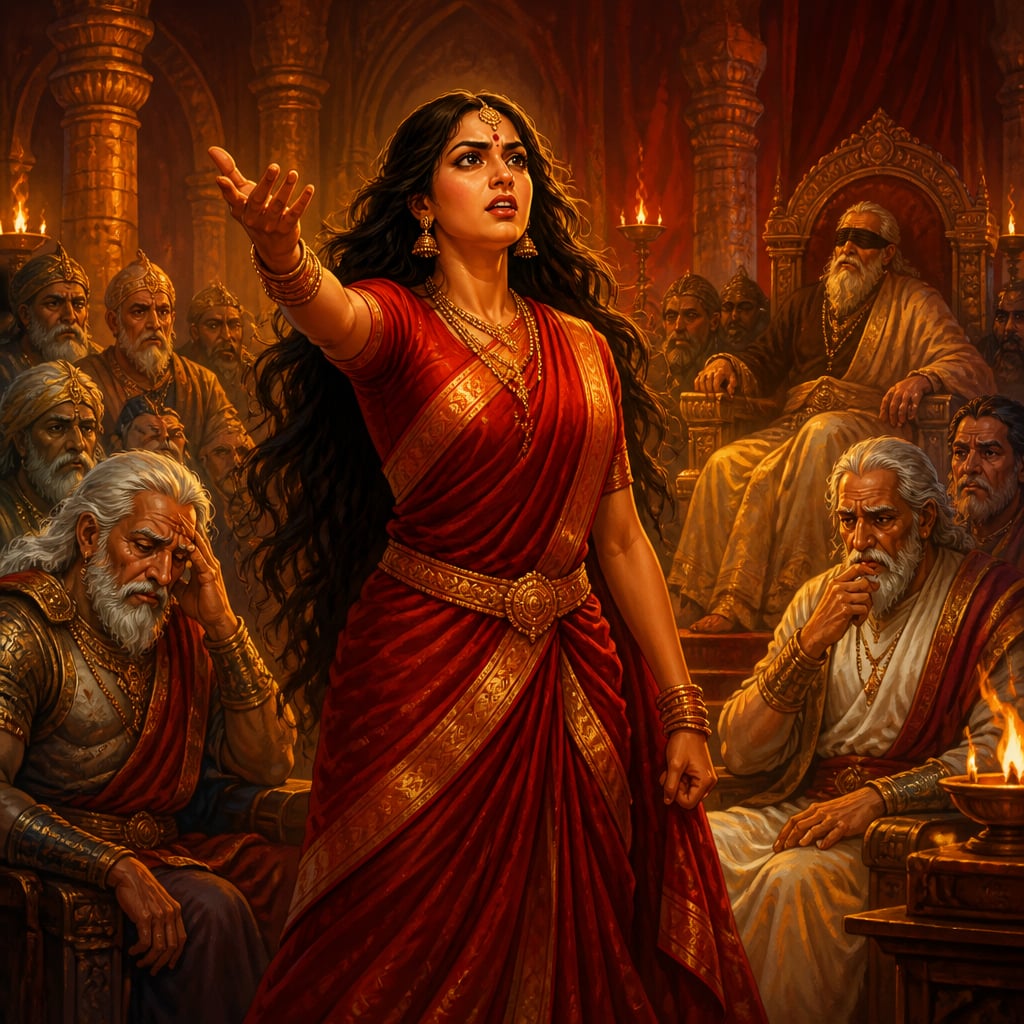
Draupadi does not collapse into passive suffering. Nor does she erupt into ineffective rage. Instead, she does something remarkable: she adapts and asserts simultaneously.
Adapting: She addresses the assembly through proper protocol, speaking to the elders, invoking dharmic law. She works within the system, using its own rules to expose its violation.
Asserting: Her questions are not meek. "Was the stake valid? Can a man who has lost himself wager another?" Each question is a sword wrapped in silk. She demands an answer from Bhishma himself.
The assembly cannot respond. Her integration of adaptation (working within dharmic protocol) and assertion (demanding justice) exposes them more completely than violence ever could.
This is samatā, not passive balance but dynamic integration of both modes of power.
To appreciate this wisdom fully: Understanding samatā reveals that the previous lessons, on śakti, Ushas, Vāk, and dhāraṇā, are not alternatives to assertive leadership but complements to it. The complete leader doesn't choose between modes but integrates them. This integration is what makes leadership sustainable, effective, and aligned with dharma.
The Myth of Balance
Modern discourse often treats "balance" as the midpoint between extremes, a lukewarm compromise. The Vedic understanding is different.
Samatā doesn't mean always being moderate. It means having full access to both poles and the discernment to deploy whichever the moment requires.
"Samaṃ sarveṣu bhūteṣu" "Even-minded toward all beings." , Bhagavad Gītā 13.28
This "even-mindedness" isn't neutrality, it's the capacity to respond appropriately to each situation without being imprisoned by one's habitual mode.
Some moments require fierce assertion (ojas). Some require patient adaptation (śakti). The leader trapped in one mode will eventually encounter situations that mode cannot serve. Samatā is freedom from such imprisonment.
The Two Modes Revisited
Through this chapter, we've explored the spectrum:
| Ojas Mode | Śakti Mode |
|---|---|
| Direct action | Enabling conditions |
| Pushing toward outcomes | Holding space for emergence |
| Setting boundaries | Creating connection |
| Decisive intervention | Patient cultivation |
| Speaking truth | Deep listening |
| Conquest | Transformation |
Neither mode is superior. Each is appropriate to different situations. The problem is when leaders can only access one.
Over-reliance on ojas creates: burnout (in self and others), broken relationships, resistance, organizations that collapse when the leader leaves, and the inability to address problems that force cannot solve.
Over-reliance on śakti creates: missed opportunities, boundary violations, exploitation by bad actors, organizations that drift without direction, and the inability to address problems that require decisive action.
The Rishis didn't worship only Indra (pure ojas) or only Aditi (pure śakti). They understood that creation requires both.
Viveka: The Discernment to Know
The key to samatā is viveka, discriminating wisdom. Not the ability to use both modes, but the wisdom to know which mode this moment requires.
Viveka asks:
- What does this situation actually need? (Not what I habitually provide)
- What is my default mode, and is it serving here? (Self-awareness)
- What would the other mode offer? (Expanding options)
- What are the risks of each approach? (Realistic assessment)
Draupadi in the assembly hall exercised viveka continuously. She read each moment: When to invoke law (adaptation), when to demand answer (assertion), when to appeal to conscience (adaptation), when to pronounce curse (assertion). Each shift was deliberate, responsive to what the moment required.
"Viveka-jñāna-samyuktam" "United with discriminating knowledge." , Traditional teaching
Traditional Wisdom on Integration
Sayanacharya, commenting on the Vedic deities, notes that even Indra, the archetypal warrior, has moments of patience and strategy, while Aditi, the archetypal container, has moments of fierce protection. The gods model integration, not one-sidedness.
Sri Aurobindo sees samatā as essential for spiritual leadership:
"The perfect action comes from a perfect calm... Equality does not mean inaction; it means action perfectly calibrated to the need." , Sri Aurobindo, Essays on the Gita
This "perfect calm" isn't passivity, it's the centered stillness from which appropriate response can arise. When we're trapped in one mode, we react. When we have samatā, we respond.
Draupadi: Integration Under Pressure
Draupadi's life demonstrates samatā across many contexts:
In the assembly: She combined protocol (adaptation) with fierce questioning (assertion), exposing the assembly's hypocrisy without abandoning dharmic process.
In exile: For thirteen years, she adapted to circumstances, living in forests, serving incognito as a palace maid. She didn't rage uselessly against conditions she couldn't change.
After the war: She showed compassion (śakti) to Gandhari, the mother of her tormentors, while never abandoning her demand for justice (ojas). She could hold both grief and righteousness.
Her vow: Draupadi's famous vow, to not bind her hair until washed in Dushasana's blood, was fierce assertion. But she held this vow through thirteen years of patient adaptation. The assertion was held within adaptive endurance.
This is what samatā looks like in practice: not alternating between modes randomly, but integrating them according to what dharma requires.
The Cautionary Tale: Elon Musk

Elon Musk offers a contemporary study in the costs and possibilities of power integration, and what happens when it goes wrong.
Where integration succeeded:
Musk's greatest achievements came when he combined both modes: visionary thinking (adaptive imagination of what could be) with aggressive execution (assertive drive to make it real). Tesla and SpaceX succeeded because he could imagine impossible futures (śakti, seeing what isn't yet) AND relentlessly push teams to build them (ojas, forcing breakthrough).
His best decisions show viveka: knowing when to listen to engineers (adaptive) and when to override conventional wisdom (assertive), when to absorb criticism and iterate (adaptive) and when to hold firm against doubt (assertive).
Where integration failed:
Musk's failures consistently show over-reliance on ojas, aggressive action without adequate adaptive wisdom:
- Publicly attacking critics rather than listening for valid feedback
- Setting impossible deadlines that burn out teams rather than building sustainable capacity
- Making impulsive decisions (Twitter acquisition) without adequate deliberation
- Treating relationships as obstacles rather than resources
The pattern is clear: when Musk integrates both modes, extraordinary things happen. When he relies only on ojas, force, speed, domination, he creates chaos, burns relationships, and undermines his own goals.
The lesson: Raw ojas, however impressive, eventually hits limits that only śakti can transcend. Sustainable transformation requires both. Musk's story is not a simple success or failure, it's a vivid demonstration of what integration enables and what imbalance costs.
Developing Samatā
How does one develop the capacity for integration?
1. Know Your Default
Most people have a habitual mode. Under stress, do you typically push harder (ojas default) or pull back (śakti default)? Neither is wrong, but unconscious defaults limit options.
2. Practice the Opposite
If you're naturally assertive, practice holding space. If you're naturally adaptive, practice setting firm boundaries. Building capacity in your weaker mode expands your range.
3. Cultivate Viveka
Before responding to situations, pause. Ask: "What does this actually need?" rather than "What do I usually do?" This pause creates space for discernment.
4. Study Integrators
Observe leaders who can access both modes. How do they shift? What signals tell them which mode to use? Learn from their pattern recognition.
5. Embrace the Paradox
Samatā isn't choosing between assertion and adaptation, it's holding both as available options. The integrated leader can be fiercely gentle and gently fierce, as the moment requires.
The Ardhanarishvara Teaching

The Vedic tradition offers a powerful image of integration: Ardhanarishvara, Shiva as half-male, half-female. Not two beings compromising, but one being who is fully both.
This image teaches that masculine (ojas) and feminine (śakti) principles are not opponents to be balanced but aspects to be integrated. The complete being has full access to both.
"Na pumān na strī na caiva klībaḥ" "Neither male nor female nor neuter." , Śvetāśvatara Upanishad 5.10
The highest state transcends the categories while including them. This is samatā at its deepest: not choosing between ojas and śakti, but being the consciousness in which both arise.
Your Turn: Finding Integration
Reflect on your own patterns:
- When stressed, do you typically push or pull back?
- What situations consistently trigger your less-developed mode?
- Where has over-reliance on one mode cost you?
- Who in your life models good integration?
The goal isn't to become perfectly balanced at all times, that's another form of rigidity. The goal is freedom: the ability to access either mode as needed, guided by viveka rather than habit.
Draupadi in the assembly hall wasn't balanced, she was fluid, shifting between modes as each moment required. She had suffered enough to know that neither pure adaptation nor pure assertion would serve. Only integration could expose the truth.
The Rishis called this capacity feminine intelligence because śakti, the adaptive, enabling power, is what allows ojas to become truly effective. Without śakti, ojas is just aggression. Without ojas, śakti is just passivity. Together, they become creative power.
You have both within you. The question is whether you can access both, and whether you have the viveka to know which to use.
Emotional intelligence research (Daniel Goleman) shows that the best leaders can access multiple modes, empathic listening AND decisive action, based on situational need. This adaptability correlates with leadership effectiveness.
Situational Leadership theory (Hersey & Blanchard) recognizes that no single leadership style works for all situations. The best leaders shift between directing, coaching, supporting, and delegating based on follower needs.
Complex systems require different interventions at different times. Sometimes you push (introduce energy), sometimes you hold (create conditions). Effective systems leadership requires both capacities.
Case studies
Elon Musk: Visionary Integration and Costly Imbalance
Elon Musk built Tesla, SpaceX, and other ventures through a distinctive combination of visionary imagination and aggressive execution. His greatest successes came from integrating both modes: seeing impossible futures (adaptive imagination) while relentlessly driving teams to build them (assertive execution). His failures, however, reveal the costs of imbalance.
When Musk demonstrates viveka, discerning when to listen and when to override, when to adapt and when to assert, extraordinary things happen. SpaceX's iterative rocket development shows integration: the adaptive willingness to fail and learn combined with assertive commitment to the mission. However, his Twitter acquisition, public feuds, and treatment of employees often show pure ojas without adequate śakti, force without the listening, adaptation, and relationship-building that make force sustainable.
Musk's career demonstrates both what integration enables (breakthrough innovations at Tesla, SpaceX) and what imbalance costs (damaged relationships, organizational chaos, self-sabotage of his own goals). He is not a simple success or failure story but a vivid illustration of the necessity of samatā.
Raw ojas, however impressive, eventually hits limits that only śakti can transcend. Musk succeeds when he integrates vision (śakti) with drive (ojas), and when he can listen (śakti) as well as push (ojas). He fails when he relies only on force, speed, and domination. The lesson: sustainable transformation requires both modes in dynamic integration.
Many high-profile leaders struggle with integrating vision and empathy, drive and listening. The pattern of spectacular success in one domain paired with destructive behavior in another is visible across industries, from tech to entertainment to politics. Sustainable leadership requires both creative force and relational intelligence working together.
SpaceX (where Musk shows more integration) has maintained stable leadership and consistent execution. Twitter/X (where Musk showed primarily ojas) lost 80% of its advertisers and significant user trust within a year of his acquisition.
Draupadi: Integration Under Extreme Pressure
When Draupadi was dragged into Hastinapura's assembly after being wagered and lost by Yudhishthira, she faced an impossible situation. Her husbands sat helpless. The assembly included elders who should have protected dharma. Dushasana attempted to disrobe her. Any response, pure assertion or pure adaptation, would have been inadequate.
Draupadi demonstrated yugapat integration, holding both modes simultaneously. She adapted by working within dharmic protocol, addressing elders properly, invoking assembly rules. She asserted by demanding answers, exposing hypocrisy, pronouncing consequences. Her questions were simultaneously respectful in form (adaptation) and devastating in content (assertion). She didn't alternate between modes; she integrated them moment by moment based on what each exchange required.
Draupadi's integrated response accomplished what neither pure mode could have. Pure adaptation would have enabled the violation. Pure assertion would have been dismissed as hysteria. Her integration exposed the assembly's failure so completely that even Dhritarashtra was forced to intervene. Her approach became a turning point that shaped the subsequent war.
Draupadi demonstrates that samatā is especially crucial under extreme pressure. When stakes are highest, habitual reactions are most dangerous. Her capacity to read each moment, when to invoke law, when to demand justice, when to appeal to conscience, required viveka operating in real-time. This is integration in action: not a strategy planned in advance but moment-by-moment discernment of what each instant required.
In high-stakes negotiations, courtroom proceedings, and crisis communications, the ability to read each moment and choose the right register, whether legal argument, emotional appeal, or moral challenge, is the hallmark of exceptional advocates. This real-time discernment cannot be scripted in advance; it requires deep integration of analytical and intuitive capacities.
Draupadi's single question in the sabha 'Was Yudhishthira free when he wagered me, or had he already lost himself?' remains one of the most debated legal and ethical questions in Indian literature, with Bhishma himself unable to resolve it definitively.
Reflection
- What is your default mode under pressure, asserting more forcefully or adapting more readily? Think of three recent challenging situations. What pattern do you see?
- The Ardhanarishvara image shows Shiva as half-male, half-female, fully both, not compromising either. What would it mean for you to be 'fully both' rather than alternating between modes or choosing the middle?
- The Gītā declares 'samatvaṃ yoga ucyate', equanimity is called yoga. Why would equanimity be equated with yoga itself? What does this suggest about the relationship between inner state and effective action?