Dhāraṇā: Holding Space vs Exercising Force

The Container That Enables Transformation

Discover the Vedic understanding that sometimes the most powerful leadership act is not directing but containing, creating a safe field (kṣetra) where transformation can occur naturally without force.

The five Pandava princes were in exile, driven from their kingdom, betrayed by their cousins, facing thirteen years of wandering. Any lesser family might have fragmented under such pressure. But they held together.

At the center of this cohesion was their mother: Kunti.
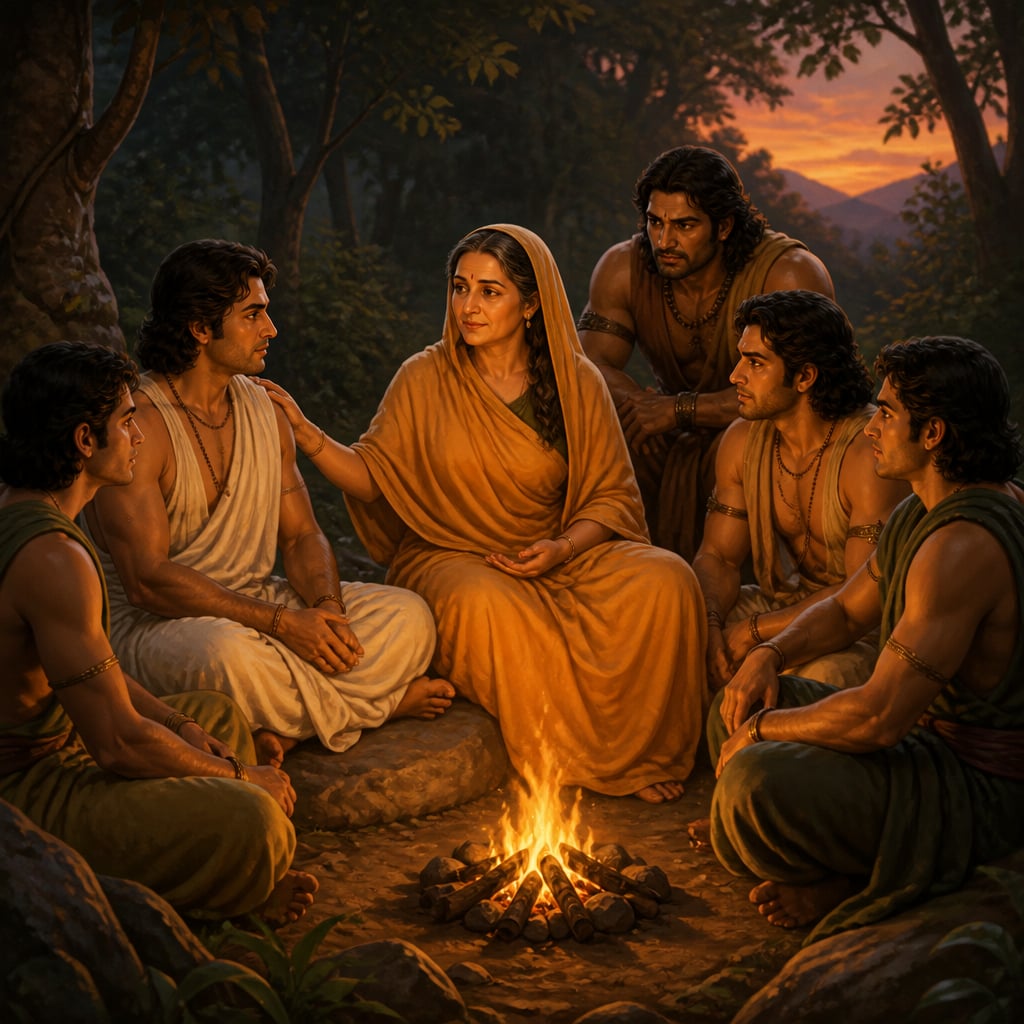
Kunti seated calmly on a forest stone in exile

She didn't command armies or strategize battles. She didn't direct her sons' actions or solve their problems. What she did was perhaps more powerful: she held space.

When Draupadi was humiliated, Kunti contained her own rage to help her daughter-in-law process hers. When Arjuna despaired, she didn't lecture, she witnessed. When the brothers quarreled, she created a field of presence where resolution could emerge.

The Rishis had a word for this capacity: Dhāraṇā, the power of holding.

This insight carries weight because: Understanding dhāraṇā reveals a mode of leadership often invisible in action-oriented cultures. The Rishis recognized that the space which holds is as powerful as what fills it. Modern research on psychological safety, therapeutic holding environments, and creative containers validates what the Vedas articulated: transformation requires safe containment before it requires direction.

Force vs. Container

Leadership discourse typically emphasizes action: decide, direct, drive, deliver. This is the ojas model, power through force.

But the Vedic tradition reveals another mode equally essential: dhāraṇā, power through containment.

Force Mode Container Mode
Push toward outcome Hold space for emergence
Direct the action Enable the process
Solve the problem Witness the struggle
Fill the silence Let silence work
Know the answer Hold the question

Both modes are necessary. The question is not which is better but which does this moment require.

Kunti understood this intuitively. During exile, her sons needed to grow into the warriors and leaders who could reclaim their kingdom. If she had directed their every move, they would have remained dependent. By holding space, present but not controlling, she created the kṣetra (field) where their transformation could unfold.

The Vedic Understanding of Dhāraṇā

In yogic philosophy, dhāraṇā means concentration, the ability to hold attention on one point. But the root meaning is simpler: dhṛ, to hold, to bear, to contain.

The earth is called dharā because she holds all beings. A vessel is dhāraṇa because it contains its contents. And a leader exercises dhāraṇā when they create a container for others' growth.

The Rig Veda presents multiple images of divine holding:

"Dyaur na bhūma" "Like heaven, the ground." , RV 1.52.12

Heaven and earth are the cosmic container, holding all existence between them without forcing anything to be other than it is. This is the archetype of dhāraṇā: presence that enables without controlling.

Aditi: The Boundless Mother

Aditi the boundless mother holding the cosmos within her open arms

The Rig Veda's supreme feminine deity is Aditi, whose name literally means "boundless" or "without limits" (a-diti). She is called the mother of the Adityas (solar deities), but more profoundly, she represents the infinite space in which all existence unfolds.

"Aditi reva dyaur aditi rntarikṣam" "Aditi is heaven, Aditi is the atmosphere." , RV 1.89.10

Aditi doesn't act in the way Indra or Agni act, fighting demons or transforming offerings. She holds the space in which all action becomes possible. Without her boundless containment, there would be no arena for creation.

This is the deepest understanding of feminine power as dhāraṇā: not the actor but the field within which action occurs.

Sayana and Aurobindo on Holding

Sayanacharya interprets Aditi as akhaṇḍa-maṇḍalākāra, having the form of an unbroken circle. She represents completeness that lacks nothing, the container that needs no external support. Her holding is not effortful but natural, the way space holds all objects without strain.

Sri Aurobindo sees Aditi as "the infinite consciousness of which all the gods are different forms." He writes:

"Aditi is the infinite Light of which the divine world is a formation... She is that which holds all the gods in her being." , Sri Aurobindo, The Secret of the Veda

For Aurobindo, holding is not passive. Aditi's boundlessness is an active infinity, consciously containing all possibilities. Similarly, human dhāraṇā requires active presence, not mere withdrawal.

Kunti: The Container That Shaped Warriors

Kunti's leadership of the Pandavas during exile exemplifies dhāraṇā at its finest.

She held grief without collapsing into it. When her sons lost everything, she didn't minimize their pain or offer false comfort. She witnessed, contained, and let grief transform naturally.

She held conflict without resolving it prematurely. The five brothers had different temperaments and often disagreed. Kunti didn't adjudicate every dispute; she held space for them to work through their differences, intervening only when necessary.

She held dignity without demanding recognition. In exile, Kunti lived humbly, never claiming the deference due a queen. This modeling of contained dignity taught her sons more than lectures could.

She held the family field through presence. Where Kunti was, the Pandavas gathered. Not through summons but through the gravitational pull of her steadfast presence.

The result: five princes entered exile as traumatized victims; five warriors emerged ready to reclaim their destiny. Kunti's dhāraṇā had created the kṣetra where transformation could occur.

Pixar's Braintrust: Corporate Dhāraṇā

Ed Catmull, co-founder of Pixar, faced a challenge: how do you get honest creative feedback in an organization where hierarchy suppresses truth?

A Pixar Braintrust meeting with directors giving candid creative feedback

His solution was the Braintrust, a meeting structure that exemplifies dhāraṇā:

No authority to mandate changes. The Braintrust gives feedback, but the director doesn't have to accept it. This removes the force dynamic that distorts honest communication.

Focus on the film, not the filmmaker. Criticism addresses the work, not the person. This creates psychological safety, the container, where even painful truths can be heard.

Candor without cruelty. The Braintrust has explicit norms: be direct but kind. This boundary defines the container's walls, what's welcome and what's not.

Regular rhythm. Braintrust meetings happen at predictable intervals throughout production. This reliability creates a kṣetra, a known space where transformation is expected.

Catmull describes the result: "The Braintrust is our primary mechanism for solving creative problems. Not by telling people what to do, but by creating the conditions where the best ideas can emerge."

This is corporate dhāraṇā: leadership through creating containers rather than directing contents.

The Practice of Holding Space

How does one develop dhāraṇā capacity?

1. Contain Your Own Reactions

Before you can hold space for others, you must be able to hold your own emotions without acting them out. When someone shares something difficult, notice your impulse to fix, advise, or deflect. Can you simply hold that impulse while remaining present?

2. Create Clear Boundaries

A container needs walls. Effective dhāraṇā defines what's welcome (honesty, emotion, struggle) and what's not (personal attacks, violations of trust). Boundless acceptance isn't holding space, it's abandonment.

3. Maintain Presence Without Filling

The hardest practice: staying present in silence or discomfort without rushing to fill it. Transformation often happens in the pauses. Your presence matters more than your words.

4. Trust the Process

Dhāraṇā requires faith that, given proper conditions, people and situations naturally move toward resolution. The container doesn't create the transformation, it enables it.

"Dharā dharaṇī dhāraṇā" "The earth holds, the foundation supports, the container sustains." , Traditional teaching

When to Hold vs. When to Force

Dhāraṇā is not always appropriate. Some situations require direct intervention, clear direction, decisive action. The art is discerning which moment calls for which response.

Hold when:

Act when:

Kunti knew when to hold and when to act. During exile, she mostly held. But when the time came to reclaim the kingdom, she supported action decisively. The container served its purpose; now different leadership was needed.

Your Turn: Becoming a Container

Notice this week: where do you rush to fix when holding might be more powerful? Where do you fill silence that wants to remain empty? Where does your need to be useful prevent others from developing their own capacity?

Aditi teaches that the boundless container is itself a form of power, perhaps the most fundamental form. Without her holding, the gods themselves would have no space to act.

You can be this container too. Not by withdrawing but by being fully present without controlling. Not by abandoning but by trusting. Not by forcing but by holding.

The Rishis called this capacity feminine, dhāraṇā, because it works through receptivity rather than force. It is available to all. The question is whether you can restrain your impulse to direct long enough to discover the power of simply holding space.

Winnicott's 'holding environment' in psychology describes the safe container a therapist (or parent) creates for emotional development. Research confirms that felt safety, the experience of being held, precedes capacity for growth.

Google's Project Aristotle found 'psychological safety' was the #1 predictor of team effectiveness, more than talent, resources, or clear goals. Safety is a container; without it, even capable people underperform.

Complex adaptive systems theory shows that transformation emerges from conditions, not control. Leaders who try to direct complex change often fail; those who create enabling conditions succeed.

Case studies

Pixar's Braintrust: The Container for Creative Truth

Pixar faced a problem endemic to creative organizations: hierarchy kills honesty. Directors are powerful; junior team members won't criticize their work. But creative excellence requires honest feedback. Ed Catmull needed a structure that would enable truth-telling without the distortions of power. His solution was the Braintrust, not a decision-making body but a container for candor.

The Braintrust exemplifies kṣetra-racanā, field creation. It has clear boundaries: feedback addresses the film, not the filmmaker; the Braintrust advises but cannot mandate; candor must be constructive. These boundaries create safety. Regular meetings create rhythm. The result is a dhāraṇā container where truths too dangerous for normal hierarchy can safely emerge.

Pixar produced 16 consecutive hits, from Toy Story to Coco, a record unmatched in film history. Former Pixar president Jim Morris credits the Braintrust: 'It's not about telling people what to do. It's about creating conditions where the best ideas can emerge.' The container, not direction, produced the excellence.

The Braintrust demonstrates that organizations can institutionalize dhāraṇā. By creating a defined kṣetra with clear boundaries and rhythms, Pixar enabled honest feedback that hierarchy would normally suppress. The lesson for leaders: sometimes the most important thing you build is not a product but a container.

Psychological safety research by Google's Project Aristotle confirmed that the highest-performing teams share one trait: members feel safe to take risks and speak honestly. Creating structured containers for candid feedback, like Pixar's Braintrust, is now recognized as a core leadership capability in creative and knowledge-intensive industries.

Pixar's films have earned over $14 billion worldwide and won 23 Academy Awards. Catmull attributes this success primarily to the Braintrust container, not to individual genius.

Kunti: The Container That Shaped Kings

When the Pandavas were exiled from Hastinapura, they lost everything, kingdom, status, security. Five princes, one wife, and their mother Kunti faced thirteen years of wandering. The trauma could have fragmented the family. Instead, they emerged stronger, more unified, ready to reclaim their destiny. At the center of this transformation was Kunti's quiet leadership.

Kunti practiced dhāraṇā, holding space without controlling. She didn't direct her sons' training or strategize their return. She held grief without collapsing, conflict without resolving prematurely, dignity without demanding recognition. Her presence created the kṣetra, the stable field, within which her sons could transform from traumatized princes into warrior kings.

The Pandavas who entered exile were dependent and defeated. Those who emerged were self-reliant, unified, and capable of winning the greatest war in Indian epic history. Kunti's contribution wasn't battlefield strategy, it was the container that enabled their growth. Her dhāraṇā was invisible but essential.

Kunti demonstrates that some of the most important leadership is invisible. She didn't give orders or solve problems, she created the conditions where her sons could develop their own capacity. This is maternal wisdom applied to leadership: the container is as important as the contents it holds.

The most effective mentors and coaches create conditions for growth without directing every step. This 'container' approach to leadership is visible in programs like Y Combinator, where the structure provides safety and accountability but the founders make their own decisions. Holding space for development is itself a form of leadership.

During the 13-year exile period, Kunti held together a family of 6 adults and their household through forest life, incognito service, and political uncertainty, ultimately producing 5 warriors who defeated a 11-akshauhini army.

Reflection

More in Śakti: Feminine Intelligence in Leadership

All lessons in Śakti: Feminine Intelligence in Leadership · Rig Vedic Leadership course