Sutra: The Eternal Thread

Connection Beyond Control

Release is not rejection. Learn from Jabala, the single mother who sent her son Satyakama into the world armed only with truth. Discover how to maintain eternal connection across distance, how blessing replaces control, and how the grandparent role becomes the final flowering of parental love. The thread doesn't break when you let go, it transforms into something that can never be severed.

The Video Call at 3 AM
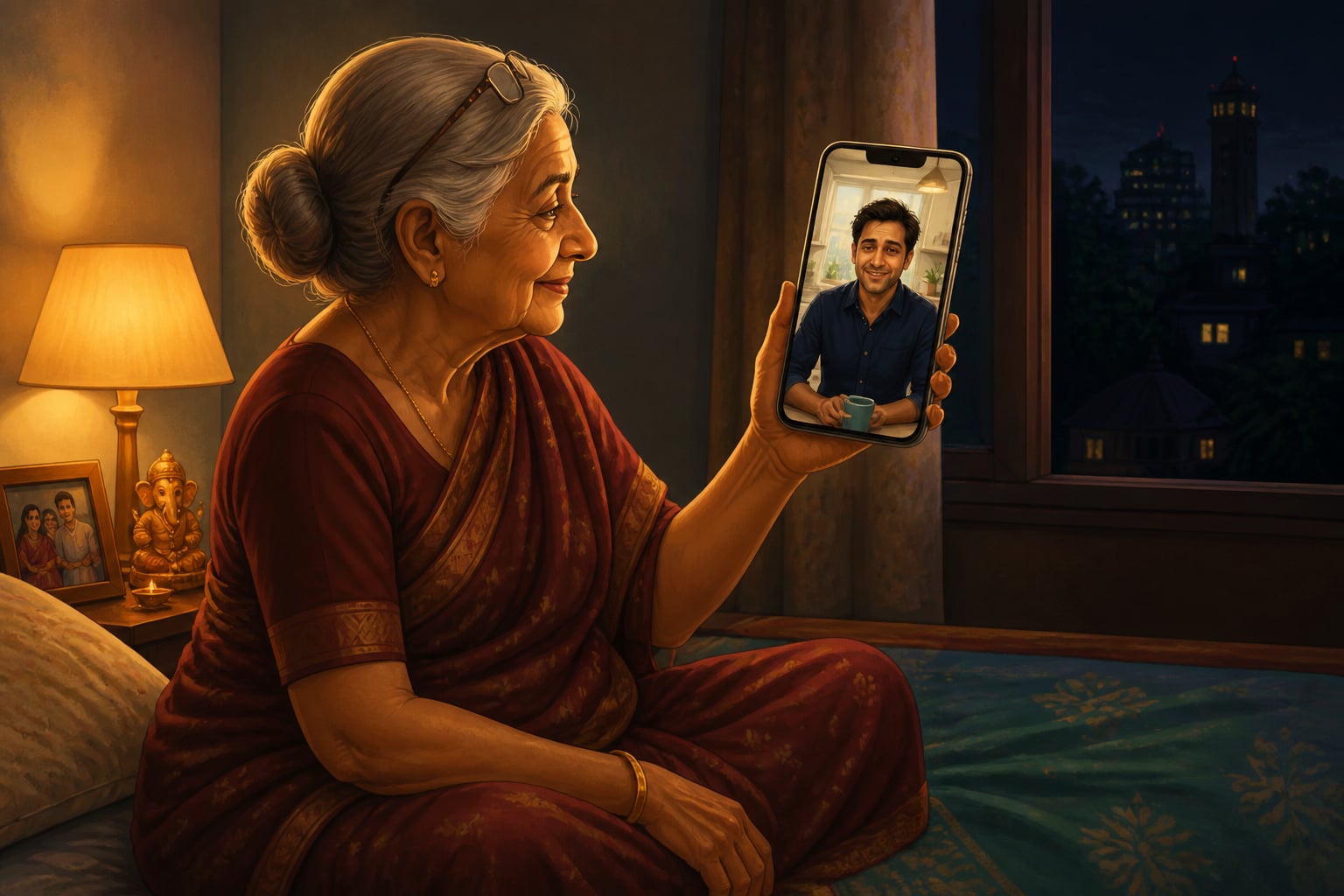
Mother on a 3 AM video call with her son in Seattle

Sunita's phone buzzed at 3:14 AM. She was already awake, had been awake for hours, actually, scrolling through Rohan's Instagram posts from his new life in Seattle, 13,000 kilometers away.

"Amma?" His face appeared on the screen, tired but happy. "I got it. The promotion. I'm now the team lead."

She watched her son, this man who had once fit entirely in her arms, celebrate an achievement she would only ever know through a screen. For a moment, grief ambushed her. He was there, she was here, and no amount of technology could bridge the fundamental truth: her son was living a life she could no longer touch.

Then something shifted. She looked at his face, the confidence, the accomplishment, the man he had become, and felt something larger than grief.

Pride. Joy. Completion.

"I'm so proud of you, Rohan," she said, and meant it with her whole being. "You built this yourself."

"I couldn't have done it without everything you gave me, Amma. Everything."

In that moment, across continents and time zones, the thread between them hummed with something that distance couldn't diminish. Not control, she had released that years ago. Not presence, they would be lucky to see each other twice a year. Something else. Something that didn't require proximity or power to remain alive.

The eternal thread.

The Sutra That Cannot Be Cut

The Sanskrit word sutra means thread, the invisible connection that binds things together. A sutra holds beads on a necklace, ideas in a teaching, souls in relationship.

The parent-child sutra is unique. Unlike the guru-shishya bond (which ends with graduation) or the spousal bond (which can dissolve), the parent-child connection is permanent. You will always be your child's parent. They will always be your child. Death itself doesn't sever this, the connection simply transforms into memory, into legacy, into the subtle ways one person's life shaped another's.

But here's what many parents miss: the sutra doesn't require control to remain strong. In fact, control weakens it. The parent who grips too tightly often finds the thread frayed or broken, children who pull away, who avoid contact, who experience their parent as burden rather than blessing.

The parent who releases, who trusts the thread to hold even without gripping, often finds the connection stronger than ever. Released children return willingly. They call because they want to, not because they feel obligated. They share their lives because the parent has made sharing safe.

The eternal thread is maintained not by holding but by blessing.

Jabala's Gift: Truth Over Control

The Chandogya Upanishad tells a story rarely cited in parenting discussions, yet profoundly relevant.

Jabala was a single mother. Her son Satyakama wanted to study with a great teacher, but the tradition required knowing one's lineage, specifically, one's father's lineage. Satyakama didn't know who his father was.

He went to his mother and asked: "Mother, I wish to study as a brahmachari. What is my lineage? What shall I tell the teacher?"

Jabala's response is remarkable. She didn't evade. She didn't construct a story. She didn't try to control the situation:

"I do not know, dear child, of what lineage you are. In my youth, I was a servant and moved about much. I do not know your father. I am Jabala, and you are Satyakama. So call yourself Satyakama Jabala."

Jabala kneeling in a sunlit courtyard tenderly telling young Satyakama the truth of his lineage.

She gave her son the only thing she could give with certainty: the truth. Her name. Her identity. And then she released him into the world to seek his own path.

Satyakama went to the sage Gautama and, when asked his lineage, repeated exactly what his mother told him, the uncertain truth about his birth, and his mother's name.

Gautama's response surprised everyone:

"None but a true brahmin would speak thus. Bring the fuel, dear child. I will initiate you. You have not swerved from the truth."

The teacher accepted Satyakama precisely because of his truthfulness, the quality his mother had given him. Jabala's gift wasn't a prestigious name or social position. It was honesty. And that gift carried her son further than any lineage could have.

What Jabala Teaches Modern Parents

Jabala's situation was difficult, a single mother of uncertain status, sending her son into a world that valued lineage above almost everything. She had every reason to be anxious, controlling, protective. She could have tried to manage the situation: "Tell the teacher this story about your father..." or "Wait until I can arrange a better introduction..." or "Maybe you shouldn't study with such a prestigious teacher."

She did none of this. She gave him truth and let him go.

Consider what this required:

1. Trust in what she had given him. Jabala trusted that the values she had instilled, especially truthfulness, would serve her son even when she couldn't be present to protect him.

2. Acceptance of uncertainty. She didn't know how the teacher would respond. She released Satyakama into a situation whose outcome she couldn't control.

3. Connection through character, not control. Her relationship with her son was maintained not by managing his life but by the character she had formed in him. Every time he told the truth, he was connected to her teaching.

4. Identity through naming. "Satyakama Jabala", seeker of truth, son of Jabala. She gave him both direction (seek truth) and connection (carry my name). The name itself became the thread.

This is the eternal thread: not control but character. Not management but meaning. Not presence but the values that operate in her absence.

The Long-Distance Dharma

Sunita's situation, a son in Seattle, parents in Chennai, is increasingly common. Global careers scatter families across continents. The parent who once could visit their child's room now visits their child's timezone.

How do you maintain the eternal thread across 13,000 kilometers?

Presence Without Proximity

The key insight: presence is not the same as proximity. You can be physically close but emotionally absent. You can be physically distant but profoundly present.

Sunita learned to be present in Rohan's life without being proximate:

Scheduled Rituals: Every Sunday morning (Saturday evening for Rohan), they video called. Not to "check up" on him, to be present. To hear about his week. To share her own life. To exist together across distance.

Significant Moments: She sent handwritten letters on his birthday, promotion days, difficult days. Physical mail that crossed the ocean, a tangible thread.

Shared Practices: They both lit diyas on Diwali, at the same moment (accounting for timezones). They both observed his grandmother's death anniversary. Ritual as connection.

Respect for His Life: She didn't call at random hours "just to check." She respected that he had a life, a schedule, responsibilities. Her presence was invited, not imposed.

The thread remained strong not despite the distance but in some ways because of it. Each contact was intentional. Each conversation was valued. The casual taken-for-grantedness of proximity was replaced by the conscious cultivation of connection.

When Control Fails, Blessing Succeeds

Sunita's early attempts to stay connected looked different. She called daily, sometimes twice. She asked probing questions about his diet, his sleep, his friendships. She offered unsolicited advice about his career. She worried out loud about his choices.

Rohan started avoiding her calls.

The turning point came when Sunita's own mother, Rohan's grandmother, observed gently: "Beta, when you call him every day asking if he's eating properly, you tell him you don't trust him to take care of himself. When you worry about his choices, you burden him with your anxiety. Is that what you want to give him?"

Sunita reflected. What did she want to give Rohan across the distance? Not worry. Not anxiety. Not the message that she doubted his competence.

She wanted to give him blessing.

Blessing is different from control. Control says: "I need to manage this." Blessing says: "I believe in you, and I send you my good wishes."

Sunita changed her approach. Instead of daily calls, weekly scheduled calls. Instead of questions that felt like interrogation, genuine curiosity about his life. Instead of advice, listening. And at the end of every call: "I'm proud of you. I bless you. I know you'll handle whatever comes."

Rohan started calling her more. Not because she demanded it, because he wanted to. The thread strengthened precisely when she stopped pulling on it.

The Grandparent Dharma

For many parents, the ultimate evolution is becoming a grandparent. The relationship with your child transforms again, now you're connected not just to them but through them to their children.

The grandparent role is distinct from the parent role, and confusion between them causes suffering.

What Grandparents Are (and Aren't)

Grandparents ARE:

Grandparents ARE NOT:

The grandparent who respects this boundary often has more influence, not less. Grandchildren love visiting grandparents who are warm without authority. Parents appreciate grandparents who support without undermining.

The Three Gifts of Grandparenthood

Gift 1: Unconditional Acceptance

Parents must sometimes be conditional. ("You can have dessert after you eat your vegetables.") Grandparents can be the place of unconditional acceptance, the people who love the child simply for existing.

This doesn't mean no boundaries. It means the child knows: "With grandmother, I don't have to earn love. I just have it."

Gift 2: Living History

Grandparents are the connection to the past. They knew great-grandparents. They remember events before parents were born. They are living proof that time extends beyond the child's short memory.

The stories grandparents tell, about family members who died before the grandchild was born, about historical events they witnessed, about how life was different, are irreplaceable. No one else can give these stories.

Gift 3: The Long View

When parents panic ("She failed her exam! Her future is ruined!"), grandparents can offer perspective. They've seen many exams. Many failures. Many recoveries. They know that most crises resolve.

This perspective, offered gently, not dismissively, is genuinely helpful. "I remember when your father failed his 10th board exam. He was devastated. Now look at him." This isn't undermining parental concern; it's contextualizing it.

The Intergenerational Thread

The parent-child sutra is actually part of a longer thread stretching across generations. You are connected to your parents, who were connected to theirs, extending back through time. Your children will be connected to their children, extending forward.

This perspective changes how we think about release.

When Jabala sent Satyakama into the world, she was not ending their connection. She was extending it. Everything she had taught him would now flow through him to others, his own students, eventually his own children. Her values would propagate beyond her lifespan.

When Sunita released Rohan to Seattle, she was not losing him. She was extending the thread. Rohan will eventually have his own family. Sunita's values, her recipes, her ways of being, these will influence people she may never meet. Her legacy extends through him.

This is the ultimate form of connection: influence that outlasts presence.

What Remains When Control Ends

Let's be clear about what parents retain when they release control:

You retain your history together. Every moment you shared, the first steps, the school plays, the arguments, the reconciliations, these are permanent. No one can take them.

You retain your influence. The values you instilled, the lessons you taught, the example you set, these operate in your child even when you're not there. Especially when you're not there.

You retain your blessing. The good wishes you send, the prayers you offer, the faith you have in them, this energy matters, whether you understand it mystically or psychologically.

You retain your welcome. Your home, your presence, your open arms, these remain available. The child who was released can always return for rest, for counsel, for connection.

You retain your love. Obviously. Love doesn't require control. Love that releases is actually stronger than love that grasps.

What you lose is the illusion of control, an illusion that was always false. You never really controlled your child. You influenced, guided, protected, corrected, but control implies the ability to determine outcomes, and no parent has that power.

Releasing control means releasing a burden that was never truly yours to carry.

Sunita's Final Transformation

Years after Rohan moved to Seattle, Sunita received different news. Rohan was getting married, to a woman named Emily, whom Sunita had met only twice, via video call.

The old Sunita might have panicked. An American daughter-in-law? Different culture, different religion, different food? What about grandchildren, would they even know Tamil? Would they visit India? Would they know Sunita at all?

The new Sunita, the one who had learned the eternal thread, responded differently.

"Tell me about Emily," she said. "Not what she does for work. Tell me who she is. What makes Rohan love her?"

She listened. She asked genuine questions. She expressed warmth.

At the wedding, held in Seattle, a 26-hour journey from Chennai, Sunita performed the traditional aarti for the couple. Emily, who had been nervous about her Indian mother-in-law, was surprised by Sunita's warmth, her lack of judgment, her genuine welcome.

"I was afraid you might not accept me," Emily confessed later.

"Why would I not accept the woman my son loves?" Sunita replied. "You make him happy. That makes you family. And family is eternal."

Grandmother seeing her newborn granddaughter on a video call

Three years later, when the video call came at an odd hour, Sunita knew before answering.

"Amma, meet your granddaughter. Maya Jabala Morrison."

Maya. Her mother's name. Jabala. Truth-seeker, like the ancient Satyakama. Morrison. Emily's family.

The thread extended again, now reaching into a future Sunita could barely imagine. A girl who would grow up in Seattle, speaking English as her first language, but named for two women on different continents who had both understood: the eternal thread doesn't require control. It requires love. It requires trust. It requires the courage to release.

The Final Teaching

This course began with a question: How do we raise children in the modern world, drawing on ancient wisdom?

The answer, across six chapters, has been consistent:

And now, the final teaching: the thread doesn't break when you let go.

Jabala sent Satyakama into the world with nothing but his name and the truth. He became one of the great sages. Her legacy extended through him for millennia.

You too will send your children into a world you cannot control. You too will watch them face challenges you cannot solve. You too will see them make choices you might not have made.

This is not failure. This is success.

The purpose of parenting is to work yourself out of a job, to raise humans who don't need you to manage them. The reward is not continued control but something better: a relationship of equals, of mutual respect, of chosen connection.

The thread holds. It has always held. It will always hold.

You can let go now.

Cultivate mental and emotional presence that transcends physical proximity. Your child can feel whether you're thinking of them with trust or with worry, and the quality of that mental presence shapes the relationship.

Research on long-distance relationships shows that quality of communication matters more than quantity. Couples and families who connect intentionally and meaningfully maintain stronger bonds than those who communicate frequently but superficially.

The Dharmic concept of 'sankalpa', focused intention, provides a framework. Your daily sankalpa for your child can be blessing rather than worry. This isn't just psychological; it shapes how you communicate and what energy you transmit.

Jabala was not physically present when Satyakama faced Gautama's question. But her presence, through the values she had instilled, through her name on his lips, was operative in that moment. She was present through what she had given, not through physical proximity.

Shift from control to blessing as your primary mode of connection. Instead of trying to manage outcomes, send good wishes. Instead of advising, affirm. Instead of worrying, trust. The energy of blessing strengthens connection; the energy of control weakens it.

Research on parental support shows that perceived emotional support matters more than practical help. Children who feel their parents believe in them perform better than children who receive more tangible assistance but feel doubted.

Case studies

Jabala's Release: When Truth Is All You Can Give

Jabala was a single mother in Vedic society, a world that valued lineage above almost everything. Her son Satyakama wanted to study with a great teacher, but admission required stating one's father's lineage. Jabala didn't know who Satyakama's father was.

Jabala faced a choice that every parent eventually faces in some form: she couldn't control her son's circumstances, only his character. **Option 1: Control through deception** She could have invented a lineage, given Satyakama a story to tell, tried to manage his reception. This might have worked short-term but would have built his future on a lie. **Option 2: Control through prevention** She could have discouraged him from seeking a prestigious teacher, steered him toward a path where lineage wouldn't matter, protected him from potential rejection. This would have limited his potential to protect him from uncertainty. **Option 3: Release through truth** She chose to give him the truth, including the uncertainty, and trust him to navigate what came. She gave him her name, her identity, and the value of honesty. Then she let him go. Jabala's release was complete. She didn't accompany him to advocate. She didn't try to explain or smooth the way. She trusted that what she had given him, truth and identity, would be enough.

Satyakama's truthfulness, operating in his mother's absence, was exactly what the teacher valued. Jabala's gift proved more valuable than any prestigious lineage. Satyakama went on to become one of the great sages, his teachings preserved in the Upanishads themselves. Jabala's legacy extended far beyond what she could have controlled.

When you cannot control circumstances, give character. When you cannot be present, give values that operate in your absence. The thread holds through what you've instilled, not through what you manage. Trust your parenting enough to release your child into uncertainty.

Single parents, adoptive parents, and families with unconventional structures often worry that their children lack something essential. Jabala's story reframes this entirely. What matters is not the family structure but the values instilled within it. A child who learns honesty, courage, and self-knowledge from a single mother carries more lasting advantage than one who inherits a prestigious surname but no character. The circumstances you cannot control matter far less than the values you choose to teach.

The Chandogya Upanishad (4.4) records that Guru Gautama accepted Satyakama solely because of his truthfulness. Satyakama went on to become a renowned Upanishadic sage whose own teachings appear in the Jabala Upanishad.

The Chennai-Seattle Connection: Presence Without Proximity

Sunita's son Rohan moved to Seattle for work, 13,000 kilometers from Chennai. After decades of daily presence, Sunita now had to maintain connection across time zones, cultures, and the fundamental limitation of screens.

Sunita's journey through this transition illustrates the path from control to connection: **Phase 1: Control Through Proximity (Failed)** Initially, Sunita tried to replicate her previous relationship. Daily calls. Detailed questions about diet, sleep, work, relationships. Advice offered (and not asked for). Result: Rohan started avoiding her calls. Distance increased. **Phase 2: Recognition** Sunita's mother observed: 'Your worry is a burden on him. Your checking is a message that you don't trust him.' This was hard to hear but true. **Phase 3: Release Into Blessing** Sunita shifted her approach: - Weekly calls, scheduled, respecting his time - Listening more than advising - Sharing her own life, not just inquiring about his - Ending calls with blessing, not worry: 'I'm proud of you. I trust you.' **Phase 4: Connection Restored** Rohan started calling more. Not because she demanded it, because he wanted to. The thread strengthened precisely when Sunita stopped pulling on it.

The relationship transformed. Sunita stopped being Rohan's manager and became his confidante, someone he chose to share with rather than someone he had to report to. When he got married, when his daughter was born, Sunita was welcomed as honored family rather than tolerated as obligation. The distance remained, but the connection deepened.

Presence doesn't require proximity. Connection doesn't require control. When you release your grip on the thread, it often becomes stronger. Your child's willing choice to stay connected is more valuable than their obligated tolerance of your management.

Millions of Indian parents face this exact situation: children in the US, UK, Canada, or Australia while they remain in India. The parents who maintain the strongest long-distance bonds are those who share their own lives rather than only interrogating their children's. A mother who talks about her morning walk, her friend's visit, or a book she read gives her child a reason to call. A mother who only asks 'Did you eat? When are you coming home?' gives her child a reason to avoid calling.

According to 2023 data from the Ministry of External Affairs, over 18 million Indians live abroad in the diaspora. A Pew Research study found that 72% of Indian Americans maintain weekly or more frequent contact with family in India.

Becoming Maya's Grandmother: The Final Role

When Sunita's granddaughter Maya was born in Seattle, Sunita faced the grandparent's challenge: how to be meaningfully present in a grandchild's life when you live on another continent, and when the grandchild is growing up in a different culture.

Sunita had learned from her earlier mistakes with Rohan. She didn't try to control Maya's upbringing or criticize how Rohan and Emily were parenting. Instead, she focused on what only a grandmother can give: **The Gift of Stories** Via video call, Sunita told Maya stories from Indian tradition, Panchatantra tales, stories of Krishna, family history. These stories created connection across distance and culture. **The Gift of Presence Without Authority** When Sunita visited (twice a year), she wasn't a second parent. She was the grandmother, the one who spoiled, who listened, who didn't enforce rules. Maya learned: grandmother is safety, is unconditional love. **The Gift of Legacy** Sunita taught Maya to cook one Tamil dish per visit. By age 10, Maya could make sambar and rasam. She couldn't speak Tamil, but she could cook it. The thread held through recipes. **The Gift of Perspective** When Maya struggled with school, Sunita didn't offer advice. She offered perspective: 'Your father struggled too, at your age. Look at him now.' When Maya fought with friends, Sunita listened without solving. The long view. **The Gift of Naming** Maya's middle name, Jabala, connected her to the ancient story. 'You're named for the mother who gave her son truth,' Sunita told her. 'That's what our family does. We tell the truth, even when it's hard.'

Maya, growing up in Seattle with an American mother and Indian father, developed a genuine connection to her Indian heritage, not through obligation but through stories, food, and relationship. Sunita's influence extended to a child she saw only twice a year, through the deliberate cultivation of the eternal thread.

The grandparent role is different from the parent role, and in some ways better. You can give unconditional love, long perspective, and cultural legacy without the burden of daily discipline. If you respect the distinction, your influence may be greater, not lesser.

Diaspora grandparents who try to parent remotely, criticizing food choices, questioning schooling decisions, or competing with the other set of grandparents, often get shut out. Those who focus on what only they can give, stories from the homeland, recipes, family history, unconditional warmth, become irreplaceable anchors of identity. A grandchild who can cook one ancestral dish carries a cultural thread that no amount of lecturing about 'our culture' can replicate.

A 2019 study published in the Journal of Intergenerational Relationships found that grandchildren who had regular meaningful contact with grandparents showed 15% to 20% higher scores on measures of emotional wellbeing and cultural identity than those with minimal grandparent involvement.

Living traditions

Reflection

More in Tyaga: The Art of Letting Go

All lessons in Tyaga: The Art of Letting Go · Parenting Dharma course