Sanskaras vs Aimlessness

Meaningful Life Transitions

Understand why Dharmic tradition created Sanskaras, meaningful rituals marking life transitions, and why their absence in modern culture produces extended adolescence, perpetual students, and boomerang adults. Learn how to create meaningful transition rituals for your family, whether through traditional or contemporary means.

The 34-Year-Old Who Was Still Finding Himself
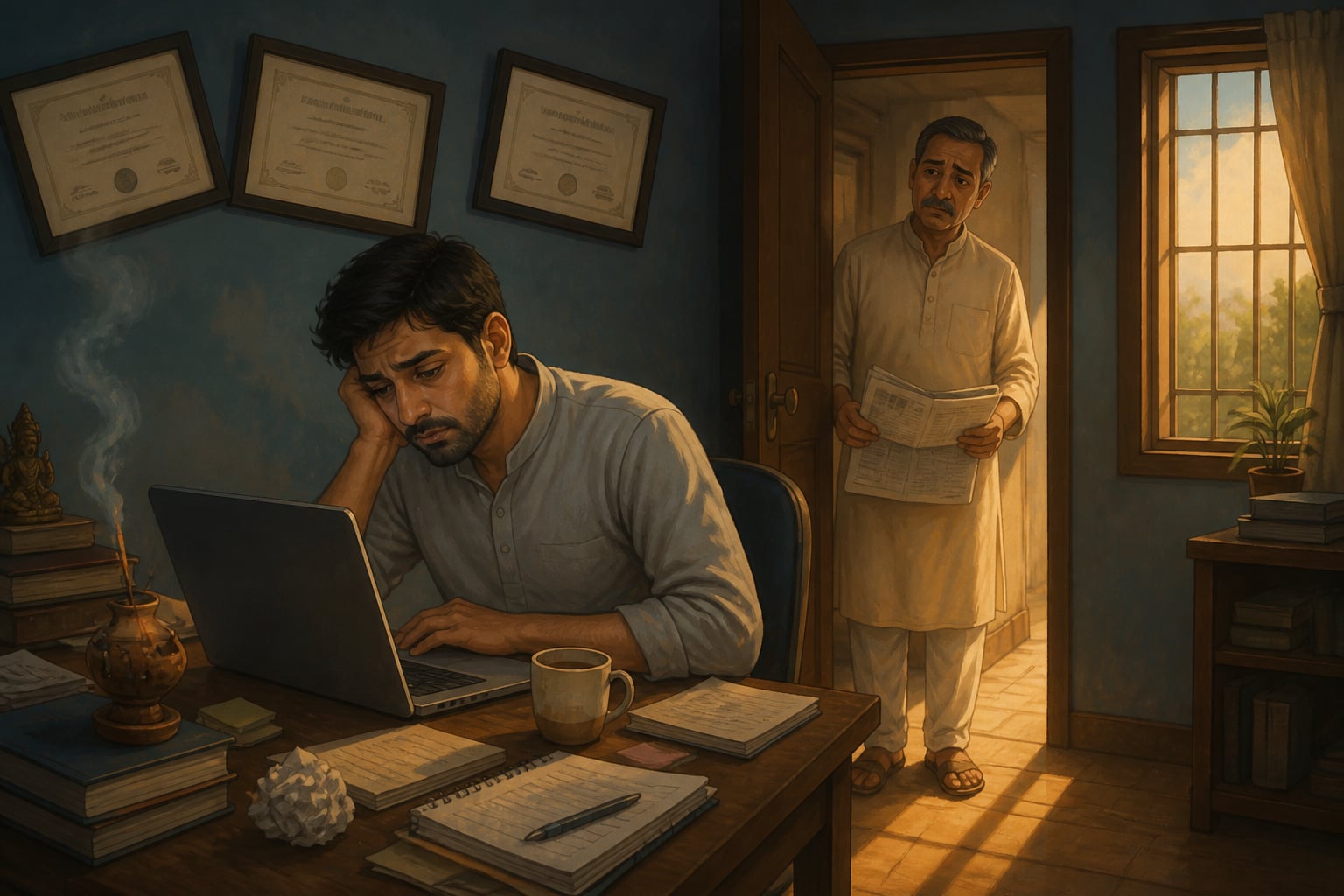
Akhil at a cluttered desk beneath three master's degree certificates

Akhil had three master's degrees. An MBA from a top-10 school. A master's in philosophy. A certificate in data science. He was working on a fourth credential, a certification in life coaching, when his father finally asked the question they'd both been avoiding.

"Beta, when will you start living?"

Akhil looked up from his laptop. "What do you mean? I'm preparing."

"You've been preparing for fifteen years. What are you preparing for?"

Akhil didn't have an answer. The truth was, he'd been preparing so long that preparation had become the point. Each degree delayed the terrifying moment when preparation ended and real life began. Each certification was a way to avoid committing to any particular path.

At 34, Akhil was still "exploring his options." He'd never held a job for more than two years. Never committed to a relationship longer than six months. Never lived in his own apartment for more than eighteen months before moving back to his parents' house "temporarily."

His parents had never pushed. They'd funded every degree, welcomed every return, supported every pivot. They'd never once said: "Enough. You are now an adult. It is time to live as one."

And so Akhil remained suspended, not a child, not quite an adult, perpetually becoming, never being.

This is what happens when a culture abandons its rituals of transition.

The Aimlessness Epidemic

Akhil is not unusual. He represents a generation, perhaps two generations now, caught in extended adolescence.

The statistics are stark:

Marker 1960 2020
Median age at first marriage 22 (women), 25 (men) 28 (women), 30 (men)
% living with parents, ages 25-29 8% 52%
% achieving 5 markers of adulthood by 30 77% 24%
Average age of financial independence 21 26 (and rising)
% of 30-somethings "still figuring it out" Not measured 43% (Pew 2019)

The five traditional markers of adulthood, finishing education, leaving home, achieving financial independence, marrying, and having children, are being delayed or abandoned entirely. Young people spend their twenties and often their thirties in a prolonged state of exploration that previous generations would have found incomprehensible.

This isn't because young people are lazier or less capable. It's because they've been given no clear markers telling them: "You are now an adult. Act like one."

The Three Syndromes

The aimlessness epidemic manifests in three recognizable patterns:

1. Extended Adolescence Syndrome

Characteristics:

The eternal question: "What do I really want to do?", asked at 35, with no more clarity than at 22.

2. Boomerang Syndrome

Characteristics:

The eternal cycle: Leave → Struggle → Return → "This time I'll figure it out" → Leave → Struggle → Return.

3. Perpetual Student Syndrome

Characteristics:

The eternal delay: "Once I finish this degree, I'll know what I want." (Spoiler: they won't.)

All three syndromes share a common root: the absence of clear transitions that say, unmistakably, "This phase is over. The next has begun."

The Dharmic Solution: Sanskara as Milestone

The Vedic tradition solved this problem millennia ago through the Sanskara system, sixteen major rituals (or more, depending on tradition) marking life's transitions. Each Sanskara served multiple functions:

1. Public Declaration: The community witnessed the transition, creating social accountability.

2. Psychological Marker: The individual experienced a clear before/after, "I was a child; now I am a student."

3. Expectation Shift: Both individual and community understood that new responsibilities and capabilities now applied.

4. Irreversibility: Once performed, the Sanskara couldn't be undone. There was no going back to the previous stage.

5. Blessing and Support: The transition came with community blessing, not just "good luck" but genuine investment in success.

Three Sanskaras are particularly relevant to the transition from childhood to adulthood:

Upanayana: From Child to Student

The Upanayana (sacred thread ceremony) traditionally marked the transition from dependent childhood to disciplined studentship. The child became a brahmachari, one committed to learning and self-development.

What happened:

What it meant psychologically:

Without Upanayana (or equivalent), children drift into adolescence with no clear marker. They're still "kids" at 15, at 18, at 22, the boundary between childhood and responsible studentship never drawn.

Samavartana: From Student to World-Ready Adult

The Samavartana marked the completion of formal education. The student was now ready to return to the world and take up adult responsibilities.

What happened:

What it meant psychologically:

Without Samavartana (or equivalent), graduation becomes meaningless. A diploma arrives in the mail. A ceremony happens that's barely distinguishable from a conference. There's no moment where the community declares: "You are ready. Now act."

Vivaha: From Individual to Responsible Householder

Vivaha (marriage) marked the transition to full adult responsibility, not just for oneself but for family and household.

What happened:

What it meant psychologically:

Without meaningful Vivaha (or equivalent commitment ritual), adults remain in perpetual singlehood, not by conscious choice but by drift. The transition to responsibility-for-others never crystallizes.

The System: Progressive Transitions

The brilliance of the Sanskara system lies in its progressiveness. Each transition builds on the previous:

Bala (Child) → [Upanayana] → Brahmachari (Student) → [Samavartana] → Snataka (Graduate) → [Vivaha] → Grihastha (Householder)

At each stage, responsibility increases. At each transition, a clear marker signals: "The previous phase is complete. You cannot return to it."

The modern default is:

Child → (fuzzy boundary) → Teenager → (fuzzy boundary) → College Student → (fuzzy boundary) → "Adulting" → (fuzzy boundary) → ???

No clear markers. No irreversible transitions. No community declaration. No psychological crystallization. Just... drift.

Arjuna's Samavartana: When the Master Said "Enough"

Consider how Drona handled Arjuna's transition from student to adult warrior.

Arjuna was Drona's finest student, perhaps the greatest archer the world had seen. Arjuna loved learning. He would have happily remained at the gurukul indefinitely, refining his skills, avoiding the messiness of real-world conflict.

But Drona understood that perpetual studentship is its own prison.

When Arjuna's training was complete, Drona didn't ask: "Do you feel ready?" He didn't suggest: "Maybe one more year of practice?" He declared:

"You have learned what I can teach. Now go. The world awaits your arrows."

The Samavartana was performed. Arjuna's studentship was formally, publicly, irreversibly ended. He could not return to the comfortable identity of "Drona's student." He was now Arjuna the warrior, expected to perform, not just prepare.

Drona's gift was not endless teaching. It was the courage to say: "Enough. You are ready. Now live."

Drona at sunrise handing a great wooden bow to Arjuna as a parting blessing at Samavartana.

Shvetaketu's Humbling: When Preparation Meets Reality

The Chandogya Upanishad tells a different but complementary story.

Shvetaketu standing before his father Uddalaka in the courtyard

Shvetaketu, son of the sage Uddalaka, had studied for twelve years at a renowned gurukul. He returned home proud, convinced of his own learning, expecting to be treated as a master.

His father asked a simple question:

"Do you know that by which the unheard becomes heard, the unthought becomes thought, the unknown becomes known?"

Shvetaketu had no idea what his father meant. Despite twelve years of study, he had missed the essential teaching, the knowledge of the Self that underlies all other knowledge.

Humbled, he asked his father to teach him. Uddalaka then delivered one of the Upanishads' most famous teachings, culminating in the great declaration: Tat tvam asi, "You are That."

The lessons for transition:

1. Return from study is not completion. Shvetaketu thought his education was finished because his formal studentship ended. His father showed him that learning continues, but in a different mode.

2. Humility is part of transition. The arrogance of the returning graduate, "I know everything now", must be tempered by the wisdom that real learning has just begun.

3. The parent's role changes. Uddalaka didn't treat Shvetaketu as a student; he treated him as a fellow seeker. The relationship evolved.

4. Transition includes testing. Uddalaka's question was a test, a way of showing Shvetaketu that graduation is not mastery but readiness for the next level.

The Modern Absence and Its Cost

What happens when these markers don't exist?

No Upanayana equivalent:

No Samavartana equivalent:

No Vivaha equivalent:

The cost is Akhil, 34, three degrees, no direction, still preparing for a life he's afraid to begin.

Creating Modern Sanskaras: Family Examples

Example 1: The Sharma Family (Traditional Hindu)

The Sharmas maintained traditional Sanskaras but made them psychologically meaningful rather than merely ritual.

Upanayana (Age 12): When their son Rohan turned 12, they performed a full traditional Upanayana with priest, sacred thread, and mantras. But they also:

Samavartana (Age 22, after college): When Rohan graduated from college, they performed a simplified Samavartana ritual. They also:

Impact: Rohan describes feeling "marked" by these transitions. "I knew I couldn't go back to being treated like a kid after my Upanayana. And after Samavartana, I knew my parents wouldn't bail me out every time I struggled. I had to become an adult because the rituals said I was one."

Example 2: The Patel Family (Secular Adaptation)

The Patels weren't religiously observant but recognized the need for meaningful transitions.

Age 13: The Responsibility Ceremony On their daughter Priya's 13th birthday, they held a private family ceremony:

Age 18: The Launch Conversation On Priya's 18th birthday, instead of a traditional party:

Age 22: The Graduation Transition After college graduation:

Impact: Priya says: "I didn't have religious rituals, but I had clear markers. I knew when childhood ended and when adulthood began. My parents didn't just let me drift, they told me, clearly, 'You're an adult now. We believe in you.'"

Example 3: The Krishnamurthy Family (Contemporary Hindu)

The Krishnamurthys blended traditional elements with contemporary relevance.

Upanayana (Age 11, reframed): Rather than performing the traditional ceremony for their son Aditya, they:

Samavartana (Age 21, after engineering):

Vivaha (Age 28): When Aditya married:

Impact: Aditya's wife notes: "He came into marriage knowing what adulthood meant. He didn't expect his parents to manage our lives. He'd had clear transitions, he knew he was responsible now."

Building Your Family's Transition Framework

You don't need to replicate traditional Sanskaras exactly. But you do need to create clear markers. Here's a framework:

Elements of an Effective Transition Ritual

1. Community Witness

2. Clear Declaration

3. Symbol or Artifact

4. New Responsibilities

5. Irreversibility

Suggested Transition Points

Age Transition From → To Key Element
12-13 Responsibility Ceremony Child → Young Person First real responsibilities, consultation begins
16 Driving/Independence Rite Dependent → Semi-autonomous Freedom AND accountability linked
18 Legal Adulthood Minor → Legal Adult Full autonomy AND full consequences
21-22 Launch Student → Independent Adult Financial and practical independence begins
First Major Commitment Commitment Ceremony Individual → Responsible-for-Others Marriage, first home, first dependent

The Parent's Role in Transition

Transitions aren't just ceremonies, they're parental commitments to change behavior.

Before the transition:

At the transition:

After the transition:

The Sharma parents didn't keep managing Rohan's life after his Samavartana because they had declared, in front of family, that he was now an adult. To manage him afterward would be to deny their own words.

This is why public declaration matters: it holds parents accountable, not just children.

What Drona and Uddalaka Teach Parents

From Drona:

From Uddalaka:

Both teachers understood: transition is not abandonment. It's elevation.

The young person who never receives a clear transition isn't being protected, they're being stunted. They remain in perpetual adolescence because no one ever said: "That phase is over. Welcome to the next."

A Letter to the Aimless

If you are Akhil, 34 with three degrees and no direction, hear this:

Your parents didn't fail you by supporting your education. They failed you by never saying "Enough." They failed you by never creating a moment where preparation ended and living began.

But you are an adult now. You can create your own transition.

Write it down: "My studentship is over. I am now a contributing adult." Say it out loud. Tell someone who will hold you accountable. Then act like it.

You don't need a ritual from your parents anymore. You can declare your own transition. The only question is: will you?

And if you are a parent reading this, don't raise an Akhil. Create transitions. Mark milestones. Have the courage to say: "You are ready. Now go."

Your child is waiting for permission to become an adult. Grant it.

Map the three key Sanskaras to modern life stages and create equivalents that work for your family context. Upanayana → Responsibility Ceremony (age 12-13). Samavartana → Launch Ceremony (age 21-22). Vivaha → Commitment Ceremony (first major adult commitment).

Developmental psychology recognizes the need for 'rites of passage' but Western culture has few remaining. Bar/Bat Mitzvah in Jewish tradition, Quinceañera in Latino culture, and graduation ceremonies are partial attempts. Research shows cultures with clear transition rituals have lower rates of extended adolescence.

The Dharmic system provides a complete framework: not just one transition but a series of progressive transitions that build on each other. Each Sanskara prepares for the next. This systematic approach is more effective than isolated ceremonies.

Arjuna's progression: Upanayana committed him to studentship → years of disciplined training → Samavartana released him into the world → Vivaha established him as householder. Each transition was clear, marked, irreversible. The result: a formed adult who knew exactly who he was and what was expected.

Every effective transition ritual needs five elements: (1) Community witness, (2) Clear declaration, (3) Tangible symbol, (4) Immediate new responsibilities, (5) Understood irreversibility. Missing any element weakens the transition's psychological power.

Modern graduation ceremonies include most elements (witness, declaration, symbol in the diploma) but often lack the last two: immediate responsibilities and irreversibility. A diploma arrives but nothing changes, the graduate still lives at home, still depends on parents, still 'figuring things out.'

Case studies

Arjuna's Samavartana: When Drona Said Enough

Arjuna had trained under Drona for years, becoming the greatest archer of his generation. He loved the gurukul, the discipline, the practice, the mastery-building. He could have happily remained a student indefinitely, always improving, always refining. But Drona had other plans.

Drona performed Arjuna's Samavartana with deliberate finality. The ceremony wasn't just ritual, it was declaration: **The Declaration**: 'Your training is complete. I have taught you all I can. You are now a master, not a student.' **The Irreversibility**: After Samavartana, Arjuna could not return to student status. The gurukul phase was formally closed. Any return would be as a visitor, not as a resident student. **The Expectation Shift**: Drona made clear what was now expected. Arjuna was to apply his skills in the world, not merely practice them. He was to protect dharma with his bow, not merely shoot targets. **The Release**: Drona released Arjuna with blessing. 'Go. The world needs you. Your arrows are for justice now, not just for practice.' Drona understood that keeping Arjuna in studentship would be comfortable for both, but it would prevent Arjuna from fulfilling his purpose.

Arjuna entered the world as a formed warrior with clear identity. He didn't wander through extended adolescence wondering what to do with his skills. The Samavartana had crystallized his transition. He was Arjuna the warrior now, and the world would soon need exactly what he had become.

The teacher/parent who never declares 'Enough' traps the student in perpetual preparation. Drona's courage, to say 'You are ready, now go', released Arjuna into his destiny. Every parent must find this courage: to declare preparation complete and release the child into living.

The rise of 'forever students,' collecting degrees into their 30s without ever entering the world, reflects a culture that has lost the Samavartana principle. Without a clear declaration of 'You are ready, now go,' preparation becomes procrastination. Parents who fund indefinite education without a transition plan often enable avoidance, not growth. The declaration 'Your training is complete' is a gift, not a rejection.

Drona's gurukul training typically lasted 5 to 7 years. The Samavartana ceremony marking graduation included ritual bathing, new garments, and the formal declaration of readiness, after which the student was forbidden from returning to student status.

Shvetaketu's Return: When Pride Met Wisdom

Shvetaketu, son of the sage Uddalaka, returned home after twelve years of prestigious gurukul education. He arrived proud, certain of his accomplishment, expecting to be treated as a learned man. He had mastered the curriculum. He had earned his credentials. He was, in his own estimation, complete.

Uddalaka saw through his son's pride immediately. Rather than simply celebrating the return, he tested: **The Humble Question**: 'Did you ask for that instruction by which the unheard becomes heard, the unthought thought, the unknown known?' Shvetaketu was confused. He had never heard of such teaching. Twelve years of study, and he couldn't answer his father's question. **The Lesson in Humility**: Uddalaka wasn't trying to shame his son. He was teaching him that formal education, however prestigious, is only the beginning. The essential knowledge, knowledge of the Self, remained to be learned. **The New Teaching**: Uddalaka then delivered the famous teaching of 'Tat tvam asi', 'You are That.' This was knowledge beyond curriculum, wisdom beyond credentials. It could only be taught after Shvetaketu's pride had been humbled. **The Relationship Shift**: Notice that Uddalaka taught Shvetaketu as an adult seeker, not as a child. The relationship had evolved. Father was now guru of a different kind, not manager of a student but guide of a fellow seeker.

Shvetaketu received the deepest teaching of the Upanishads, knowledge of the ultimate Self. But he received it only because his father had the courage to humble him first. The proud graduate needed to become a humble seeker before the essential teaching could land.

Welcome returning graduates with celebration AND honest assessment. Don't let credentials create false confidence. Test readiness. Ask the humble questions. Then teach at a new level, not as guardian to dependent, but as wise one to seeker. The relationship must evolve with the transition.

The new graduate who arrives home with a prestigious degree and an inflated sense of completeness is a universal pattern. Parents who simply celebrate without honest assessment miss a critical window. The first year after graduation is when young adults are most receptive to deeper mentorship. Welcoming them with genuine pride while gently revealing what they still need to learn keeps the learning relationship alive through the transition.

The Chandogya Upanishad (6.1.1) records that Shvetaketu studied for 12 years and returned having learned all the Vedas, yet his father Uddalaka needed only one teaching session to reveal the knowledge his son had missed: 'Tat Tvam Asi' (You are That).

The Sharma Family: Traditional Transitions Made Meaningful

The Sharmas were a modern Hindu family, both parents working professionals, children in secular schools, religion practiced but not ostentatiously. They decided to perform traditional Sanskaras for their son Rohan, but to make them psychologically meaningful rather than merely ceremonial.

**Their Approach:** At Rohan's Upanayana (age 12), they: - Performed the traditional ceremony with a priest - But also had a family conversation explaining the meaning - Gave Rohan immediate new responsibilities: managing his own schedule, beginning to cook, contributing to household decisions - Changed their communication style: more consultative, less directive - Explicitly stated: 'You are no longer a small child. We will treat you differently now, and expect you to act differently.' At Rohan's Samavartana (age 22), after engineering graduation: - Held a modified ceremony at home - Each elder gave Rohan a blessing and practical advice - Rohan presented his plans to the family, not asking permission, but declaring intention - Financial support ended on a clear timeline - The household dynamic shifted: Rohan was a contributing adult, not a dependent **The Critical Element:** The Sharmas followed through. After Upanayana, they actually treated Rohan differently. After Samavartana, they actually stopped managing his life. The rituals weren't empty, they marked real changes in relationship and expectation.

Rohan reports: 'I knew I couldn't go back to being treated like a kid after Upanayana. And after Samavartana, I knew my parents wouldn't rescue me every time I struggled. The rituals meant something because my parents changed how they treated me afterward. I had to become an adult because the rituals said I was one.'

Traditional Sanskaras can be powerful, but only if they're followed by actual changes in treatment and expectation. The ceremony means nothing if parents continue managing afterward. The ritual's power lies in its irreversibility: once performed, the previous status is gone.

Many Hindu families perform Upanayana as a social event but change nothing about how they treat the child afterward. The ceremony becomes a photo opportunity rather than a psychological turning point. Families who pair the ritual with actual changes in responsibility and communication, as the Sharma family did, report that their children take the transition seriously. The ritual's power lies not in the ceremony itself but in the behavioral shift that follows it.

The Hindu Sanskara system traditionally includes 16 rites of passage from conception to death, with Upanayana (sacred thread ceremony) performed between ages 8 and 12 and Samavartana (graduation) marking the transition from student to householder.

The Patel Family: Secular Transitions That Work

The Patels weren't religiously observant. Traditional Sanskaras didn't fit their worldview. But they recognized their daughter Priya needed clear transitions, not just birthdays that came and went without meaning. They created their own secular transition framework.

**Age 13: The Responsibility Ceremony** - Private family ceremony on Priya's 13th birthday - Each parent wrote a letter about her transition to young adulthood - Grandparents (via video) shared one piece of wisdom each - Priya received new privileges (phone, later curfew) AND new responsibilities (laundry, budgeting allowance, helping plan family activities) - The event was documented and letters saved for future reference **Age 18: The Launch Conversation** - Formal conversation instead of typical birthday party - Priya articulated her values, goals, and plans - Parents stated what support they would provide, and what they would no longer manage - A symbolic key given: 'This unlocks your own life now' **Age 22: The Graduation Transition** - Financial support ended on clear six-month timeline - Priya moved out, with understanding that returning home was not a default option - Parents shifted to 'consultant' role, advice when asked, no management **The Secular Equivalent:** No religious elements, but all the psychological elements: public declaration, clear expectation shift, symbolic artifacts, immediate new responsibilities, understood irreversibility.

Priya says: 'I didn't have religious rituals, but I had clear markers. I knew when childhood ended and when adulthood began. My parents didn't just let me drift, they told me, explicitly, "You're an adult now. We believe in you." That mattered.'

Transitions don't require religion. They require intentionality. The Patels created ceremonies that had all the psychological elements of Sanskaras: declaration, witness, symbol, new responsibilities, irreversibility. Any family can do this regardless of religious background.

In secular or non-observant families, the absence of formal transition markers leaves children drifting between childhood and adulthood with no clear boundary. Many 25-year-olds still feel like imposters in adult life because no one ever officially told them 'You are an adult now.' Any family can create meaningful transitions: a formal conversation, a symbolic gift, a visible change in responsibilities. The form matters less than the intentionality behind it.

A 2018 study in the Journal of Adolescent Research found that adolescents who experienced deliberate coming-of-age rituals (secular or religious) reported 23% higher scores on identity clarity measures and 18% better adjustment to adult responsibilities than peers without such transitions.

Living traditions

Reflection

More in Tyaga: The Art of Letting Go

All lessons in Tyaga: The Art of Letting Go · Parenting Dharma course