Katha: Story-First, Not Screen-First
Panchatantra Method for Modern Times
Learn the neuroscience of storytelling (22x memory retention). Compare the Panchatantra teaching methodology with 7+ hours daily screen time. Discover read-aloud research and screen-free alternatives that actually work.
The Sage and the Unteachable Princes
A king in ancient India had a problem. His three sons were, by all accounts, unteachable.
They had rejected tutors. They had slept through lectures. They had shown no interest in the sciences, arts, or statecraft they would need to rule. Scholars came and went, defeated. The kingdom's future looked grim.
Then came Vishnu Sharma, an aged Brahmin scholar who made a bold promise: he would educate these princes in six months. Not through lectures. Not through textbooks. Not through punishment or reward.
He would teach them through stories.
The result was the Panchatantra, five books of interconnected animal fables that have taught wisdom to children for over 2,000 years. The 'unteachable' princes became capable rulers. And the teaching method Vishnu Sharma pioneered would travel across the world, influencing every culture it touched.
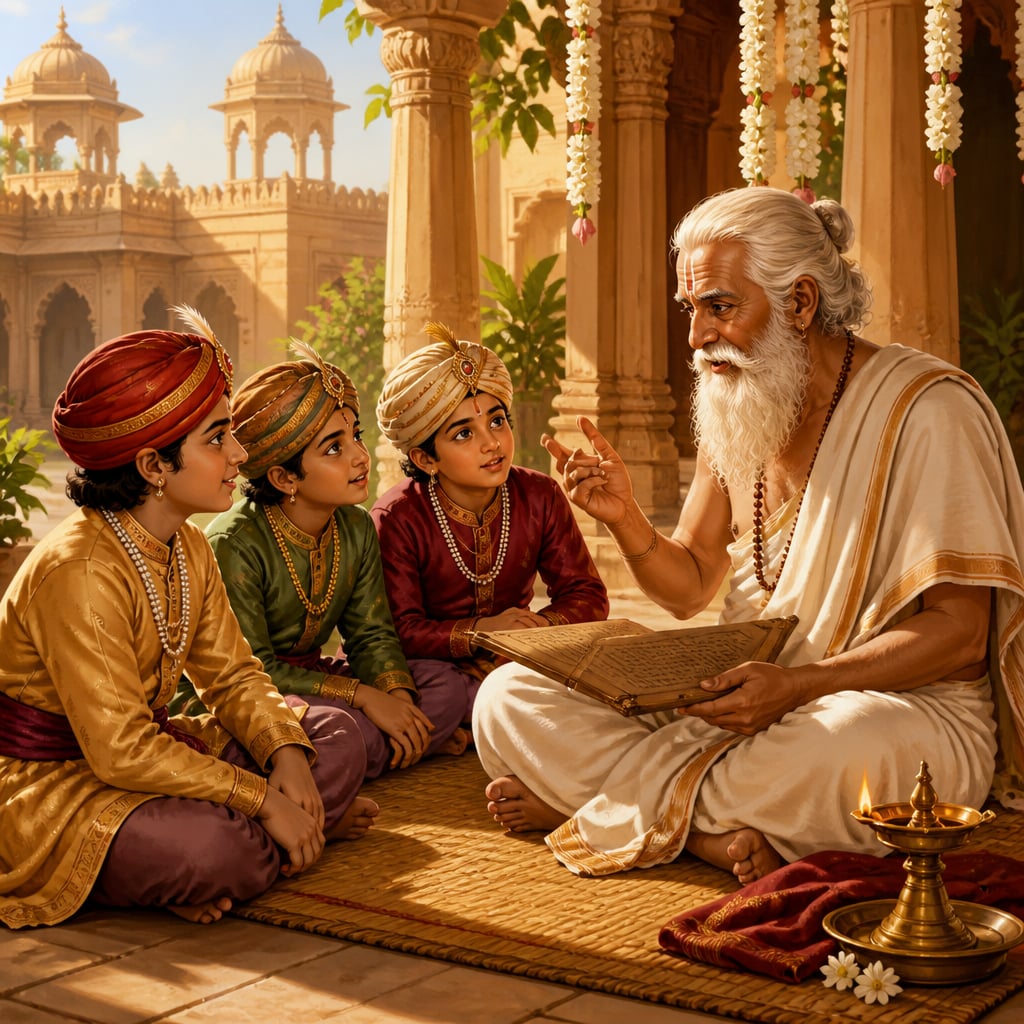
This is the Katha tradition, wisdom through narrative. And it stands in stark contrast to what we're doing to our children today.
The 22x Memory Advantage
Neuroscience has finally caught up to what Vishnu Sharma knew intuitively:
Stories activate the entire brain. Facts activate only the language centers.
When we hear a story, our brains don't distinguish between hearing about an experience and having one. Neuroimaging studies at Princeton show that storytelling triggers neural coupling, the listener's brain patterns begin to mirror the teller's. When a character faces danger, our amygdala activates. When they feel joy, our reward centers fire.
The result? Information embedded in narrative is remembered 22 times better than information presented as facts alone.
Consider how you learned that fire is dangerous. Not from a lecture on combustion chemistry. You learned from a story, perhaps about a careless child, or a brave firefighter, or your grandmother's warning wrapped in a tale. The lesson stayed because it came wrapped in narrative.
The Panchatantra understood this. Each story isn't just entertainment, it's a delivery system for wisdom. The crocodile and monkey fable isn't about animals; it's about recognizing false friendship. The tale of the bragging hare isn't about racing; it's about the folly of underestimating steady effort.
Vishnu Sharma was a neuroscientist 2,000 years before neuroscience existed.
The Yaksha's Method: Learning Through Inquiry
Story-based learning isn't just about telling tales. The Mahabharata offers another dimension: learning through narrative inquiry.

The Pandavas, dying of thirst after years of forest exile, discovered a lake guarded by a Yaksha (a celestial being). One by one, the brothers approached the water. One by one, they collapsed, dead, because they drank without answering the Yaksha's questions.
Only Yudhishthira paused. And then began one of the most profound philosophical dialogues in world literature.
The Yaksha asked: "What is the greatest wonder?"
Yudhishthira answered: "Day after day, countless people die. Yet the living believe they will live forever. What can be more wonderful than this?"
Through question after question, about dharma, about life, about human nature, Yudhishthira demonstrated his wisdom. His brothers were restored. The lesson was delivered.
The Yaksha Prashna shows story-teaching at its deepest: wisdom isn't transmitted, it's evoked through narrative challenge.
Every parent can be a Yaksha. Instead of lecturing children about right and wrong, embed the questions in stories. Let children discover answers through identification with characters. Let them argue with you about what the monkey should have done, what Yudhishthira might have answered differently.
The story becomes a laboratory for moral reasoning.
What Screens Are Doing to Young Brains
While the Katha tradition delivered wisdom through engagement, modern screens deliver dopamine through passivity.
The statistics are staggering:
| Metric | Finding | Source |
|---|---|---|
| Average daily screen time (children) | 7+ hours | Common Sense Media, 2021 |
| Decrease in attention span since 2000 | 4 seconds (12 to 8 seconds) | Microsoft Research |
| Increase in teen anxiety since 2010 | 37% | Jean Twenge, iGen |
| Increase in teen depression (girls) | 63% | CDC YRBSS data |
| Children who can't hold a pencil | 1 in 3 | UK occupational therapy data |
| Decrease in face-to-face interaction | 40% in one generation | American Psychological Association |
What's happening neurologically?
Screens deliver variable reward stimulation, the same mechanism that makes gambling addictive. Every swipe, every refresh, every notification triggers a small dopamine hit. The developing brain recalibrates. Ordinary life becomes boring by comparison.
Stories, by contrast, require active engagement. The listener must imagine the forest, feel the character's fear, predict what happens next. This builds neural pathways. Screens let algorithms do the work the brain should do.
The difference is like the difference between walking a trail and being carried in a car. One builds strength; the other atrophies it.
The Panchatantra's Journey Around the World
Here's a story most people don't know about stories:
The Panchatantra, composed in India around 300 BCE, became one of the most translated texts in human history, second only to religious scriptures.
In the 6th century CE, the Persian physician Burzoe translated it into Pahlavi (Middle Persian), calling it Kalilah wa Dimnah after two jackal characters. From there it traveled to:
- Arabic (8th century) - spreading throughout the Islamic world
- Greek (11th century) - entering the Byzantine Empire
- Hebrew and Latin (12th-13th centuries) - reaching medieval Europe
- German, Italian, Spanish, French - becoming the foundation for European fable literature
Aesop's Fables, which Western children learn as 'Greek,' contain stories that originated in the Panchatantra. La Fontaine's 17th-century French fables drew directly from Indian sources. The Brothers Grimm acknowledged the debt.
Why did this particular text travel so far?
Because it worked. Cultures across the world discovered that Vishnu Sharma's method, embedding lessons in compelling narratives, succeeded where direct instruction failed. The stories were adapted, localized, retold, but the core insight remained: humans learn through narrative.
The Panchatantra's global journey is proof that story-teaching isn't a cultural quirk. It's a human universal.
The Neuroscience of 'Once Upon a Time'
When a child hears 'Once upon a time,' something measurable happens in their brain:
1. Cortisol drops. The stress hormone decreases as the child enters a safe narrative space. Learning cannot happen in stressed brains; stories create safety.
2. Oxytocin rises. The bonding hormone increases, especially when stories are told by loved ones. The child associates the lesson with love, not fear.
3. Mirror neurons activate. The brain simulates the characters' experiences. When a story character faces a moral dilemma, the child's brain practices moral reasoning.
4. Hippocampus encodes memory. The narrative structure, beginning, conflict, resolution, provides scaffolding that helps the brain organize and store information.
5. Prefrontal cortex develops. Stories require predicting what happens next, understanding characters' motivations, evaluating choices. These are prefrontal cortex functions, the same ones needed for impulse control, planning, and ethical behavior.
Screen content does none of this. It delivers stimulus without requiring response. It provides entertainment without demanding engagement. It fills time without building capacity.
Story-listening is brain exercise. Screen-watching is brain junk food.
The Read-Aloud Revolution
Jim Trelease's The Read-Aloud Handbook (1982) documented what research has since confirmed:
20 minutes of daily read-aloud transforms children.
The effects are measurable:
- Vocabulary expands 50% faster than in non-read-aloud homes
- Reading comprehension scores rise significantly
- Attention spans extend naturally
- Parent-child bonding strengthens
- Love of books develops organically
- Empathy scores increase
The Commission on Reading (1985) declared reading aloud "the single most important activity for building the knowledge required for eventual success in reading."
But Trelease added something the studies miss: the magic is in the relationship, not just the text.

When a parent reads to a child, they're not just transmitting words. They're creating ritual. They're demonstrating that stories matter enough to stop everything else. They're modeling the posture of attention that screens erode.
The Katha tradition wasn't just about stories. It was about who told them and how.
The Cautionary Tale: Screens as Surrogate Storytellers
Modern parents, exhausted by work and overwhelmed by demands, have outsourced storytelling to devices.
The reasoning seems sound: Educational apps teach letters. YouTube has nursery rhymes. At least they're learning something while I catch my breath.
But research shows the opposite:
Children learn language 70% less effectively from screens than from live humans. The brain knows the difference. A screen has no oxytocin exchange, no responsive eye contact, no embodied presence.
'Educational' screen content often backfires. Baby Einstein videos were found to delay language development. The American Academy of Pediatrics recommends zero screen time before age 2, not because screens are inherently evil, but because they displace the activities that build brains.
Every hour of screen time is an hour of not being read to, not playing imaginatively, not developing through relationship.
The Yaksha would ask: "What is the greatest loss of our age?"
Perhaps this: "Parents once told stories. Now screens tell stories. And children have lost both the stories and the parents."
Bringing Katha Back: Practical Application
You don't need to become a master storyteller. You need only reclaim what was stolen.
1. The Bedtime Ritual
Establish a non-negotiable 15-20 minutes of story time before bed. No screens in the hour before. Just voices, books, presence. This single change can transform your child's relationship to narrative, and to you.
2. The Panchatantra Method
When your child faces a moral situation, conflict with a friend, temptation to lie, handling disappointment, don't lecture. Tell a story. "You know, there was once a monkey who faced exactly this..." Let the tale do the teaching.
3. The Yaksha Approach
After stories, ask questions. Not quizzing questions ('What color was the bird?') but thinking questions ('What would you have done?' 'Was the fox really clever?' 'What should the monkey have noticed earlier?'). Turn passive reception into active moral reasoning.
4. Make Them the Storyteller
Ask your child to tell you a story. Watch what they reveal about their world, their fears, their understanding. Story-creation builds the same neural pathways as story-reception, plus adds creativity.
5. Car Katha
Instead of screens on car rides, tell stories. Make them up. Be ridiculous. Let them take over. The 'boredom' of screen-free travel becomes the space where imagination grows.
The Competition for Your Child's Brain
Make no mistake: there's a battle happening for your child's attention.
On one side: thousands of engineers at the world's wealthiest companies, using decades of behavioral psychology research, optimizing for one thing, time on device. Their success is measured in engagement, in scroll depth, in daily active users.
On the other side: you, with an ancient tradition, a 20-minute window before bed, and stories that have shaped human character for millennia.
The engineers have algorithms. You have the Panchatantra.
The engineers have dopamine manipulation. You have oxytocin and presence.
The engineers have screens that babysit. You have a tradition that transforms.
The competition isn't fair. But you have something they can never replicate: you are your child's parent.
No algorithm can provide what a parent's voice provides. No screen can replace the warmth of reading together. No engineered engagement can match the deep resonance of 'Once upon a time, there was a king with three sons...'
What Vishnu Sharma Knew
Let's return to where we started.
Vishnu Sharma faced princes who had defeated every conventional teaching method. They were the 'unteachable' children of their age, distracted, disengaged, impossible.
He didn't blame them. He changed the method.
He met them where they were, in their love of tales, their hunger for excitement, their natural engagement with narrative. He used what was already in them to deliver what they needed.
The 'unteachable' became wise rulers. The method became the Panchatantra. The Panchatantra became a world treasure.
Every child is teachable through story. The question is whether we will tell them.
The screens are waiting. The algorithms are ready. The attention engineers have done their work.
But so did Vishnu Sharma. So did the countless parents across millennia who passed wisdom through narrative. So did the Yaksha who tested Yudhishthira.
The Katha tradition isn't dead. It's waiting to be reclaimed.
Once upon a time, there was a parent who turned off the screen and began to tell a story...
Narrative Transport - The phenomenon where listeners become absorbed in a story, lowering resistance to the lessons it contains.
Modern advertising discovered 'narrative transport' in the 1990s. Story-based ads outperform product-focused ads by factors of 2-3x. Behavioral economists show that case studies persuade more than statistics. Vishnu Sharma understood this principle millennia before it was measured.
The Panchatantra doesn't just tell stories, it nests them. A main story contains characters who tell stories, which contain characters who tell stories. This structure mirrors how the brain organizes knowledge: in interconnected networks, not isolated facts. Western teaching's linear, abstracted approach works against neural architecture.
When the Panchatantra reached Persia, it was immediately adopted for prince education. When it reached the Arab world, the Caliph Al-Ma'mun made it required reading. European courts imported it for noble training. Everywhere it went, leaders recognized its effectiveness. The method worked universally because brains work universally.
Socratic Method - Teaching through questioning rather than telling, allowing understanding to emerge from the learner's own reasoning.
Socrates (469-399 BCE) famously taught through questions, claiming he knew nothing and simply helped others discover their own knowledge. The Yaksha Prashna predates this in the Indian tradition. Both arrived at the same insight: real understanding cannot be transferred, only facilitated.
Case studies
The Panchatantra's World Journey
Around 570 CE, the Persian physician Burzoe traveled to India seeking a mythical herb of immortality. He found something more valuable: the Panchatantra. His translation into Pahlavi (Middle Persian), titled 'Kalilah wa Dimnah,' began the most extensive literary migration in pre-modern history.
The Panchatantra's journey shows that story-based teaching isn't a cultural quirk, it's a human universal. Arabic translators found the fables as effective for teaching wisdom to Arab children as Vishnu Sharma found them for Indian princes. European adapters discovered the same. The method worked because it aligned with how all human brains process narrative.
Today, variations of Panchatantra stories appear in Aesop's Fables (Greece), La Fontaine's Fables (France), the Brothers Grimm (Germany), and countless folk traditions worldwide. Stories like 'The Crow and the Pitcher' and 'The Tortoise and the Hare' originated in Indian narrative traditions. The Panchatantra became one of the most translated non-religious texts in human history.
When something works across every culture it touches, we've found a human universal. Story-based teaching isn't an 'alternative method', it's the method our brains evolved for. Modern education's reliance on abstract instruction and screen-based 'content' represents a deviation from this universal, not an advance beyond it.
Podcasts, YouTube storytellers, and narrative-driven apps are booming because they tap into the same brain wiring the Panchatantra exploited 2,300 years ago. Parents struggling to teach values through lectures should switch to stories. A child who zones out during a sermon about honesty will remember the Panchatantra tale of the dishonest crane for decades. Story is the original educational technology, and it still outperforms every digital alternative.
The Panchatantra has been translated into over 50 languages since its composition around 300 BCE. It reached Persia by 570 CE, Arabic by 750 CE, and Europe by the 11th century, making it one of the most translated non-religious texts in human history.
The Screen Time Experiment
In 2012, the American Academy of Pediatrics recommended zero screen time for children under 2. By 2016, the average one-year-old was getting 60 minutes daily. By 2021, children aged 8-12 averaged 5-7 hours of screen time per day, while teens exceeded 7 hours.
Traditional learning was relational and narrative-based. A grandmother told stories. A father modeled skills. A guru guided through experience. Screens offer content without relationship, information without wisdom, stimulation without growth. The Katha tradition understood that the who matters as much as the what.
The consequences are measurable: 37% increase in teen anxiety, 63% increase in teen depression, declining attention spans, reduced empathy, epidemic loneliness despite constant 'connection.' Children can swipe before they can hold pencils. They consume but don't create. They are entertained but not engaged.
We are running an unprecedented experiment on human development, and the early results are alarming. The Katha tradition offers a proven alternative: wisdom delivered through relationship, learning embedded in narrative, growth through engagement rather than consumption. The question is whether we'll recognize the experiment's failure before permanent damage is done.
Children who grow up on screens consume content created by others but rarely create anything themselves. The shift from maker to consumer is historically unprecedented. A generation ago, children built forts, cooked with grandmothers, and invented games. Today, the average child spends more time watching others play video games than playing outside. Replacing even one hour of screen time with storytelling, cooking, or hands-on activity restores the relational, narrative-based learning that screens have displaced.
A 2022 Common Sense Media report found children aged 8 to 12 averaged 5 hours and 33 minutes of daily screen time, while teens aged 13 to 18 averaged 8 hours and 39 minutes, both figures excluding time spent on schoolwork.
Reflection
- When you were a child, what stories shaped your understanding of right and wrong? Who told them to you? How did the telling context matter?
- The Yaksha asked Yudhishthira profound questions about life and dharma. What 'Yaksha questions' would you want your child to be able to answer wisely?
- If you tracked your child's weekly hours: screen time versus story time (read-aloud, telling, or listening), what would the ratio reveal?