Gurukul: Beyond Industrial Schooling

Child-Led Learning Isn't New

Discover the full Montessori-India story: her 10 years in India (1939-1949), training 1,000+ teachers in Kodaikanal, and why she said her methods were 'best understood' in India. Compare Gurukul education with factory-model industrial schooling.

The Italian Doctor in the South Indian Hills

In 1939, a 69-year-old Italian physician arrived in Madras for what she planned as a three-month lecture tour. Ten years later, she would leave India having trained over 1,000 teachers, watched Indian children confirm her life's theories, and declared that her methods were 'best understood' in this ancient land.
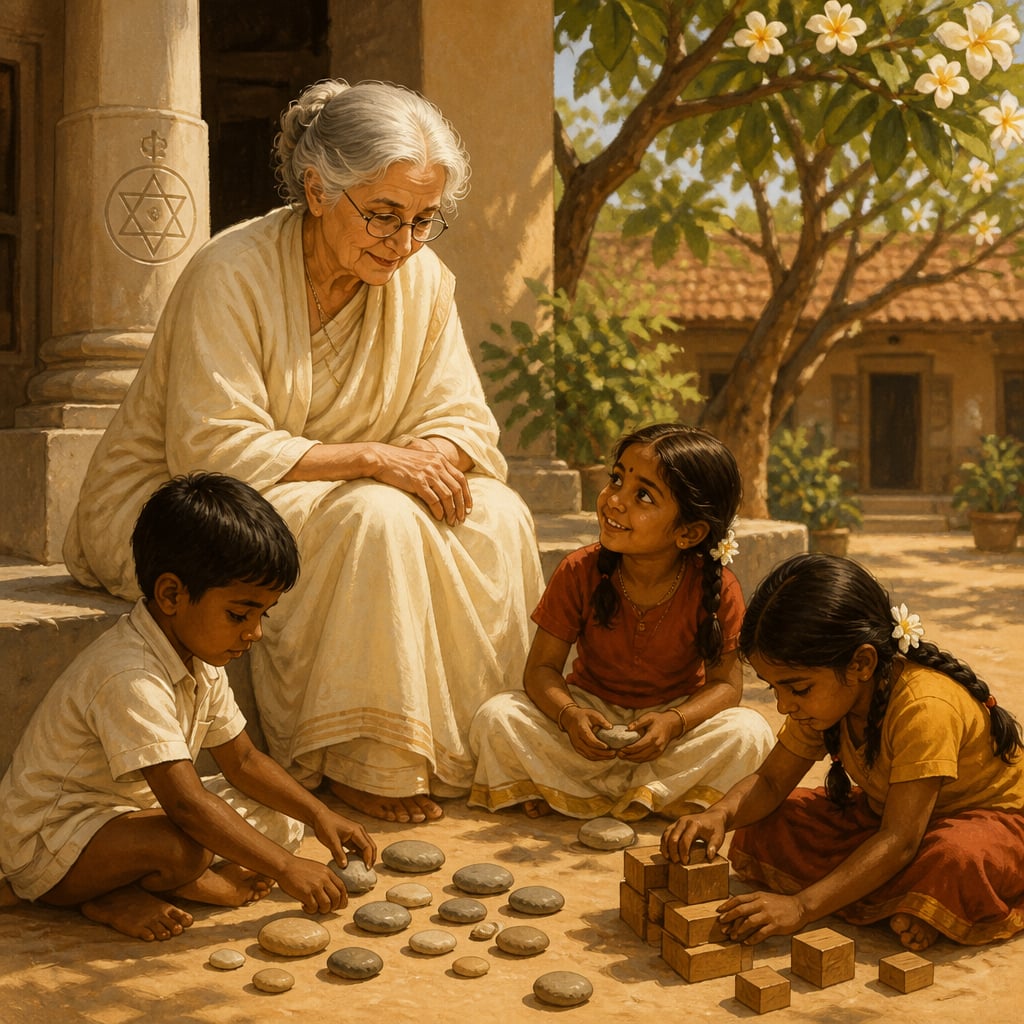
Maria Montessori on a veranda in 1939 Madras watching South Indian children play with river pebbles and wooden blocks.

Her name was Maria Montessori, and this is the story most education books don't tell.

When World War II erupted, Montessori, as an Italian national in a British colony, was interned. But unlike harsh prison camps, her 'internment' became a decade of deep immersion in Indian educational philosophy. In Kodaikanal, a Tamil Nadu hill station whose forests and climate resembled the ancient ashrams, Montessori refined her final theories.

What she discovered confirmed everything she had spent her life proving scientifically: India had known it all along.


The Story Most People Don't Know

The Theosophical Society in Adyar, Chennai, hosted Montessori throughout her stay. Its leaders, steeped in Vedantic philosophy, introduced her to traditional learning concepts. She was struck by how naturally Indian children behaved in ways she had struggled to cultivate in European classrooms.

In a 1939 lecture, she observed:

"India has much to teach the world about the child's development... The ancient wisdom here recognizes what I have spent my life trying to prove scientifically."

Her son Mario later noted that watching Indian children in their natural environment 'confirmed' Maria's theories in ways laboratory settings never could.

Consider what she witnessed:


The Factory Model: A Historical Accident

Before we celebrate what Montessori rediscovered, we must understand what she was fighting against.

The industrial schooling model, children in rows, bells signaling transitions, standardized tests, age-segregated classes, was not designed to educate. It was designed to create factory workers.

In 1892, Horace Mann returned from Prussia with a vision: schools should produce citizens who follow orders, arrive on time, and perform repetitive tasks without complaint. The bell was borrowed from factories. The rows mimicked assembly lines. The curriculum standardized workers like interchangeable parts.

This was never about children's development. It was about industrial efficiency.

The tragedy? India, home to the Gurukul system that had produced the world's greatest mathematicians, astronomers, grammarians, and philosophers, imported this factory model through colonial education.

Macaulay's infamous 1835 Minute on Education explicitly aimed to create 'a class of persons Indian in blood and colour, but English in tastes, in opinions, in morals and in intellect.' The Gurukul was suppressed. The factory school took its place.


Gurukul vs Factory: A Comparison

Aspect Gurukul (गुरुकुल) Factory School
Setting Nature, forests, rivers, ashrams Four walls, artificial lighting
Class structure Mixed ages learning together Age-segregated, grade-locked
Teaching method Experiential, questions-driven Lecture-based, answer-focused
Teacher role Guru as guide and mentor Teacher as content-deliverer
Assessment Mastery through demonstration Standardized tests
Duration Until mastery achieved Fixed calendar regardless of learning
Subjects Integrated knowledge Siloed disciplines
Student ratio Small, personalized 30-50 per classroom
Goal Character + knowledge + skill Passing exams
Movement Free, learning through body Sit still for hours

Every principle Montessori fought for, mixed ages, experiential learning, teacher as guide, prepared environment, intrinsic motivation, existed in the Gurukul for millennia.


Vishvamitra's Forest: The Original 'Prepared Environment'

Vishvamitra leading young Rama through the forest

When Rishi Vishvamitra came to King Dasharatha seeking young Rama and Lakshmana, he wasn't taking them to a classroom. He was taking them to a forest.

In the Ramayana, this journey becomes the prototype of Gurukul education:

The forest was the curriculum.

Rama learned not from textbooks but from:

Vishvamitra didn't lecture. He created experiences. He asked questions. He walked alongside his students.

Montessori called this 'prepared environment.' The Gurukul called it araṇya-vāsa (forest dwelling).

The parallel is not coincidental. It's convergent evolution, when different traditions independently discover the same truth about how humans actually learn.


The Neuroscience Validation

Modern neuroscience confirms what both Vishvamitra and Montessori knew:

Movement and Learning Are Inseparable

The cerebellum, which controls physical movement, also plays a crucial role in cognitive processing. When children sit still for hours, they're not just physically restrained, they're neurologically handicapped. Stanford studies show learning improves by 23% when movement is incorporated.

Nature Reduces Stress Hormones

Cortisol, the stress hormone, drops 21% within 20 minutes of nature exposure. Forest school studies show reduced ADHD symptoms, improved attention, and better emotional regulation. The ashram's forest setting wasn't accidental; it was therapeutic.

Multi-Age Learning Builds Social Intelligence

Neuroimaging shows different brain regions activate when children teach versus when they learn. Mixed-age settings activate both, building more complex neural networks. The Gurukul's natural mixing of ages wasn't logistical convenience, it was pedagogically optimal.

Questions Beat Answers

The brain releases dopamine when solving problems, not when receiving solutions. Curiosity-driven learning builds stronger memory encoding. When Vishvamitra asked Rama questions about what he observed, he was triggering neurological learning pathways that lecturing cannot activate.


The Silicon Valley Secret

Here's a modern paradox worth pondering:

The executives who build our screens send their own children to screen-free schools.

A screen-free Waldorf classroom in California

In Silicon Valley, Waldorf and Montessori schools, both rooted in hands-on, nature-based, experiential learning, are the choice of tech leaders. The Waldorf School of the Peninsula counts among its parents employees of Google, Apple, Yahoo, and other tech giants.

No computers until 8th grade. Knitting. Woodworking. Storytelling. Nature walks.

When a New York Times reporter asked a Google executive why he chose this for his children while selling screens to everyone else, he replied: "We know what technology does to the brain."

They're creating the tools of distraction while protecting their own children from them.

These schools, Waldorf and Montessori, share core DNA with the Gurukul:


Montessori Returns to India

The story comes full circle.

After decades of exporting factory education, India is now importing Montessori, a method refined on Indian soil, influenced by Indian philosophy.

Montessori schools have proliferated across urban India, marketed as 'progressive education.' Parents pay premium fees for their children to learn through 'child-led exploration' and 'prepared environments.'

The irony is profound: Indians are paying to rediscover what their ancestors practiced for free.

But there's hope in this return. Each Montessori school in India, whether its teachers know it or not, carries forward principles that Vishvamitra would recognize. When a Mumbai Montessori teacher watches a five-year-old choose their own work, they're practicing what rishis did in forest ashrams.

The knowledge was never lost. It was suppressed, exported, repackaged, and sold back. But it survives.


The Cautionary Tale: When We Forgot

The consequences of abandoning Gurukul principles are visible today:

The factory model was designed for 19th-century industrial workers. We're still using it in the 21st century, and wondering why our children are stressed, uncreative, and disengaged.

The solution isn't to import more Western innovations. It's to remember what we knew.


What This Means for You

You cannot single-handedly reform the education system. But you can bring Gurukul principles into your own home:

  1. Value questions over answers: When your child asks 'why,' don't rush to answer. Ask them, 'What do you think?' Curiosity is a muscle; exercise it.

  2. Get outside: Forest bathing isn't just Japanese, it's Vedic. Nature exposure reduces stress hormones and improves cognition.

  3. Let them do, not just watch: Cooking, cleaning, building, practical skills build neural pathways that screens cannot.

  4. Find mentors, not just teachers: One guru who knows your child deeply matters more than dozens who teach subjects.

  5. Trust the process: Mastery takes time. Don't compare your child's timeline to factory-school benchmarks.

Montessori spent ten years in India learning what Vishvamitra knew thousands of years ago: children learn best when trusted, guided, immersed in nature, and allowed to discover.

The question isn't whether this approach works, the neuroscience is clear, the research overwhelming, the historical evidence abundant.

The question is: will we remember what we knew?

Experiential Learning - Knowledge acquired through direct experience and active participation rather than passive reception.

John Dewey's 'learning by doing' (1938) and David Kolb's 'experiential learning cycle' (1984) articulated what Vishvamitra practiced millennia earlier. Modern research confirms: retention from lecture is 5%; from practice, 75%; from teaching others, 90%.

The Gurukul embedded experiential learning in a complete environment. Western 'experiential education' often becomes occasional field trips within an otherwise factory model. True experiential learning requires what Montessori called 'prepared environment', the whole setting designed for active discovery.

The students of Takshashila (Taxila) didn't just learn medicine from texts, they practiced on patients. They didn't just study warfare, they trained in combat. Chanakya didn't just teach Chandragupta strategy, he had him apply it in building a coalition to defeat the Nandas. Outcomes prove method: Takshashila produced Panini, Charaka, and Chanakya himself.

Facilitative Teaching - The instructor guides discovery rather than transmits content, drawing out the student's latent understanding.

Socrates' method of questioning to elicit understanding parallels this approach. Montessori's 'teacher as directress' who prepares the environment and observes, intervening minimally, captures the same insight. Modern coaching frameworks distinguish 'teaching' (telling) from 'coaching' (drawing out).

Case studies

Montessori's India Years: When East Met West

In 1939, Maria Montessori arrived in India for a three-month lecture tour. The outbreak of World War II stranded her as an 'enemy alien' in British India. What began as forced detention became a decade of immersion that would shape the final evolution of her method.

The Theosophical Society that hosted Montessori was steeped in Vedantic philosophy. Her exposure to traditional learning concepts, the guru-shishya relationship, learning through karma (action), the ashram as prepared environment, provided a philosophical framework for what she had observed empirically. Indian children's natural behavior confirmed her theories: self-directed learning, reverence for the teacher, comfort in mixed-age groups.

Montessori trained over 1,000 Indian teachers during her stay. She declared that India was where her methods were 'best understood', an acknowledgment that her scientific discoveries aligned with ancient Bharatiya wisdom. The Montessori method, now practiced globally, carries within it principles refined on Indian soil.

What the West 'discovered' through scientific method, India knew through traditional wisdom. Montessori's India years demonstrate that child-led, experiential, nature-based education isn't a modern innovation, it's a return to what we knew. The task isn't to import foreign ideas but to remember our own.

Indian parents today pay premium prices for Montessori, Waldorf, and 'experiential learning' schools, often unaware that these methods were refined on Indian soil and mirror ancient Gurukul principles. The irony is spending lakhs to import back what India exported. Parents seeking alternatives to rote schooling should look not just to Western pedagogies but to the indigenous traditions these pedagogies were built upon.

Maria Montessori lived in India from 1939 to 1949, training over 1,000 teachers. She established training centers in Madras, Kodaikanal, and Ahmedabad, and the first Indian Montessori school opened in 1926 in Vijayawada.

Silicon Valley's Screen-Free Secret

At the Waldorf School of the Peninsula in Silicon Valley, children learn knitting, woodworking, and storytelling. There are no computers until 8th grade. The parents? Employees of Google, Apple, Yahoo, and other tech giants, the very companies creating the screens they keep away from their own children.

The Waldorf method, like Montessori, emphasizes experiential learning, natural materials, creative play, and the teacher as guide. These principles echo the Gurukul: learning by doing, nature as classroom, imagination as faculty to develop. Both represent the same insight that Vishvamitra knew, children learn through experience, not passive absorption.

When asked why they choose screen-free education while selling screens to the world, tech executives are candid: 'We know what technology does to the brain.' Their children are protected from the attention fragmentation, dopamine manipulation, and cognitive damage that screens cause, protections not offered to the masses who consume their products.

Those who understand technology most deeply protect their children from it most carefully. The factory model has simply digitized: instead of preparing workers for assembly lines, it now prepares consumers for attention harvesting. The alternative, experiential, nature-based, mentor-guided learning, remains what it always was: the Gurukul principle.

The people who design addictive apps, infinite scroll feeds, and engagement algorithms protect their own children from them. This is not hypocrisy but insider knowledge. When the engineers building the slot machine keep their kids away from it, every other parent should pay attention. Delaying screen access and prioritizing hands-on learning is not being 'backward.' It is acting on the same information the tech elite already acts on.

A 2011 New York Times report found that 75% of students at the Waldorf School of the Peninsula in Los Altos had parents working at Silicon Valley tech companies including Google, Apple, and eBay.

Reflection

More in Siksha: The Gurukul Revolution

All lessons in Siksha: The Gurukul Revolution · Parenting Dharma course