Darshan: Two Visions of Childhood
Dharmic Purpose vs Western Individualism
Explore the fundamental difference between Dharmic parenting (child as soul with Svadharma to discover) and post-1946 Western parenting (child as tabula rasa for self-expression). Learn through Jijabai's purposeful raising of Shivaji, contrast with the Affluenza case, and understand why Dhritarashtra's blind love destroyed what it meant to protect.
The Mother Who Built a King
In 1630, in a small fort called Shivneri, a mother held her newborn son and made a decision that would change history. She wasn't thinking about his happiness. She wasn't concerned with his self-expression. She was thinking about his dharma.
Jijabai named her son Shivaji, and from his earliest years, she filled his mind not with lullabies but with stories. Stories of Rama's courage. Krishna's wisdom. The valor of ancient Kshatriyas. She showed him the humiliation of their land under foreign rule, not to breed hatred, but to kindle a sacred fire.
"You are not born merely to live," she taught him. "You are born to fulfill a purpose."
By age sixteen, Shivaji had captured his first fort. By thirty, he had established Swarajya. By forty, he was crowned Chhatrapati. The mother who saw her child as a soul with a mission raised a king who liberated a nation.
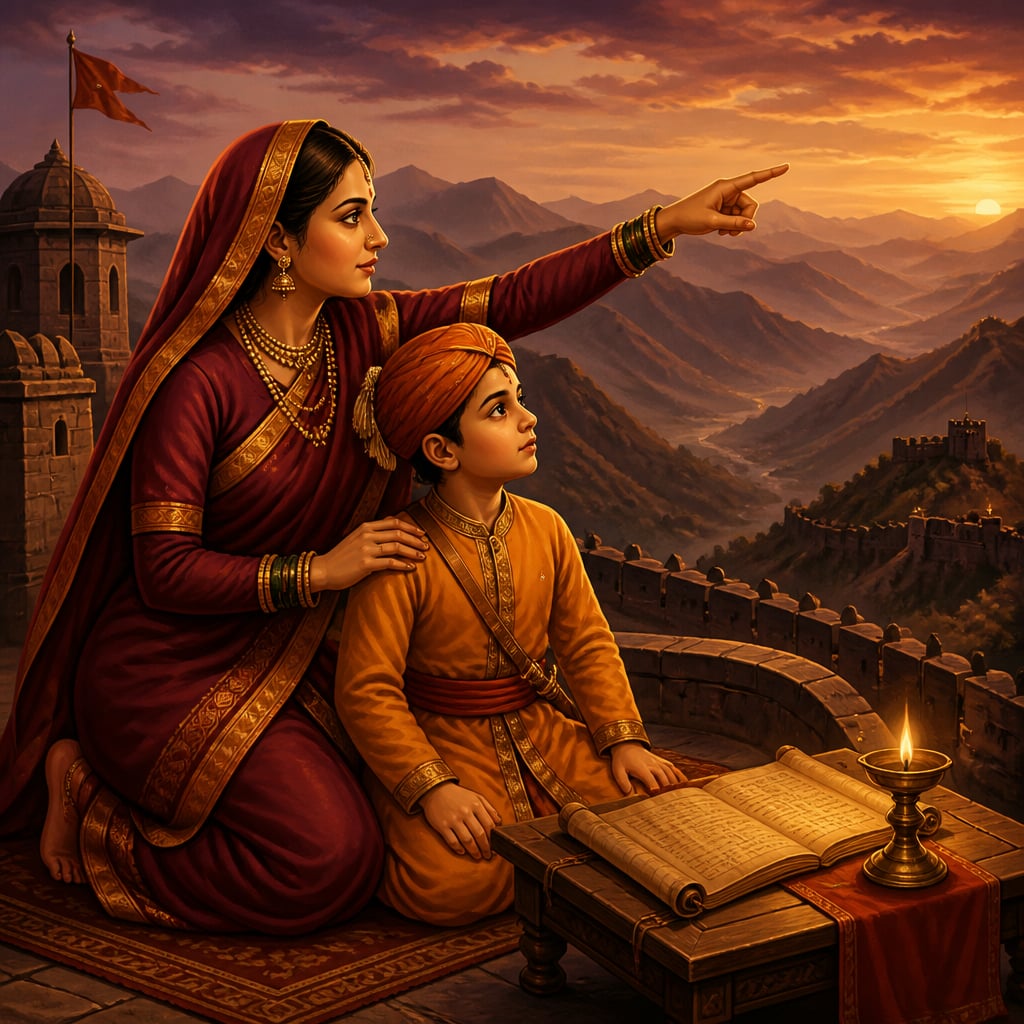
Now consider a different story, a story that ends very differently.
The Boy Who Was Never Told "No"
In 2013, in Fort Worth, Texas, a sixteen-year-old named Ethan Couch got behind the wheel of his father's pickup truck with a blood alcohol level three times the legal limit. He crashed into a group of people helping a stranded motorist, killing four and paralyzing one of his own passengers.
The court psychologist testified that Ethan suffered from "affluenza", his wealthy parents had never set limits, never imposed consequences, never said no. He had been given everything except boundaries. His lawyers argued he literally didn't understand that actions have consequences because he had never experienced any.
The judge sentenced him to probation. No prison time for four deaths.
When Ethan later fled to Mexico to avoid a probation violation, his mother helped him escape. The pattern continued: protect the child from all discomfort, even when that "child" had taken four lives.
Two Philosophies, Two Outcomes
These aren't just stories. They represent two fundamentally different answers to the question: What is a child?
The Dharmic view: A child is a soul on a journey, temporarily entrusted to parents as guardians. The child comes with a Svadharma, a unique nature and purpose that parents must help discover and develop. Parenting is sacred stewardship, preparing the soul for its dharmic mission in the world.
The modern Western view (post-1946): A child is a blank slate for self-expression. The parent's job is to make the child happy, protect them from discomfort, and let them "find themselves." Success is measured by the child's feelings, not their character.
One philosophy produced Shivaji. The other produced Ethan Couch.
How the West Lost Its Way
This wasn't always the Western approach. Before 1946, Western parenting had much in common with Dharmic traditions, clear expectations, structured development, moral formation, and the understanding that children need guidance to become good adults.
Then came Dr. Benjamin Spock's "Baby and Child Care", which would become the second best-selling book after the Bible. His message: "Trust yourself. You know more than you think you do."
This sounds reasonable until you understand what followed. Spock's permissiveness sparked a revolution:
| Era | What Happened | Result |
|---|---|---|
| 1960s-70s | Counter-culture rejected all authority | Children treated as "equals" |
| 1980s | Self-esteem movement launched | "Everyone is special" without earning it |
| 1990s | Trophy culture spread | Praise without achievement |
| 2000s | Helicopter parenting peaked | Children never learned to struggle |
| 2010s | Snowplow parenting emerged | Every obstacle removed |
| 2020s | "Gentle parenting" extremes | Negotiating with toddlers for 45 minutes |
The result? By 2020, teen anxiety had increased 37%, teen depression in girls had risen 63%, and 52% of young adults were living with their parents, the highest rate since the Great Depression.
The Dhritarashtra Warning
The dangers of blind love aren't just a modern Western problem. Our own tradition warned us three thousand years ago through the tragedy of Dhritarashtra.

Dhritarashtra was blind from birth, but his greater blindness was to his son's faults. When young Duryodhana cheated in games, Dhritarashtra looked away. When Duryodhana humiliated the Pandavas, his father said nothing. When Duryodhana ordered Draupadi's humiliation in open court, the king sat silent.
Why? Because he loved his son too much to correct him.
"A father who sees no fault in his son," says the Mahabharata, "is not a father, he is a destroyer."
Dhritarashtra's blind love didn't protect Duryodhana. It destroyed him. It destroyed Dhritarashtra's other ninety-nine sons. It destroyed the Kuru dynasty. It led to the greatest war in Bharatiya history.
The same love that could have built character through boundaries instead bred entitlement through indulgence. This is the cautionary tale for every parent who confuses kindness with permissiveness.
What Research Shows
Modern psychology has validated what Jijabai knew and Dhritarashtra forgot.
Diana Baumrind's 30-year studies identified four parenting styles:
| Style | Description | Child Outcomes |
|---|---|---|
| Authoritative | High warmth + High expectations | Best outcomes: confident, competent, resilient |
| Authoritarian | Low warmth + High control | Obedient but anxious |
| Permissive | High warmth + No expectations | Entitled, anxious, poor self-regulation |
| Neglectful | Low warmth + No expectations | Worst outcomes across all measures |
The authoritative style, which mirrors the Dharmic balance of Vatsalya (love) and Anushasana (discipline), produces the best outcomes across every measure: academic achievement, emotional health, relationship quality, and life satisfaction.
Permissive parenting, despite good intentions, produces children who are more anxious, not less. They lack the internal structure that boundaries provide.
The Svadharma Principle
The Dharmic approach isn't about imposing your will on children. It's about discovering their unique nature and helping them fulfill it.
Jijabai didn't decide Shivaji should be a warrior-king and force him into that mold. She observed his nature, his courage, his strategic mind, his sense of justice, and nurtured those qualities. She told him stories that resonated with what was already inside him.
The Bhagavad Gita teaches: "श्रेयान्स्वधर्मो विगुणः परधर्मात्स्वनुष्ठितात्", "Better is one's own dharma, though imperfect, than the dharma of another, well performed."
This means:
- Not projecting your ambitions onto your child
- Not living vicariously through their achievements
- Not forcing them into paths that don't fit their nature
But it also means:
- Not leaving them without guidance
- Not pretending all paths are equal
- Not abandoning them to "find themselves" without a compass
The parent's role is to observe, nurture, guide, and prepare, not to control, but certainly not to abdicate.
The Vision You Hold
Every parenting choice flows from your vision of what a child is. If you see your child as a soul with a dharma, you'll:
- Tell them stories of purpose and heroism
- Set expectations that build character
- Allow struggles that develop strength
- Guide them toward contribution, not just consumption
If you see your child as a vessel for happiness, you'll:
- Protect them from all discomfort
- Praise without substance
- Remove every obstacle
- Produce someone who crumbles at life's first real challenge
Jijabai's question wasn't "Is my son happy today?" but "Will my son be ready for his dharma?"
That shift in question changes everything.
Your fundamental vision of what a child IS determines every parenting decision. The Dharmic view sees a soul with a mission; the modern Western view sees a happiness project.
Post-1946 Western parenting, influenced by Dr. Spock's permissive revolution and the self-esteem movement, increasingly treated children as fragile beings whose happiness must be maximized and discomfort minimized. The child became a project for parental management rather than a soul requiring guidance. Research by Jean Twenge and others shows this shift correlates with rising anxiety, depression, and fragility in subsequent generations.
The Dharmic framework provides what modern Western approaches lost: a clear understanding that children need formation, not just freedom. Jijabai didn't ask 'Is Shivaji happy?' She asked 'Is Shivaji becoming who he's meant to be?' This question produces children capable of contributing to the world, not merely consuming from it.
When young Shivaji asked Jijabai why their temples were destroyed and their people humiliated, she didn't shield him from harsh truths. She used those truths to kindle purpose. 'You were born to change this,' she told him. That vision, child as agent of dharmic change, shaped everything that followed.
Love without boundaries isn't love, it's a sophisticated form of neglect that feels good to the parent while damaging the child. Dhritarashtra loved genuinely, but his love destroyed what it meant to protect.
Diana Baumrind's research identifies the 'permissive' parenting style, high warmth, low expectations, as producing anxious, entitled, poorly regulated children. The permissive parent feels loving; the child experiences abandonment to their own immature impulses. Research shows children from permissive homes have HIGHER anxiety than those with authoritative (balanced) parents.
Case studies
Jijabai and Shivaji: Vision-Driven Parenting
In 17th century Maharashtra, under Mughal and Adil Shahi rule, Jijabai raised her son Shivaji with deliberate purpose. Rather than shielding him from the difficult realities of their time, she used stories from the Ramayana and Mahabharata to kindle his sense of dharma and destiny. She showed him the suffering of their people not to traumatize but to motivate. Every childhood lesson connected to a larger purpose: the establishment of Swarajya (self-rule) and the protection of dharma.
Jijabai embodied the Dharmic understanding that children are souls with missions, not blank slates for happiness. Her parenting was: - **Purpose-centered**: Every story, every lesson pointed toward dharmic purpose - **Character-building**: She cultivated courage, wisdom, and justice, not just skills - **Observation-based**: She recognized his Svadharma as a leader and warrior - **High-expectation**: She held him to standards befitting his potential - **Balanced**: Warmth and discipline in proper proportion (Vatsalya + Anushasana)
Shivaji established Swarajya, protected Hindu dharma, treated all religions with respect, built a navy from scratch, created administrative systems that outlasted him, and was crowned Chhatrapati. He became one of history's greatest warrior-kings, not despite his mother's demanding parenting but because of it.
Children who are given purpose outperform children who are given only comfort. Jijabai asked not 'Is my son happy?' but 'Is my son becoming who he's meant to be?' This shift in question changed history.
Today's parents often ask 'Is my child happy?' when the deeper question is 'Does my child have a sense of purpose?' Research on meaning and motivation consistently shows that young people with a clear sense of purpose report higher life satisfaction, better academic outcomes, and greater resilience. Connecting daily activities to a larger 'why,' as Jijabai did, is the single most protective factor against the aimlessness epidemic affecting modern youth.
Shivaji established Swarajya at age 16 in 1646 with the capture of Torna Fort, going on to build a kingdom of over 300 forts across the Deccan by the time of his coronation in 1674.
The Affluenza Case: Love Without Limits
In 2013, sixteen-year-old Ethan Couch of Fort Worth, Texas, drove drunk at three times the legal limit, crashed into a group of people, and killed four. His blood alcohol was 0.24. He had Valium in his system. He was driving 70 mph in a 40 mph zone. The victims included a youth pastor, a mother and daughter, and a young woman helping a stranded motorist. Another passenger in Ethan's truck was paralyzed.
A psychologist testified that Ethan suffered from 'affluenza', his wealthy parents had never set limits, never imposed consequences, never taught that actions have effects. He had: - **No Anushasana**: Zero discipline or boundaries his entire life - **Distorted Vatsalya**: Love expressed only through indulgence - **No Svadharma awareness**: Never taught he had responsibilities, only rights - **Helicopter protection**: Parents solved every problem, shielded from every consequence - **Material excess**: Given things instead of character formation This is what Dhritarashtra's parenting looks like in modern America.
Ethan received probation, no prison time for four deaths. When he later violated probation, his mother helped him flee to Mexico. Eventually captured, he served less than two years. Four families lost loved ones forever. One young man is paralyzed for life. Ethan's life is defined by that night, and by the parenting that made it inevitable.
Love without limits isn't love, it's abandonment disguised as kindness. The Couches loved Ethan in the worst possible way: by removing every obstacle, every consequence, every opportunity to develop character. They didn't prepare him for the world; they prepared him for catastrophe.
The affluenza pattern is not limited to billionaires. Any household that consistently removes consequences, whether through wealth, connections, or emotional capitulation, produces the same dynamic at smaller scale. The parent who always calls the school to get homework extensions, who argues away every teacher's criticism, who replaces every broken phone without discussion, is running the same experiment the Couch family ran.
Ethan Couch's blood alcohol level of 0.24 was three times the legal adult limit. His family's net worth exceeded $15 million, and his defense cost over $500,000 in legal fees.
Dhritarashtra and Duryodhana: The Blindness of Indulgent Love
Dhritarashtra, blind from birth, was made king of Hastinapura. His eldest son Duryodhana grew up jealous of his Pandava cousins. When young Duryodhana tried to poison Bhima, Dhritarashtra said nothing. When Duryodhana cheated in games, his father looked away. When Duryodhana plotted to burn the Pandavas alive in Varanavata, the king remained silent. When Duryodhana orchestrated the dice game and the humiliation of Draupadi in open court, Dhritarashtra sat on his throne and did nothing.
The Mahabharata explicitly links Dhritarashtra's failure to discipline with the eventual destruction: - **Vatsalya without Viveka**: Love without wisdom became poison - **Moha (delusion)**: He saw what he wanted to see, not what was - **Fear of displeasure**: He couldn't bear Duryodhana's upset, so avoided all correction - **False hope**: He kept believing things would improve without intervention - **Enabled escalation**: Each uncorrected wrong became the foundation for worse wrongs Vidura warned him repeatedly. Bhishma counseled restraint. Dhritarashtra knew his son was wrong and said nothing.
The Kurukshetra war killed all one hundred of Dhritarashtra's sons, millions of warriors, and most of a generation. Duryodhana died unrepentant, his last words still blaming others. The Kuru dynasty was effectively ended. Dhritarashtra spent his final years as a dependent in the home of the nephews his son had tried to murder.
The parent who cannot say 'no' becomes the agent of destruction. Dhritarashtra's love was real, but love without boundaries is not protection, it is abandonment to consequences. Every father who sees his child's fault and looks away is Dhritarashtra. Every mother who shields her child from deserved consequences is building a Duryodhana.
Every parent group chat has a Dhritarashtra. The parent who laughs off bullying as 'boys being boys,' who blames the teacher for their child's failing grade, who sees clear warning signs and says 'it's just a phase.' Small uncorrected wrongs compound. The child who faces no consequences for cheating in 5th grade becomes the college student who plagiarizes, then the adult who cuts corners at work.
The Mahabharata records that the Kurukshetra war lasted 18 days and resulted in the deaths of all 100 Kaurava brothers, with ancient texts estimating 1.66 billion warriors killed in total.
Living traditions
- Shivneri Fort: Birthplace of Chhatrapati Shivaji, where Jijabai raised him with purposeful parenting
- Raigad Fort: Capital of the Maratha Empire where Shivaji was crowned Chhatrapati
Reflection
- What is your fundamental vision of your child? Do you see a soul with a dharmic mission to discover, or a project whose happiness you must manage? How does this vision shape your daily decisions?
- In what areas might you be 'Dhritarashtra', looking away from your child's faults because confronting them feels uncomfortable? What small wrong are you allowing to compound?
- What stories are you telling your children, either explicitly or through the examples you set? Do these stories point toward purpose and contribution, or toward comfort and consumption?