Vatsalya: Love That Liberates

Secure Attachment, Dharmic Style

Discover Vatsalya - the nurturing parental love that creates security while fostering independence. Through the models of Kausalya-Rama and Yashoda-Krishna, and the cautionary tale of Dhritarashtra's blind love, learn how Bowlby's attachment theory validates ancient Dharmic wisdom about bonding that liberates rather than binds.

The Blessing That Changed Everything

The moment had come that every mother dreads. Rama stood before Kausalya, not to receive her embrace, but her blessing. He was leaving for fourteen years of exile in the forest - a young prince banished by his father's promise to another wife.

Kausalya's heart shattered. She had every right to weep, to cling, to beg him to stay. She could have cursed the circumstances. Instead, she did something extraordinary.

She blessed him.

"May the dharma that you protect, protect you in return," she said, performing the aarti, applying the tilak. Her love was so complete, so secure, that she could release him into the world. This was not abandonment - it was the highest form of love. Vatsalya.
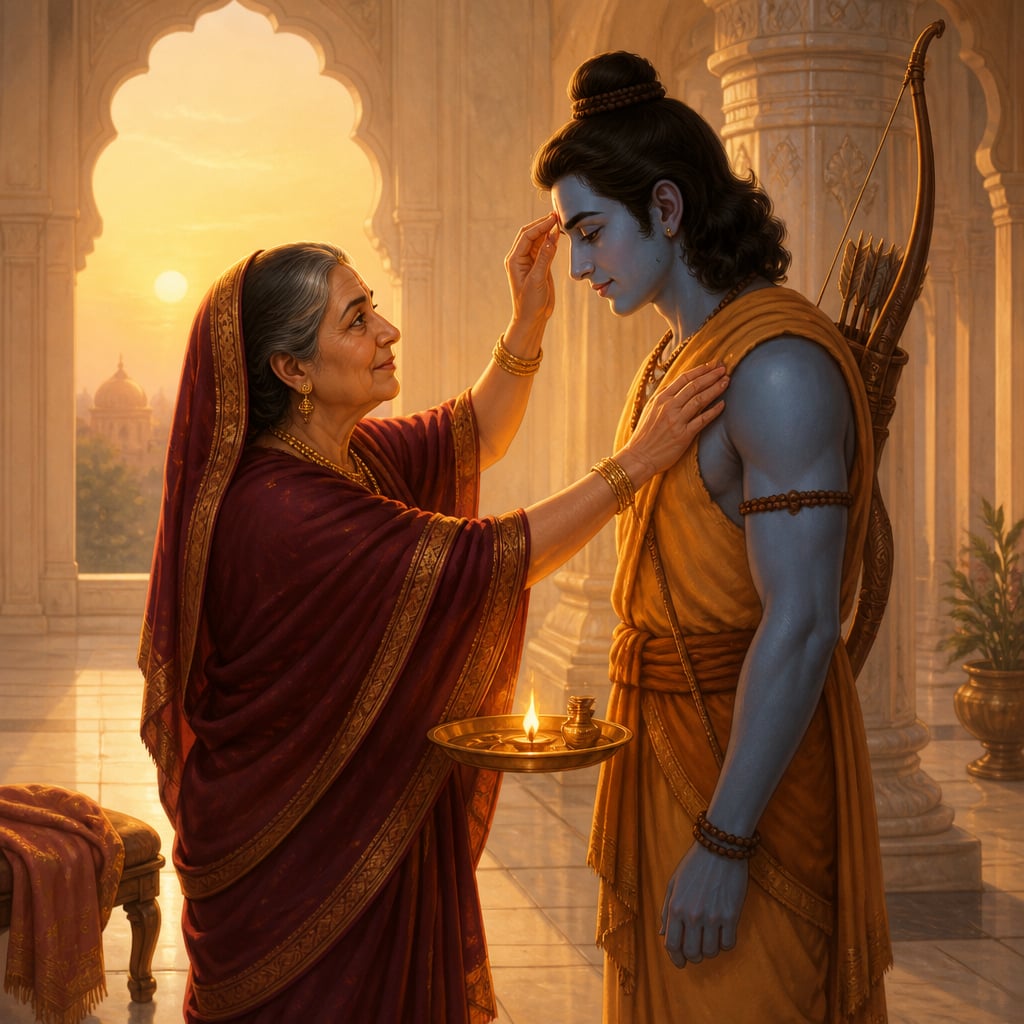
Queen Kausalya performs aarti and applies tilak on Rama as she blesses him before his forest exile.

Modern psychology has a name for what Kausalya demonstrated: secure attachment. The child who knows they are deeply loved can venture into the unknown because they carry that love within them. The mother who loves securely can let go because her love is not possession - it is preparation.

What Is Vatsalya?

Vatsalya (वात्सल्य) comes from "vatsa" - meaning calf. Watch a cow with her calf: she nourishes, protects, licks clean, nudges back when it strays too far. But she doesn't carry the calf forever. She prepares it to walk, then run, then graze independently.

This is the Dharmic model of parental love:

Contrast this with what has become common in modern parenting: love that clings, that fears separation, that measures itself by the child's constant proximity. This is not Vatsalya - it is attachment anxiety wearing the mask of love.

The Science of Secure Bonding

In the 1950s, British psychiatrist John Bowlby observed something troubling: children separated from their mothers showed profound distress that didn't fade with physical care. They needed more than food and shelter - they needed attachment.

Bowlby's attachment theory, later validated by Mary Ainsworth's famous "Strange Situation" experiments, revealed three types of attachment:

Secure Attachment (the Vatsalya model)

Anxious Attachment

Avoidant Attachment

The research is clear: securely attached children become more independent, not less. They have higher self-esteem, better relationships, greater resilience, and more success in life. The love that holds tightly produces anxiety; the love that holds securely produces freedom.

This is exactly what Kausalya demonstrated. Her love was so reliable, so unconditional, that Rama could walk into the forest knowing he carried her blessing within him.

The Neurochemistry of Bonding

Modern neuroscience reveals the biological machinery behind Vatsalya. When a mother holds her infant, both release oxytocin - often called the "bonding hormone." This creates:

But here's the crucial finding: oxytocin doesn't just bond - it also enables safe separation. The child whose brain has been bathed in oxytocin through consistent, loving presence develops the neural architecture to self-soothe, to tolerate separation, to carry the feeling of being loved even when alone.

This is the neurological basis of Vatsalya: build the bond so strong that the child can leave without losing it.

Yashoda tying Krishna in the Damodar-lila

Yashoda's Playful Wisdom

If Kausalya shows us Vatsalya at the moment of release, Yashoda shows us Vatsalya in the daily work of parenting.

Krishna was no ordinary child. He stole butter from every house in Vrindavan. He broke pots, released calves prematurely, and blamed others for his mischief. He was, by any measure, a challenging toddler.

How did Yashoda respond?

She didn't ignore the behavior. When Krishna ate mud, she demanded he open his mouth. When he broke the butter pot, she chased him with a rope. She set boundaries. She corrected.

But she did it with play, with laughter, with the knowledge that this little butter-thief was her beloved. Even when tying him to the grinding mortar (the famous Damodar episode), she did it with exasperation that was really love, firmness that was really care.

Yashoda's parenting shows that Vatsalya is not permissiveness. She had expectations. She corrected misbehavior. But she never withdrew her love as punishment. The relationship remained secure even as the behavior was addressed.

Dhritarashtra unable to restrain Duryodhana

The Cautionary Tale: Dhritarashtra's Blindness

Now consider the opposite.

King Dhritarashtra was physically blind, but his greater blindness was to his son's faults. Duryodhana was jealous, cruel, and driven by hatred for his cousins. Everyone could see it. Vidura warned repeatedly. Bhishma counseled restraint.

But Dhritarashtra, blinded by what he called "love," could not correct his son.

"What can I do? He is my son," became his refrain. Every injustice Duryodhana committed, Dhritarashtra excused. Every warning, he dismissed. His "love" was not Vatsalya - it was weakness dressed as affection, fear masquerading as tenderness.

The result? Duryodhana's character was never shaped. His impulses were never checked. He grew into a man who could order Draupadi's humiliation, poison his cousin, and start a war that killed millions - including himself.

Dhritarashtra's love did not liberate his son. It destroyed him.

This is the dark side of attachment without wisdom: love that cannot see faults, that cannot bear to correct, that sacrifices the child's character for the parent's comfort. Modern psychology calls it "enmeshment" - when parent and child are so fused that the parent cannot tolerate the child's distress even when that distress is necessary for growth.

The Western Parallel Gone Wrong

Bowlby's attachment theory was meant to highlight the importance of bonding. But something got lost in translation to popular parenting culture.

"Attachment parenting" became a movement that emphasized constant physical proximity, extended breastfeeding, co-sleeping, and immediate response to every cry. The intention was good: create security.

But some parents interpreted this as: never let the child experience any frustration, separation, or discomfort.

The research doesn't support this. Secure attachment is built through:

The child who never experiences mild frustration never learns to tolerate it. The child who is never allowed to struggle never builds coping muscles. The child whose every whimper is immediately soothed never develops self-soothing capacity.

Vatsalya includes the wisdom to allow appropriate struggle. Kausalya blessed Rama for exile - she didn't try to prevent it. Yashoda tied Krishna to the mortar - she didn't let him run wild without consequence.

Love With Expectations vs. Love That Indulges

The Dharmic framework gives us a crucial distinction:

Vatsalya (Love That Liberates)

Moha (Love That Binds)

Dhritarashtra suffered from Moha - blind attachment that served his emotional needs, not Duryodhana's developmental needs. His "love" was actually about his own inability to tolerate conflict, his own fear of his son's rejection, his own weakness.

Kausalya and Yashoda demonstrated Vatsalya - love that saw clearly, corrected when needed, and released when the time came. Their love was about preparing their children for life, not keeping their children close for their own comfort.

The Modern Epidemic

Today's parenting culture often resembles Dhritarashtra more than Kausalya. Consider:

The results are documented:

Diana Baumrind's research on parenting styles found that authoritative parents - high warmth AND high expectations - produced the best outcomes. This is precisely the Vatsalya model: love that holds securely AND has standards, that nurtures warmly AND corrects firmly.

The Garbha Sanskar Foundation

Dharmic tradition teaches that Vatsalya begins before birth. Garbha Sanskar - prenatal nurturing - recognizes that the bond between mother and child forms in the womb.

Modern research confirms:

This isn't pressure on pregnant mothers - it's recognition that bonding is a process, not an event. The love that will eventually liberate begins forming before the child takes their first breath.

Building Your Vatsalya Practice

Vatsalya is not a feeling - it is a practice. It requires cultivating:

Presence Without Anxiety Be fully with your child when you're with them. Not checking your phone, not mentally elsewhere. This builds the secure base. But don't hover anxiously, monitoring for every potential problem. Trust develops through reliable presence, not constant surveillance.

Warmth With Boundaries Express love freely and frequently. Physical affection, words of appreciation, delight in their existence. But also hold clear boundaries. "I love you, and the answer is no." Both parts are essential.

Correction Without Withdrawal When behavior needs correcting, address the behavior while maintaining the relationship. "What you did was wrong" is different from "You are bad." Discipline should never involve withdrawing love - the relationship remains secure even as the behavior is addressed.

Release When Ready This is the hardest part. Recognize that your child is not yours to keep. They are souls on their own journey, passing through your care. Your job is to prepare them to leave, not to keep them dependent. Kausalya's blessing, not Dhritarashtra's clinging.

Emotion coaching during tantrums - maintaining secure connection while holding necessary limits.

Modern 'gentle parenting' extremes suggest never saying no, always explaining, negotiating with toddlers. Diana Baumrind's research shows this 'permissive' style produces worse outcomes than 'authoritative' parenting (warmth + expectations). The science supports Yashoda, not endless negotiation.

The Dharmic model integrates what Western psychology separates: you can be warm AND firm, compassionate AND boundaried, loving AND limiting. Yashoda didn't choose between connection and correction - she held both. This is the Vatsalya way.

The Damodar-lila shows Yashoda tying Krishna with rope after he broke the butter pot. She was frustrated, he cried, the rope kept slipping - but she persisted, and he submitted. The relationship emerged stronger, not damaged. Limits held with love build security.

Stress inoculation theory - building resilience through manageable challenges rather than avoiding all difficulty.

Stanford stress research shows that children who experience appropriate challenges develop stronger stress-response systems. Carol Dweck's growth mindset research proves that children praised for effort rather than talent seek challenges rather than avoid them. Trophy culture - protecting all children from failure - produces fragile adults.

Case studies

The Destruction of Duryodhana: When Love Cannot Correct

From childhood, Duryodhana showed troubling signs: jealousy of his cousins, cruelty to servants, entitlement beyond his station. Vidura warned Dhritarashtra repeatedly. Bhishma counseled intervention. Even Duryodhana's brothers saw the problem. But Dhritarashtra could not bring himself to correct his firstborn. 'He is young, he will change,' he said. 'I cannot bear to see him unhappy,' he admitted. 'What can I do? He is my son,' he rationalized. Year after year, the king's blindness allowed the prince's character to calcify into something monstrous.

Dhritarashtra confused Moha (blind attachment) with Vatsalya (nurturing love). True Vatsalya would have recognized that allowing Duryodhana's behavior to continue was harming him, not loving him. Each excuse the king made, each correction he avoided, was actually an act of abandonment - abandoning his son to his worst impulses. Vidura's niti makes clear: the parent who fails to discipline fails to love.

Duryodhana grew into a man capable of ordering Draupadi's public humiliation, poisoning his cousin Bhima, attempting to burn the Pandavas alive, and eventually starting a war that killed millions - including himself and all his brothers. Every soul lost on Kurukshetra was a consequence of a father who could not say no to his son.

The discomfort of correcting a child is nothing compared to the disaster of failing to correct them. Dhritarashtra avoided small conflicts and created a catastrophic one. Parents must find the courage to disappoint their children in small ways, or risk the child becoming someone who disappoints everyone, including themselves.

Teachers, counselors, and relatives often see a child's behavioral problems before parents do, and they try to raise concerns. Modern Dhritarashtras respond with 'You don't understand my child' or 'He's going through a phase.' Ignoring early warning signs from trusted adults is the single most common parental mistake in cases that escalate to serious behavioral or legal problems.

Vidura warned Dhritarashtra at least 7 distinct times in the Sabha Parva alone about Duryodhana's destructive path, each warning recorded as a separate dialogue in the Mahabharata text.

The Modern Dhritarashtra: Helicopter Parenting and Failure to Launch

A study by Holly Schiffrin at the University of Mary Washington followed college students whose parents exhibited 'helicopter' behaviors: fighting their battles with professors, monitoring their daily activities, rescuing them from every difficulty. These parents believed they were showing love by protecting their children from all discomfort. They completed their children's projects, argued with coaches about playing time, and ensured their children never experienced failure or frustration.

Like Dhritarashtra, these parents confuse comfort with care. They cannot tolerate their child's distress, so they prevent all situations that might cause it. But distress tolerance is built through experiencing distress - the child who never struggles never builds coping muscles. The Dharmic understanding recognizes that tapas (endurance through difficulty) builds character. Shielding children from all difficulty is not Vatsalya; it is Moha wearing the mask of love.

The research found these students had higher rates of depression and anxiety, lower life satisfaction, and reduced sense of autonomy and competence. Many struggled to function independently. The 'failure to launch' epidemic - adults in their 20s and 30s still dependent on parents - is the modern equivalent of Duryodhana's character deformation.

Over-protection is not protection - it is a form of harm. The child who never learns to handle frustration becomes an adult who cannot handle life. Vatsalya prepares the child for independence; helicopter parenting creates permanent dependence. Kausalya blessed Rama's departure; the helicopter parent cannot bear it.

The 'failure to launch' phenomenon, where adults in their 20s and 30s remain financially and emotionally dependent on parents, is now widespread enough to have its own clinical literature. College counseling centers report record demand. The common thread is parents who solved every problem, leaving their children without the psychological muscles that only struggle can build. Letting a 10-year-old navigate a conflict with a friend is practice for the 30-year-old navigating a conflict with a boss.

Holly Schiffrin's 2014 study at the University of Mary Washington surveyed 297 undergraduate students and found that helicopter parenting was significantly associated with higher levels of depression and decreased satisfaction with life.

Living traditions

Reflection

More in Bandhan: The Science of Sacred Bonds

All lessons in Bandhan: The Science of Sacred Bonds · Parenting Dharma course