Kutumba: The Joint Family Advantage

Why 'The Village' Matters

Discover why multiple caregivers create more resilient children through the stories of Prahlada saved by Narada and Nachiketa taught by Yama. Explore cross-cultural research on 'alloparenting' and understand why nuclear family isolation leads to burnout while traditional village-style parenting produces thriving children.

The Mentor Who Saved a Soul

Hiranyakashipu had a plan. He would raise his son Prahlada to be exactly like himself - an enemy of Vishnu, a conquerer of the three worlds, a being of unlimited ego and rage.

He controlled everything. He chose Prahlada's teachers. He monitored his education. He surrounded him with influences that reinforced his own values. It was the ancient equivalent of helicopter parenting taken to demonic extremes.

But there was one thing he couldn't control: Narada.

The wandering sage had visited Prahlada's mother during pregnancy. He had sung devotional songs, told stories of dharma, planted seeds of wisdom that Hiranyakashipu couldn't see or uproot. When Prahlada emerged as a devotee of Vishnu despite his father's totalitarian parenting, Hiranyakashipu was baffled. How could his son be so different from everything he had taught?
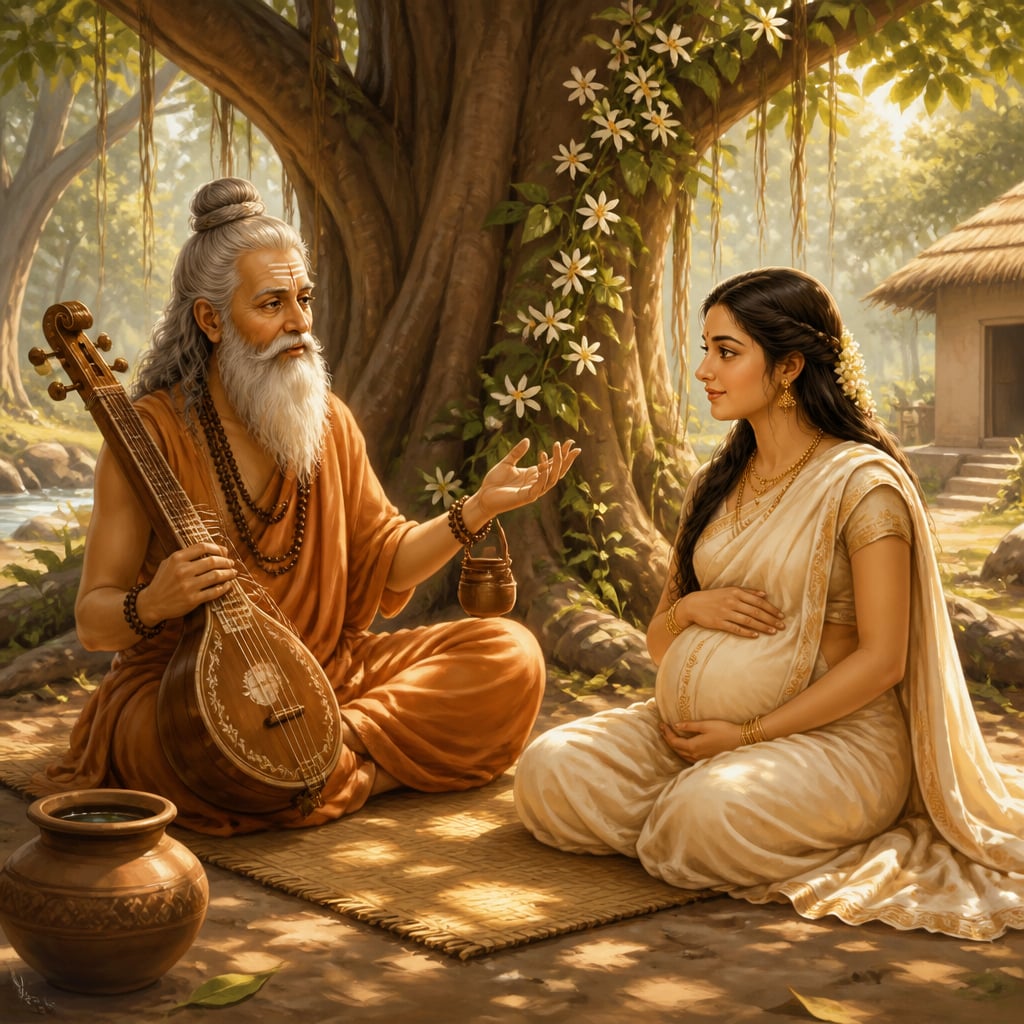
Sage Narada sits under a banyan with the pregnant queen Kayadu, reciting a quiet verse on a forest mat.

The answer: one mentor, outside the nuclear family, changed everything.

Narada didn't raise Prahlada. He wasn't there daily. But his influence - one alternative voice, one different perspective, one connection to wisdom beyond the father's control - was enough to save a soul from what would have been spiritual destruction.

This is the power of the village. No single parent, however well-intentioned, can provide everything a child needs. And when a parent is harmful, outside influences become literally life-saving.
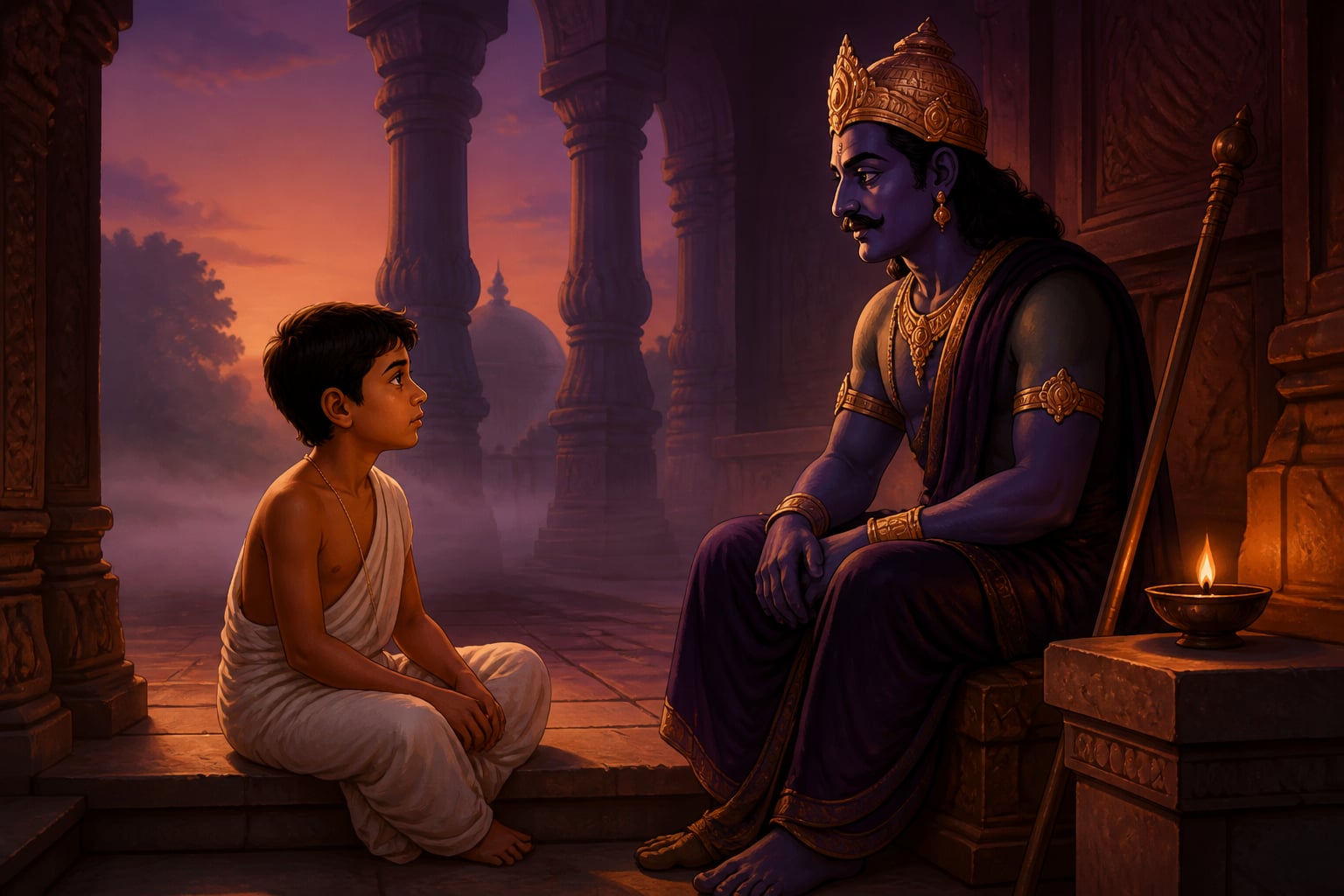
Nachiketa receiving teaching from Yama

Nachiketa: What Father Couldn't Teach

The story of Nachiketa in the Katha Upanishad begins with parental failure.

Vajasravasa, Nachiketa's father, was performing a sacrifice that required giving away all his possessions. But he was giving away only old, worthless cows - technically fulfilling the ritual while violating its spirit. Young Nachiketa, watching this hypocrisy, asked his father: "To whom will you give me?"

The question was pointed: If you're giving away everything, what about me? Irritated, Vajasravasa snapped: "I give you to Yama (Death)."

A lesser father would have taken it back. Vajasravasa, trapped by pride, did not. And so Nachiketa went to Yama's abode, waited three days, and received the greatest teaching in the Upanishads - the nature of the Self, the secret of immortality, wisdom his father could never have given.

The lesson is profound: sometimes children need teachers their parents cannot be.

Vajasravasa was spiritually limited. His son outgrew him. The universe provided a teacher - Yama himself - who could take Nachiketa further than his father ever could. This is not parental failure in the shameful sense; it's the natural recognition that no parent is complete. Children need influences beyond us.

Village courtyard with multiple caregivers

The Alloparenting Revolution

In 2021, journalist Michaeleen Doucleff published "Hunt, Gather, Parent," documenting how traditional cultures around the world raise children. What she found challenged everything Western parenting assumes.

Among the Maya in Mexico's Yucatan Peninsula:

Among the Inuit in Arctic Canada:

Among the Hadza in Tanzania:

The anthropological term is alloparenting - literally "other parenting." It's the norm in human history. The nuclear family raising children in isolation is the historical anomaly.

What We Lost

The joint family system of Bharat provided alloparenting naturally:

Multiple attachment figures

Distributed expertise

Natural mentorship

Built-in respite

Intergenerational wisdom transfer

The Nuclear Burnout Epidemic

Modern nuclear families attempt what no culture in human history asked parents to do: raise children essentially alone.

The statistics are brutal:

Parental burnout rates:

Isolation statistics:

Mental health impact:

Child outcomes:

We've created a structure that sets parents up to fail, then blame them when they struggle.

Prahlada's Principle: One Outside Voice Can Save

Prahlada's story teaches something essential: children need influences beyond their parents.

Narada was not Prahlada's daily caregiver. He was an outside voice - someone who planted different seeds, offered different wisdom, represented possibilities the father couldn't imagine.

Modern research confirms this:

Mentorship research shows:

Resilience research shows:

For Prahlada, that one outside voice was Narada. For Nachiketa, it was Yama. For every child, there's a need for someone beyond the parents who sees them, believes in them, and offers perspective the parents can't.

Why Multiple Attachments Strengthen

Early attachment research (Bowlby, 1950s) focused on the mother-infant bond. This was sometimes misinterpreted as: children should attach only to their mothers.

Later research corrected this:

The multiple attachment model shows:

Cross-cultural research shows:

The fear that children will be "confused" by multiple caregivers is unfounded. Children naturally adapt to multiple relationships. What confuses them is inconsistency and isolation - exactly what nuclear families often provide.

Nachiketa's Principle: Parents Can't Teach Everything

Nachiketa's father, Vajasravasa, was spiritually limited. His hypocrisy was obvious to his own son. If Nachiketa had only his father as a teacher, he would have inherited that limitation.

But the universe provided Yama - a teacher who could take him where his father could not.

This principle is crucial for parents to accept:

You cannot be your child's everything.

Your child needs:

The parent who tries to be the sole influence creates dependency at best, limitation at worst. Vajasravasa's failure was actually Nachiketa's liberation - it sent him to a teacher he desperately needed.

What the Village Provides

The traditional joint family / village provided for children what no nuclear family can:

Redundancy

Diversity

Specialization

Continuity

Balance

Building Your Village

Most of us can't recreate the joint family system. But we can build intentional villages that provide some of its benefits.

Leverage existing family:

Create intentional networks:

Accept help without guilt:

Create rituals of connection:

The Parent's Humble Role

Prahlada didn't need Hiranyakashipu to become who he was meant to be. In fact, he became who he was despite his father. Narada's brief influence outweighed years of his father's totalitarian parenting.

Nachiketa outgrew Vajasravasa. The father's limitation became the occasion for the son's transcendence. Yama taught what the father couldn't.

These stories humble the parent. We are necessary but not sufficient. We are important but not irreplaceable. We are foundational but not complete.

The Dharmic parent understands:

This isn't parental failure - it's parental wisdom. The best thing you can do for your child might be to let others influence them, teach them, love them in ways you cannot.

Beyond the Nuclear Prison

The nuclear family in isolation is a prison - for parents and children alike.

Parents are trapped:

Children are trapped:

The village - whether traditional joint family or intentionally built network - liberates everyone.

Prahlada was saved by one outside voice. Nachiketa was elevated by one external teacher. Your child needs their Narada, their Yama - influences beyond what you alone can provide.

Your job isn't to be everything. Your job is to build the village.

Creating networks of trusted adults to provide children the multiple caregiver benefits that traditional joint families offered naturally.

The 'village parenting' movement in the West recognizes this need, with cooperative childcare, 'family pods,' and intentional communities forming. These are attempts to recreate what traditional cultures never lost.

Dharmic tradition provides clear frameworks: the mama (maternal uncle) has a specific role, the nani (maternal grandmother) has another. Rather than generic 'help,' these defined relationships give everyone clarity about their contribution.

When Prahlada's mother Kayadu was taken to Narada's ashram during her husband's absence, she joined a village of sages. Even temporary immersion in a supportive community during pregnancy shaped her son's entire life.

Giving grandparents meaningful roles rather than just occasional visits, even when they live at a distance.

Western grandparents often feel sidelined - wanted as babysitters but not as real influences. Research shows that children with involved grandparents show better emotional regulation, stronger family identity, and more intergenerational perspective.

Case studies

The Modern Parental Burnout Epidemic

A 2020 study across 42 countries measured parental burnout - defined as overwhelming exhaustion, emotional distancing from children, and loss of parenting pleasure. The study found burnout rates of 5-8% in countries with strong extended family support (like parts of Africa and Asia) versus 20-40% in countries with nuclear family isolation (like Belgium, USA, Poland). The researchers noted that burnout correlates directly with the degree of isolation from extended family support.

Traditional kutumba (joint family) structures prevented burnout by design. No single person was responsible for everything. When a mother was exhausted, grandmother or aunt stepped in. When a father was working, uncles provided male guidance. The system had built-in redundancy and respite. Modern nuclear families ask one or two adults to do what entire communities used to share.

Burned-out parents show higher rates of depression, marital conflict, and critically - neglect and abuse of their children. The children of burned-out parents show more behavior problems, more anxiety, and worse developmental outcomes. The nuclear family in isolation produces suffering for both parents and children.

Parental burnout is not personal failure - it's structural failure. You are trying to do what humans were never designed to do alone. Seeking help, building networks, and leveraging extended family isn't weakness - it's the ancient wisdom of survival. Burning out helps no one, least of all your children.

The nuclear family experiment is failing globally, and the data is clear. Indian families that migrated to Western countries and maintained joint family structures report significantly lower parental stress than those who adopted the nuclear model. The rise of 'parenting villages,' co-housing communities, and grandparent co-living arrangements in the West represents an unconscious return to the kutumba model that traditional Indian families never abandoned.

A 2021 study published in Affective Science surveyed 17,409 parents across 42 countries and found parental burnout rates between 5% and 8% globally, with Western individualistic cultures showing rates 2 to 4 times higher than collectivist ones.

The One Caring Adult: Resilience Research

Decades of resilience research (starting with Emmy Werner's Kauai Longitudinal Study in 1955) has consistently found one factor that predicts which at-risk children will thrive despite adverse circumstances: the presence of at least one stable, caring adult who is NOT the parent. This could be a grandparent, teacher, coach, neighbor, mentor - anyone who provides consistent positive attention and believes in the child.

Prahlada had Narada. Nachiketa had Yama. The Dharmic tradition has always understood that children need anchors beyond their parents. Joint families provided this naturally - every child had multiple adults invested in their development. The 'one caring adult' research simply validates what traditional structures provided: redundancy in adult support.

Children with at least one non-parent mentor show dramatically better outcomes in education, mental health, career success, and relationship stability - even when facing poverty, abuse, or family dysfunction. The mentor effect is so strong it can compensate for significant parental failure.

If you are a parent: your child needs adults beyond you. Facilitate these relationships, don't hoard your child's attention. If you are not a parent: you could be someone's 'one caring adult.' Teachers, coaches, mentors, neighbors - your consistent, positive attention to a child could literally change their trajectory. Be someone's Narada.

Mentorship programs like Big Brothers Big Sisters consistently show that a single stable adult relationship can shift a child's trajectory more than any curriculum or intervention. In India, the tradition of the mama (maternal uncle), the family friend who acts as informal guide, and the neighborhood 'aunty' who watches over children all serve this function naturally. As urbanization shrinks these networks, parents must deliberately cultivate non-parent adult relationships for their children.

Emmy Werner's Kauai Longitudinal Study followed 698 children born in 1955 on the Hawaiian island of Kauai for over 40 years, finding that one third of at-risk children became competent, caring adults when they had at least one stable, supportive relationship.

Living traditions

Reflection

More in Bandhan: The Science of Sacred Bonds

All lessons in Bandhan: The Science of Sacred Bonds ยท Parenting Dharma course