Survival Against All Odds
Lance Naik Hanumanthappa Koppad - Miracle of Siachen
In February 2016, an avalanche buried Lance Naik Hanumanthappa under 25 feet of ice at Siachen. Found alive after 6 days in a frozen tomb where survival was medically impossible, he became a symbol of the indomitable human spirit. Though he died soon after rescue, his survival defied science and moved an entire nation.
The Frozen Tomb
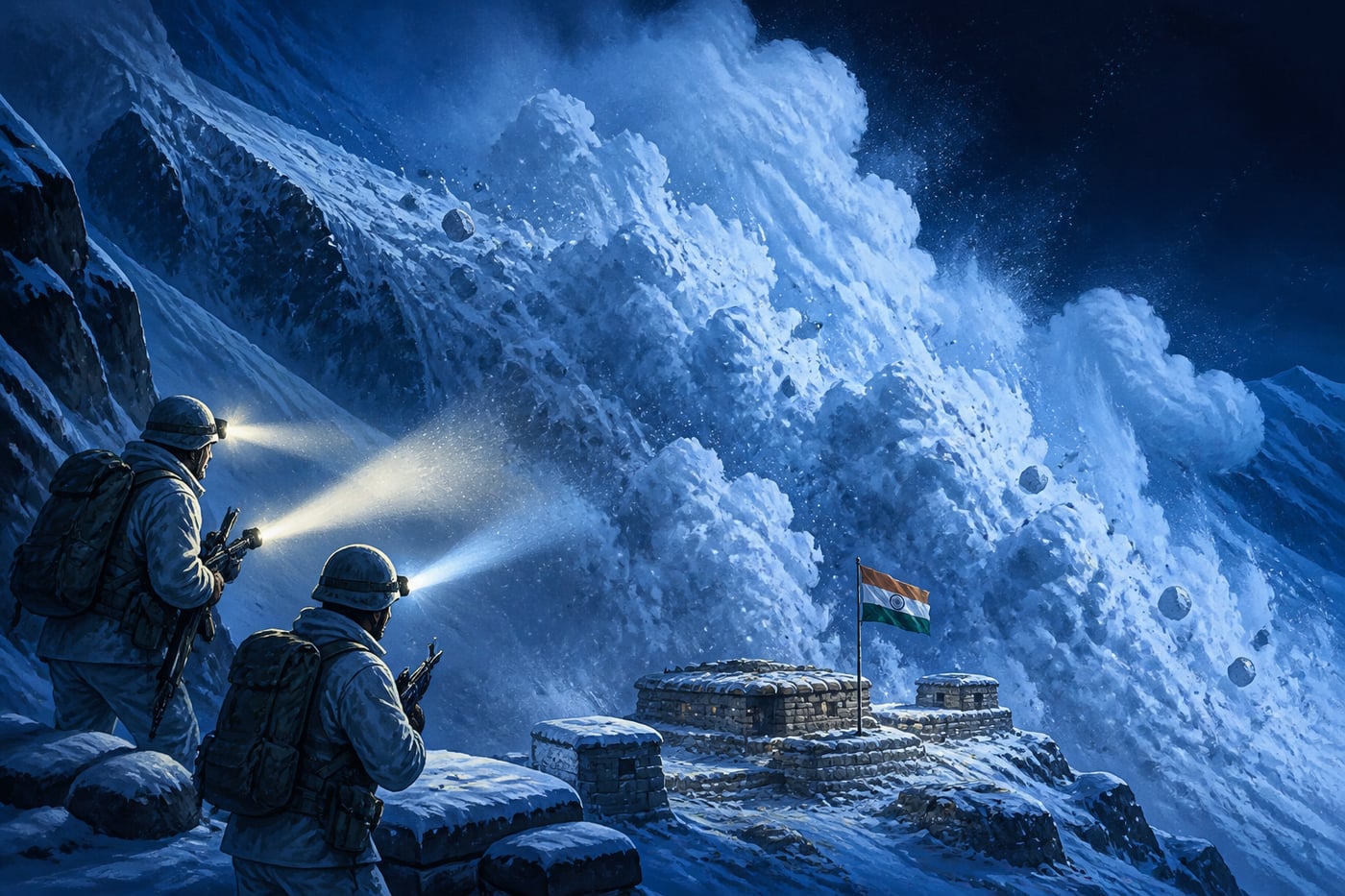
At 3:00 AM on February 3, 2016, the mountain came alive with death.
A wall of snow, ice, and rock - an avalanche traveling at over 100 kilometers per hour - slammed into the Indian Army post at an altitude of 19,600 feet on the Siachen Glacier. In seconds, the entire post was buried under 25 feet of frozen debris.
Ten soldiers of 19 Madras Regiment were entombed alive.
Among them was Lance Naik Hanumanthappa Koppad, a 33-year-old soldier from the coastal district of Kundapur in Karnataka. He had been serving at Siachen for five months, enduring temperatures that dropped to -60°C, winds that could freeze exposed skin in minutes, and an altitude where every breath was a struggle.
Now, he was buried in a frozen grave - and the clock had started ticking.
The Impossible Search
When dawn broke on February 3rd, rescue teams from the Army and the Snow Avalanche Study Establishment (SASE) faced a nightmare scenario.
The avalanche had deposited a debris field the size of three football fields. Somewhere beneath 25 feet of compacted ice and snow lay ten of their brothers. In the oxygen-starved air of Siachen, where even walking was exhausting, they had to dig.
The mathematics of survival were brutal:
- At -45°C, an unprotected human loses consciousness within 15 minutes
- Without insulation, death from hypothermia follows within 2-3 hours
- Buried victims typically have only 30 minutes of trapped air before suffocation
- No one had ever survived more than a few hours under such conditions
But the soldiers of 19 Madras Regiment and the rescue teams didn't care about mathematics.
They dug. Through freezing wind. Through frostbite. Through their own exhaustion. Day after day.
Five days passed. Nine bodies were recovered. Medical science said the tenth man must be dead too.
But they kept digging.
The Miracle - Day Six
February 9, 2016. 1:30 PM.
After 144 hours of continuous rescue operations, a digging team spotted something. A cavity in the ice - perhaps three feet wide. And inside, impossibly, a faint sign of life.

Lance Naik Hanumanthappa Koppad was alive.
He had survived for six days buried under 25 feet of ice, in temperatures of -45°C, with minimal air and no food or water.
The medical teams couldn't believe their instruments. His heart was beating. His lungs were moving. In a tomb that should have killed him in hours, he had held on for nearly a week.
"This is not science. This is something beyond. In my 25 years of medical service, I have never seen anything like this." , An Army doctor at the site
The Will to Live
How did Hanumanthappa survive?
Doctors later speculated that a small air pocket had formed around his face, providing just enough oxygen. The extreme cold, paradoxically, may have slowed his metabolism, reducing his body's oxygen needs. His physical fitness from months of high-altitude duty had prepared his body for oxygen deprivation.
But science could only explain part of it.
The rest was something beyond measurement: the human will to live.
Hanumanthappa had a wife, Mahadevi, and a young daughter, Netra, waiting for him in Karnataka. He had promised them he would return. And somewhere in that frozen darkness, buried alive with no hope of rescue, he refused to break that promise.
His body shut down to the minimum. His mind held on.
The Nation Watches
The moment news broke that a soldier had been found alive after six days under the ice, India stopped.

Hanumanthappa was airlifted by helicopter to the Army's Research and Referral Hospital in New Delhi - the best military medical facility in the country. Prime Minister Narendra Modi rushed to the hospital. Television channels ran continuous coverage. Millions prayed.
The doctors found him in critical condition:
- Severe hypothermia
- Organs in shutdown
- Brain damage from oxygen deprivation
- Blood pressure barely detectable
They fought to save him. The best doctors in the country worked around the clock. The nation held its breath.
The Final Battle
February 11, 2016. 11:45 AM.
After three days of intensive care - the same three days the whole country had been praying - Lance Naik Hanumanthappa Koppad breathed his last.
He had survived six days in a frozen tomb. But the damage to his body was too severe. His organs, pushed beyond all human limits, finally gave out.
The soldier who had defied death for 144 hours lost his final battle.
But in those six days, he had done something extraordinary: he had shown India - and the world - what the human spirit was capable of.
A Nation Mourns
Prime Minister Modi's statement captured the nation's grief:
"Lance Naik Hanumanthappa showed us that even when hope seems impossible, the human spirit can endure. He was a soldier who fought not just against enemies but against death itself. India will never forget his courage."
The Army gave him a funeral with full military honors. His body was flown to his village in Karnataka, where thousands gathered to pay their respects. Schoolchildren lined the streets. Veterans saluted.
He was posthumously awarded the Sena Medal for his bravery and will to survive.
The Story Behind the Soldier
Hanumanthappa Koppad was born on February 28, 1983, in Betadur village, Kundapur Taluk, Karnataka. His father was a farmer. Money was always tight.
Like many young men from rural India, he saw the Army as a path to a better life - steady income, respect, and a chance to serve his country. In 2002, at age 19, he joined 19 Madras Regiment.
His service record:
- Multiple deployments in Jammu & Kashmir
- High Altitude Warfare training
- Posted to Siachen in October 2015
- Married to Mahadevi in 2010
- Daughter Netra born in 2012
He was known as a quiet, dedicated soldier who never complained about hardship. His fellow soldiers remembered him as someone who always volunteered for the tough duties.
The Siachen posting was supposed to be his last high-altitude deployment. He had been planning to transfer to a less demanding posting to spend more time with his young family.
The Physics of a Miracle
Scientists and doctors have studied Hanumanthappa's survival extensively. Here is what they believe happened:
| Factor | How It Helped |
|---|---|
| Air pocket | A small cavity formed around his face, possibly from his body heat melting a space. This gave him about 10 liters of air - enough for a few hours if breathing slowly |
| Extreme cold | The -45°C temperature put his body into a near-hibernation state, reducing oxygen consumption by up to 50% |
| Physical fitness | High-altitude adaptation had trained his body to function with less oxygen |
| Mental focus | Staying calm reduced oxygen consumption and prevented panic-induced carbon dioxide buildup |
| Snow insulation | Paradoxically, the snow acted as insulation, keeping his temperature from falling further |
But even with all these factors, medical experts said survival beyond 48 hours was impossible. Hanumanthappa survived 144.
The answer, they concluded, lay somewhere beyond physiology - in the realm of willpower and the human spirit.
19 Madras Regiment - A Legacy of Valor
19 Madras Regiment, to which Hanumanthappa belonged, has a distinguished history:
Battle Cry: "Veera Madrasi, Adi Kollu!" (Brave Madrasi, Strike and Kill!)
Notable Actions:
- 1965 War: Distinguished service in the Western Sector
- 1971 War: Operations in East Pakistan
- Op Pawan (Sri Lanka): Counter-insurgency against LTTE
- Siachen: Continuous deployment since 1984
The regiment recruits from Tamil Nadu, Karnataka, Kerala, and Andhra Pradesh. They are known for their discipline, physical endurance, and calm under pressure - traits that Hanumanthappa exemplified.
The Nine Who Fell
Hanumanthappa's story captured headlines, but we must remember: nine other soldiers died in that same avalanche. They too were someone's sons, husbands, fathers.
The complete list of martyrs from February 3, 2016:
- Havildar Elumalai
- Lance Naik Sudheesh
- Lance Naik Mahesha
- Lance Naik Havildar
- Sepoy Ganesan
- Sepoy Rama Moorthy
- Sepoy Nandakumar
- Sepoy Mustafa
- Sepoy Rafeeq Ahmad
- Lance Naik Hanumanthappa Koppad
All ten made the ultimate sacrifice serving at the world's highest battlefield. Each deserves to be remembered.
What Siachen Demands
Hanumanthappa's story highlights what Siachen demands from its soldiers:
The Daily Reality:
- Temperatures: -60°C in winter
- Altitude: 17,000-21,000 feet
- Oxygen: 40% of sea level
- Avalanches: 100+ annually
- Casualties: More soldiers die from weather than combat
- Rotation: 3 months on, 3 months recovery
The Physical Toll:
- High Altitude Pulmonary Edema (HAPE)
- High Altitude Cerebral Edema (HACE)
- Frostbite leading to amputations
- Snow blindness
- Chronic joint problems
Yet soldiers volunteer for Siachen duty. They know the risks. They go anyway.
The Deeper Lesson
Hanumanthappa's survival - even temporary - offers a profound teaching about the human spirit.
In the Yoga tradition, there is a concept called Prāṇa - the life force that animates all living beings. It is said that Prāṇa can be strengthened through discipline, devotion, and purpose.
Hanumanthappa spent six days in conditions where life should have been impossible. But his Prāṇa - strengthened by love for his family, loyalty to his regiment, and the discipline of a soldier - refused to depart.
The Bhagavad Gita teaches:
नैनं छिन्दन्ति शस्त्राणि नैनं दहति पावकः। न चैनं क्लेदयन्त्यापो न शोषयति मारुतः॥
"Weapons cannot cut the soul, fire cannot burn it, water cannot wet it, wind cannot dry it."
In his frozen tomb, Hanumanthappa proved that the soul - the deepest essence of a human being - is stronger than any physical circumstance.
Legacy
After Hanumanthappa's death, the Army and the government took several steps:
For his family:
- Ex-gratia payment of ₹20 lakhs
- Job for his wife in Karnataka government
- Education guarantee for daughter Netra
- A house built in his village
- Monthly pension for parents and family
For his memory:
- Sena Medal (posthumous)
- Stadium named in his honor in Karnataka
- School named after him
- Annual memorial lecture in his regiment
But perhaps his greatest legacy is the story itself - a reminder that even when everything seems lost, the human spirit can endure.
Key figures
Lance Naik Hanumanthappa Koppad
Soldier of 19 Madras Regiment who survived 6 days buried under avalanche
The Rescue Teams
Army and SASE personnel who dug for 6 days without giving up
The Nine Martyrs
Soldiers who died in the February 3, 2016 avalanche
Case studies
The Trapped Miner
A mining supervisor receives word that a tunnel has collapsed, trapping three workers. Rescue experts estimate the trapped area has only 24 hours of air. After 20 hours of digging, they've made little progress. The experts recommend calling off the rescue. What should the supervisor do?
The 2018 Thai cave rescue of 12 boys trapped underground for 18 days succeeded because rescuers refused to accept the statistical improbability of survival. Medical science gives averages, but individual cases can defy those averages when human will and ingenuity refuse to stop.
The Dying Patient
A doctor has a patient in critical condition with multiple organ failure. The patient's family is poor and already in debt from treatment. The prognosis is grim - less than 5% chance of survival. Should the doctor recommend continuing expensive treatment or suggest the family accept the inevitable?
In palliative care, the principle of 'fighting the good fight' is now well established. Even when outcomes are uncertain, the process of trying gives families closure and patients dignity. Medical ethics increasingly recognizes that effort has value independent of results.
The Extreme Challenge
A young professional is offered a high-altitude expedition to one of the world's most dangerous peaks. The pay is excellent, but several climbers have died on this mountain in recent years. She has a young child at home. Should she take the risk for the reward?
Firefighters, deep-sea divers, and high-altitude construction workers all face calculated risks daily. The difference between reckless thrill-seeking and purposeful risk is whether your exposure serves something beyond yourself. This distinction matters in career choices, entrepreneurship, and even personal investments.
Historical context
Siachen Conflict (1984-Present)
By 2016, India had maintained a presence on Siachen for 32 years - the longest continuous high-altitude deployment in military history. While no shots had been fired since 2003, the glacier continued to claim lives through avalanches, crevasse falls, and altitude sickness. Hanumanthappa's story brought national attention to these invisible casualties.
Living traditions
Hanumanthappa's story changed how India perceives Siachen casualties. Before 2016, weather-related deaths received little attention compared to combat casualties. His survival and the national vigil that followed highlighted that every soldier serving at Siachen is engaged in a daily battle for survival - making them all heroes, regardless of whether they fall to bullets or blizzards.
- Hanumanthappa Memorial, Betadur: A memorial statue and garden in his home village where he was laid to rest with full military honors. The local school has been renamed in his honor.
- Siachen Base Camp: While the glacier itself is not accessible to civilians, the Siachen Base Camp has a memorial to all soldiers who have fallen on the glacier. Special permission from the Army is required for visits.
Reflection
- Hanumanthappa held on for six days in conditions that should have killed him in hours. What do you think enabled him to survive so far beyond medical probability? Was it purely physical, or was something else at work?
- The rescue teams continued digging for six days even though all evidence suggested the buried soldiers must be dead. What drives people to continue when logic says to stop? Have you ever persisted against all odds - and what was the outcome?
- Hanumanthappa died three days after being rescued, despite the best medical care. Does this mean the rescue was 'pointless'? Or did those final days - when the nation watched, prayed, and honored him - have meaning of their own?