Operation Meghdoot

How India Secured the World's Highest Battlefield

In April 1984, India launched Operation Meghdoot to pre-empt Pakistan's occupation of the Siachen Glacier. Ladakh Scouts and early climbers reached the peaks first. The operation that began a 40-year vigil at 21,000 feet where temperatures drop to -60°C.

The Frozen No-Man's Land

Above the clouds, where the air thins to almost nothing, lies a glacier unlike any other. The Siachen Glacier stretches 76 kilometers through the Karakoram Range - the world's longest glacier outside the polar regions. At altitudes between 18,000 and 24,000 feet, temperatures plunge to -60°C. Winds howl at 150 kilometers per hour. Avalanches strike without warning.

No one believed armies could survive here. The 1949 Karachi Agreement and the 1972 Simla Agreement both left this region undefined, marked simply as a line ending at coordinate NJ9842, with territory beyond described as "thence north to the glaciers." Both nations assumed the land was too hostile for military presence.

They were wrong.

Pakistan's Secret Plan

By the early 1980s, Indian intelligence noticed a disturbing pattern. Pakistan was issuing mountaineering permits to international expeditions - permits that listed peaks in the Siachen region as Pakistani territory. Foreign maps began showing the glacier as part of Pakistan. This was not innocent cartography.

In 1983, Indian intelligence confirmed the worst fears: Pakistan was planning to occupy the glacier's key passes and ridgelines in spring 1984. Pakistani forces had already procured cold-weather equipment from European suppliers. They intended to present the world with a fait accompli - Pakistani troops on Indian territory, claiming historical possession.

India had one option: reach the peaks first.

Colonel Narinder Kumar - The Man Who Knew the Mountains

India's ace was a man who had climbed these peaks before. Colonel Narinder Kumar, nicknamed "Bull" for his relentless drive, had led the first Indian expeditions to the Siachen region in 1978 and 1981. He knew the terrain intimately - every crevasse, every ridgeline, every approach route.
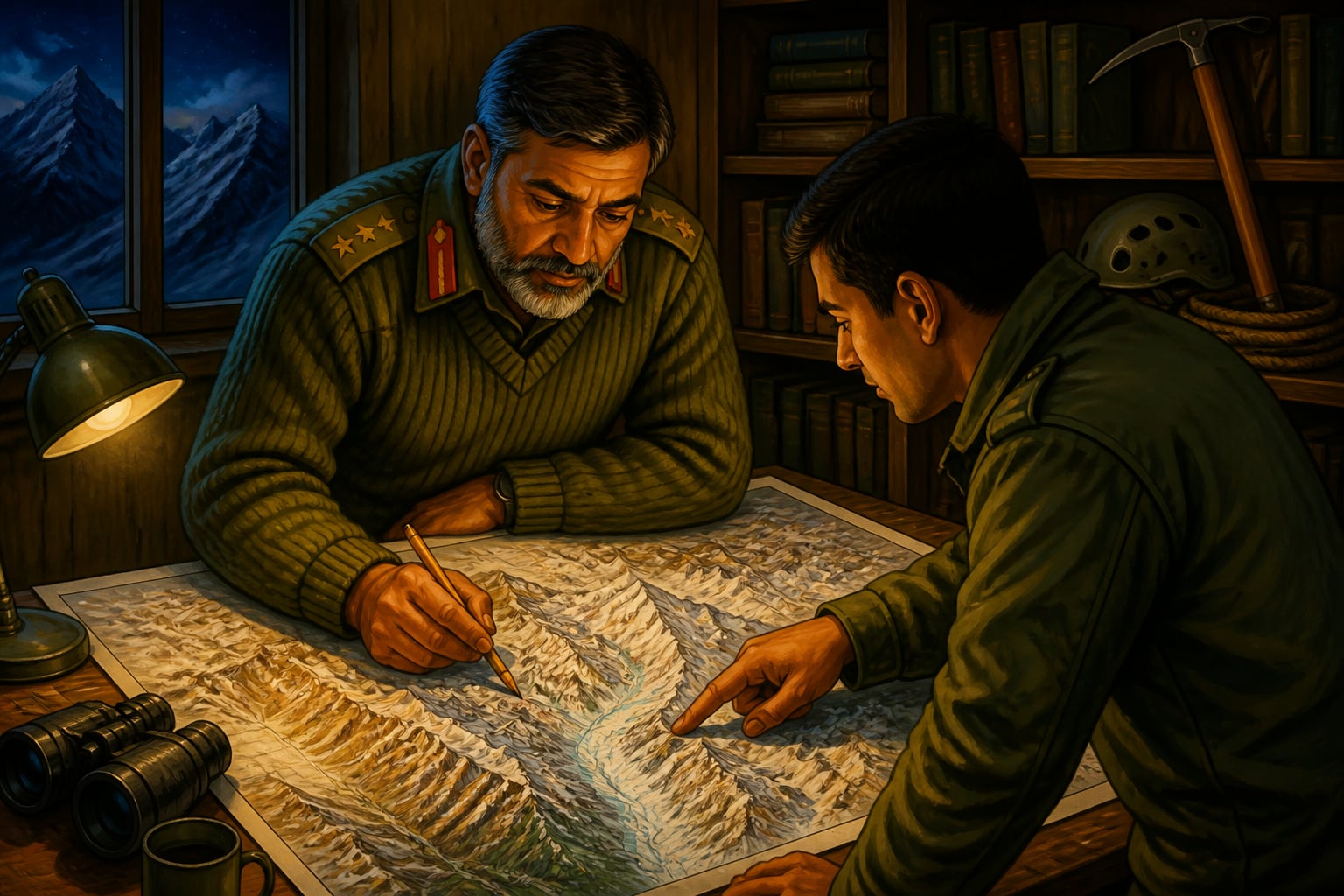
Col Narinder Kumar planning Operation Meghdoot at a map table

When the government decided to act, Col Kumar was recalled from retirement to plan the operation. His assessment was blunt:

"The side that reaches the heights first will hold them. The glacier favors the defender. We must be on those passes before April."

The plan was named Operation Meghdoot - "Cloud Messenger" - after Kalidasa's Sanskrit masterpiece. The name was fitting: India's soldiers would ascend into the clouds to deliver a message that this land was Indian.

The Race to the Top

D-Day was set for April 13, 1984 - coinciding with Baisakhi, the harvest festival. But intelligence reports indicated Pakistan was mobilizing faster than expected. The date was advanced to April 13 - a full day before Pakistan's planned occupation.

In one of the most audacious helicopter operations ever attempted, Cheetah helicopters of the Indian Air Force and Army Aviation began ferrying troops to altitudes where rotors barely generated lift. Each helicopter could carry only two soldiers with minimal equipment at those heights.

The first wave consisted of the Ladakh Scouts and Kumaon Regiment soldiers - men accustomed to high-altitude warfare. Many were from Ladakh themselves, their bodies naturally adapted to thin air.

First Footprints on the Glacier

On April 13, 1984, Captain Sanjay Kulkarni led a patrol to the crucial Bilafond La pass at 18,500 feet. When they crested the ridge, they found - nothing. Empty snow. No Pakistani flags. They had won the race by hours.

Cheetah helicopters landing at Bilafond La as Captain Sanjay Kulkarni leaps into the snow

Simultaneously, other teams secured Sia La and other critical passes. When Pakistani troops arrived days later, they found Indian soldiers already dug in, the tricolor flying from the peaks.

The message was clear: India had claimed the heights.

Settling Into the Impossible

But reaching the glacier was only the beginning. Now India had to hold it.

Ladakh Scouts soldiers enduring the first winter inside a Siachen bunker

The first winter was a test of human endurance beyond imagination. At Bana Post (21,153 feet), later made famous by Naib Subedar Bana Singh, soldiers lived in temperatures where exposed skin froze in seconds. Water had to be melted from snow using precious fuel. Food arrived frozen solid and had to be thawed over stoves before eating.

Soldiers suffered from:

Yet they held. Day after day, week after week, through blizzards that buried posts under twenty feet of snow.

The Human Cost

Since Operation Meghdoot, more Indian soldiers have died from the weather than from enemy action. Avalanches have buried entire posts. Crevasses have swallowed patrols without warning. The cold has claimed limbs and lives.

The Siachen casualty figures tell a sobering story:

Yet not one inch has been yielded. The peaks secured in April 1984 remain in Indian hands today.

Why Siachen Matters

Some ask: why fight for a glacier where nothing grows and no one lives?

The answer lies in geography. If Pakistan controlled Siachen, it would:

  1. Connect Pakistani territory with Chinese-held Aksai Chin - linking India's two adversaries
  2. Overlook Ladakh - giving strategic high ground over Indian positions
  3. Control the headwaters of rivers vital to the subcontinent

More importantly, it would reward Pakistani aggression. The 1984 operation sent a message: India will not cede territory by default. Every inch of the motherland will be defended, no matter how harsh the terrain.

The Legacy of Meghdoot

Operation Meghdoot established India as a nation capable of operating in the harshest environments on Earth. The technology, tactics, and spirit developed here have applications far beyond Siachen.

The operation also gave India heroes whose names echo through military history:

Today, the Siachen Glacier is sometimes called the "Third Pole" - as hostile to human life as the Arctic or Antarctic. Yet Indian soldiers patrol its ridges daily, a testament to what human will can achieve in service of dharma.

The Param Veer Spirit at Siachen

Siachen is not a place of conventional battles. There are no charging armies or dramatic last stands. Instead, there is a daily war against nature itself - waged for forty years without pause.

Every soldier who serves on the glacier embodies the Param Veer spirit:

The message of Operation Meghdoot is simple: India's defenders will go where others fear to tread. The frozen frontier remains guarded.

Key figures

Colonel Narinder 'Bull' Kumar

Chief Planner of Operation Meghdoot, legendary mountaineer and reconnaissance expert

Captain Sanjay Kulkarni

Led the first patrol to reach Bilafond La on April 13, 1984

Lieutenant General Prem Nath Hoon

GOC-in-C Northern Command during Operation Meghdoot

Ladakh Scouts Soldiers

The 'Himveer' - Snow Warriors who formed the backbone of the glacier operation

Case studies

First Mover Advantage: From Battlefields to Business

Operation Meghdoot was fundamentally about first-mover advantage - reaching the heights before the competition. India won by hours, not days. This principle applies far beyond military strategy.

In competitive situations, timing is often more important than overwhelming force. India didn't have more troops or better equipment than Pakistan - they simply arrived first. In business, technology, and career advancement, being first to recognize and act on opportunities often matters more than being the biggest or best-resourced player.

In the tech industry, first-mover advantage decides markets. Amazon launched AWS before competitors recognized cloud computing's potential, and Google indexed the web before others saw search as a business. Speed of recognition and action remains the single biggest differentiator between market leaders and followers.

Expertise Over Rank: Why Col Kumar Was Essential

When India needed to plan the Siachen operation, they didn't just consult generals - they recalled a retired Colonel who had actually climbed those peaks. His on-ground knowledge was more valuable than theoretical military planning.

Domain expertise often trumps hierarchical authority. Col Kumar knew the glacier because he had walked it, climbed it, mapped it. No amount of theoretical planning could substitute for his direct experience. Organizations succeed when they value expertise over mere seniority.

Companies like SpaceX and Tesla consistently hire for deep domain expertise over credentials or seniority. Elon Musk reportedly preferred engineers who had hands-on rocket-building experience over those with impressive titles. In any field, the person who has actually done the work will outperform the person who has only studied it.

Historical context

Cold War Period - 1984

Living traditions

Operation Meghdoot established the template for India's high-altitude warfare doctrine. The techniques developed for Siachen - helicopter operations at extreme altitude, cold-weather survival, high-altitude medicine - have applications across the entire Himalayan frontier. The Ladakh Scouts, who spearheaded the operation, are now among the most decorated regiments in the Indian Army. Most importantly, Meghdoot demonstrated that India will defend its territory regardless of cost or hardship.

Reflection

More in Siachen - The Frozen Frontier

All lessons in Siachen - The Frozen Frontier · Param Veer: Guardians of the Heights (1984-Present) course