Rezang La - The Last Stand
Major Shaitan Singh and Charlie Company's 114 Martyrs
At Rezang La in Ladakh, Major Shaitan Singh's Charlie Company of 120 men faced over 1,000 Chinese troops. They had no artillery support, limited ammunition, and temperatures below -30°C. When it ended, 114 of 120 lay dead - along with over 400 Chinese. They never retreated.
The Frozen Gates of Ladakh
On the morning of November 18, 1962, the sun rose over the Rezang La pass at 16,000 feet in Ladakh. The temperature was -30°C. The ground was frozen solid. The wind cut like knives through the thin mountain air.
At this desolate post, 120 men of Charlie Company, 13 Kumaon Regiment, prepared for what they knew would be their last battle.
Their commander was Major Shaitan Singh Bhati - a Rajput warrior from Jodhpur whose very name meant "devil" in Hindi. That morning, he would show the Chinese exactly why.
The Strategic Importance of Rezang La
Rezang La guarded the southern approach to the critical Chushul airstrip - India's only aerial lifeline to Ladakh. If the Chinese captured Rezang La, they would control access to Leh itself. The entire defense of Ladakh hung on this single frozen pass.
Charlie Company's orders were simple: Hold at all costs.
But the odds were impossible:
| Factor | Indian Forces | Chinese Forces |
|---|---|---|
| Troops | 120 men | 1,000+ soldiers |
| Artillery Support | None | Heavy mortar and artillery |
| Ammunition | 50 rounds per man | Unlimited supplies |
| Reinforcements | None possible | Multiple waves available |
| Clothing | Inadequate for -30°C | Padded winter gear |
Major Shaitan Singh knew all this. And he chose to stand.
The Battle Begins
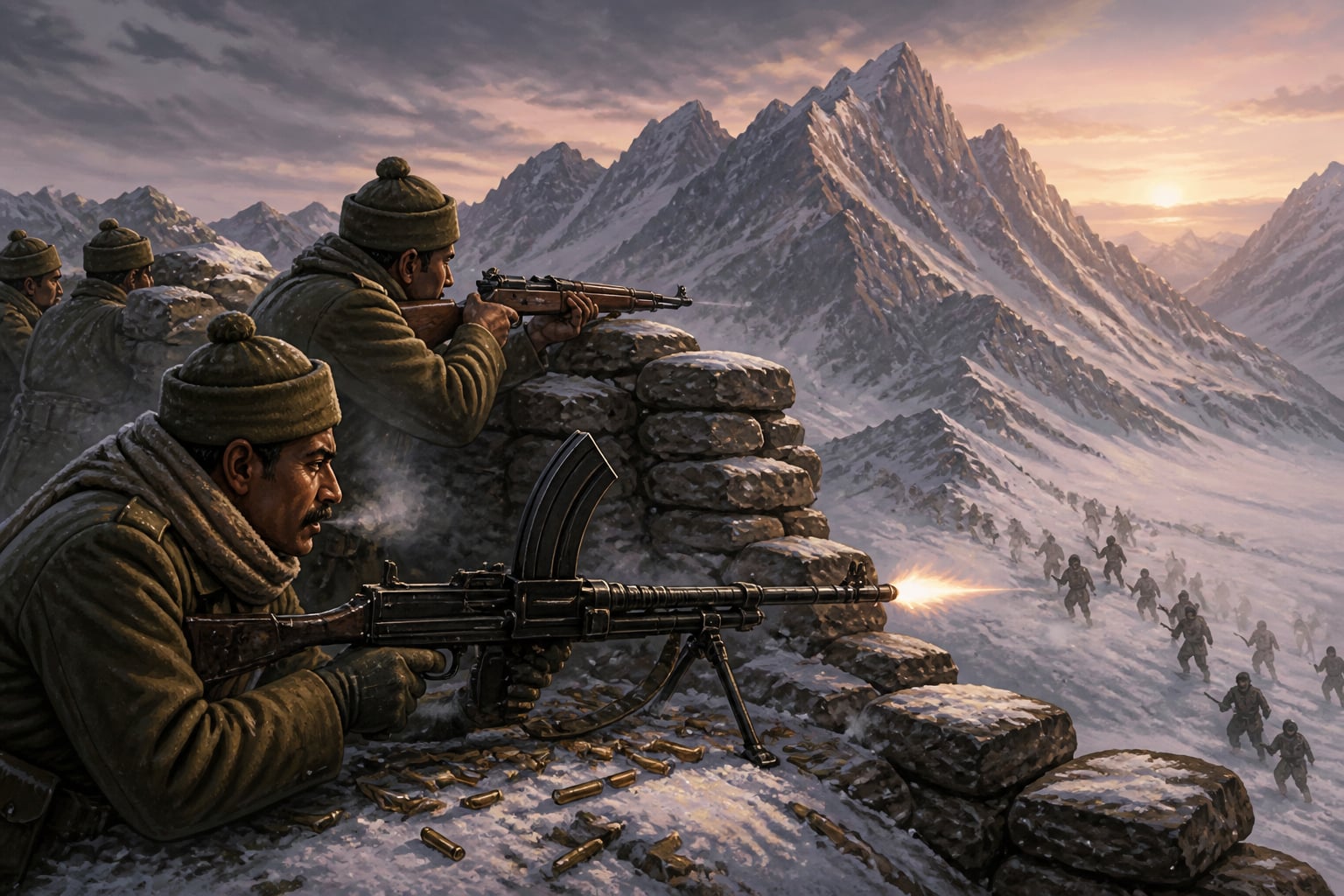
At 4:00 AM on November 18, the Chinese launched their assault. Over 1,000 soldiers advanced in waves toward the Indian positions. Their artillery opened up, pounding the frozen ground around the Indian bunkers.
The Kumaonis held their fire until the Chinese were within range. Then they opened up.
The first wave fell. The second wave came. It fell too.
But the Chinese kept coming. They had orders to take Rezang La that day, whatever the cost. And unlike the Indians, they had unlimited reserves.
"No Reinforcements. Hold."
As the battle raged, Major Shaitan Singh radioed battalion headquarters for support. The response was devastating:
"No reinforcements available. You are on your own. Hold your position."
Major Shaitan Singh didn't waver. He moved from bunker to bunker, directing fire, rallying his men, and fighting alongside them. He was hit multiple times but refused to be evacuated.
One by one, the bunkers fell silent as their defenders were killed. But each bunker had to be taken separately - the Kumaonis never surrendered a position while even one man lived.
The Final Stand
By noon, most of Charlie Company was dead. Major Shaitan Singh, bleeding from multiple wounds, ordered his men not to waste effort trying to carry him to safety.
"Don't bother about me. Fight to the last man and the last round."
He then began crawling toward the enemy, pistol in hand, determined to die facing his foes rather than retreat.

When the Chinese finally overran Rezang La, they found a sight that shocked even their hardened soldiers:
- 114 Indian soldiers lay dead at their posts
- Their hands were frozen to their weapons - they had died still fighting
- Over 400 Chinese soldiers lay dead around them
- Not a single Indian soldier had retreated
The surviving 6 Indians were all critically wounded. They had held for over 8 hours against 10:1 odds.

The Bodies in the Snow
The most haunting detail emerged weeks later. When Indian patrols finally reached Rezang La after the ceasefire, they found the bodies of Charlie Company exactly where they had fallen - frozen solid in combat positions.
Some were found with bayonets still embedded in Chinese soldiers. Others had died reloading their rifles. Major Shaitan Singh's body was found about 300 yards from his bunker, pistol in hand, facing the enemy. He had crawled that distance with multiple wounds, still fighting.
The bodies were so frozen that they could not be moved. They remained at Rezang La through the winter, silent sentinels guarding the pass they had died to defend.
The Ahir Legacy
A remarkable aspect of Rezang La was the composition of Charlie Company. The majority of the 120 soldiers were Ahirs - members of a community traditionally associated with cattle-herding and agriculture, not warrior castes.
The Ahirs of Rewari district in Haryana had enlisted in large numbers during World War II and afterward. At Rezang La, they proved that warrior spirit transcends caste and origin. Simple farmers from the plains of Haryana held a frozen Himalayan pass against impossible odds.
After Rezang La, the Ahir community's martial reputation was forever established. The Ahir community has since produced numerous officers and soldiers who serve with distinction.
Major Shaitan Singh's Legacy
Major Shaitan Singh was posthumously awarded the Param Vir Chakra - India's highest wartime gallantry award. His citation reads:
"Major Shaitan Singh, with indomitable courage and leadership, inspired his company to fight almost to the last man. His personal example and bravery were largely responsible for causing heavy casualties to the enemy."
But perhaps the greatest tribute came from the Chinese themselves. According to accounts, when Chinese commanders learned the details of the defense, they ordered their soldiers to salute the Indian dead. Even the enemy recognized that they had witnessed something extraordinary.
The Rezang La Memorial
Today, a memorial stands at Rezang La, inscribed with the names of all 114 martyrs. Every year on November 18, the Indian Army holds a ceremony at this frozen pass to honor Charlie Company.
In Rewari, Haryana - where most of the Ahir soldiers came from - a grand memorial called Shaheed Smarak commemorates the heroes. The main road in Rewari is named after Major Shaitan Singh.
Why Rezang La Matters
1962 was a national humiliation for India. The Chinese advanced almost at will across NEFA. The Indian Army was outmaneuvered, outgunned, and out-supplied at almost every point.
But at Rezang La, something different happened. 120 men showed that even in defeat, honor remains. They could have retreated - the pass was indefensible against such odds. They could have surrendered - the Chinese were offering quarter. They could have broken and fled - no one would have blamed them.
They chose to stand. And in standing, they wrote a chapter that military academies around the world still study as an example of defensive fighting against overwhelming odds.
As the snow melted in spring 1963 and the frozen bodies of Charlie Company could finally be recovered, the nation mourned. But it also remembered. The sacrifice at Rezang La became a symbol of what India's soldiers were willing to give.
Three years later, when Pakistan attacked in 1965, the Indian Army that fought back was forged in the lessons of 1962. And the spirit of Rezang La marched with them.
The Last Message
Major Shaitan Singh's final radio message before the equipment was destroyed has been reconstructed from survivor accounts:
"We will not withdraw. We will fight to the last man. The position will be held at any cost."
It was.
At a cost of 114 lives, frozen forever in the posture of warriors, hands on their weapons, faces to the enemy. They held Rezang La until there was no one left to hold it.
Jai Hind.
Historical context
Sino-Indian War (October-November 1962)
The 1962 war came as a devastating shock to India. PM Nehru's policy of non-alignment and trust in China's peaceful intentions left the military ill-prepared. At Rezang La and elsewhere, Indian soldiers fought with inadequate clothing, limited ammunition, no artillery support, and against overwhelming odds. The war exposed major failures in political and military leadership, but also revealed the extraordinary courage of ordinary soldiers.
Living traditions
The Battle of Rezang La is taught in military academies worldwide as an example of defensive combat against overwhelming odds. In India, it has special significance for the Ahir community, who point to Rezang La as proof of their martial valor. The Kumaon Regiment proudly carries 'Rezang La' as a battle honor. Major Shaitan Singh's name is invoked whenever soldiers face impossible odds - his spirit remains a living inspiration.
- Rezang La War Memorial: A stone memorial at the actual battle site, inscribed with the names of all 114 martyrs. The frozen heights where Charlie Company made their last stand can be seen exactly as they were in 1962. The terrain itself tells the story of the impossible defense.
- Shaheed Smarak (Ahir War Memorial): A grand memorial honoring the Ahir soldiers of Rezang La. Includes a museum with artifacts, photographs, and detailed narratives of the battle. The main gathering point for families of the martyrs and for annual commemoration ceremonies.
- Kumaon Regimental Centre: The regimental center of the Kumaon Regiment maintains a detailed gallery on the Battle of Rezang La and Major Shaitan Singh. Includes personal effects, battle maps, and the regiment's proud history since 1813.
Reflection
- Major Shaitan Singh knew the battle was unwinnable, yet he chose to fight with complete commitment. Have you ever faced a situation where success seemed impossible, but you gave your best effort anyway? What did you learn from that experience?
- The Ahir soldiers of Rezang La came from farming communities, not traditional warrior castes. Yet they fought with extraordinary valor. What does this tell us about the nature of courage and martial spirit?
- When Major Shaitan Singh ordered his men not to carry him to safety, was he being heroic or was he giving up on life? Is there a difference between accepting death and seeking it?