Learning from Defeat

Lesser-Known Heroes and India's Military Rebirth

1962 produced many heroes whose stories are barely known - soldiers who held positions until overwhelmed, officers who led from the front, jawans who saved comrades. This lesson explores how India processed the defeat and rebuilt the military for the victories of 1965 and 1971.

From Humiliation to Transformation

The 1962 war ended on November 21 when China declared a unilateral ceasefire. India had lost. The maps showed Chinese forces deep inside territory India considered its own. Thousands of soldiers had fallen. The nation was in shock.

But in the years that followed, something remarkable happened. India took its humiliation and transformed it into determination. The military that had been caught unprepared in 1962 would emerge, within three years, as a force that could defeat Pakistan in 1965 and achieve total victory in 1971.

This is the story of that transformation - and of the many heroes of 1962 whose sacrifices made it possible.

The Unsung Heroes

We have learned about the Param Vir Chakra recipients - Major Shaitan Singh, Subedar Joginder Singh, Major Dhan Singh Thapa. We have met Jaswant Singh Rawat and the Monpa heroines Sela and Nura.

But 1962 produced hundreds of heroes whose names are rarely spoken. Let us remember some of them.
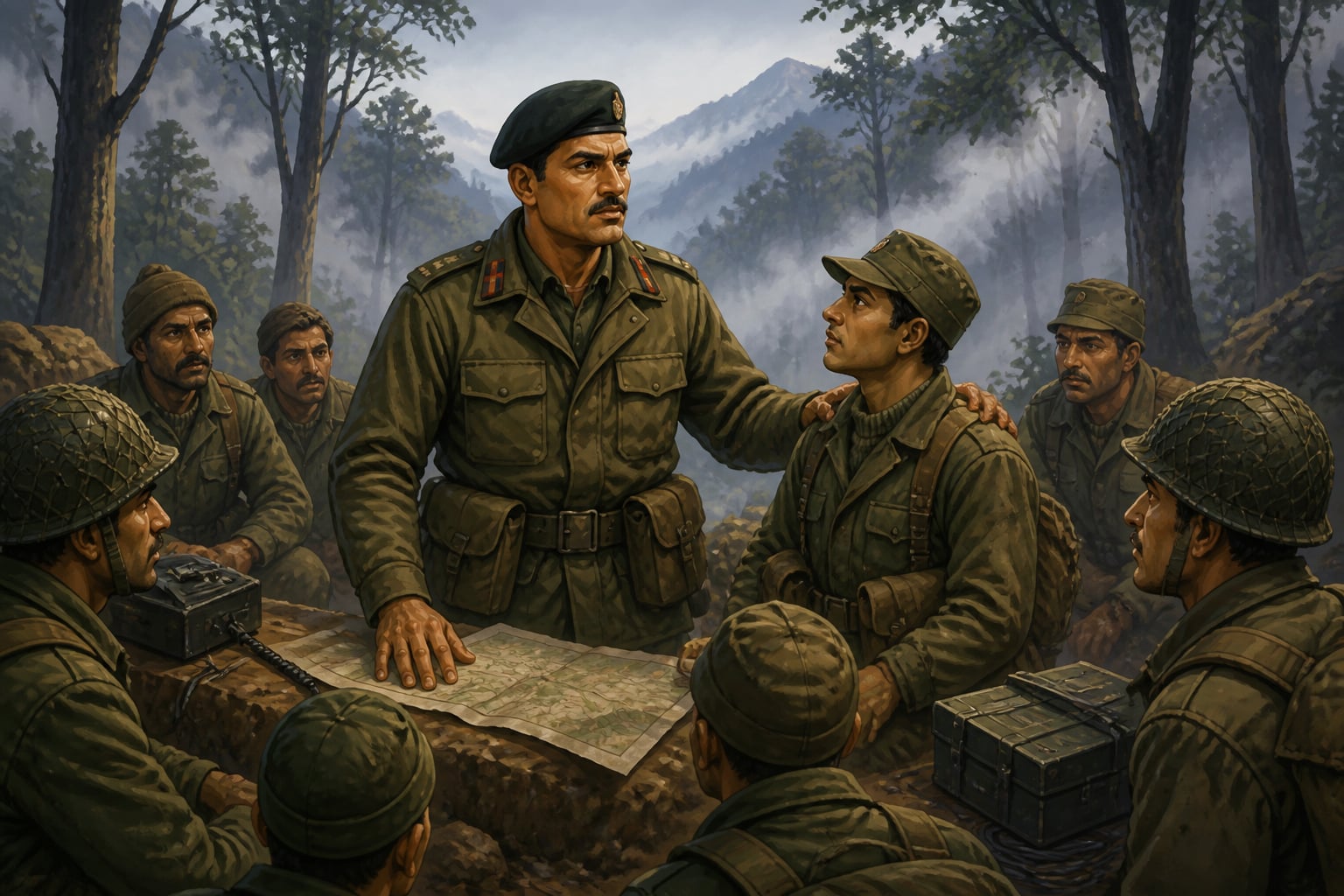
Brigadier Hoshiar Singh briefing his men in the NEFA hills

Brigadier Hoshiar Singh, MVC

Brigadier Hoshiar Singh commanded 62 Infantry Brigade in NEFA. When the Chinese attacked in overwhelming force, his brigade conducted a fighting retreat that saved many lives. He personally led counterattacks, reorganized broken units, and held defensive positions long enough for others to escape.

His Maha Vir Chakra citation notes his "magnificent leadership and inspiring courage" in a situation where the odds were impossible.

Lieutenant Colonel Tarapore (Senior)

Before his nephew became famous in 1965, Lieutenant Colonel J.S. Tarapore commanded forces in the Walong sector of NEFA. His defense of Walong was one of the few tactical successes of the war. Indian forces actually counterattacked and regained positions.

The spirit of Walong - that Indians could fight and win even in 1962 - was important for morale.

The Assam Rifles

The Assam Rifles - a paramilitary force recruited from the Northeast - fought alongside the Army throughout NEFA. Often manning isolated posts with limited weapons, these local soldiers defended their own homeland against the Chinese.

Many Assam Rifles personnel fell in 1962. Their sacrifice demonstrated that the people of the Northeast were as committed to India as anyone.

The Air Force Crews

The Indian Air Force was forbidden from using its fighters in 1962 - a controversial decision that left ground forces without air support. But IAF transport crews flew countless missions:

Flying in the Himalayas, with primitive navigation aids and unpredictable weather, these crews risked their lives daily. Several aircraft were lost.

Medical Corps Heroes

In the freezing heights of Ladakh and NEFA, Army Medical Corps personnel performed miracles. They treated the wounded with limited supplies, evacuated casualties under fire, and saved lives that would otherwise have been lost to cold and injury.

The stories of doctors and medics who stayed with their patients even when positions were being overrun deserve to be remembered.

Why India Lost

To learn from defeat, India first had to understand what went wrong. The causes were multiple:

1. Political Miscalculation

The government believed China would not attack despite clear warning signs. The "Hindi-Chini Bhai Bhai" (Indians and Chinese are brothers) policy had created complacency.

2. The Forward Policy

India had established small posts near the disputed border to assert presence. But these posts were:

When China attacked, these posts were systematically overwhelmed.

3. Military Unpreparedness

Factor Problem
Troops Insufficient numbers for the front to be defended
Equipment Soldiers lacked proper winter clothing and high-altitude gear
Weapons Many units had World War II-era equipment
Ammunition Limited stocks, no possibility of resupply during battle
Training Little experience in mountain warfare at these altitudes
Intelligence Poor knowledge of Chinese positions and strength

4. Command Failures

Some senior commanders made poor decisions. Others were overruled by political leadership. The coordination between Army headquarters and field formations broke down.

5. Air Power Not Used

The decision not to use the Air Force for offensive operations meant ground forces had no air support against an enemy with overwhelming numbers. This decision remains controversial.

The Henderson Brooks Report

After the war, the government commissioned Lieutenant General T.B. Henderson Brooks and Brigadier P.S. Bhagat to investigate what went wrong. Their report, completed in 1963, was classified secret.

The report apparently:

The full report has never been officially released, but its findings shaped the military reforms that followed.

The Transformation Begins

India didn't wallow in defeat. Within months of the ceasefire, massive changes began:

1. Military Expansion

The Army was dramatically expanded:

2. Modern Equipment

India sought modern weapons from multiple sources:

Border Roads Organisation cutting an all-weather road into the Himalaya

3. Border Infrastructure

A massive road-building program began:

4. Training Reforms

5. Intelligence Improvement

6. Leadership Changes

Some commanders who had failed were retired. A new generation of officers, many of them veterans of 1962 who had learned from the experience, rose to senior positions.

The Spirit That Survived

Despite the defeat, certain elements of 1962 gave India hope:

1. Individual Heroism Was Abundant

At post after post, Indian soldiers had fought to the last. The problem wasn't courage - it was numbers, equipment, and strategy.

2. The Enemy Paid a Price

Even in defeat, Indian forces inflicted significant casualties on the Chinese. The battles were not one-sided routs but hard-fought engagements.

3. Some Sectors Held

Not every battle was lost. At Walong in NEFA, Indian forces actually counterattacked successfully. In some sectors of Ladakh, posts held until the ceasefire.

4. China Withdrew

China's unilateral ceasefire and subsequent withdrawal from NEFA suggested that even they recognized limits to what they could hold. India had not been conquered - the Chinese stopped and went back.

1965: Redemption Begins

Just three years after 1962, Pakistan tested India with Operation Gibraltar - sending infiltrators into Kashmir to spark an uprising. India responded forcefully.

The war of 1965 showed how much had changed:

The result was essentially a stalemate - but for an Army that had been humiliated three years earlier, holding Pakistan to a draw was itself a victory.

More importantly, 1965 produced new heroes - Abdul Hamid, Tarapore, and others - whose stories would inspire the next generation.

1971: Complete Victory

Six years after 1965, India achieved what no one had thought possible in 1962: total military victory.

Lieutenant General Aurora watches as General Niazi signs the Instrument of Surrender at the Race Course Maidan in Dhaka, December 1971.

The 1971 war against Pakistan resulted in:

The Army that achieved this victory was built on the lessons of 1962. The commanders who led it had been junior officers in 1962, shaped by that experience.

What the Heroes of 1962 Made Possible

The soldiers who fell at Rezang La, Bum La, Sirijap, and Nuranang did not die in vain. Their sacrifice:

1. Bought Time

Every hour the Chinese were delayed, every casualty they suffered, contributed to slowing their advance. This gave other units time to prepare.

2. Established a Standard

The conduct of men like Major Shaitan Singh set a standard for future generations. They showed what was expected of Indian soldiers, even in hopeless situations.

3. Revealed Problems

The very completeness of the defeat forced India to confront its failures. A narrow loss might have allowed excuses; 1962's disaster demanded transformation.

4. Created Determination

The humiliation of 1962 fueled a national determination that India would never again be caught so unprepared. This determination drove the massive reforms that followed.

5. Inspired Future Soldiers

When soldiers today learn about Rezang La or Nuranang, they understand what their predecessors gave. The spirit of 1962's heroes lives on in every Indian soldier who stands watch on the frontier.

Lessons for Life

The story of 1962 and its aftermath offers lessons beyond military history:

1. Defeat Can Be Transformed

The worst moment can become the turning point. What matters is how you respond to failure - whether you learn from it or let it define you.

2. Individual Heroism Matters Even in Defeat

Major Shaitan Singh's company was overwhelmed. But their stand inspired millions. Sometimes the way you lose matters as much as whether you win.

3. Honest Assessment Is Essential

India's willingness to investigate what went wrong (the Henderson Brooks Report) was crucial to reform. Hiding from failure prevents learning.

4. Change Takes Time but Starts Immediately

The transformation from 1962 to 1971 took nearly a decade. But it started within weeks of the ceasefire. Big change requires immediate action sustained over time.

5. Remember the Fallen

The heroes of 1962 deserve to be remembered not as victims of a defeat but as the foundation on which victory was later built.

Conclusion

The 1962 war was a dark chapter in India's military history. The Chinese betrayal, the unpreparedness, the retreat, the casualties - all of these are painful to remember.

But from that darkness came light. The soldiers who fell at frozen passes and remote outposts did not die for nothing. Their sacrifice shocked a nation into action. The army that emerged from 1962's ashes would go on to win in 1965, triumph in 1971, hold Siachen, and recapture Kargil.

Today, the China border is defended by well-equipped, well-trained soldiers in strong positions. Roads connect forward areas to the heartland. Intelligence monitors every movement. The Air Force stands ready.

This is the true legacy of 1962 - not defeat, but transformation. Not humiliation, but the determination it created.

The mountains where Major Shaitan Singh, Subedar Joginder Singh, Major Dhan Singh Thapa, and Jaswant Singh Rawat made their stands still guard India's frontier. And the spirit of these men - the spirit that holds to the last man and last round - still animates India's soldiers.

1962 was a defeat. But it was also a beginning.

Jai Hind.

Historical context

Post-1962 Transformation (1962-1971)

The 1962 defeat shocked India into comprehensive military reform. The nation that had believed in peaceful coexistence suddenly invested heavily in defense. The experience shaped Indian strategic culture for generations - never again would India be caught so unprepared. The 'spirit of 1962' became both a warning and an inspiration.

Living traditions

The transformation that began after 1962 continues to shape India's military. Today's Army is well-equipped, well-trained, and positioned to defend against any threat. The China border has modern roads, strong positions, and quick-reaction forces. The Air Force has modern fighters. The Navy patrols the Indian Ocean. All of this traces back to the determination born from 1962's defeat. The soldiers who fell in that war did not die in vain - they sparked the transformation that made India a military power.

Reflection

More in The Mountains of Sacrifice - 1962

All lessons in The Mountains of Sacrifice - 1962 ยท Param Veer: Forging the Nation (1947-1971) course