Vilaapa: The March of Widows

Women walk to Kurukshetra

As dawn breaks, the women of Hastinapura begin their journey to Kurukshetra, not as spectators, but as witnesses. Led by Gandhari, thousands of mothers, wives, and daughters will walk among the dead, searching for husbands, sons, and fathers. The battlefield that rang with war cries now echoes with lamentation.

The Women Prepare

The palace of Hastinapura had known many departures. Kings had ridden out to war. Princes had left for conquests. Armies had marched with drums and trumpets.

But this departure was different.

Gandhari stood at the palace gates, her blindfold damp with tears she refused to acknowledge. Around her gathered the women who had waited through eighteen days of horror, receiving news each evening of who had fallen, who yet lived, who might never return.

"We go to Kurukshetra," Gandhari announced, her voice steady as iron. "We go to claim our dead."

No one questioned her. Not the queens. Not the princesses. Not the servants' wives who had also lost men in that terrible harvest. When a mother who has lost a hundred sons says she will walk to hell itself, who dares say no?

The Procession Forms

They left Hastinapura in the gray hour before dawn, a river of white and sorrow flowing toward the battlefield.
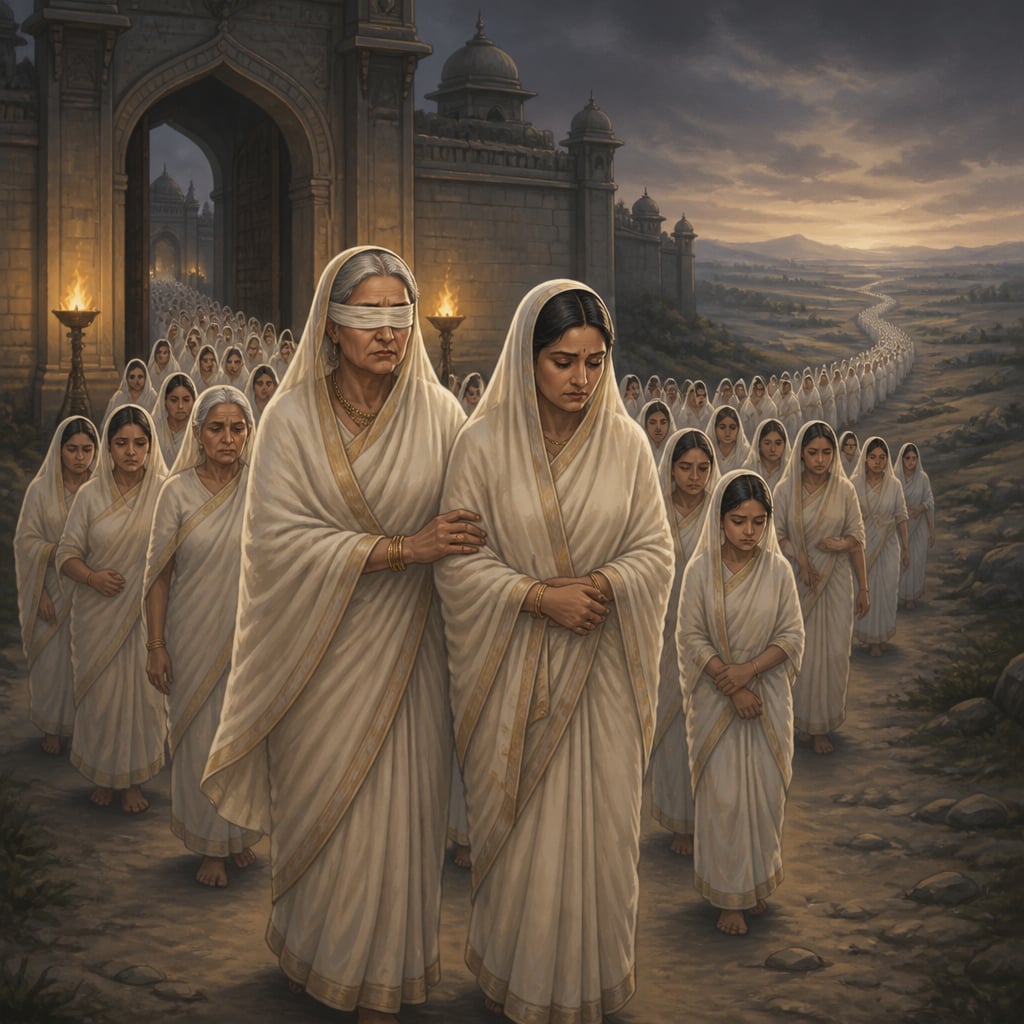
A procession of women in white mourning saris flows out of Hastinapura at pre-dawn, Gandhari and Kunti leading on the road to Kurukshetra.

Kunti walked alongside Gandhari, the two queens united now in ways they had never been before. Kunti had lost differently, her sons had survived, but she carried a secret that burned like acid: Karna, her firstborn, lay dead on that field, and no one had mourned him as her son.

Behind the queens came:

Who They Were Who They Sought
Wives of the hundred Kauravas Their husbands, Duryodhana, Duhshasana, and ninety-eight more
Mothers of warriors Sons who had promised to return
Draupadi Her five sons, killed by Ashwatthama
Subhadra News of her son Abhimanyu's body
Uttara The grave of her husband, father of her unborn child
Servants and attendants Husbands, brothers, sons

The Pandavas walked behind, their heads bowed. What could victors say to the women whose world they had destroyed? What words could bridge the gulf between military triumph and domestic devastation?

We won, thought Yudhishthira. We won, and look at what winning means.

The Road to Kurukshetra

The journey from Hastinapura to Kurukshetra normally took a few hours. For this procession, it took an eternity.

Every step brought them closer to truth. Every mile stripped away whatever denial might have cushioned the blow. The women had heard reports, "Your husband fell on the fourteenth day"; "Your son died bravely against Arjuna", but hearing is not seeing. The mind can reject words. It cannot reject a body.

Vidura had arranged the procession with care. Water bearers accompanied them. Physicians walked among the older women. Priests chanted mantras meant to prepare the living for encounter with the dead.

But nothing could truly prepare them.

The procession crests a hill and beholds Kurukshetra's field of dead

As they crested the final hill, the smell reached them first, iron and rot, flesh returning to earth. Then the sight.

The Field of Death

Kurukshetra stretched before them like a wound in the earth.

Eighteen million men had died here. The bodies had been partially cleared, the Pandavas had begun cremation rites, but the scale was beyond any ritual. Vultures circled in columns that touched the clouds. Jackals had grown fat and bold. The sacred field of dharma had become an open grave.

"This," whispered Gandhari, who could not see but somehow saw everything, "this is what we built. This is what we allowed. This is the fruit of hatred and greed."

The women fanned out across the field, each seeking their own dead.

Finding the Fallen

The search was its own form of torture.

Some women found their men quickly, guided by surviving soldiers, by distinctive armor, by the prayers of Brahmins who had catalogued the dead. These lucky ones could begin their grief immediately.

Others searched for hours, turning over bodies swollen beyond recognition, calling names that would never answer, refusing to accept what every passing moment made more certain.

Subhadra found the place where Abhimanyu had fallen, marked now by a small shrine the soldiers had built for the young hero who had entered the Chakravyuha alone. She collapsed there, her wails rising to join the chorus of mourning that filled the air.

Draupadi moved through the Pandava section where her five sons lay. Ashwatthama had killed them in their sleep, not in battle, but in the sanctuary of their beds. The sons of the world's greatest warriors, murdered without the chance to raise a weapon.

Prativindhya. Sutasoma. Shrutakarma. Shatanika. Shrutasena. Five names. Five bodies. Five young men who should have had kingdoms of their own.

The Individual Laments

Across the field, individual griefs merged into collective anguish.

A young wife found her husband, married only months before the war, and threw herself across his body, refusing to move until soldiers gently carried her away.

An old mother discovered that both her sons had fallen on the same day, on opposite sides of the same battle. She had given one to the Kauravas, one to the Pandavas. Now they were equal in death.

A serving woman found her husband, a charioteer, still sitting in his ruined chariot. He had died protecting his master. Neither master nor servant would see home again.

Type of Loss Grief's Expression
A wife losing her husband Tears, wailing, threats to follow him into death
A mother losing a son Silence, or screams, nothing in between
A daughter losing a father Confusion, abandonment, terror for the future
A sister losing brothers Rage at the senselessness of it all

Gandhari's Survey

Gandhari moved through the battlefield like death herself, a queen blind by choice, seeing now through the hands of attendants who described each fallen Kaurava.

"Here lies Duhshasana, O Queen. His chest is torn open."

Duhshasana. The son who had tried to disrobe Draupadi. The son whose blood Bhima had drunk as he'd vowed to do. A monster in the Sabha. A corpse now.

"Here lies Vikarna, O Queen. He fell defending the right flank."

Vikarna. The one Kaurava who had spoken against the dice game. The one who had said Draupadi should not be gambled. Even dharma had not saved him from this war.

One by one, Gandhari received her sons. The attendants lost count of how many times they had to support the queen as her legs gave way. Yet each time, she rose again, demanding to know more.

I will see them all, she had sworn. Every son I bore, every son this war took, I will witness.

Kunti's Secret Grief

Amid the public mourning, Kunti carried a private agony.

She had told no one, not even her sons, the truth about Karna. He was her firstborn, conceived before her marriage to Pandu, given away in shame, raised as a charioteer's son. He had died fighting for the Kauravas, killed by Arjuna, his own half-brother.

Now she searched for his body.

Where is my son? The question she could not ask aloud. Where is the child I abandoned, the warrior I never claimed, the hero I watched die without a mother's blessing?

When she found him, recognition struck like lightning. Here was the face she had glimpsed in Arjuna's features, the same cheekbones, the same brow. Here was the son who had lived his whole life thinking himself low-born, who had died not knowing he was a prince.

Kunti weeps secretly beside Karna's body, her firstborn unrevealed

Kunti knelt beside Karna's body and wept, but silently, secretly, her grief invisible amid the ocean of tears.

Forgive me, my son. Forgive a mother who chose reputation over her child. Forgive me, and know that I will carry this weight forever.

The Scale of Loss

As the day wore on, the true magnitude of Kurukshetra became impossible to ignore.

This was not a battle where hundreds died. Not even thousands. The Mahabharata counts the fallen in categories that stagger comprehension:

For each fallen warrior, someone mourned. The mathematics of grief was simple and devastating: eighteen million dead meant tens of millions bereaved.

The Women's Question

As evening approached and the women began gathering for the night, for no one could return to Hastinapura without performing proper rites, a question circled through the camp:

Why?

Not "why did this happen?", that answer was known. Ambition, insult, rivalry, pride. The usual poisons of royal courts.

But why was this the answer? Why did a dispute over land require the death of nations? Why did a game of dice lead to this field of corpses?

Draupadi gave one answer, her voice harsh from hours of weeping:

"They humiliated me in open court. They tried to strip me naked before kings and elders. Did you think that crime would go unpunished? Did you think dharma would let it pass?"

But another widow, whose name history does not record, gave a different answer:

"My husband died because your husbands demanded a throne. Your honor was wounded, so my children have no father. Tell me, Panchali: is your revenge sweet now that you taste it?"

Draupadi had no reply. There was none to give.

Preparing for Tomorrow

As darkness fell over Kurukshetra, the women made camp among the dead.

Priests began the work of preparation, identifying bodies, arranging them for cremation, chanting the mantras that would guide souls to their next destination. The fires would begin tomorrow. Tonight was for grief.

Gandhari sat alone, surrounded by the invisible weight of a hundred lost sons. Tomorrow she would see Duryodhana, the son she had loved most fiercely, the son whose stubbornness had brought all this to pass. Tomorrow she would face the boy who had been her heart and had broken every other heart in the kingdom.

And after that... after that, she would have something to say to Krishna.

For in Gandhari's mind, a terrible certainty was forming. The Pandavas had won, yes. But they had not won fairly. Time and again, Krishna's counsel had bent the rules, Bhima's blow to Duryodhana's thigh, Arjuna's killing of Karna when his wheel was stuck, the deception that killed Drona.

You guided them to victory through adharma, Gandhari thought. You, who claim to be God, you who preach dharma in the Gita, you let them win by cheating. And for that, there will be a reckoning.

But that reckoning would wait for tomorrow. Tonight, there was only grief, pure, overwhelming, infinite.

The stars rose over Kurukshetra, indifferent to the sorrow below. The women's laments continued through the night, a chorus of loss that would echo in Indian literature for three thousand years.

And somewhere in that darkness, the threads of karma were already weaving the next chapter of suffering.

Living traditions

The Stri Parva has influenced modern anti-war literature and film. Dharamvir Bharati's Hindi play 'Andha Yug' (Blind Age, 1954) draws heavily on the parva's imagery of post-war devastation. Filmmaker Shyam Benegal cited the women's perspective in the Stri Parva as inspiration for depicting civilian suffering in partition narratives. The parva's central question, 'was victory worth the cost?', continues to challenge military triumphalism across cultures.

Reflection

More in Stri Parva

All lessons in Stri Parva · The Mahabharata course