Antyeshti: Farewell to the Fallen
Funeral rites for the warriors
With all secrets revealed and all curses spoken, the time comes to perform the final duty to the dead. Across Kurukshetra, funeral pyres are prepared for millions of fallen warriors. Led by Vidura and the priests, the survivors perform the sacred antyeshti rites, the last sacrament that releases souls from earthly bonds. In fire and water, in mantra and offering, the war finds its final closure.
A Field of Pyres
Kurukshetra had been a battlefield. Now it became a cremation ground.
Across the plain where eighteen armies had clashed for eighteen days, sandalwood pyres rose like a forest of the dead. Each mound represented not just a body but a story, a warrior who had lived, fought, loved, and now awaited the flames that would free his soul.
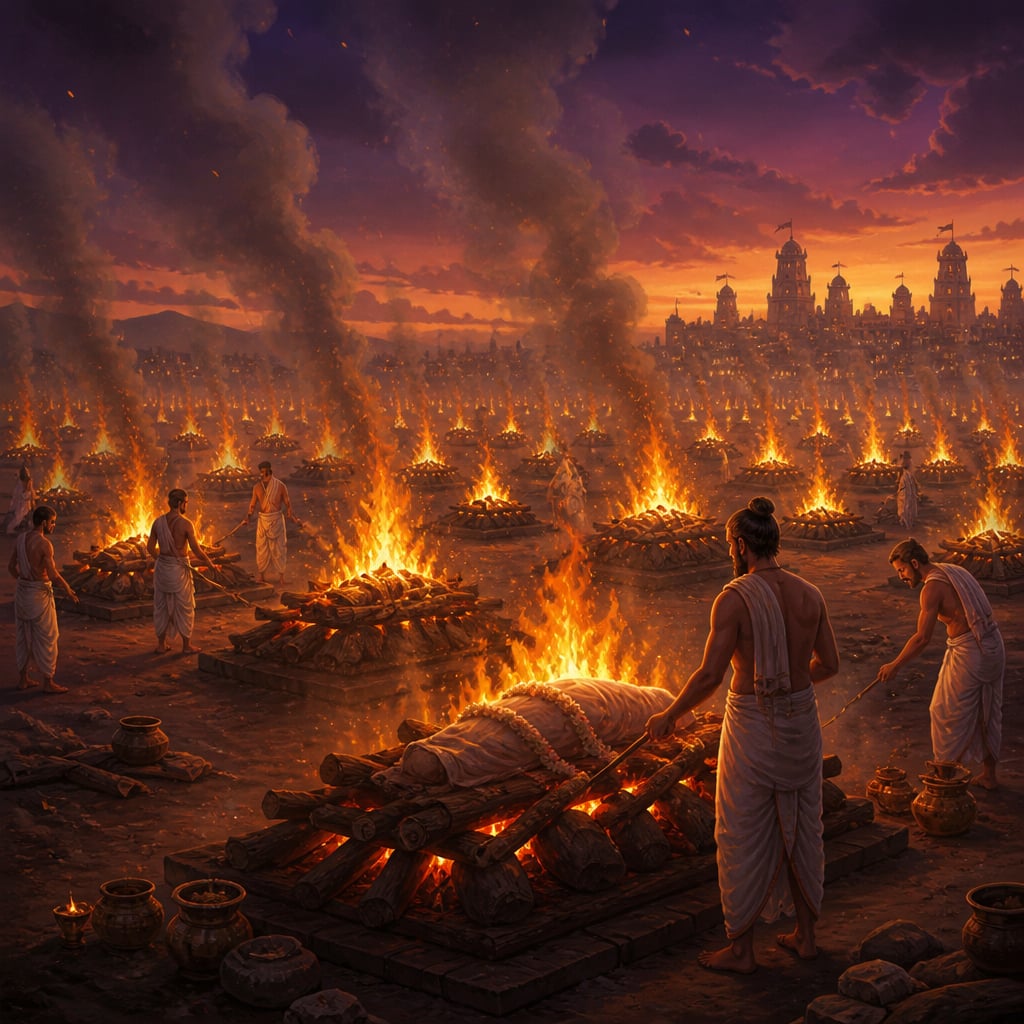
Yudhishthira surveyed the preparations with hollow eyes. As the victorious king, it fell to him to ensure proper rites for all the fallen, not just the Pandava allies, but the Kauravas, the neutrals, even the nameless foot soldiers whose families would never know where they died.
"How do we cremate millions?" he asked Vidura, the wise uncle who had remained alive through the carnage.
"We do what we can," Vidura replied. "We honor who we can identify. We pray for those we cannot. And we trust that dharma accounts for all, even when we cannot."
The Hierarchy of Death
Even in death, hierarchy persisted, though the Pandavas tried to honor merit as much as birth.
The great heroes received individual pyres of sandalwood and precious woods. Bhishma still lay on his bed of arrows, waiting for the auspicious moment to release his soul. Drona and his son Ashwatthama, though Ashwatthama still lived, cursed to wander, had pyres prepared. Karna, newly acknowledged as eldest Pandava, received royal honors.
| The Great Pyres | Who Performed Rites |
|---|---|
| Bhishma | Waited on arrow-bed for Uttarayana |
| Drona | Dhrishtadyumna (his slayer) and Ashwatthama (his son) |
| Karna | Yudhishthira and the Pandavas |
| Duryodhana | Dhritarashtra and surviving Kauravas |
| The Hundred Sons | Gandhari, with Kunti's support |
| Abhimanyu | Arjuna and Subhadra |
| Ghatotkacha | Bhima, mourning his rakshasa son |
Below these, lesser kings received their own fires. Below them, common soldiers were cremated in groups, their names recited in collective prayer.
Vidura's Guidance
Vidura, half-brother to Dhritarashtra and Pandu, had watched the war from the sidelines. Too wise to fight, too righteous to choose sides beyond truth, he had waited for this moment, when the living needed guidance more than the dead needed champions.
"The antyeshti is not for the dead," Vidura taught the mourners. "The soul is already departing, our rituals cannot help or harm its journey. The antyeshti is for the living. It gives us actions to perform when grief leaves us paralyzed. It creates order when chaos threatens. It transforms raw loss into structured mourning."
He organized the priests, assigned families to pyres, ensured that sacred materials were distributed fairly. Where sandalwood was insufficient, other woods were blessed and consecrated. Where ghee ran short, other oils were purified.
"In the Vedic ideal, each soul receives perfect rites," Vidura explained. "In reality, we do our best. The Divine accepts intention when resources fail."
The Sacred Fire
The fire for the pyres was brought from the sacrificial flames that had been maintained throughout the war, the same fire that had blessed weapons, consecrated vows, and witnessed oaths.
Dhaumya, the Pandavas' family priest, led the preliminary rituals:
"Fire is the mouth of the gods. What we offer to fire reaches the divine realm. When we place our beloved in the flames, we are not destroying them, we are offering them. The body becomes the final oblation, the smoke becomes the soul's vehicle, the ash becomes sacred remains."
The mantras began at dawn and continued through the day:
"Agnaye svāhā", To Agni, we offer.
"Somāya svāhā", To Soma, we offer.
"Yamāya svāhā", To Yama, we offer.
Each offering purified the path between worlds, ensuring the dead would not wander as ghosts but proceed directly to Yama's judgment.
The Hundred Sons
Gandhari performed the rites for her hundred sons alone.
Blind from birth by choice, she had never seen their faces, not in life, not in death. But she had touched each body on the battlefield, memorizing their wounds, their armor, the way death had arranged their limbs. Now she walked from pyre to pyre, laying offerings on each.
"Duryodhana," she said, placing ghee on the first pyre. "My eldest. My pride. My ruin."
"Duhshasana." The second pyre. "Who listened to your brother when he should have listened to wisdom."
She named all hundred, her voice steady, her movements sure. She had spent a lifetime memorizing her sons by touch and sound. She would not forget them now.
"A mother should not outlive her children," she said to no one. "To outlive one is tragedy. To outlive all hundred is something beyond words. And yet I live. And yet I must perform these rites. And yet the world continues."
Kunti stood beside her, a different kind of bereaved mother. She too had lit a pyre for a son, but her son had been raised by others, killed by his own brothers, and only claimed in death. The two mothers, so different in their grief, found strange kinship in their losses.
The Waters of the Ganga
After cremation came the water rites. Tradition demanded that ashes be immersed in sacred rivers, and the Ganga flowed not far from Kurukshetra.
A great procession formed: the royal families, the surviving warriors, the widows, the priests, all moving toward the river with urns of ash. Elephants carried the remains of kings. Simple soldiers' ashes were gathered in communal vessels.
The Ganga received them all.
"As rivers flow to the ocean and lose their individual names," Dhaumya chanted, "so the souls of the departed flow to Brahman and lose their individual forms. The ocean does not reject any river. The Divine does not reject any soul. Release your beloved to the waters. Release your grief to the infinite."

One by one, the urns were emptied. The ash spread across the sacred water, gray clouds dissolving into flow, becoming part of the river that would carry them to the sea.
Yudhishthira poured Karna's ashes himself.
"Brother," he whispered, "I give you to the waters. May you find in death the honor you deserved in life. May the current carry you beyond the sorrows of this world."
The Tarpana Offerings
After immersion came tarpana, offerings of water mixed with sesame, barley, and rice to nourish the souls of the departed.
The survivors stood in the Ganga, waist-deep, facing south toward Yama's realm. Each offering was accompanied by the names of the dead:
"Bhishma-pitāmahāya tarpayāmi", I offer to grandfather Bhishma.
"Drona-ācāryāya tarpayāmi", I offer to teacher Drona.
"Karna-bhrātre tarpayāmi", I offer to brother Karna.
The water was cold, but no one complained. The ritual demanded physical discomfort, a small suffering to honor those who had suffered so much more.
Dhritarashtra, blind and broken, stood in the river for hours, naming each of his hundred sons, each of his allies, each of the warriors who had died for his family's cause. His voice grew hoarse, then silent, but his lips kept moving, the names continuing even when sound failed.
The Pinda Offerings
For thirteen days following cremation, pinda offerings would be made, rice balls that symbolically constructed a new body for the deceased in the afterlife.
"The physical body is gone," Dhaumya explained. "But the subtle body needs assistance to form. Each day of pinda-dana builds another part: bones on the first day, flesh on the second, blood on the third. By the thirteenth day, the deceased has a complete subtle body and can proceed to judgment."
The Pandavas performed these rites meticulously, not just for their allies but for their enemies. Yudhishthira insisted.
"We killed them in war," he said. "The least we owe them is proper passage to the next world. Their sins were theirs, but their deaths were ours. Let us not add incomplete rites to our burden."
The Widows' Return
As the rites concluded, the widows faced a terrible choice: return to a world without husbands, without sons, without the men who had defined their social existence.
Some chose sati, following their husbands into the fire. This practice, later controversial, was understood in this era as the ultimate expression of devotion. The wives of certain Kaurava princes chose this path, preferring death with their husbands to life without them.
Others, especially those with living children, chose to continue. The widows of the Pandava allies were given places in the new kingdom. The widows of the Kauravas were not punished for their husbands' choices, Yudhishthira ensured they received pensions and protection.
Uttara, widow of Abhimanyu and pregnant with the only heir of the next generation, was given special care. Her son would continue the Kuru line, if he survived. (He would, barely, becoming Parikshit, but that is a story for later parvas.)
Bhishma Awaits
One great hero was not yet cremated: Bhishma, the grandfather, still lay on his bed of arrows.
He had the boon to choose his death-moment, and he waited for Uttarayana, the period when the sun travels northward, considered auspicious for dying. For fifty-eight days he would lie on the battlefield, suspended between life and death, teaching wisdom to those who came to learn.
Yudhishthira visited him daily, receiving instruction that would form the core of the Shanti Parva, teachings on governance, dharma, and the duties of a king. But that belongs to the next parva. For now, Bhishma simply waited, patient as always, the last of the old order keeping vigil over the transition to the new.
The Empty Battlefield
When the rituals ended and the mourners departed, Kurukshetra fell silent.
The pyres had burned to ash, swept away by wind and rain. The blood had soaked into the earth, enriching soil that would grow crops for centuries. The weapons had been collected, some preserved as relics, others melted for peaceful use.

Krishna walked through the empty field one last time before departing for Dwaraka.
"This field will never forget," he said to Arjuna, who accompanied him. "A thousand years from now, people will come here and feel the weight of what happened. The earth remembers. The sky remembers. And those who died here, they too remember, wherever they are now."
"Is that supposed to comfort me?" Arjuna asked bitterly.
"No," Krishna replied. "Some truths do not comfort. They simply are. What you did here was necessary, terrible, and permanent. You will carry it forever. So will this land. That is not comfort, it is reality."
The Living Must Continue
The Stri Parva ends not with resolution but with exhaustion.
The dead have been honored. The secrets have been told. The curses have been spoken. The ashes have been given to the waters. Nothing remains but to return to Hastinapura and begin the impossible task of building a kingdom from the wreckage of war.
Yudhishthira looked back at Kurukshetra one final time.
"We came here as claimants," he said. "We leave as inheritors of ashes. The throne we won cost more than any throne is worth. And now we must sit upon it and pretend that governing is possible when we have destroyed the governed."
He turned his back on the battlefield and walked toward the future, a future built on bones, consecrated in blood, and haunted by the ghosts of everyone he had failed to save.
The Stri Parva closes. The Shanti Parva, the book of peace, of governance, of attempting to create order after chaos, begins.
Living traditions
The funeral rites described in the Stri Parva provide the template for Hindu funerals to this day. When a family cremates a loved one, immerses ashes in the Ganga, performs thirteen days of mourning rituals, and offers annual tarpana during Pitru Paksha, they reenact, often unknowingly, the same rites that the Pandavas performed for the dead of Kurukshetra. This continuity of practice across millennia represents one of the longest unbroken ritual traditions in human history. The epic doesn't just describe ancient practices; it helped create practices that endure.
- Antyeṣṭi Saṃskāra: Hindu funeral rites continue to follow the essential structure described in ancient texts. Cremation (in most traditions), immersion of ashes in sacred rivers, tarpana offerings, and the thirteen-day mourning period remain standard practice. While details vary by region and caste, the core elements, fire, water, offering, prayer, remain consistent with the Mahabharata's descriptions.
- Asthi Visarjana (Ash Immersion): Immersion of cremated remains in sacred rivers, especially the Ganga, remains one of the most important post-cremation rituals. Families travel significant distances to immerse ashes in sacred waters, believing (as the Mahabharata teaches) that the river carries souls toward liberation.
- Kurukshetra War Memorial Sites: Several sites around modern Kurukshetra commemorate the war's dead, including Sannihit Sarovar (a sacred pool where the Pandavas reportedly performed tarpana) and various temples and memorials. Pilgrims still perform ancestor rites here, believing the location retains spiritual significance from the ancient cremations.
- Varanasi Ghats: The cremation ghats of Varanasi, especially Manikarnika and Harishchandra Ghats, continue the tradition of funeral rites on sacred riverbanks. Watching the cremations and tarpana offerings here provides a living connection to the practices described in the Stri Parva.
- Brahma Sarovar, Kurukshetra: This large sacred tank is believed to be the site where the Pandavas performed rituals during the war period. Today, pilgrims perform tarpana here for their ancestors, continuing the tradition of water offerings that the Stri Parva describes being performed for the war's dead.
Reflection
- When you've experienced significant loss, what rituals or practices helped you process grief? If traditional rituals don't resonate with you, what alternative structures have you created, or might you create, to give grief a container?
- Vidura says the funeral rites are 'for the living, not the dead.' If that's true, what obligations do we actually have to the deceased, as opposed to ourselves?
- Some widows chose to follow their husbands into the fire (sati). The text presents this without judgment. How should we understand historical practices that we now find abhorrent, with contextual empathy or moral clarity?