Shoka: A Mother's Anguish

Draupadi mourns her five sons

Draupadi has survived insult, exile, and war. But nothing has prepared her for the sight of her five sons lying cold in their beds. Her grief transforms into rage, her tears become demands. She will not rest, she will not eat, she will not accept any comfort until Ashwatthama is brought before her, and until the divine gem in his forehead is torn from his skull. The hunt for Drona's son begins.

A Mother's Cry

Draupadi stood over the bodies of her five sons.

For a long moment, she did not move. She did not speak. She simply looked, at Prativindhya's peaceful face, at Sutasoma's clenched fists, at Shrutakarma's raised hands, at Shatanika's beautiful features, at little Shrutasena who had called for his mother as he died.

The Pandavas watched her, uncertain what to do. They had seen Draupadi in many states, proud, humiliated, angry, loving, fierce, patient. But they had never seen her like this. There was something terrifying in her stillness, something that went beyond grief into a place where words could not reach.

Then she fell.

She fell upon the bodies of her children, gathering them to her as if she could warm them back to life. She kissed their cold foreheads, stroked their matted hair, held their stiffening hands. And then the sound came, a sound that none who heard it would ever forget.
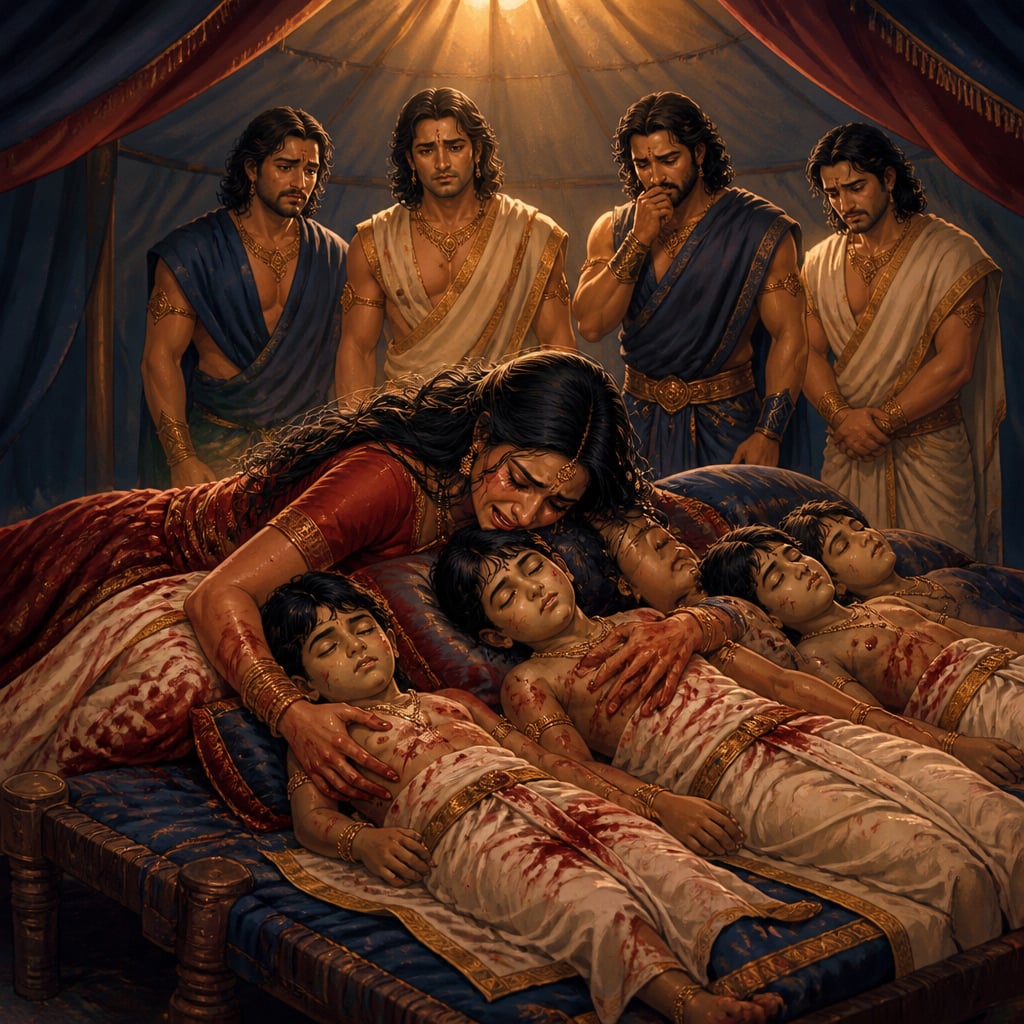
Draupadi collapses across the cots of her five slain sons, gathering them in her arms.

It was not a scream. It was not a wail. It was the sound of a soul being torn apart, a mother's heart breaking into pieces too small to ever be reassembled.

The Pandavas wept. Even Krishna, who had seen all the horrors of the war with equanimity, turned his face away.

The Memories

As she held her sons, Draupadi remembered.

She remembered the day Prativindhya was born, her firstborn, the child of her marriage to Yudhishthira. She had been so young then, so full of hope for the future. This child would be a king, she had thought. This child would rule a peaceful kingdom.

She remembered Sutasoma's first steps, how the boy had run with such fearlessness that even Bhima laughed. He has my strength, Bhima had said proudly. But your eyes.

She remembered teaching Shrutakarma to string his first bow, watching him try to imitate his father Arjuna's stance. I'll be the greatest archer, the boy had declared. Greater even than Pitashri. And Arjuna had smiled and said, Perhaps you will.

She remembered Shatanika's love of horses, how the boy would spend hours in the stables, whispering to the animals. Nakula had been so pleased. He understands them, he said. He has the gift.

She remembered Shrutasena, her youngest, her baby, asking her just days ago when the war would end. I want to go home, Mata, he had said. I miss our garden.

None of them would go home now.

None of them would grow up, fall in love, have children of their own, become the kings and warriors they were meant to be.

Child What She Remembered
Prativindhya His first words: "Mata, look at the sun"
Sutasoma His fearless laughter as he learned to wrestle
Shrutakarma His determination to match his legendary father
Shatanika His gentleness with every living creature
Shrutasena His question: "When can we go home?"

All of it, ended. All of it, stolen by a blade in the darkness.

The Question

Yudhishthira approached her carefully, as one might approach a wounded animal.

"Draupadi," he said softly. "Draupadi, we will, "

"Where is he?"

Her voice stopped him cold. It was not the voice of a grieving mother. It was the voice of something harder, something colder, something that had moved past grief into a place where only vengeance existed.

"Where is Ashwatthama?"

"He has fled," Krishna answered. "Into the forest. We believe he is heading for the river."

"Then why are you standing here?" Draupadi rose to her feet. Her sari was stained with her children's blood. Her hair hung loose around her face like a dark shroud. Her eyes burned with a fire that seemed to come from somewhere beyond the mortal world.

"Why are you standing here when the murderer of your sons walks free?"

Bhima stepped forward. "We will find him. We will kill him. I swear, "

"Kill him?" Draupadi's laugh was terrible. "You think death is enough? Death is mercy. Death is release. Death is what he gave my children, quick, painless, in their sleep."

She advanced on her husbands, and despite their size, despite their power, they fell back before her.

"I do not want him dead. I want him to suffer. I want him to know what it means to lose everything. I want him to live with his crime until the end of time."

The Demand

"What would you have us do?" Arjuna asked. His voice was rough with his own grief, but he would not deny her anything. Not now. Not after what had been taken from them.

Draupadi's eyes fixed on something in the distance, or perhaps on something only she could see.

"There is a jewel," she said slowly. "A mani embedded in Ashwatthama's forehead. It was placed there at his birth, a divine gem that protects him from hunger, fatigue, disease, and fear. It is the source of his power. It is the thing he values above all else."

"Bring me that jewel. Tear it from his forehead and bring it to me. Let him live without it, stripped of his protection, marked by its absence, forever reminded of what his crime has cost him."

The Pandavas exchanged glances. The mani was legendary. To remove it would require overwhelming force, and Ashwatthama, even grieving and fleeing, remained one of the most dangerous warriors alive.

But Bhima was already reaching for his mace.

"I will bring you his head with the jewel still attached."

"No." Draupadi's voice was steel. "Not his head. The jewel. I will not wear the ornament of a dead man. I want him alive to know what he has lost."

The Pursuit

Krishna prepared his chariot.

"Arjuna, Bhima, you will come with me. We will track Ashwatthama to wherever he has fled. The others will remain here to protect Draupadi and prepare the funeral rites."

"No," Draupadi said. "I will not perform their rites until I have the mani. My sons will not find peace until their murderer has paid."

"The rites cannot wait," Yudhishthira protested. "The souls, "

"Let them wait." Draupadi's voice broke for just a moment, then hardened again. "They waited for years while we wandered in exile. They waited while their fathers fought and nearly died. They can wait a little longer. I will not send them to their rest until justice is done."

There was no arguing with her. There never had been, really, not when Draupadi had made up her mind. Her will had bent the course of kingdoms. It would not be denied now.

Arjuna took up his bow, Gandiva. The weapon that had killed thousands in the war now had one more target.

Bhima shouldered his mace. The same weapon that had shattered Duryodhana's thighs now thirsted for more Kaurava blood.

Krishna took the reins of his chariot. His face was unreadable, but his movements were swift and certain.

"We ride for the Bhagirathi," he said. "The sage Vyasa's ashram is near the river. If Ashwatthama seeks sanctuary, he will go there."

Krishna's chariot surging from the ruined camp toward the river

The chariot surged forward, leaving behind the ruined camp, the grieving mother, the bodies of five boys who would never become men.

The Hunt

They found the trail quickly.

Ashwatthama had not been careful in his flight. Perhaps he was exhausted from the night's killing. Perhaps he believed no one would pursue him, that the Pandavas would be too busy mourning to seek vengeance. Perhaps he simply did not care anymore.

The signs were clear: broken branches, footprints in soft earth, disturbed undergrowth. Three sets of prints, Ashwatthama, Kripacharya, Kritavarma.

"They've separated," Krishna observed. "Kripacharya and Kritavarma went east. Ashwatthama continues alone toward the river."

"Then we follow Ashwatthama," Arjuna said.

"What of the other two?" Bhima asked. "They helped him. They guarded the camp exits while he murdered inside."

"We will deal with them later." Krishna's voice was calm. "For now, Draupadi wants Ashwatthama. That is who we pursue."

The chariot flew through the forest, following tracks that grew fresher with each passing moment. Ashwatthama was not far ahead now. Perhaps an hour. Perhaps less.

The Weight of What Comes

As they rode, Arjuna found himself thinking about the man they hunted.

Ashwatthama had been his fellow student. They had trained together under Drona, competed for their teacher's attention, practiced the arts of war side by side. In another life, they might have been friends.

But Ashwatthama had made his choice. He had chosen massacre over mourning, vengeance over virtue, destruction over dharma. He had killed children in their sleep.

There is no coming back from that, Arjuna thought. Some acts cannot be forgiven. Some crimes cannot be balanced by any penance.

Yet he felt a strange reluctance. Not mercy, Ashwatthama deserved none. But weariness. The war was supposed to be over. The killing was supposed to have stopped. And here they were, charging through the forest to find one more enemy, shed one more drop of blood.

Will it ever end? he wondered. Or does violence simply breed more violence, forever and ever, until there is no one left to kill?

"You are thinking too much," Krishna said, as if reading his thoughts. "Save your philosophy for after. Now, there is only the hunt."

Finding the Quarry

The Pandavas finding Ashwatthama at the Bhagirathi

They found Ashwatthama at the bank of the Bhagirathi river, near the ashram of the sage Vyasa.

He was sitting on a rock at the water's edge, his weapons laid beside him. The morning sun caught the jewel in his forehead, the mani that Draupadi had demanded, making it blaze like a third eye.

He looked up as they approached. There was no surprise in his face. Perhaps he had been expecting them. Perhaps he no longer cared.

"You found me," he said. His voice was flat, empty. "I thought you might."

"You murdered our sons," Bhima growled. "You killed children in their sleep. Did you think we would let you go?"

"I thought nothing." Ashwatthama stood slowly, his hand moving toward his weapons. "I was not thinking when I did what I did. I was only... doing."

"That is not an excuse," Arjuna said. "That will never be an excuse."

"I know." Ashwatthama's eyes moved from one Pandava to the other, then to Krishna. "So you have come to kill me. Very well. I will not make it easy for you."

His hand closed around an arrow. But not just any arrow, a special arrow, blessed with the power of Brahma himself.

"If I am to die," Ashwatthama said, "I will take more with me. I will destroy what you love, as you destroyed what I loved."

He nocked the arrow. He spoke the mantras.

And the Brahmastra began to form.

Krishna's eyes widened, the first genuine alarm he had shown throughout the entire crisis.

"Arjuna," he said urgently. "Counter it. Now. Or everything ends here."

Arjuna reached for his own arrow, his own knowledge of the ultimate weapon. He had hoped never to use it. He had prayed the war would never come to this.

But the war was not over.

The war would never be over.

Living traditions

Draupadi's response to her children's murder has become a reference point for discussions of how trauma can be channeled into action. Her refusal to be passive, her specific demands for justice, and her rejection of simple revenge in favor of meaningful accountability resonate with contemporary discussions of restorative versus retributive justice. Some feminist interpretations see her demand for the mani as an assertion of female agency, she directs the pursuit, she sets the terms, she determines what justice looks like.

Reflection

More in Sauptika Parva

All lessons in Sauptika Parva · The Mahabharata course