Krodha: The Fury of Ashwatthama
The owl hunts sleeping crows
The war is over. Duryodhana lies dying, his thighs shattered by Bhima's mace. But for three surviving Kaurava warriors, the night brings a terrible vision: an owl slaughtering sleeping crows. What Ashwatthama sees in that moment will transform him from a grieving son into an instrument of destruction, and set in motion the darkest chapter of the Mahabharata.
The Three Survivors
The eighteenth day of Kurukshetra had ended. The great war was over.
But for three men, the war had just begun.
Ashwatthama, Kripacharya, and Kritavarma had escaped the final carnage. While the Pandavas celebrated their hollow victory and Duryodhana lay dying by the lake, these three survivors wandered through the darkness, their minds unable to accept what had happened.
Ashwatthama walked ahead, his father's death still fresh in his memory. Drona, the invincible acharya, the man who had seemed as permanent as the mountains, had been killed through treachery. They had told him his son was dead. And when Drona laid down his weapons in grief, Dhrishtadyumna had cut off his head.
A Brahmin's head, Ashwatthama thought. Severed by a Kshatriya while he meditated in sorrow. This is dharma? This is the righteousness the Pandavas claim to fight for?
"We should find food and shelter," Kripacharya said quietly. The old teacher looked broken, his legendary composure shattered by the day's horrors. "The night is cold. We can decide what to do in the morning."
"Decide what?" Kritavarma's voice was bitter. "There is nothing left to decide. We have lost. Everyone is dead."
"Not everyone," Ashwatthama said. His voice was strange, calm on the surface, but with something terrible moving beneath. "Not everyone is dead yet."
Finding the King
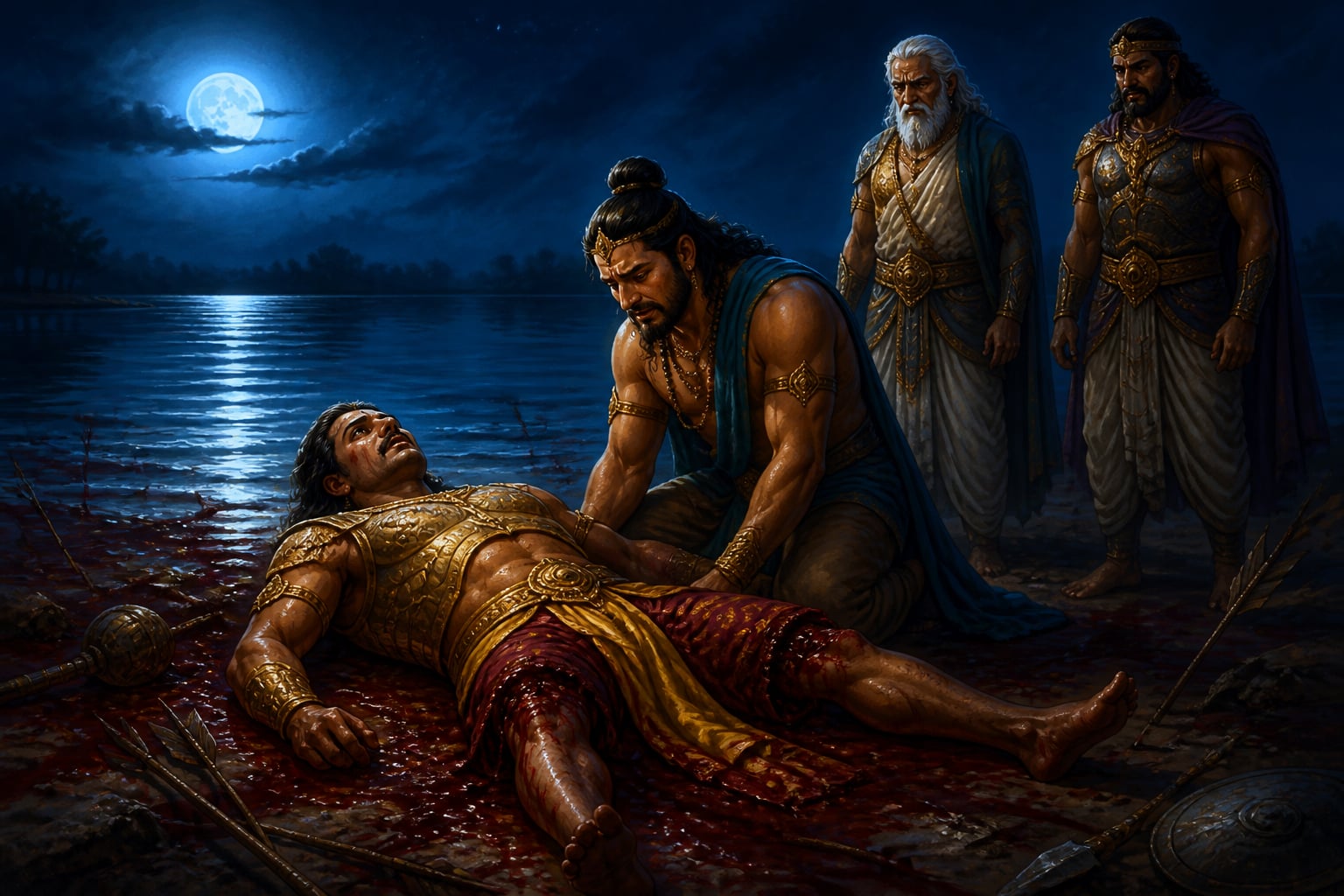
They found Duryodhana at the lake called Dvaipayana, his body broken, his thighs shattered beyond any hope of healing.
He lay on the blood-soaked ground, staring up at stars he could barely see through his pain. Around him, the water of the lake reflected moonlight, peaceful, indifferent to the dying king beside it.
"My lord." Ashwatthama knelt beside him, his face contorting with grief and rage. "My lord, what have they done to you?"
Duryodhana's eyes focused slowly. A ghost of a smile crossed his face.
"Ashwatthama. My loyal friend. My father's student." His voice was a whisper. "I wondered if anyone would come."
"We are here." Kripacharya knelt on the other side. "We survived. Tell us, what would you have us do?"
Duryodhana tried to laugh, but the sound became a groan of agony. His legs, those powerful legs that had carried him through a hundred battles, were twisted at impossible angles, crushed by Bhima's mace.
"What can you do? The war is lost. My brothers are dead. My army is dead. I am dying." He paused, gathering strength. "All I ask is that you flee. Save yourselves. There is no point in dying for a cause already finished."
"No." Ashwatthama's voice was iron. "No, my lord. I will not flee."
The Son's Rage
Ashwatthama rose to his feet, and something in his posture made both Kripacharya and Kritavarma step back.
"They killed my father," he said. The words were measured, precise, each one falling like a hammer on stone. "They told him I was dead, a lie, and when he stopped fighting, they murdered him."
"Ashwatthama, " Kripacharya began.
"They killed my father through treachery. They violated every rule of dharma-yuddha. Bhishma killed through deception. Drona murdered through lies. Karna slain while helpless. And now, " He gestured at Duryodhana. "Now they break every rule of mace combat to shatter our king's thighs."
| Pandava Violations | Victim | Method |
|---|---|---|
| Using Shikhandi as shield | Bhishma | Exploited Bhishma's vow |
| "Ashwatthama is dead" lie | Drona | Tricked into laying down weapons |
| Killing during chariot repair | Karna | Struck while defenseless |
| Blow below the waist | Duryodhana | Violated mace combat rules |
"And we should flee?" Ashwatthama's laugh was terrible. "We should let them enjoy their victory, celebrate over the corpses of better men?"
Duryodhana's eyes brightened. For the first time since his fall, something like hope entered his face.
"What are you proposing, son of Drona?"
"Revenge," Ashwatthama said simply. "Not on the battlefield, they have won there. But in the night. When they sleep, drunk on victory, dreaming of the kingdom they have stolen."
The Vision of the Owl
They left Duryodhana to wait for death and walked through the forest, seeking a place to rest and plan. The moon had risen fully now, casting silver light through the trees.
It was Kritavarma who first heard it, the commotion in the branches above.
"Look," he whispered, pointing upward.
In a massive banyan tree, a drama was unfolding. A colony of crows had settled for the night, hundreds of black birds huddled together on the branches, sleeping in the false security of their numbers.
And hunting them was an owl.
The owl moved with terrible patience. It would glide silently to a branch, select a sleeping crow, and kill it with a single strike of its talons. Then it would move to the next. And the next. The sleeping crows never woke, their dead companions' bodies simply fell from the branches, one after another.

The strong do not always win, Ashwatthama realized as he watched. The clever do. The patient do. The ones willing to strike when their enemies cannot defend themselves.
"Do you see?" he asked his companions. His voice had changed, it was distant now, as if he were speaking from somewhere very far away. "The owl cannot defeat the crows in daylight. They are too many, too fierce in their numbers. But at night, when they sleep..."
Kripacharya understood immediately. "No. Ashwatthama, no. What you are proposing is against every law of warfare. Killing sleeping enemies, "
"They killed my sleeping father's honor before they killed his body," Ashwatthama replied. "They lied to him about his son. They broke his spirit before Dhrishtadyumna broke his neck. Do not speak to me of laws."
Shiva's Blessing
The three warriors sat in silence as the owl continued its work above them. Finally, Ashwatthama rose.
"I am going to the Pandava camp," he announced. "Tonight, while they sleep. I will kill every one of them. Dhrishtadyumna first, he took my father's head. Then the Upapandavas, Draupadi's five sons. Then anyone else I find."
"The Pandavas themselves?"
"If I find them." Ashwatthama's smile was ghastly in the moonlight. "But they are protected by Krishna. I doubt they will be in the main camp. Their soldiers, their commanders, their sons, those are unprotected. Those I can reach."
Kripacharya stood, placing himself between Ashwatthama and the forest path. "I cannot allow this. As your teacher, as your father's friend, I forbid you."
"You are not my father." The words were quiet but devastating. "My father is dead. Murdered. And you would have me do nothing?"
"I would have you remember dharma!"
"Dharma died with my father. Now there is only vengeance."
Ashwatthama pushed past the old teacher and walked into the forest. But before he had gone twenty paces, something strange happened.
He could not move.
His feet would not carry him forward. Some invisible force held him in place, and no matter how he struggled, he could not break free.
The Guardian at the Gate
Ahead of him, at the edge of the Pandava camp, stood a figure that should not have been there.
It was massive, tall as three men, wreathed in flame, its form shifting between human and something far more terrible. Multiple arms brandished weapons. Its skin was the blue-black of a thundercloud. Its eyes burned like funeral pyres.
A Yaksha? Ashwatthama thought. A Rakshasa? What guardian protects the Pandava camp?
He unleashed his divine weapons, astras taught to him by his father, powers that could devastate armies. The Agneyastra, weapon of fire. The Varunastra, weapon of water. The Vayavyastra, weapon of wind.
Each weapon dissolved harmlessly against the terrible figure.
For the first time, Ashwatthama felt fear. Not fear of death, death held no terror for him now, but fear of failure. Fear that he would not be able to avenge his father.
"Who are you?" he cried. "What are you?"
The figure did not answer. It simply stood, blocking the path, its presence an absolute denial.
The Desperate Prayer
Ashwatthama fell to his knees.
He was a Brahmin by birth, trained in the sacred texts as well as the martial arts. And now, facing a power beyond his weapons, he turned to the only force he knew that might match it.
"Mahadeva," he whispered. "Lord Shiva. Great God of Destruction. Hear me."
He had worshipped Shiva all his life. His father had been a devotee. The family had kept the traditions, performed the rituals, maintained their connection to the deity who understood both creation and destruction.
"I seek only justice," Ashwatthama prayed. "They killed my father through adharma. They broke every sacred law. If there is any righteousness in vengeance, grant me the power to claim it."
The forest went silent. Even the owl stopped its hunting.
And then the terrible guardian figure before him began to change.
Its form softened, clarified. The multiple arms became two. The thundercloud skin became ash-smeared flesh. The burning eyes became calm, deep, filled with understanding.

Lord Shiva stood before Ashwatthama, the same being who had blocked his path now revealed as his own deity.
"I have protected the Pandava camp," Shiva said, his voice like the rumble of distant thunder. "Their time had not come. Their karma was not yet complete."
"And now?" Ashwatthama whispered.
"Now their protection ends." The god's eyes held infinite sadness. "What you seek to do is terrible, son of Drona. It will stain your soul for eternity. But I will not stop you. The wheel of karma turns as it must."
The Dark Blessing
Shiva extended his hand, and power flowed into Ashwatthama, power unlike anything his father had taught him, power that came from the source of destruction itself.
"Go," the god said. "Do what you believe you must. But know this: every action has consequences. What you plant tonight, you will harvest for ages to come."
Ashwatthama bowed low. "I understand, Lord."
"No." Shiva's voice was gentle now, almost paternal. "You do not. You cannot. No one understands the full weight of karma until they feel it pressing down upon them. But that is a lesson for another time."
The god's form began to fade, becoming transparent, dissolving into moonlight and shadow.
"The camp is unprotected now," were Shiva's last words. "The Pandavas sleep. Their guards are drunk with victory. Go, Ashwatthama. Become what vengeance makes you."
Ashwatthama rose. Behind him, Kripacharya and Kritavarma had followed, unable to stop him, unable to leave him.
"Well?" he asked them. "Will you help me? Or will you try again to stop me?"
Kripacharya's face was a mask of anguish. But Kritavarma's eyes had hardened.
"We cannot stop you," Kritavarma said slowly. "And if we cannot stop you... perhaps we should help you. Perhaps this is what we were spared for, to be the instruments of justice when daylight justice has failed."
Kripacharya said nothing. But he did not turn away.
The three survivors of the Kaurava army walked toward the Pandava camp, moving silently through the forest, their weapons ready, their hearts cold.
The owl had shown them the way.
Now it was time to hunt.
Living traditions
The Sauptika Parva's themes resonate disturbingly in modern discussions of warfare and terrorism. Ashwatthama's reasoning, that the enemy's violations justify abandoning all rules, echoes justifications for targeting civilians in contemporary conflicts. Military ethics courses sometimes use this parva to discuss the moral limits of retaliation and the dangers of reciprocal escalation. The text's unflinching depiction of atrocity, and its clear condemnation of Ashwatthama despite his grievances, offers ancient wisdom about the costs of abandoning moral constraints.
- Shiva Worship for Protection: The tradition of seeking Shiva's protection before dangerous undertakings continues across India. While Ashwatthama sought destructive power, most devotees seek Shiva's blessing for protection and the strength to overcome obstacles. The practice acknowledges Shiva's role as both destroyer and protector.
- Drona Sagar: The tank associated with Dronacharya, Ashwatthama's father. Pilgrims visit to honor the memory of the great teacher whose death triggered his son's terrible vengeance. The site invites reflection on the complex legacy of the guru-shishya tradition.
- Ashwatthama Temple: One of the few places where Ashwatthama is venerated rather than condemned. Local tradition holds that the immortal warrior still visits this temple to offer prayers to Shiva. Devotees seek his blessing for strength in adversity and the courage to face impossible situations.
Reflection
- Ashwatthama argues that the Pandavas' violations of dharma, lying to Drona, killing Karna while defenseless, justify his own violations. Is there merit to his argument? At what point do the other side's transgressions free you from moral constraints?
- The owl hunting sleeping crows becomes Ashwatthama's inspiration. What does it mean to learn moral lessons from nature? Is nature a source of wisdom or merely a mirror for what we already want to do?
- Kripacharya tries to stop Ashwatthama but ultimately accompanies him to the camp. What is his moral responsibility for what follows? Is a witness who fails to prevent evil complicit in it?