Niyati: The Weight of Curses
Karna's curses come true
Every choice Karna ever made has led to this moment. The lie he told Parashurama. The cow he accidentally killed. The armor he surrendered to Indra. Now, on the seventeenth day, these ancient debts come due. Karna faces not just Arjuna but the accumulated weight of his own fate, curses that will activate at the worst possible moment, stripping away his advantages one by one.
The Architecture of Doom
Fate is not imposed from outside. Fate is constructed, choice by choice, until the structure becomes inescapable.
Karna had always known this. Throughout his life, he had made decisions that seemed necessary at the time, lies to gain knowledge, trades to gain weapons, sacrifices to maintain honor. Each choice had consequences. Now, those consequences gathered like storm clouds, ready to break.
Three curses. Three debts. Three ways to die.
As the seventeenth day's sun climbed higher, Karna rode toward his destiny carrying weights no one else could see.
The First Curse: Parashurama's Wrath
Years ago, a young Karna had sought the greatest weapons master alive.
Parashurama, the immortal warrior-sage, taught only Brahmins. He had sworn never to instruct a Kshatriya after his rage-fueled slaughter of the warrior caste. His knowledge of divine weapons was unmatched, and completely forbidden to anyone of martial birth.
Karna was born a warrior. But desperate for training that no one else would give him, he lied.
"I am a Brahmin," he told the sage. "Please accept me as your student."
Parashurama, seeing the young man's dedication, agreed. For years, he taught Karna everything, the Brahmastra, the Bhargavastra, techniques that could defeat gods themselves. Karna became, arguably, the greatest archer in the world.
Then came the day of discovery.
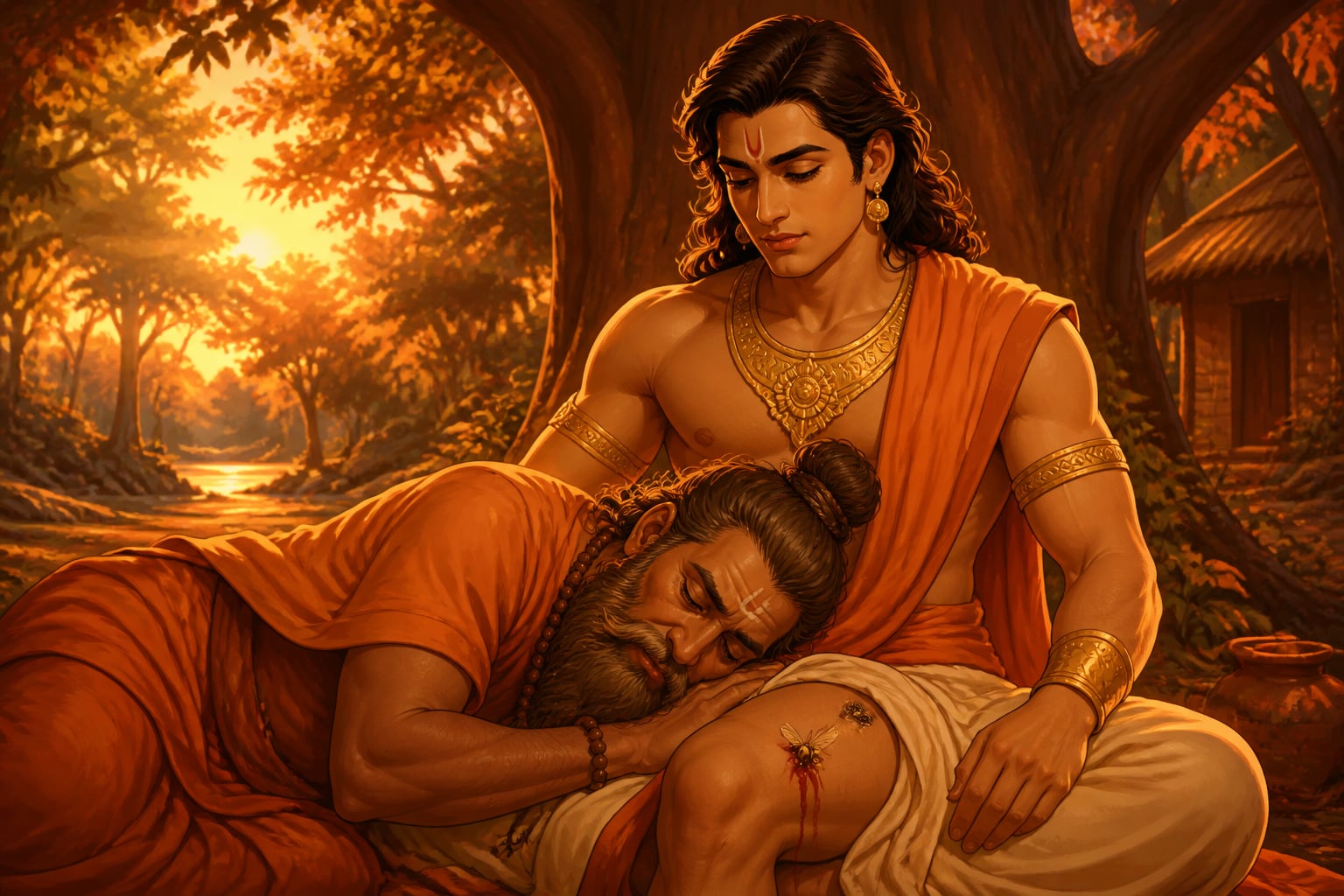
Parashurama was resting, his head in Karna's lap, when an insect began boring into Karna's thigh. The pain was excruciating, but Karna didn't move, didn't want to disturb his teacher's sleep. Blood flowed freely.
When Parashurama awoke, he saw the blood, and understood.
"Only a Kshatriya could endure such pain without flinching. A Brahmin would have cried out. You are no Brahmin."
"Guru, I, "
"You LIED to me. You deceived me to gain knowledge forbidden to your kind." Parashurama's eyes blazed with ancient fury. "Very well. You have learned my teachings. But hear my curse:"
"When you need your knowledge most, in the moment of supreme crisis, it will desert you. The mantras will not come. The weapons will not answer. You will forget what I taught you at the very instant remembering would save your life."
Karna bowed his head and accepted the curse. What else could he do?
The Second Curse: The Brahmin's Cow
The second curse came from an accident.
Years later, Karna was practicing archery in a forest. He heard a rustling in the bushes, assumed it was game, and loosed an arrow. The arrow struck true, but its target was not a deer. It was a cow.
A Brahmin's cow. The man's sole possession, the source of his family's livelihood.
Karna rushed to help, but it was too late. The cow lay dying, its blood soaking into the earth.
"I will compensate you," Karna said desperately. "I will give you a thousand cows. Gold. Land. Whatever you desire."
The Brahmin looked at his dying cow, then at Karna, and his grief transformed into rage.
"What use is gold when my companion of twenty years lies dead? You have taken what cannot be replaced."
"It was an accident, "
"And my curse will be an accident too." The Brahmin's voice dropped to a whisper. "At the moment of your greatest need, when your life depends on your chariot's movement, your wheel will sink into the earth just as my cow sank to her death. The earth itself will hold you helpless for your enemy to kill."
Karna accepted this curse too. A cow was sacred. A Brahmin's curse was earned.
The Third Loss: Indra's Bargain
The third doom was not a curse but a trade.
Karna was born with divine protection: the kavach-kundal, golden armor and earrings that made him nearly invulnerable. As long as he wore them, no weapon could kill him.
Indra, king of the gods and Arjuna's divine father, knew that his son could never defeat Karna while this armor existed. So he came to Karna in disguise, as a Brahmin seeking charity.

Indra came during Karna's morning prayers, when Karna was famous for giving anyone anything they asked.
"I seek a gift," the disguised god said. "Give me your armor and earrings."
Karna's father, Surya the Sun god, had warned him. He knew Indra was coming. He knew what the god wanted. He could have refused, there was no obligation to give what would mean his death.
But Karna was Daanveer, the heroic giver. His entire identity was built on never refusing a request.
"You know what you ask," Karna said. "You know it will mean my death."
"I know."
"And you ask anyway."
"I ask."
Karna smiled, a smile that held both sorrow and defiance. He took a blade and cut the armor from his own flesh, for it had grown into his body since birth. He removed the earrings that had protected him since childhood. Blood ran down his body as he handed them to the disguised god.
"Take them. May they serve your son better than they served me."
Indra, moved despite himself, offered a boon in return: the Shakti, a weapon that would kill any single enemy, but could only be used once.
Karna accepted. It was better than nothing.
But he had traded immortal protection for a single-use weapon. And he had already spent the Shakti killing Ghatotkacha during the war's night battle.
Now I have nothing. No armor. No Shakti. Only skill that will fail me when I need it most.
The Dawn of Reckoning
As the seventeenth day began, Karna dressed for battle with full awareness of what waited.
"You could withdraw," Shalya suggested. "Let others fight today. Face Arjuna tomorrow, when perhaps the curses, "
"The curses don't care what day it is." Karna buckled his mortal armor, so much heavier than the divine kavach had been. "They wait for the moment of crisis. That moment comes when I face Arjuna, whenever I face him."
"Then perhaps don't face him."
"That's not an option." Karna mounted his chariot. "I've waited my whole life for this confrontation. The curses are the price I pay for the skills that make it possible. Without Parashurama's teaching, I wouldn't be Arjuna's equal. Without my sacrifice of the kavach, I wouldn't have the Shakti, or the reputation that made Duryodhana trust me."
"You sound like you've accepted death."
"I've accepted that death is possible. That's different." Karna took up the reins. "Maybe the curses won't activate today. Maybe I'll defeat Arjuna before they strike. Maybe fate has a different plan."
"Do you believe that?"
"No." Karna's voice was quiet. "But I believe in fighting anyway. What else can a warrior do?"
The Weight Descends
Midway through the day, Karna faced Arjuna for what would be their final duel.
At first, everything went as it had before. Arrow matched arrow. Skill matched skill. Neither could gain advantage.
Then Karna reached for the Brahmastra, Parashurama's ultimate weapon.
The mantra was on his lips. He had chanted it a thousand times in practice. It was as natural as breathing.
Oṃ brahmāstrāya...
The next word wouldn't come.
Oṃ brahmāstrāya...
Nothing. His mind was blank. The word he needed, the word that would summon the weapon that could kill Arjuna, had vanished as if it had never existed.
Parashurama's curse had struck.
"What's wrong?" Shalya demanded. "Why aren't you firing?"
"I can't... I can't remember..." Karna's voice was barely a whisper. "The mantra. It's gone."
Shalya's face went pale. "The curse."
"Yes." Karna lowered his bow. "The curse."

Fighting Through Fate
Another warrior would have despaired. Another warrior would have fled.
Karna did neither.
I still have skill. I still have the Vijaya bow. I still have arrows. The curse took the divine weapons, it didn't take me.
He fought on with mortal weapons, matching Arjuna shot for shot through pure technique. His fingers flew. His aim stayed true. Without the astras, he was diminished, but he was still one of the greatest archers who had ever lived.
"How?" Shalya breathed, watching Karna deflect another volley. "How are you still fighting?"
"Because I prepared for this." Karna's voice was strained but steady. "I always knew the curse would come. I trained for decades to be able to fight without divine weapons if I had to."
"But you can't win, "
"Maybe not. But I can make him earn it. I can show the world that Karna, son of Radha, son of Surya, was worthy, curse or no curse. That matters."
Across the battlefield, Krishna watched with something like admiration.
"He knows," Krishna murmured to Arjuna. "He knows his fate and fights anyway. That is a rare kind of courage."
"Should I feel sorry for him?"
"Feel whatever you wish. But don't let it stop your arm." Krishna's voice hardened. "He chose his side. He chose his friend. Now he pays the price of those choices. That is karma. That is niyati. That is fate earned, not imposed."
The Wheel Begins to Sink
As the afternoon shadows lengthened, the second curse stirred.
Karna's chariot wheel, the left wheel, the one that bore the burden of his maneuvers, began to sink into the earth.
No. Not now. Not when I'm still fighting.
The Brahmin's curse had waited decades for this moment. Now it struck with patient precision.
The wheel sank an inch. Then another. The chariot listed, throwing off Karna's aim.
"The ground!" Shalya shouted. "The ground is swallowing us!"
"I know what it is." Karna's voice was calm, the calm of a man who had always known this moment would come. "Get down and try to free it."
"In the middle of battle?"
"What choice do we have?"
Shalya leaped down and began trying to pull the wheel free. The earth held it like a hand refusing to release its grip.
The cow. The dying cow. The blood soaking into the earth.
Now the earth claims me.
Karna stood alone in his listing chariot, watching Arjuna approach, knowing that the final moments of his life had begun.
The Last Stand
"Arjuna!" Karna called out. "Give me a moment, let me free my wheel! Remember dharma! Warriors do not strike the disabled!"
Arjuna hesitated. The rules of dharmic warfare were clear: you didn't attack a man whose chariot was disabled, whose weapons were broken, who was helpless.
But Krishna spoke:
"Where was dharma when you stood silent while Draupadi was humiliated? Where was dharma when Abhimanyu was surrounded and slaughtered? Where was dharma when you helped cheat Yudhishthira at dice?"
Karna had no answer. The accusations were true.
"You remember dharma now because it suits you. You forgot it when forgetting suited you. The wheel of karma turns, Karna. It has turned for you."
Karna looked at Krishna, at the god who had orchestrated so much of this war, who had guided the Pandavas through every crisis, who now pronounced his doom.
"You're right," Karna said quietly. "I have no claim on dharma. I abandoned it when I stood with Duryodhana." He raised his bow one final time. "But I can still die fighting. That, at least, is mine."
The final arrow flew toward him as the sun, his father, watching helplessly from the sky, began its descent toward the horizon.
Karna, son of Surya, son of Kunti, son of Radha, friend of Duryodhana, rival of Arjuna, had reached the end of the road his choices had built.
The curses had found him.
Fate had come home.
Living traditions
Karna's curses have become a metaphor in Indian discourse for 'delayed consequences', the idea that past actions catch up with us at the worst possible moment. Politicians and commentators reference 'Karna's curse' when discussing how past compromises return to haunt present leaders. The concept has also influenced discussions of 'technical debt' in Indian software development culture, shortcuts that seem harmless at the time but cause critical failures later.
- Go-dāna (Cow Donation): Donating cows to Brahmins remains a significant charitable act in Hindu tradition, partly influenced by stories like the Brahmin whose cow Karna killed. The donation is believed to bring merit and avert karmic consequences.
- Mahendragiri: Traditional site associated with Parashurama's ashram, where he taught students including Karna. Pilgrims visit to honor the immortal warrior-sage.
- Parshurama Temple, Chiplun: Major temple dedicated to Parashurama, one of the few temples to this immortal avatar. Devotees pray here for knowledge and martial prowess.
Reflection
- Karna lied about his caste to gain knowledge denied to him by society's rules. Was this lie justified? Does the injustice of the caste system excuse the deception that led to his curse?
- Karna knew Indra was coming to take his armor, Surya warned him. Yet he gave it anyway, because refusing would compromise his identity as Dānavīra. Was he right to value reputation over survival?
- Krishna argues that Karna forfeited dharmic protection by his past violations. Does past wrongdoing justify abandoning ethical rules in the present? Can 'they did it first' ever excuse anything?