Maha Rana: The Final Duel Begins
Karna and Arjuna face off
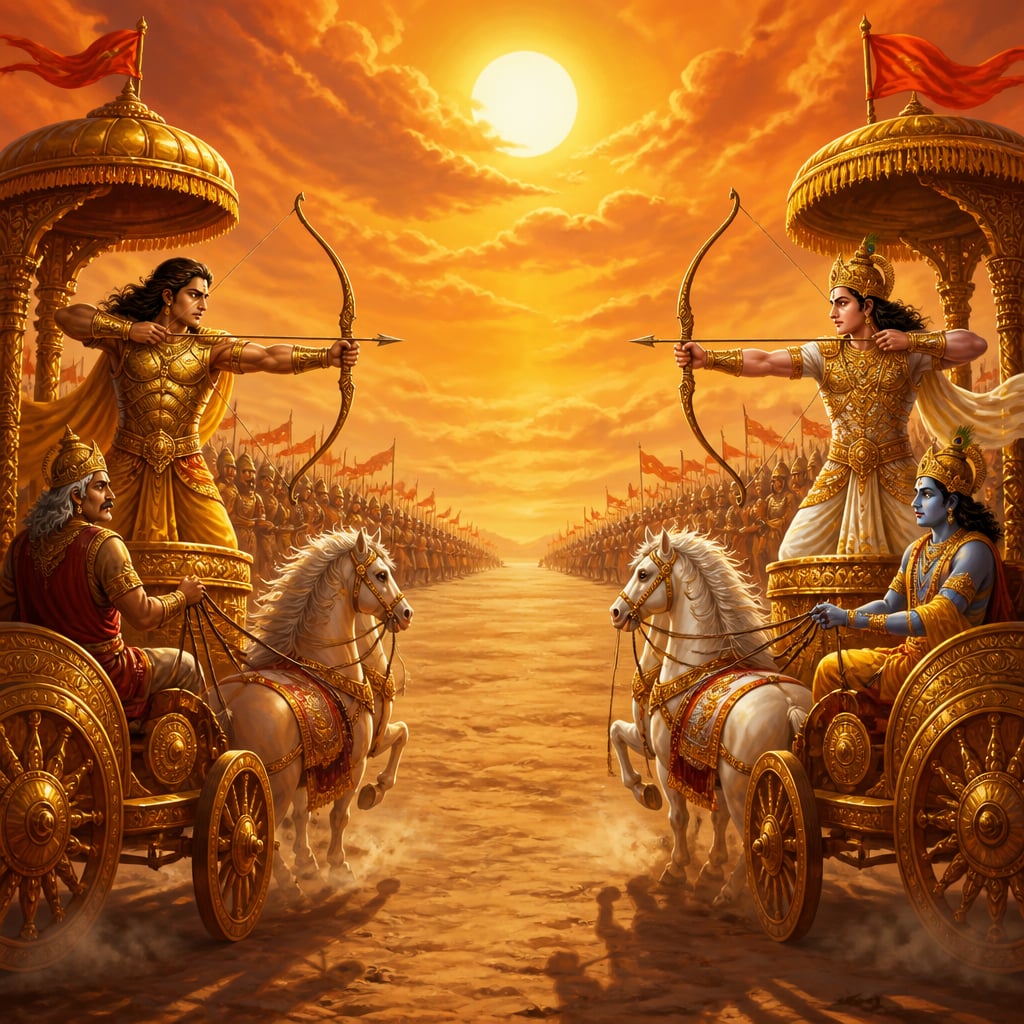
The moment that both armies, indeed, the entire universe, have waited for has arrived. Karna and Arjuna finally face each other in single combat, with no interference, no escape, no rules left to break. What follows is the greatest archery duel in history: two supreme masters of the bow, two rivals bound by fate and blood, fighting to determine not just the war's outcome but the meaning of their entire lives.
The Field Clears
As if by unspoken agreement, both armies fell back.
Warriors who had been fighting for their lives moments before stopped mid-swing, lowered their weapons, and retreated. A space opened in the center of Kurukshetra, a circle of blood-soaked earth perhaps five hundred yards across.
In that space, two chariots faced each other.
Karna, son of Surya, champion of the Kauravas. His golden armor gleamed, mortal armor now, not the divine kavach that had once made him invulnerable. Behind him, Shalya held the reins, his face set in grim concentration.
Arjuna, son of Indra, champion of the Pandavas. The Gandiva bow hummed in his hands, eager for battle. Behind him, Krishna smiled his enigmatic smile, the smile of one who sees past present into eternity.
Finally, both warriors thought. Finally we end this.
The Weight of the Moment
Seventeen days of war had led to this.
Thousands had died so that these two could face each other. Bhishma had fallen. Drona had fallen. Jayadratha, Abhimanyu, Ghatotkacha, Duhshasana, all the blood that had soaked Kurukshetra had been, in some sense, prelude to this confrontation.
"Do you remember," Karna called across the distance, "the tournament at Hastinapura? When we were young?"
"I remember," Arjuna replied. "You challenged me. They wouldn't let you fight."
"Because I was a charioteer's son." Karna's voice held no bitterness, only the calm of a man who has moved past old wounds. "Not good enough to face a prince. Not worthy of the Kuru court."
"That was wrong of them."
"Yes. It was." Karna raised his bow. "But today, there are no castes. No courts. No judges to say who is worthy and who is not. Today there is only you and me, and the arrows between us."
"Then let us see who is truly the greater archer."
"Yes." Karna smiled. "Let us see."
The Opening Volleys
The arrows began to fly.
Not in ones and twos, but in torrents, sheets of shafts that darkened the sky. Each archer loosed dozens of arrows per breath, each arrow aimed with lethal precision, each arrow met by counter-arrows before it could strike home.
| Weapon | Karna | Arjuna |
|---|---|---|
| Opening volley | 27 arrows | 31 arrows |
| Arrows neutralized | 31 | 27 |
| Time elapsed | 3 breaths | 3 breaths |
The watching armies gasped. They had seen great archers before, but never two who could match each other so perfectly.
"Krishna," Arjuna murmured, "his speed, "
"Is equal to yours. Did you doubt it?" Krishna guided the chariot to the left, avoiding a cluster of arrows that had somehow slipped through Arjuna's defense. "This is why we feared him. This is why Indra took his armor. Karna is your equal, Arjuna. Perhaps your only equal."
"Then how do I defeat him?"
"By being more than equal when it matters."
The Dance of Death
The duel became a dance.
Both chariots moved in intricate patterns, circling, advancing, retreating, pivoting. Krishna and Shalya were no longer mere drivers but full participants, their skill with horses as crucial as their warriors' skill with bows.
Karna fired the Bhargavastra, the weapon of Parashurama, which multiplied into thousands of arrows. Arjuna countered with the Aindrastra, Indra's weapon, and the sky became a lattice of steel.
Arjuna released a shaft that could split mountains. Karna deflected it with three arrows, each striking at a different point along its trajectory.
Karna loosed an arrow that sought Arjuna's heart with serpent-like intelligence. Arjuna's protective mantra shattered it into splinters that fell harmless to the ground.
"The devas watch," observers whispered. "The asuras watch. This is not a mortal battle, this is a contest of the ages."
The Nagastra
Then Karna reached for a special arrow, one he had saved for this moment.
The Nagastra was no ordinary weapon. Bound within it was Ashwasena, a serpent prince whose mother Karna had accidentally killed years before. The serpent had sworn revenge on Arjuna, and had offered himself as an arrow to achieve it.
"This arrow will find you," Karna said, fitting it to his bow. "It will seek your throat and will not be denied."
He loosed.

The Nagastra flew with terrible purpose, guided by the serpent's hatred, accelerating as it approached its target. Arjuna fired counter-arrows, but they veered away as if repelled by invisible force.
*It's going to hit, *
Krishna stamped his foot.
The earth beneath the chariot sank, not much, perhaps a foot, but enough. The Nagastra, aimed at Arjuna's throat, struck his crown instead, knocking the diadem from his head but leaving him unharmed.
"Again!" Ashwasena's voice echoed from somewhere in the ether. "Fire me again! I will not miss a second time!"
Karna hesitated. His hand moved toward the arrow that had somehow returned to his quiver.
"No," he said.
"Why not? I can kill him!"
"Because I will not owe my victory to another's hatred." Karna lowered his hand. "If I cannot defeat Arjuna with my own skill, I don't deserve to defeat him at all."
Ashwasena's rage was palpable. But Karna's word was final.
Across the field, Krishna nodded almost imperceptibly. Even now, his expression seemed to say, even now he chooses honor.
The Turning Point
The duel continued, but something had shifted.
Karna was fighting brilliantly, matching Arjuna arrow for arrow, technique for technique. But without the Nagastra, without the divine weapons that Parashurama's curse had stripped from his memory, he was slowly losing ground.
I trained for this, Karna reminded himself. I trained to fight without the astras.
But training couldn't fully compensate. Arjuna still had access to divine weapons. Karna had only mortal skill, supreme mortal skill, but mortal nonetheless.
"His defense is weakening," Krishna observed. "His arrows are coming slower. The curse is taking its toll."
"Should I use the Brahmastra?"
"Not yet. Let him exhaust himself. Let the curses do their work." Krishna's voice was gentle but implacable. "This is not cruelty, Arjuna. This is karma. His choices led him here. His curses are his own doing."
"He could have been my brother."
"He IS your brother." Krishna turned to meet Arjuna's shocked gaze. "Kunti bore him before she married Pandu. He is the eldest son, your elder brother. You are fighting your own blood."
Arjuna's hands trembled on the Gandiva. "Why... why didn't you tell me?"
"Because it wouldn't have changed anything. He chose his side. You chose yours. This war was never about blood, it was about dharma. And dharma demands that adharma be defeated, regardless of who carries it."
Karna's Knowledge
Across the field, Karna saw Arjuna's momentary hesitation, and understood.
Krishna has told him. He knows we're brothers.
For years, Karna had carried this secret. Kunti's revelation at the riverbank. The knowledge that the Pandavas were his brothers, that Arjuna was his competition not just in skill but in blood.
I could have been the eldest. I could have been king. I could have had everything Arjuna has.
But he had chosen Duryodhana. He had chosen loyalty over lineage, friendship over family.
And I don't regret it.
"Brother!" Karna called out, using the word deliberately. "Does knowing change anything?"
Arjuna stiffened. "You knew?"
"Kunti told me before the war. She begged me to join you." Karna loosed another arrow, aimed carefully to miss, to make a point rather than kill. "I refused. Duryodhana gave me honor when the world gave me only scorn. I couldn't betray him, not even for blood."
"Then this is... fratricide."
"This is war." Karna's voice was sad but steady. "And one of us has to win. I'd rather it be you, brother, I'd rather the son of Kunti survive than fall, but I won't let you win easily. That would dishonor us both."
The Final Phase
The revelation should have changed things. It didn't.
Both archers continued fighting, perhaps with more sorrow, but with no less intensity. Blood ties couldn't undo seventeen days of war. Brotherhood couldn't erase the deaths of sons and friends and teachers.
And somewhere in the back of Karna's mind, the curses stirred.
His chariot wheel had begun to sink, slowly, almost imperceptibly. The Brahmin's curse was awakening.
His fingers were slowing, just slightly, just enough to notice. Parashurama's curse was taking hold.
Not yet. Not yet. Give me a few more moments. Let me show them what I could have been.
Karna drew the Vijaya bow to its fullest extent. He sighted on Arjuna, not to kill, but to prove something.
The arrow flew true. It struck Arjuna's bowstring, severing it.
For one heartbeat, Arjuna was defenseless. Karna could have fired again, could have ended the war with a single shot.

Instead, he lowered his bow.
"Restring your weapon," he said. "I will not kill an unarmed man. Not even for victory. Not even for Duryodhana."
Because I am Karna. And Karna fights with honor, even when honor is a luxury he cannot afford.
Arjuna stared at him, at this brother he had never known, this enemy he had fought his whole life, this rival who somehow remained noble even in defeat.
"Thank you," he said quietly.
Karna smiled. "Don't thank me. When your bow is ready, I expect you to kill me. That's what brothers do in this war."
The Gandiva's string was replaced.
The final moments of the duel were about to begin.
And the earth beneath Karna's chariot continued, inexorably, to sink.
Living traditions
The Karna-Arjuna rivalry has become a metaphor in Indian sports journalism for any great rivalry between equally matched competitors. Cricket matches between legendary rivals are often described as 'Karna-Arjuna duels.' The phrase captures both the intensity of competition and the underlying respect between true equals. Business competition is sometimes framed similarly, rivals who push each other to excellence rather than merely seeking to destroy.
- Karna's Pool (Karna Taal): A water tank traditionally associated with Karna. Local legends say Karna performed charity here, giving away gold to Brahmins who came to bathe.
Reflection
- Karna refuses to fire the Nagastra a second time because he won't 'owe his victory to another's hatred.' Is this admirable principle or foolish pride? When is winning too tainted to accept?
- When Arjuna learns Karna is his brother, he continues fighting. Was this the right choice? Could the revelation have, should it have, stopped the war?
- Karna lets Arjuna restring his bow instead of taking an easy kill. Arjuna accepts this mercy and then prepares to kill Karna. What does this exchange tell us about honor between enemies?