Pancha Kedar: The Five Sacred Sites
Shiva's body parts across five Himalayan temples
Explore the Pancha Kedar pilgrimage circuit. When Shiva dived as a bull, different parts appeared at five sites: Kedarnath (hump), Tungnath (arms), Rudranath (face), Madhyamaheshwar (navel), and Kalpeshwar (hair). Learn the legends and significance of each.
The Divine Body Scattered
When Shiva dove into the earth as a bull to escape the Pandavas, his cosmic body did not remain whole. It fragmented across the Garhwal Himalayas, each sacred part emerging at a different location, creating five temples that together form the Pancha Kedar, one of Hinduism's most challenging and spiritually rewarding pilgrimage circuits.
The five temples, in traditional order of worship, are:
| Temple | Body Part | Altitude | District |
|---|---|---|---|
| Kedarnath | Hump (pṛṣṭha) | 11,755 ft | Rudraprayag |
| Tungnath | Arms (bāhu) | 12,073 ft | Rudraprayag |
| Rudranath | Face (mukha) | 11,811 ft | Chamoli |
| Madhyamaheshwar | Navel (nābhi) | 11,450 ft | Rudraprayag |
| Kalpeshwar | Hair (jaṭā) | 7,217 ft | Chamoli |
Together, these five sites reconstitute the complete divine bull, and completing the circuit reconstitutes the pilgrim.
Tungnath: The Arms of the Destroyer
Perched at 12,073 feet, Tungnath is the highest Shiva temple in the world. Here, the arms (bāhu) of Shiva's bull-form emerged, the arms that hold the trident, the drum, and the fire; the arms that destroy and create.
The Temple
The small stone temple, believed to be over 1,000 years old, is attributed to the Pandavas' construction. Its architecture reflects high-altitude necessity: compact, low-roofed, built to withstand avalanches and extreme winds. Inside, a natural rock formation is worshipped as Shiva's arms.
The Trek
From Chopta (often called "Mini Switzerland"), the trek to Tungnath is only 3.5 kilometers, but steep. Beyond Tungnath, another 1.5 km leads to Chandrashila ("Moon Rock") summit at 13,123 feet, offering panoramic views of Nanda Devi, Kedar Dome, and Chaukhamba peaks.
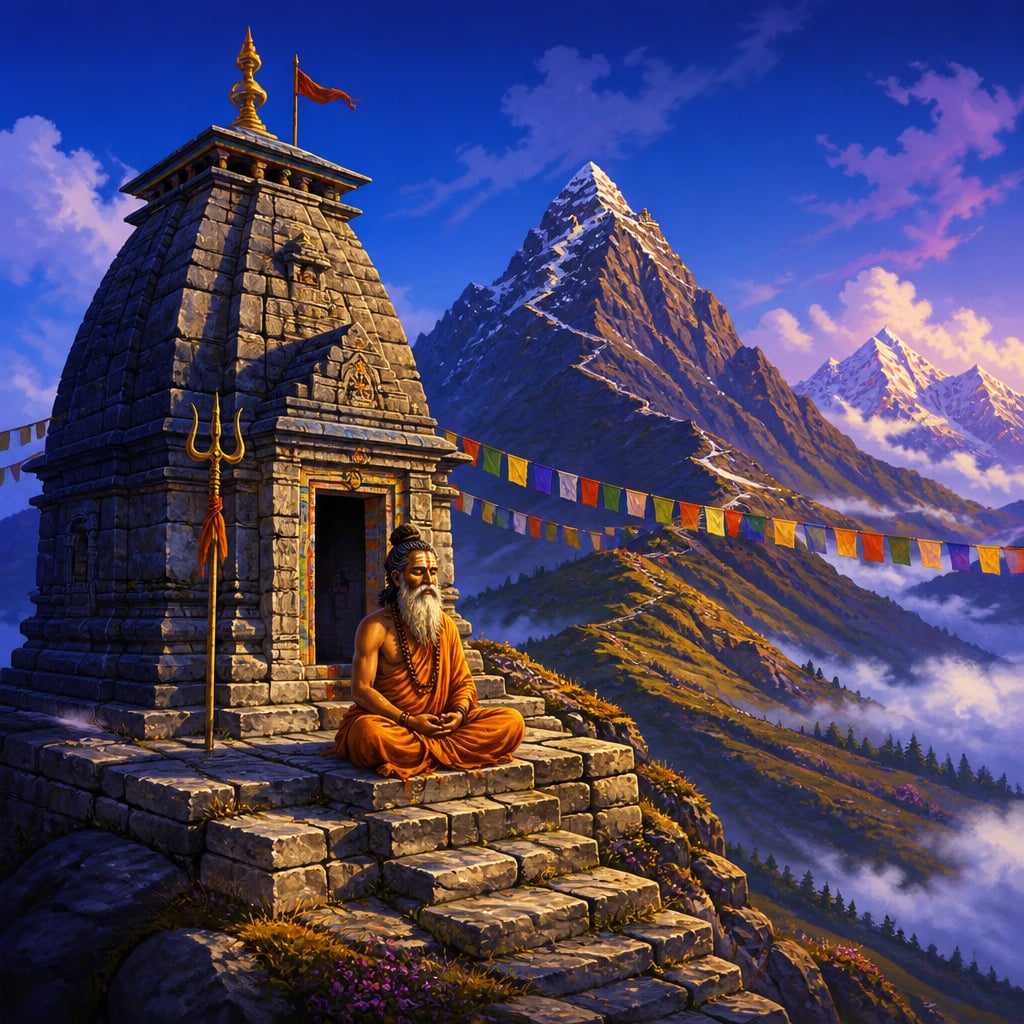
The arms of Shiva reach toward the highest peaks. At Tungnath, we are reminded that divine action operates at heights our normal vision cannot reach.
Rudranath: The Face That Cannot Be Seen
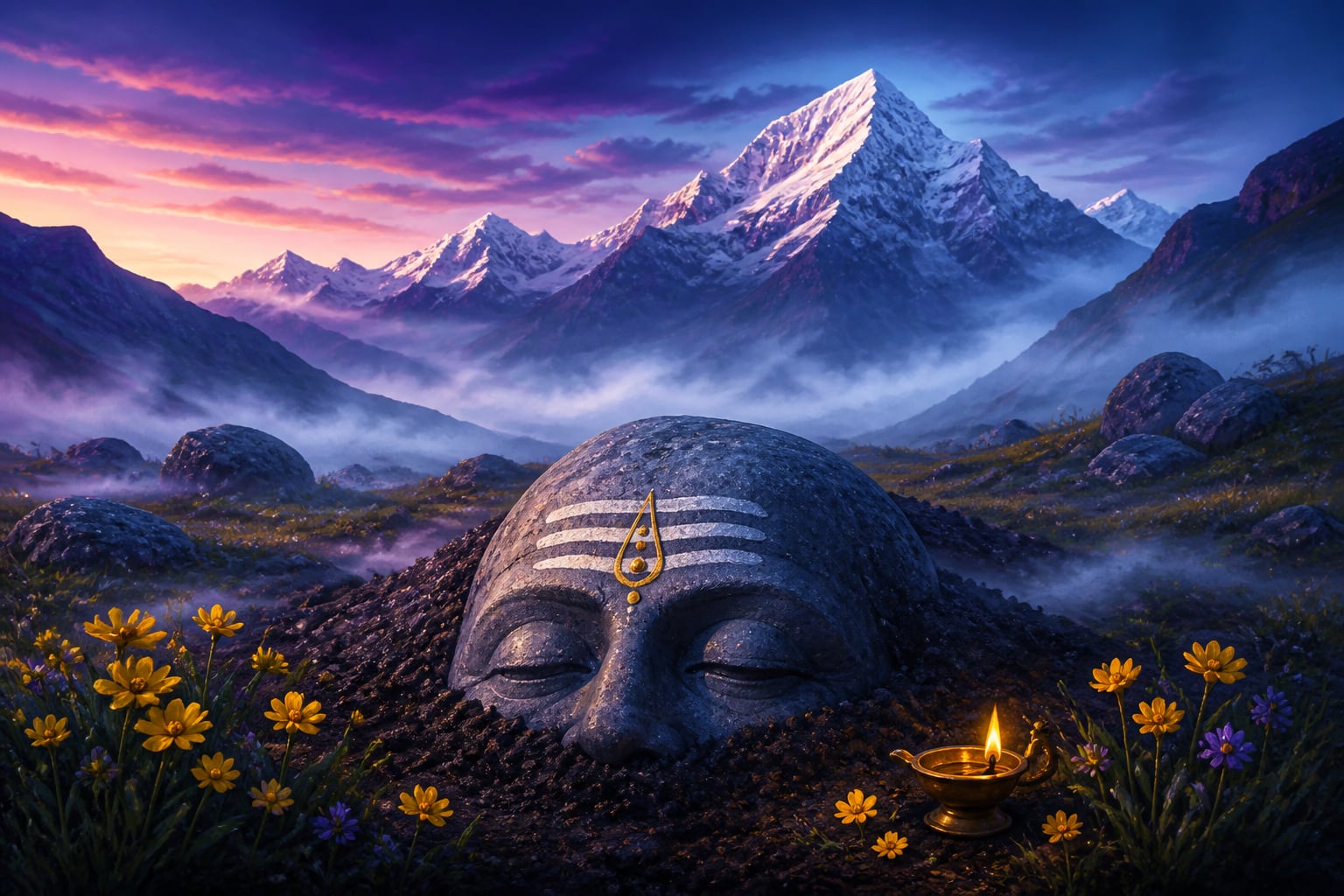
The most remote and challenging of the Pancha Kedar, Rudranath houses Shiva's face (mukha), yet this face is not a carved idol but a natural rock formation in the shape of Rudra's visage.
The Mystery of the Hidden Face
Unlike other temples where the deity is clearly visible, Rudranath's face-shaped rock is partially submerged in the ground, revealing only features like the nose, eyes, and mouth in natural stone. Devotees believe this face continues deep into the earth, infinite, unseeable, representing that aspect of the divine which can never be fully perceived.
The Journey
Rudranath is the most difficult Pancha Kedar to reach:
- Trek distance: 20 km one way from Sagar village
- Multiple routes exist, none easy
- No motorable road, pure mountain walking
- Requires 2-3 days minimum
The remoteness is the teaching. Shiva's face, his true identity, is not easily seen. Those who would behold the divine countenance must earn that vision through effort, solitude, and surrender.
Surrounding Mandirs
Near Rudranath lie several smaller temples to other deities: Vaitarni, Anusuya, Surya Kund, and others. The area is considered a Tīrtha Sthāna (sacred crossing point) where multiple divine energies converge.
Madhyamaheshwar: The Navel of Creation
At Madhyamaheshwar, Shiva's navel (nābhi) appeared, the cosmic center from which creation flows. In Hindu cosmology, Vishnu's navel produces the lotus on which Brahma sits; here, Shiva's navel represents the center of his own infinite body.
The Temple Setting
Madhyamaheshwar sits in a beautiful alpine meadow called Bantoli Bugyal, surrounded by snow-capped peaks including Kedarnath, Chaukhamba, and Neelkanth. The temple is a small stone structure housing a linga that represents Shiva's navel.
The Symbolism
The navel is the body's center, the point where we were once connected to our mothers, the remnant of our first nourishment. Shiva's navel at Madhyamaheshwar represents:
- The center from which energy radiates, all limbs extend from this core
- The connection point, where divine and material worlds touch
- The place of sustenance, where cosmic nourishment flows
Nearby Sites
From Madhyamaheshwar, devotees can see the Kedarnath peak in the distance. A traditional belief holds that praying here while viewing Kedarnath multiplies the spiritual merit of both pilgrimages.

Kalpeshwar: The Matted Locks of the Yogi
The final temple houses Shiva's matted hair (jaṭā), the locks that caught the Ganga as she fell from heaven, breaking her fall lest she destroy the earth. Hair represents asceticism, renunciation, and the power accumulated through tapas.
The Only Year-Round Temple
At just 7,217 feet, Kalpeshwar is the lowest and most accessible of the Pancha Kedar, and the only one that remains open throughout the year. While other temples close for six months of winter, Kalpeshwar's priests maintain continuous worship.
The Natural Cave Temple
Unlike the others, Kalpeshwar is housed in a natural cave. The linga inside is said to resemble Shiva's matted locks, appearing as stone shaped like twisted hair. The cave-temple setting evokes Shiva as the primordial yogi, meditating in mountain caves since before time began.
Urgam Valley
Kalpeshwar sits in the beautiful Urgam Valley, a relatively undeveloped area that maintains the pristine quality that once characterized all of Garhwal. The walk from Urgam village is gentle, just 2 km, making this the easiest Pancha Kedar to reach.
The Complete Circuit
Pilgrims traditionally complete the Pancha Kedar in order:
1. Kedarnath → 2. Tungnath → 3. Rudranath → 4. Madhyamaheshwar → 5. Kalpeshwar
However, due to logistics, most modern pilgrims visit them based on accessibility:
| Route | Order | Difficulty |
|---|---|---|
| Traditional | 1→2→3→4→5 | Extreme |
| Practical | 1→5→4→2→3 | Hard |
| Accessible First | 5→1→2→4→3 | Moderate start |
Time Required:
- Minimum: 12-15 days for all five
- Recommended: 18-21 days (including rest and weather buffer)
- Season: May-June or September-October
Shiva Tattva: The Scattered Body, the Unified Soul
Why does Shiva's body appear fragmented across five locations?
The Pancha Kedar teaches a profound truth: the divine cannot be contained in one place. Brahman is infinite, and any single temple can only house a fraction of that infinity. The five temples together form a maṇḍala, a sacred diagram spread across mountains.
Each body part teaches something specific:
- Hump (Kedarnath): The weight we carry; the karma that bends us
- Arms (Tungnath): Our capacity for action; power and protection
- Face (Rudranath): Identity and perception; how we see and are seen
- Navel (Madhyamaheshwar): Our center; connection to source
- Hair (Kalpeshwar): Our accumulated tapas; spiritual power stored through practice
By visiting all five, the pilgrim symbolically reunites Shiva's body, and in doing so, integrates these qualities within themselves. The scattered becomes whole. The journey across mountains mirrors the journey to wholeness within.
The Pancha Kedar is not five temples, it is one temple spread across geography. The pilgrim's walking is the thread that sews the divine body back together.
This is the deeper purpose of pilgrimage: not merely to see sacred sites, but to become the connection between them. The pilgrim's body, walking from temple to temple, becomes the living vehicle of divine integration.
Living traditions
The Pancha Kedar circuit has gained renewed interest among adventure seekers and spiritual tourists, leading to improved trail maintenance and basic infrastructure. Environmental organizations now monitor the ecological impact of increased footfall. Some travel companies offer guided Pancha Kedar packages combining trekking expertise with spiritual guidance. The circuit represents a meeting point between traditional pilgrimage and modern adventure tourism.
- Pancha Kedar Yatra: The traditional pilgrimage circuit visiting all five temples in order: Kedarnath → Tungnath → Rudranath → Madhyamaheshwar → Kalpeshwar. Traditionally completed in a single season (May-October). Modern pilgrims often take 2-3 seasons. Some devotees undertake the circuit annually until completing it.
- Ekadashi at Pancha Kedar: Many devotees time their temple visits to coincide with Ekadashi (11th lunar day), especially during Shravan month (July-August). Fasting on Ekadashi while at a Pancha Kedar temple is considered exceptionally meritorious. Some undertake all five visits on consecutive Ekadashis.
- Chandrashila Trek: After visiting Tungnath, pilgrims often continue 1.5 km to Chandrashila summit (13,123 ft). According to legend, Rama meditated here after defeating Ravana to absolve any sin of killing. The 360-degree Himalayan views at sunrise are considered a form of darshan, seeing the divine in nature.
- Tungnath Temple: The highest Shiva temple in the world. Small stone temple housing Shiva's arms. Continue to Chandrashila summit (1.5 km) for panoramic Himalayan views. The meadows around Tungnath bloom with wildflowers in May-June.
- Rudranath Temple: Most remote Pancha Kedar. Natural rock formation resembling Shiva's face, partially visible above ground. Surrounded by smaller temples to other deities. The journey itself is the primary experience, 20 km trek through pristine wilderness.
- Kalpeshwar Temple: Cave temple housing Shiva's matted locks. Easiest and only year-round Pancha Kedar. Beautiful Urgam Valley setting. The cave adds mystical atmosphere, Shiva as the eternal yogi in his mountain cave.
- Madhyamaheshwar Temple: Fourth Pancha Kedar, housing Shiva's navel. Set in beautiful Bantoli Bugyal meadow with views of Kedarnath peak. Less visited than others, offering a more intimate experience.
- Makkumath: Winter residence of Kedarnath and Tungnath deities. When temples close for winter, the utsav murtis (processional deities) are brought here. Devotees who cannot trek can have darshan during winter months.
Reflection
- What parts of yourself feel scattered or disconnected? If you were to design a 'pilgrimage' to reunite them, what five places, practices, or experiences would you include?
- Why might ancient sages have intentionally placed these temples in such difficult locations? What is lost when sacred sites become too easily accessible?
- If the divine is infinite, why would it manifest in specific locations at all? What does it mean that Brahman, which is everywhere, can be 'more present' in certain places?