Gyanvapi: History and Controversy

The temple-mosque complex and its layers of history

Examine the Gyanvapi complex where the original Vishwanath temple once stood. Learn about the pre-Mughal temple's grandeur, Aurangzeb's 1669 order, the construction of the mosque using temple remains, and the 2022 archaeological survey findings - presented factually with focus on the site's spiritual significance.

The Well of Knowledge

In the shadow of Kashi Vishwanath temple lies a structure whose very name reveals its purpose: Gyanvapi, the 'Well of Wisdom' (ज्ञान = knowledge, वापी = well/tank). According to tradition, Lord Shiva himself dug this well with his trishul to cool the jyotirlinga with its waters. The well predates all human construction on the site.

Today, Gyanvapi refers not just to the ancient well but to a complex where Hindu and Muslim sacred structures share walls, a physical reminder of India's layered history. Understanding this site requires separating archaeological evidence from political narratives, and recognizing that the spiritual significance of Kashi transcends any single structure.

The Pre-Mughal Temple

The original Vishwanath temple was one of the grandest in medieval India. Historical accounts and surviving architectural elements reveal:

Temple Descriptions:

Architectural Evidence Still Visible:

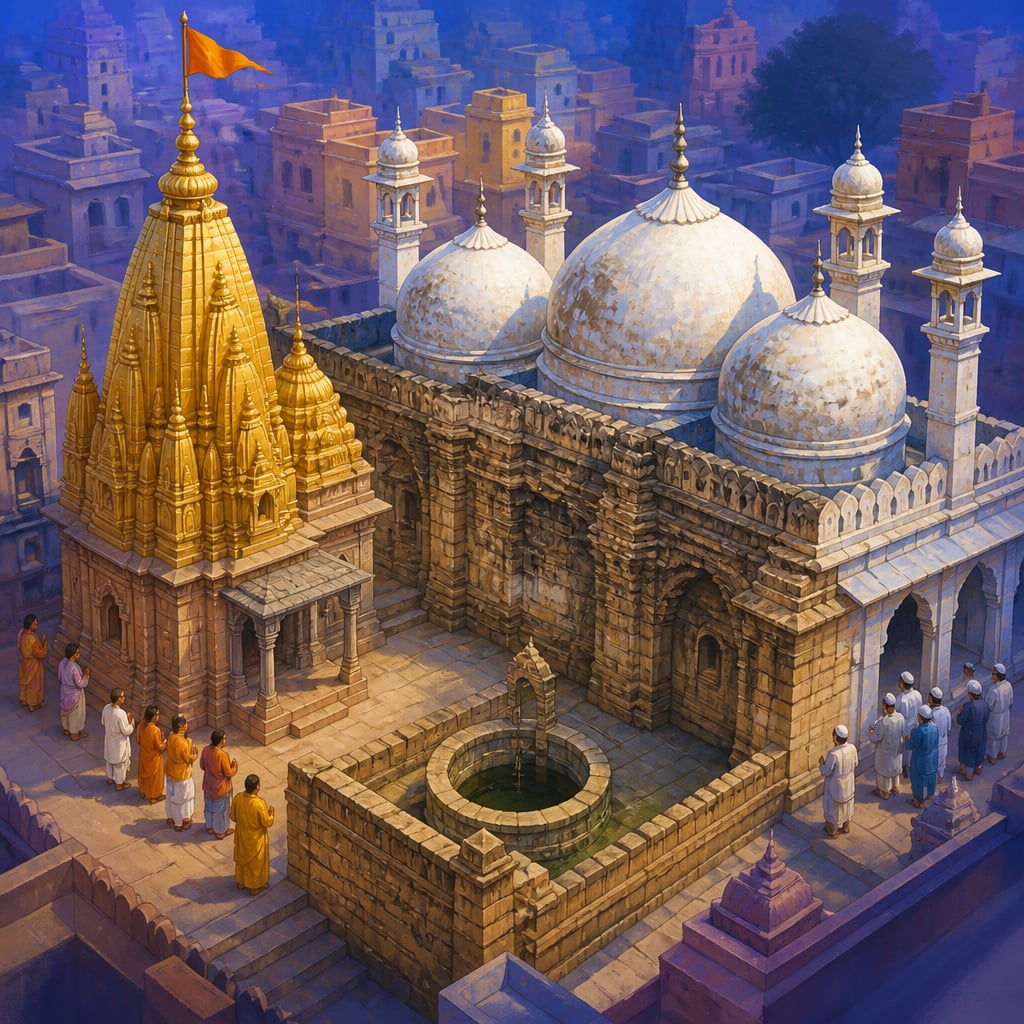
Aerial view of the Gyanvapi complex with temple and mosque sharing a wall

The 1669 Order

On April 18, 1669, Mughal Emperor Aurangzeb issued a firman (royal decree) ordering the demolition of the Vishwanath temple. This is documented in the Maasir-i-Alamgiri, the official court chronicle:

"The Emperor ordered the governors of all provinces to demolish the schools and temples of the infidels, and with the utmost urgency put down the teaching and public practice of idolatrous forms of worship."

The temple was demolished, and a mosque was constructed on the site in 1669, using materials from the demolished temple. The lower portions of the temple structure were incorporated into the mosque's foundation and walls, a common practice during this period, visible at several sites across India.

What Was Preserved:

The Adjacent Coexistence (1780-Present)

Ahilyabai Holkar overseeing the 1780 rebuild of the Vishwanath temple

When Ahilyabai Holkar rebuilt the Kashi Vishwanath temple in 1780, she chose to construct it adjacent to the mosque rather than attempting to demolish it. This decision created the unique situation that exists today:

The 2022 Survey and Findings

In May 2022, a Varanasi court ordered an archaeological survey of the Gyanvapi mosque after a petition by Hindu plaintiffs. The survey, conducted by the Archaeological Survey of India (ASI), concluded in December 2023 with significant findings:

Key Findings (as reported in court documents):

Current Legal Status: The matter remains under judicial consideration. Multiple petitions have been filed by both Hindu and Muslim parties. Key legal questions include:

The Spiritual Perspective

Beyond the legal and political dimensions lies a deeper spiritual truth that Kashi's traditions emphasize:

The Jyotirlinga's Indestructibility: According to Shaiva philosophy, a jyotirlinga is not merely a stone, it is a svayambhu (self-manifested) point where Shiva's consciousness pierces the material plane. Structures may be built and destroyed, but the tirtha-shakti (pilgrimage power) of the site remains eternal.

The Skanda Purana declares: "Kashi is not on Earth, Earth is in Kashi." This suggests that Kashi's sanctity exists at a level that human actions cannot fundamentally alter.

What Devotees Understand:

Kashi's Pattern: Destruction and Renewal

Gyanvapi's story fits a larger pattern in Kashi's history:

Period Event Outcome
~1194 CE Qutb-ud-din Aibak's raids Temple rebuilt
~1585 CE Todarmal's reconstruction under Akbar Grand restoration
1669 CE Aurangzeb's demolition Mosque built
1780 CE Ahilyabai's reconstruction Adjacent temple
2019-Present Kashi Vishwanath Corridor Temple complex expanded

This cycle of destruction and renewal is itself a Shaiva teaching: Shiva is both the destroyer and regenerator. What is destroyed comes back in new form. The devotee's task is to see through temporal changes to the eternal presence beneath.

The Well That Remains

The ancient Gyanvapi well, its stone mouth weathered by centuries

The Gyanvapi well itself, the original 'Well of Wisdom', remains intact through all these changes. This is spiritually significant:

Whether one enters through the temple or glimpses it from the mosque's boundary, the well stands as a reminder that Kashi's sacred geography is older than any single tradition's claims upon it.

What Endures

The history here is documented, and there is no purpose in denying it: the temple was demolished in 1669, and the record survives in the demolisher's own court chronicle. But a jyotirlinga is not its building. It is a svayambhu point, a place where Shiva's presence pierces the world, and that presence is older than any structure raised over it and outlasts any structure taken from it. The linga was carried to safety and is worshipped to this day; the Gyanvapi well, which predates every wall around it, still stands; and Kashi's power to liberate has never depended on which roof covered the linga in which century. "Kashi is not on earth," says the Skanda Purana; "earth is in Kashi." The questions of the present site are, at the time of writing, before the courts. The tradition's own answer runs deeper than any verdict: what was sacred here was never the stone, and what is sacred here was never destroyed.

Living traditions

The Gyanvapi case has become a landmark in Indian jurisprudence on religious sites. The 2022-2024 proceedings have established precedents on what constitutes 'maintaining religious character' under the Places of Worship Act (1991). Regardless of outcome, the case demonstrates India's commitment to resolving such disputes through constitutional means rather than violence, itself a dharmic achievement. The site continues to attract millions of pilgrims annually who focus on worship rather than controversy.

Reflection

More in Himalaya Dhama: The Mountain Abodes

All lessons in Himalaya Dhama: The Mountain Abodes · The Twelve Jyotirlingas course