Srisailam: The Dakshina Kashi

Adi Shankara, Bhramaramba, and the Chenchu tribes

Explore Srisailam's rich traditions. Learn about Bhramaramba Devi (the Shakti Peetha goddess), Adi Shankaracharya's Sivananda Lahari composed here, the Chenchu tribal priests who maintain ancient forest traditions, and why this is called the Kashi of the South.

Why 'Dakshina Kashi'?

Every sacred geography has its center. For North India, Kashi (Varanasi) is the spiritual axis, the city where moksha is guaranteed, where Shiva himself whispers the taraka mantra into the dying. But for the South, there is another such place: Srisailam.

The title 'Dakshina Kashi' (Southern Kashi) is not mere flattery. It indicates that Srisailam holds equivalent power for liberation. Just as pilgrims believe death in Kashi liberates the soul, so devotees hold that darshan at Srisailam burns accumulated karma. The mountain, the forests, the ancient linga, all function as a southern gateway to the infinite.

Bhramaramba: The Goddess of Bees

The Shakti Peetha

While Mallikarjuna is the jyotirlinga, Bhramaramba is the Shakti Peetha, one of the eighteen Maha Peethas where parts of Sati's dismembered body fell. At Srisailam, tradition holds that Sati's upper lip (or neck, in some versions) manifested here as the fierce goddess Bhramaramba.

The name 'Bhramaramba' (भ्रमराम्बा) means 'Mother of Bees', from 'bhramara' (bee) and 'amba' (mother). Several interpretations exist:

The Forest Interpretation: The dense Nallamala forests surrounding Srisailam buzz with wild bees. The goddess took this name because she presides over these forests.

The Devotional Interpretation: Just as bees are irresistibly drawn to flowers, the soul is drawn to the divine. Bhramaramba is the magnetic power that pulls devotees toward liberation.

The Fierce Interpretation: Bees sting those who threaten them. Bhramaramba's fierce aspect protects devotees and destroys obstacles, she stings ignorance itself.

The Temple Position

Unlike many temples where the goddess has a separate shrine, Bhramaramba's sanctum is within the same temple complex as Mallikarjuna, to his left. This positioning is significant: traditionally, the wife stands to the husband's left in Hindu iconography. Here, Shakti and Shiva are united, you cannot worship one without encountering the other.
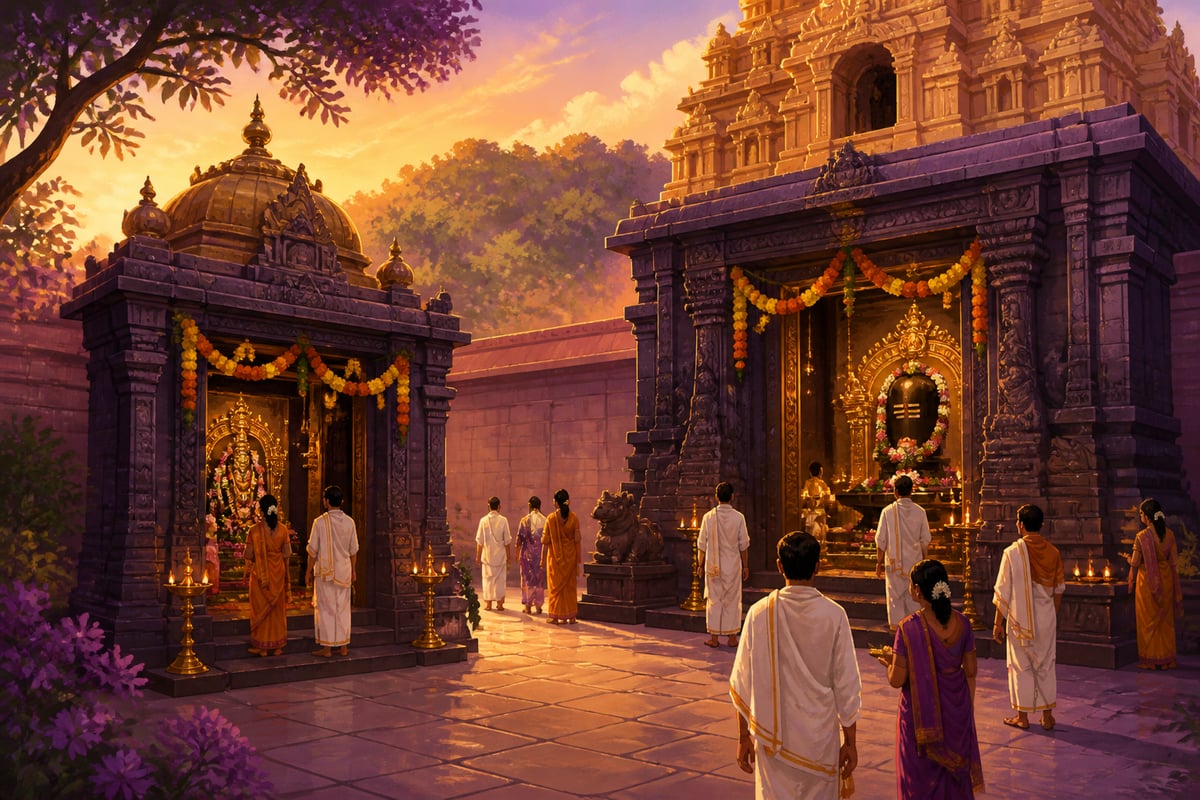
Devotees moving through the dual sanctums at Srisailam

Devotees entering the temple typically receive darshan of Bhramaramba first, then proceed to Mallikarjuna. The theological meaning is clear: the seeker approaches the Divine Mother, who then leads them to Shiva.

Adi Shankaracharya at Srisailam

The Digvijaya and the Southern Stop

In the 8th century CE, Adi Shankaracharya (788-820 CE) undertook his famous digvijaya yatra, a pilgrimage across India to revive Vedic dharma and establish the philosophy of Advaita Vedanta. Srisailam was a crucial stop on this journey.

Shankara spent significant time here in meditation and philosophical discourse. The Nallamala forests, remote from urban centers, provided ideal conditions for tapas. The presence of both a jyotirlinga and a Shakti Peetha made Srisailam a complete sacred site for a philosopher who honored all forms of the Divine.

Sivananda Lahari: Waves of Shiva-Bliss

It was at Srisailam that Shankara composed the Sivananda Lahari, 'Waves of Bliss in Shiva.' This hundred-verse hymn is one of the most beautiful devotional poems in Sanskrit, expressing the emotional surrender that complements Shankara's intellectual Advaita.

The composition begins from the shikhara (peak) of Srisailam, and the first 27 verses use the 'shikharini' meter, a poetic reference to the mountain peak. The opening verses invoke both Mallikarjuna and Bhramaramba, honoring the divine couple together.

A famous verse from Sivananda Lahari captures Shankara's devotional ecstasy:

Ankola-nija-bija-santati-ayukteva | Aayaskaantopalam soochikeva...

"As the seed of the ankola tree falls and returns to the parent tree, as iron is drawn to the magnet, so may my mind be drawn to Shiva's lotus feet."

This was not the dry philosopher, this was Shankara the devotee, overwhelmed by the mountain's power.

Adi Shankaracharya at Srisailam shikhara

The Clever Opening

Shankara faced a theological dilemma: when composing hymns for Shiva and Shakti, whom should he invoke first? His solution was elegant. In Soundarya Lahari (praising the Goddess), he opens with "Shiva shaktya yukto...", beginning with Shiva's name. In Sivananda Lahari (praising Shiva), he opens with "Kalabhyam...", beginning with a reference to the Goddess.

This reflects the Ardhanareeshwara teaching: Shiva and Shakti are not two beings but one reality with two aspects. At Srisailam, where both are present in their most powerful forms, this unity is experienced directly.

The Chenchu Tradition: Forest Priests of Mallikarjuna

Who Are the Chenchus?

The Chenchu are an ancient Dravidian tribe indigenous to the Nallamala forest region. References to them appear as early as the Manu Smriti (circa 600-200 BCE), identifying them as original inhabitants of the Andhra region. They are among India's oldest surviving tribal communities.

Traditionally, the Chenchus were hunter-gatherers living in complete harmony with the forest. Their knowledge of medicinal plants, animal behavior, and forest survival is encyclopedic. The Nallamala was not just their home, it was their mother, their teacher, their temple.

Chenchu Mallaiah: The Tribal Name for Shiva

The Chenchus have a unique relationship with Srisailam. According to their tradition, Lord Shiva once came to the Nallamala forests on a hunting expedition. There he met and fell in love with a beautiful Chenchu woman named Chenchu Lakshmi. He married her, and she accompanied him in his forest wanderings.

Chenchu Lakshmi meeting Shiva in the Nallamala forest

For this reason, the Chenchus call Mallikarjuna by an intimate name: 'Chenchu Mallaiah', 'The Chenchu's Mallaiah.' He is not a distant god but a son-in-law of their tribe. The relationship is one of kinship, not just worship.

This legend reflects a historical reality: the Chenchus were likely the original custodians of whatever sacred site existed on Srisailam before Brahmanical priests arrived. Their goddess worship was absorbed into the Shakti Peetha tradition; their forest spirits became aspects of Mallikarjuna.

Chenchu Priests and Temple Rights

Historically, Chenchu priests performed rituals at Srisailam alongside Brahmin priests. They had specific duties and privileges connected to the forest aspects of worship, perhaps reflecting their original custodianship of the site.

When the temple came under government endowment department management in the modern era, these traditional Chenchu roles diminished. Yet the connection remains. Chenchus still claim special privileges at the temple, and many consider themselves descendants of Chenchu Lakshmi and Lord Shiva himself.

The Chenchu Lakshmi Tribal Museum near Srisailam now preserves their traditions, displaying their material culture, spiritual practices, and the unique story of how a forest tribe became kin to a jyotirlinga.

The Complete Pilgrimage

What Makes Srisailam Unique

Unlike temples in cities, Srisailam is embedded in wilderness. The Nallamala forest, now the Nagarjuna Sagar-Srisailam Tiger Reserve, surrounds the temple. Tigers, leopards, sloth bears, and countless bird species share this space with pilgrims.

This is deliberate. Srisailam's power comes partly from its isolation. To reach it, you must enter the forest. The journey itself is transformative, modern roads have made it easier, but the sense of entering another world remains.

The Shiva Tattva of Srisailam

If Mallikarjuna's story (the previous lesson) teaches patient parental love, Srisailam's broader tradition teaches integration:

The teaching is that the highest spiritual truth embraces opposites rather than choosing between them. Srisailam is complete because it holds everything, the fierce and the gentle, the intellectual and the emotional, the ancient and the renewed.

Living traditions

Srisailam's model of integrating tribal and Brahmanical traditions is studied by scholars of Indian religious history. The Chenchu's relationship with the temple demonstrates how Hinduism absorbed indigenous traditions rather than simply replacing them. Today, efforts to preserve Chenchu cultural rights at Srisailam continue, balancing temple modernization with honoring ancient custodianship.

Reflection

More in Bhakti Kshetra: Temples Born of Devotion

All lessons in Bhakti Kshetra: Temples Born of Devotion · The Twelve Jyotirlingas course