Sankhapala: The Generous Serpent King
Giving even when it means suffering
Sankhapala, the magnificent Naga King, takes a vow to observe the holy days by lying on an anthill, harming no creature. When cruel snake charmers find him, they pierce his body with stakes and drag him to perform in villages. Despite his power to destroy them with one breath, Sankhapala endures everything rather than break his vow of non-harm - the highest gift of all.
The King Beneath the Waters
Deep beneath the great lake, in a palace of coral and pearl, lived Sankhapala, king of the Nagas. His scales shimmered with all the colors of the rainbow. His hood spread wide as a temple roof. His power was beyond measure.
With a single breath, he could summon storms. With a flick of his tail, he could shatter mountains. No creature in all the realms was mightier than Sankhapala.
But power meant nothing to him. He longed for something greater.
"What good is strength if it only brings fear?" he wondered. "What good is kingship if it only means others bow before me? There must be a higher path."
The Sacred Vow
One day, Sankhapala made a decision. He would observe the holy days of the full moon by leaving his palace and practicing perfect non-harm.
"For one day and night each month," he declared, "I will lie upon an anthill at the edge of the forest. I will move not a single scale. I will harm no creature - not the ants who crawl upon me, not the birds who peck at my eyes, not even those who might try to hurt me. This is my vow."

His serpent ministers were horrified.
"But my lord! You will be helpless! Anyone might attack you!"
Sankhapala smiled his serpent smile.
"That is precisely the point. Any being can be strong. I wish to learn what it means to be harmless - to give the gift of safety to every creature, even my enemies."
So on the day of the full moon, the great Naga king left his underwater palace, slithered through the forest, and coiled himself upon an anthill. He closed his eyes. He became still as stone.
Ants crawled across his scales. He did not move. Birds landed on his hood and pecked curiously. He did not move. A wild boar snuffled against him, testing if he was dead. He did not move.
When the sun rose the next morning, Sankhapala returned to his palace, his vow kept.
Month after month, he practiced this way. His patience grew. His peace deepened. He was becoming something rare: a being who was powerful but chose not to use that power to harm.
The Cruel Hunters
One holy day, a group of snake charmers was passing through the forest. These were rough men who captured serpents and forced them to perform tricks in village squares for coins.
"Look!" one cried, spotting Sankhapala's magnificent form coiled on the anthill. "The biggest snake I've ever seen! We'll be rich!"
They approached with their tools - sharp stakes, ropes, and baskets.
Sankhapala heard them coming. With one breath, he could have burned them to ashes. With one strike, he could have crushed them all.
But he remembered his vow.
I have promised to harm no one, he thought. Not even those who harm me.
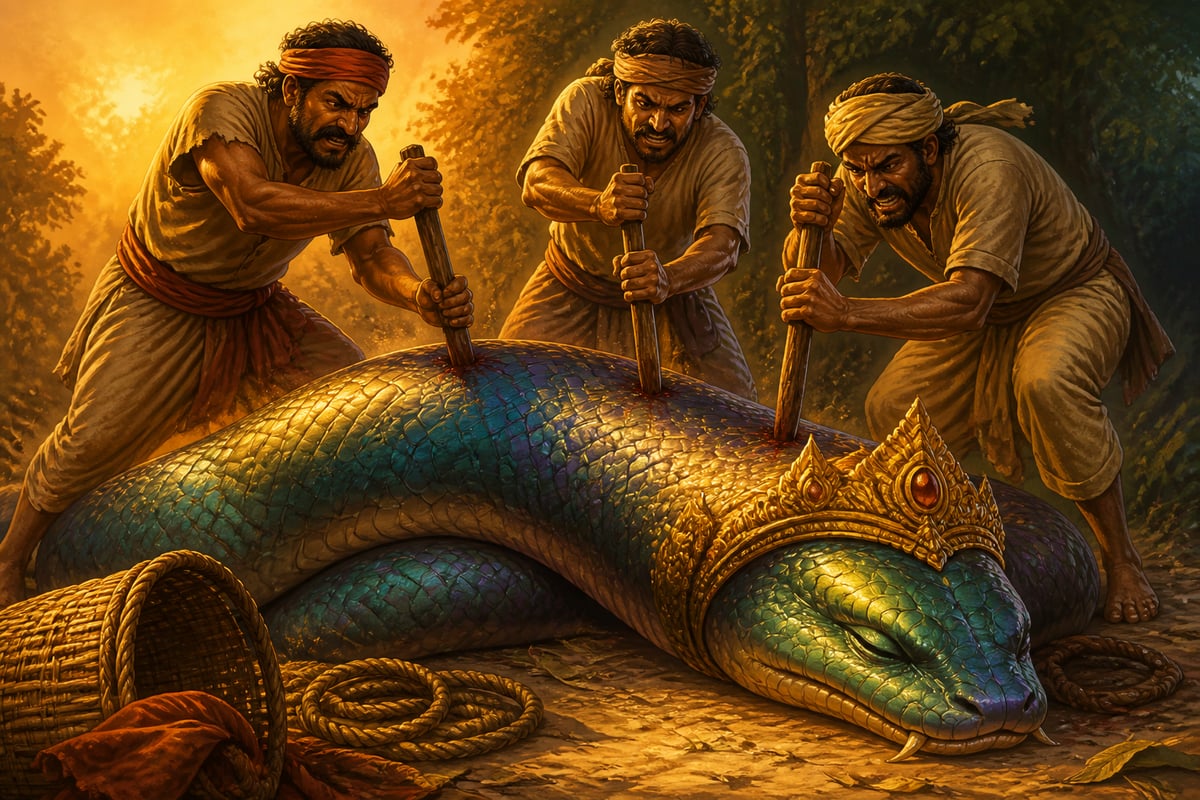
The snake charmers drove stakes through his beautiful body, pinning him to the ground. They tied ropes around his neck. They beat him with sticks when he didn't move fast enough.
Sankhapala bore it all in silence.
Dragged Through Villages
For days, the snake charmers dragged the mighty Naga from village to village. They made him perform tricks - spreading his hood, swaying to their music, pretending to dance.
"Look at this monster!" they shouted to the crowds. "Throw coins, and watch him obey!"
People gasped at his size. Children threw stones. Dogs barked. And through it all, Sankhapala remained gentle. He never hissed. He never struck. He never showed the slightest anger.
This is my gift, he thought through his pain. The gift of fearlessness. Even as they hurt me, I give them the gift of not being hurt by me.
One young boy in the crowd noticed something strange.
"Father," he whispered, "that snake - he's not even trying to escape. He could easily break those ropes. Why doesn't he fight back?"
The father looked closely. The boy was right. This was no ordinary serpent.
The Noble Son
The father was a nobleman named Alara, a man who recognized holiness when he saw it.
He approached the snake charmers.
"Name your price," he said. "I wish to buy this serpent."
The charmers named an absurd sum. Alara paid it without bargaining.
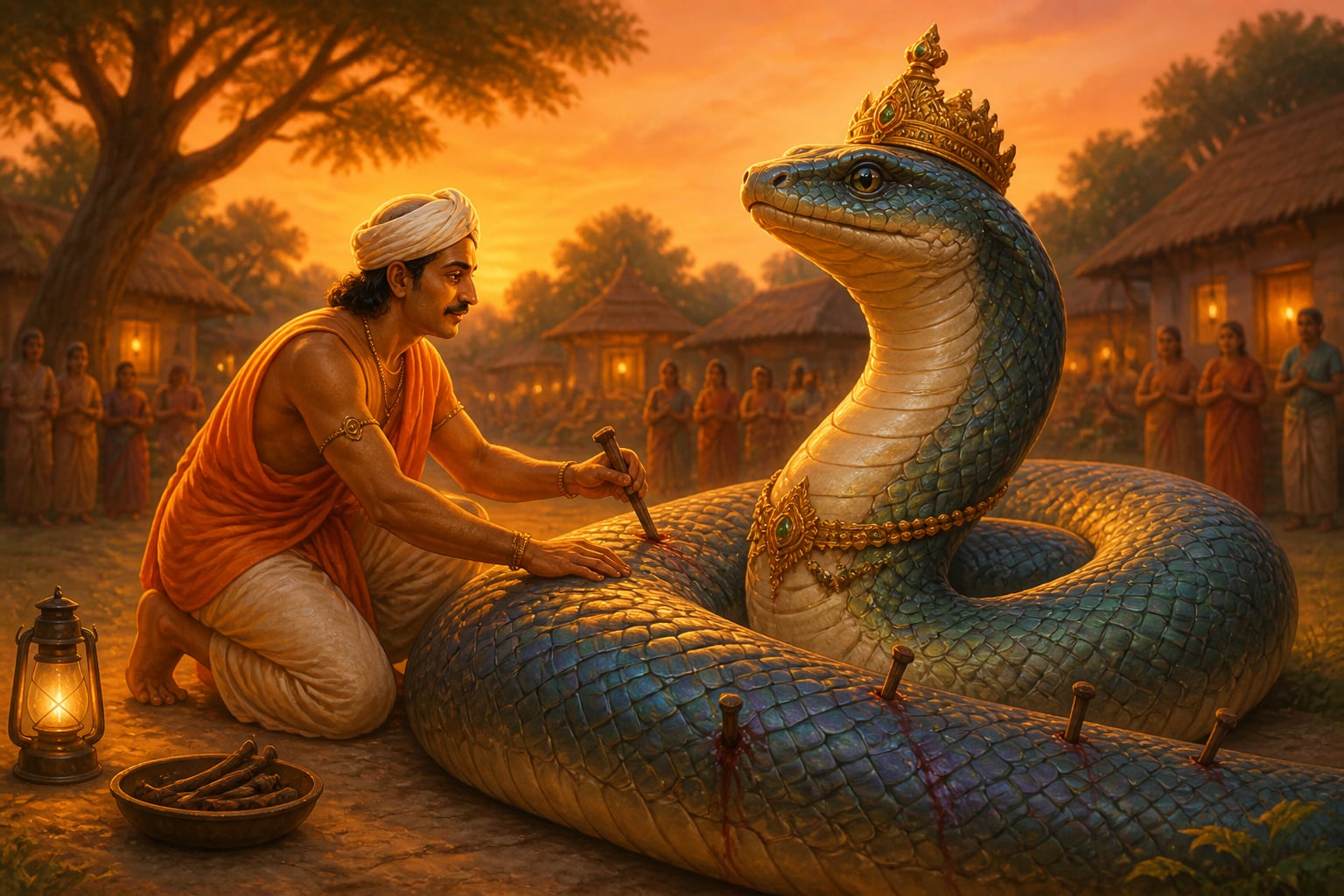
Carefully, gently, he removed the stakes and ropes. He tended to Sankhapala's wounds with healing herbs. Then he carried the great Naga to the forest and laid him beside a stream.
"I know what you are," Alara said quietly. "No ordinary snake could bear such suffering with such peace. Whatever vow you have taken, I honor it. Go in peace."
Sankhapala opened his ancient eyes. For the first time in days, he spoke - in a voice like distant thunder.
"Human, you have shown me something I had forgotten. Even in a world with cruelty, there is also kindness. My vow was to give the gift of harmlessness. You have given me the gift of compassion."
He slithered into the waters and returned to his underwater kingdom. But he never forgot the nobleman's kindness, and Alara never forgot the serpent's peace.
The Wisdom
Sankhapala's story teaches us about a special kind of generosity: the gift of non-harm.
We usually think of giving as handing something over - money, food, objects. But there's another gift that costs nothing and means everything: the gift of not hurting others, even when we have the power to do so.
Sankhapala could have destroyed his tormentors. He chose not to. That choice - made again and again, through each painful moment - was his gift to them. He gave them their lives, their safety, their freedom from his wrath.
This is called abhaya-dāna, the "gift of fearlessness." It means making others feel safe around you, even when you could easily harm them.
In Your Life
You have power too - maybe not to summon storms, but power nonetheless. You might be bigger than your sibling. You might be smarter than a classmate. You might know a secret that could hurt someone.
Every time you have power over someone and choose not to use it harmfully, you're giving Sankhapala's gift.
When your little brother breaks your toy and you don't yell - that's the gift of fearlessness.
When you could spread gossip that would hurt someone and you stay quiet - that's the gift of fearlessness.
When you feel angry enough to hit but you walk away instead - that's the gift of fearlessness.
These choices might feel small, but they're not. They're the same choice the mighty Naga king made: the choice to be powerful and peaceful at the same time.
Reflection
- Think of a time when you had the power to hurt someone but chose not to. What did that feel like? What helped you make that choice?
- Sankhapala let himself be hurt rather than hurt others. Is there a limit to this? When, if ever, is it okay to fight back?
- The snake charmers saw Sankhapala as weak because he didn't fight back. But he was actually incredibly powerful. How can non-violence be a form of strength rather than weakness?