Viruddha Āhāra: The Incompatible Foods Charaka Warned About
Ancient food combination wisdom meets modern science
Explore Viruddha Āhāra, the Āyurvedic science of incompatible food combinations. From classical warnings about milk and fish to modern 'healthy' combinations that may actually impair digestion, discover why what you combine matters as much as what you eat.
The Perfect Smoothie Bowl
She photographs it from above, finding the perfect angle. The smoothie bowl is a work of art: a vibrant purple base of açaí and frozen berries blended with Greek yogurt. On top, she's arranged sliced banana, mango chunks, a drizzle of honey, and a generous handful of granola with chia seeds. It looks exactly like the wellness influencer's post she's recreating.
'Healthy breakfast goals!' she captions, posting to her 50,000 followers. The likes pour in. The comments celebrate her commitment to nutrition. No one mentions that according to Āyurveda, she's created a digestive disaster.
Fruit with dairy? Viruddha. Sour fruits (berries) with milk (yogurt)? Viruddha. Cold foods first thing in the morning? Weakening to Agni. Honey that may have been heated? Potentially toxic by Āyurvedic standards. Multiple heavy, hard-to-digest items combined? A recipe for āma.
The influencer feels bloated by mid-morning. She attributes it to 'cleansing' or 'detox.' She doesn't consider that her carefully curated 'healthy' breakfast might be the problem.
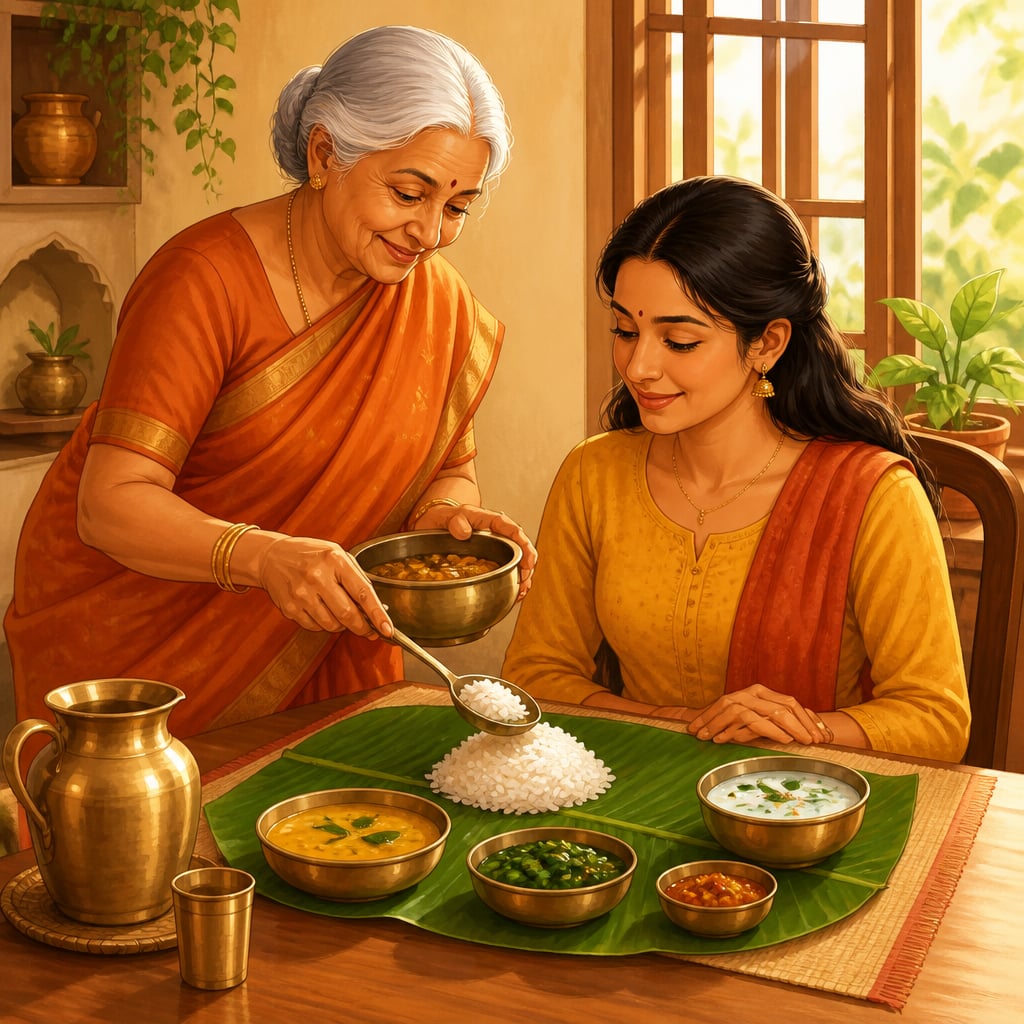
Welcome to viruddha āhāra, the science of incompatible foods that modern wellness has largely forgotten, even while promoting combinations that traditional wisdom explicitly warned against.
What Is Viruddha Āhāra?
Viruddha āhāra (विरुद्ध आहार) means 'opposite' or 'incompatible' food. The Caraka Saṃhitā dedicates significant attention to this concept, listing eighteen different categories of food incompatibility and numerous specific examples.
The principle is straightforward: foods that are individually beneficial can become harmful when combined. This isn't about nutritional deficiency, it's about how combinations affect digestion, create āma, and disturb the doṣas. Two foods might each be excellent, but together they may fight in the digestive tract, produce toxins, or have effects opposite to their individual natures.
Charaka explains that viruddha āhāra can cause:
- Impotence and reproductive disorders
- Skin diseases including leprosy (kuṣṭha)
- Digestive disorders and bloating
- Fever and other diseases
- Even death in extreme cases
This severity may seem exaggerated for food combinations, but Āyurveda thinks long-term. Occasional viruddha consumption may cause only mild discomfort. Chronic consumption, eating incompatible combinations daily, meal after meal, accumulates āma and creates the conditions for serious disease over years and decades.
The Instagram smoothie bowl, eaten daily as a 'healthy' breakfast, represents exactly this pattern: regular consumption of multiple incompatibilities, creating subtle but cumulative damage.
The Eighteen Categories of Incompatibility
Caraka describes viruddha operating through eighteen different mechanisms:
1. Deśa Viruddha (Place-based): Foods inappropriate for the geography or climate. Dry, rough foods in dry climates; cold foods in cold places.
2. Kāla Viruddha (Time-based): Foods wrong for the season or time of day. Cold foods in winter; heavy foods late at night.
3. Agni Viruddha (Digestive Fire-based): Foods inappropriate for one's digestive capacity. Heavy food for weak Agni; light food when Agni is sharp.
4. Mātrā Viruddha (Quantity-based): Wrong proportions of honey and ghee (equal quantities are specifically warned against).
5. Sātmya Viruddha (Habituation-based): Foods that oppose one's accustomed diet. Sudden introduction of unfamiliar foods.
6. Doṣa Viruddha (Doṣa-based): Foods that aggravate one's dominant doṣa. Vāta-increasing foods for Vāta constitutions.
7. Saṃskāra Viruddha (Processing-based): Foods made harmful through processing. Heated honey is the classic example.
8. Vīrya Viruddha (Potency-based): Combining hot and cold potency foods. Fish (hot) with milk (cold) is the quintessential example.
9. Koṣṭha Viruddha (Bowel-based): Foods wrong for one's bowel type. Heavy food for those with constipation tendency.
10. Avasthā Viruddha (Condition-based): Foods wrong for one's current state. Heavy food when exhausted; cold food during fever.
11. Krama Viruddha (Sequence-based): Wrong order of eating. Dessert before meal; fruit after a heavy meal.
12. Parihāra Viruddha (Rule-based): Breaking specific dietary rules. Hot water after honey; cold water after ghee.
13. Upacāra Viruddha (Treatment-based): Foods that contradict ongoing treatment or therapy.
14. Pāka Viruddha (Cooking-based): Improper cooking. Undercooked foods; foods cooked in wrong oils.
15. Saṃyoga Viruddha (Combination-based): The most commonly discussed, certain foods that shouldn't be combined together.
16. Hṛdaya Viruddha (Palatability-based): Foods eaten without genuine desire or appetite; forced eating.
17. Sampat Viruddha (Quality-based): Foods of poor quality, stale, or denatured.
18. Vidhi Viruddha (Rule of eating-based): Violating proper eating practices, eating in wrong posture, while distracted, etc.
This comprehensive system shows that 'food combining' is just one dimension of viruddha. The concept extends to timing, place, individual constitution, current state, food quality, and manner of eating. Modern food combining rules typically address only category 15, missing the broader framework.
Classical Combinations to Avoid
The texts specify numerous particular combinations:
Milk and Fish: The most frequently cited viruddha. Milk has cold potency; fish has hot potency. Combined, they create toxins and are said to cause skin diseases over time. This combination appears regularly in Bengali cuisine (fish curry with milk-based sweets afterward), and traditional practitioners note higher rates of skin problems in that population.
Milk and Sour Fruits: Milk curdles with acid, creating a digestive burden. Yet modern 'healthy' breakfasts frequently combine yogurt (sour) with berries (sour) and other acidic fruits.
Milk and Bananas: Though commonly recommended in modern smoothies and shakes, this combination is considered heavy and āma-producing. It may taste pleasant but sits heavily in digestion.

Honey and Ghee in Equal Proportions: Individually, both are considered highly beneficial. In equal quantities, they're considered toxic, one of the most specific and oft-repeated viruddha warnings.
Heated Honey: Once honey is heated (above approximately 40°C/104°F), it's considered to become toxic. This applies to cooking with honey, adding honey to very hot beverages, or consuming baked goods containing honey. Modern processing of commercial honey often involves heating.
Milk After Radishes, Garlic, or Green Leafy Vegetables: These combinations create digestive conflict and should be separated by time.
Melons with Other Foods: Melons should be eaten alone, not combined with other foods, especially dairy. They digest quickly and ferment if held up by slower-digesting foods.
Cold Drinks with Meals: Ice water or cold beverages during meals extinguish Agni, impairing digestion. This is one of the most routinely violated principles in modern eating.
Fruit After Meals: Fruit digests quickly; if eaten after a heavy meal, it sits atop the slower-digesting food and ferments, creating gas and discomfort.
Modern 'Healthy' Violations

The smoothie bowl from our opening combines multiple viruddha principles:
Fruit-Yogurt Combinations: Nearly every modern 'healthy' breakfast includes this pairing. Yogurt parfaits, smoothie bowls, fruit-and-yogurt cups, all combine sour dairy with fruit, often acidic fruit. Āyurveda would predict the digestive discomfort many experience from these 'healthy' breakfasts.
Protein Shakes with Fruit: The fitness industry's staple, whey protein (milk-derived) blended with berries, bananas, and other fruits. By viruddha principles, this combines multiple incompatibilities.
Cheese and Fruit Platters: Elegant party food, but problematic by Āyurvedic standards. Cheese (heavy, slow-digesting dairy) with fresh fruit (quick-digesting, often acidic) creates the conditions for āma.
Milkshakes: Ice cream (cold, dairy) blended with often-acidic flavorings, served ice-cold, multiple viruddha principles violated simultaneously.
Grilled Fish with Cream Sauce: Upscale dining regularly combines fish (hot potency) with cream-based sauces (dairy, cold potency), the classic viruddha.
Fruit Desserts After Meals: The standard Western meal structure, fruit-based dessert following a heavy meal, ensures fruit ferments while waiting for the main course to digest.
Cold Water with Meals: Perhaps the most universal violation. Restaurants default to ice water; most people drink cold beverages with food. Āyurveda considers this directly suppressive of Agni.
The pattern is clear: many combinations modern nutrition considers healthy or at least neutral, Āyurveda explicitly identifies as problematic.
The Scientific Debate
Is there scientific evidence for food combining principles? The honest answer: mixed, limited, and requiring nuance.
What Science Partially Supports:
Digestive Timing: Different foods do digest at different rates. Protein requires more time than simple carbohydrates; fat slows digestion further. The sequence and combination of foods does affect digestive processing.
Fermentation: When fast-digesting foods (like fruit) are trapped behind slow-digesting foods (like meat or cheese), bacterial fermentation can occur, producing gas and discomfort. This aligns with the viruddha principle about fruit after meals.
Cold and Digestion: Cold does slow enzyme activity. Ice-cold beverages during meals would theoretically slow digestive enzyme function, though the body compensates somewhat by warming food to body temperature.
Individual Variation: Modern research confirms what Āyurveda always emphasized, individuals vary significantly in digestive capacity and food tolerance. What one person handles easily, another cannot.
What Science Doesn't Support (or hasn't studied):
Specific Combinations: There's little modern research specifically testing combinations like milk-and-fish or honey-and-ghee. These remain based on traditional observation rather than clinical trials.
Potency Conflicts: The concept of foods having 'hot' or 'cold' potency that conflict doesn't map directly to any Western scientific framework. This doesn't mean it's wrong, it means it's unstudied.
Long-term Effects: Most food studies are short-term. Āyurveda's claims about viruddha causing disease over years or decades would require longitudinal research that doesn't exist.
The Nuanced Position:
Modern science hasn't validated all viruddha principles, but it also hasn't disproven them. The absence of studies doesn't equal the absence of effects. Traditional observation across millennia deserves consideration even when modern validation is incomplete.
Practitioners can take a reasonable middle path: honor the principles that have direct experiential validation (cold drinks impairing digestion is noticeable), remain open to those that traditional wisdom strongly emphasizes (milk and fish), and observe their own responses rather than either dismissing all viruddha or following it rigidly.
The Journey West: Food Combining Movements
Viruddha concepts reached Western audiences primarily through the food combining movement of the early 20th century, though without acknowledgment of Āyurvedic origins.
Herbert Shelton (1895-1985), a prominent naturopath, promoted 'food combining' principles from the 1920s onward. His rules, don't combine protein with starch, eat fruit alone, don't combine different proteins, echo viruddha principles, though Shelton credited his own observation and naturopathic predecessors rather than Āyurveda.
The Hay Diet, developed by William Howard Hay in the 1920s-30s, similarly promoted food separation. Hay's rules about not combining proteins and starches, and eating fruit separately, parallel viruddha teachings without citing them.
By the late 20th century, food combining became a recurring wellness trend. Books like 'Fit for Life' (1985) brought food combining to mainstream audiences. Each wave introduced 'new' principles that traditional Āyurveda had articulated millennia earlier.
The wellness industry continues recycling these concepts without consistent acknowledgment of their origins. Modern programs promote 'sequential eating,' 'mono meals,' or 'proper food pairing', viruddha principles with new packaging.
What's Preserved and What's Lost
What's Preserved:
- Core insights about digestive timing and sequence
- Recognition that combinations matter, not just individual foods
- Some specific rules (fruit alone, avoid cold with meals)
- Awareness that 'healthy' foods can combine poorly
What's Lost:
- The eighteen-category framework (modern food combining addresses mainly saṃyoga viruddha)
- Individual variation (viruddha depends on constitution, current state, Agni strength)
- The concept of potency (vīrya) that underlies many combinations
- The connection to doṣa theory and āma
- Seasonal and climatic considerations
- Long-term perspective (viruddha effects accumulate over years)
- The flexibility built into the traditional system (strong Agni can handle more; occasional violations matter less than chronic patterns)
Without the full framework, food combining becomes either rigid dogma or easily dismissed pseudoscience. The traditional system offered nuance that modern extractions lose.
Practicing with Awareness
How might we apply viruddha wisdom without becoming obsessive or rigid?
Start with the obvious: Cold drinks with meals and fruit immediately after heavy meals are easily avoided and have noticeable effects. Try warm or room-temperature water with meals for a week and notice the difference.
Question 'healthy' breakfasts: If your morning smoothie or yogurt parfait leaves you bloated or sluggish, the combination may be the issue regardless of how healthy the individual ingredients are. Experiment with simpler breakfasts.
Separate fruit: Try eating fruit on its own, between meals rather than with or immediately after them. This single change addresses multiple viruddha principles.
Respect your Agni: If your digestion is strong (sama agni), occasional viruddha combinations may cause no problem. If your digestion is weak or variable, even small incompatibilities may affect you. Adjust strictness accordingly.
Think patterns, not incidents: One milkshake won't cause disease. Daily smoothie bowls combining multiple incompatibilities over years might contribute to problems. Focus on regular habits rather than occasional exceptions.
Observe your own responses: The body gives feedback. Bloating, gas, heaviness, skin issues, and energy dips after eating may indicate viruddha effects. Pay attention rather than dismissing symptoms.
Don't become obsessive: The Āyurvedic texts themselves note that strong Agni, proper exercise, and other factors can mitigate viruddha effects. The goal is awareness, not fear.
Practical Application in Family Meals
For those cooking for families, viruddha awareness can improve everyone's digestion without dramatic changes:
Meal Structure: Serve fruit before the meal or between meals, not as dessert. This single change helps the whole family.
Beverage Timing: Offer water 30 minutes before meals rather than ice-cold drinks with meals. Warm or room-temperature water during meals if needed.
Simplify Breakfasts: Instead of complex smoothie bowls combining dairy, fruit, nuts, and grains, try simpler options. Cooked oatmeal with warming spices. Eggs and toast. Fruit eaten alone, followed later by something more substantial.
Dairy-Fruit Separation: Serve yogurt and fruit at different times rather than combined. If the family loves yogurt parfaits, consider adding them as an afternoon snack rather than breakfast, and monitor how everyone feels.
Avoid Common Traps: Fish without cream sauce. Desserts that don't immediately follow heavy meals. Honey not in hot beverages or baked goods.
Gradual Adjustment: You needn't overhaul family eating overnight. Make one change, let everyone adapt, observe effects, then consider another. The goal is better digestion, not food anxiety.
The Deeper Principle
Beyond specific combinations, viruddha points to a larger truth: digestion is an art of transformation, not just input. What you combine, when you eat it, how you prepare it, and your state while eating all affect what happens in the digestive tract.
Modern nutrition tends toward reductionism, counting calories, macros, micronutrients. This misses the dimension that Āyurveda emphasizes: how food transforms in your specific body at this specific time. Two people eating identical meals can have opposite outcomes depending on their Agni, their current state, and how they eat.
Viruddha āhāra reminds us that food is not just chemistry, it's relationship. The relationship between food and food, between food and eater, between eating and time and place. When we honor these relationships, digestion proceeds smoothly. When we ignore them, however 'healthy' our ingredients, we may inadvertently create the conditions for disorder.
The smoothie bowl photograph may get thousands of likes. But the traditional wisdom asks: how does it feel in your body hours later? What happens when you eat it daily for years? The Instagram aesthetic offers one answer. Caraka offers another.
In the next lesson, we'll explore ṣaḍrasa, the six tastes that form the foundation of Āyurvedic nutrition and predate modern macro counting by millennia.
For families, the goal isn't perfect viruddha compliance but reducing the most common problematic patterns. Focus on what's easy to change and has noticeable impact: meal structure, beverage temperature, fruit timing. Don't create food anxiety; create awareness.
The Instagram-worthy smoothie bowl often combines: yogurt (dairy, sour), berries (sour fruit), banana (sweet fruit), honey (shouldn't be combined with many things), granola (heavy, processed), in a cold preparation (weakens Agni). Traditional wisdom suggests simpler, warmer alternatives.
Key figures
Herbert Shelton
American naturopath who promoted food combining principles from the 1920s through the 1970s. His books, including 'Food Combining Made Easy,' introduced food combining to mainstream Western audiences without acknowledging Āyurvedic origins.
Through decades of writing and practice, Shelton made food combining a recognized concept in Western alternative health. His formulation influenced later movements including 'Fit for Life' and various detox protocols.
William Howard Hay
American physician who developed the 'Hay Diet' in the 1920s-30s, emphasizing food separation and proper combining. His approach paralleled Āyurvedic viruddha concepts without citing them.
The Hay Diet introduced food combining to medical discourse and popular culture. Though Hay died in 1940, his approach continued influencing Western dietary thinking for decades.
Harvey and Marilyn Diamond
Authors of 'Fit for Life' (1985), which brought food combining principles to mainstream American audiences in the 1980s-90s. The book sold millions of copies and made food combining a household concept.
'Fit for Life' became one of the bestselling diet books of all time. Its influence extended food combining from alternative health circles to mainstream wellness culture.
Case studies
The Scientific Debate: What Research Says About Food Combining
In 2000, the International Journal of Obesity published a study that seemed to settle the food combining question. Researchers in Switzerland compared a dissociated diet (separating carbohydrates and proteins as food combining advocates recommend) with a balanced diet of equal calories. After six weeks, both groups lost similar weight. The conclusion: food combining offers no advantage over balanced eating. This study is frequently cited to dismiss food combining as pseudoscience. But closer examination reveals limitations: the study measured only weight loss over six weeks. It didn't assess digestive comfort, energy levels, or long-term health. It didn't individualize based on digestive capacity. And it tested only one version of food combining - not the full viruddha framework. Other research offers partial support for specific principles. Studies on digestive enzyme activity confirm that different macronutrients do require different enzymatic processes, and cold does slow enzyme function. Research on post-meal fruit consumption suggests fermentation can occur when fast-digesting foods are trapped behind slow-digesting ones. Individual variation in digestive capacity is well-documented. The honest scientific position: modern research hasn't validated comprehensive food combining systems, but it also hasn't systematically tested them. Most studies examine only isolated variables (does separating protein and starch aid weight loss?) rather than the integrated principles (does chronic consumption of specific incompatible combinations cause disease over decades?). Meanwhile, traditional observation across millennia suggests effects that short-term studies can't capture. The grandmother who warns against milk with fish isn't citing a journal article - she's transmitting accumulated observation that predates modern science by millennia.
The Bhagavad Gita (17.8-10) classifies food into three categories: sattvic (promoting clarity and longevity), rajasic (promoting restlessness), and tamasic (promoting dullness). Charaka Samhita further elaborates dietary principles based on prakriti (constitution), rtu (season), and desha (geography), creating a personalized nutrition framework.
Practitioners can take a nuanced position: neither dismissing viruddha as superstition nor accepting every detail uncritically. Personal observation matters - if combinations consistently cause you discomfort, that's data regardless of whether journals have validated it. The traditional system offers hypotheses worth testing in your own experience.
The scientific debate illustrates the challenge of evaluating traditional knowledge through modern methods. Absence of validation isn't disproof. Short-term studies can't capture long-term effects. Individual variation makes population-level conclusions difficult. And some concepts (like vīrya/potency) don't translate into measurable Western frameworks.
Personalized nutrition companies increasingly acknowledge that population-level dietary guidelines fail at the individual level. The Ayurvedic principle of viruddha ahara (incompatible food combinations) may contain empirical patterns that nutrigenomics is only now equipped to test rigorously.
A 2022 Lancet study of 130,000 people across 18 countries found that diets emphasizing whole grains, legumes, fruits, and dairy (similar to sattvic principles) reduced cardiovascular mortality by 25% compared to standard Western diets.
Historical context
Classical Āyurveda to Modern Food Combining (c. 400 BCE – Present)
Living traditions
Viruddha āhāra lives on in traditional households where grandmothers warn against specific combinations, in Āyurvedic treatment centers where meals are carefully planned, and in the global 'food combining' movements that echo these principles without acknowledgment. The Instagram smoothie bowl culture represents an interesting counterpoint, promoting combinations that traditional wisdom explicitly warns against, often with claims of health benefits. The tension between modern wellness trends and traditional food wisdom remains unresolved.
- Traditional Āyurvedic Households: The living practice of viruddha āhāra exists not in institutions but in traditional households where grandmothers still prepare meals according to classical principles. If you have Indian friends or family with traditional backgrounds, ask about their food combination rules. This living transmission preserves knowledge that texts alone cannot convey.
- Kerala Āyurvedic Centers: Treatment centers in Kerala prepare meals according to strict Āyurvedic principles, including careful attention to viruddha. Visiting for treatment provides direct experience of how traditional practitioners manage food combinations in clinical settings.
Reflection
- Do you regularly eat any of the 'healthy' combinations mentioned (smoothie bowls with yogurt and fruit, cheese and fruit platters, ice water with meals)? Have you noticed any digestive effects you might have attributed to other causes?
- Western food combining movements developed principles remarkably similar to viruddha without citing Āyurveda. What does this suggest, parallel discovery of universal truth, indirect influence, or something else?
- Science hasn't validated all viruddha principles, but also hasn't disproven them. How do you weigh traditional observation against the absence of modern validation? What would it take for you to change eating habits based on traditional guidance?