The Tiny Fish That Grew and Grew

A king saved a small fish. It kept growing. When the flood came, that fish saved everyone.

King Manu cupped his hands in the river one morning and a tiny fish swam in. It begged to be saved. He took it home in a little pot. By next morning the fish was too big for the pot. By the next, too big for a tank. The fish kept growing. By the time Manu realised who it really was, a great flood was on its way, and the world was about to need exactly this fish.

A King by the River

Long ago, by the soft brown waters of a river called the Kritamala, the sun was just coming up. A man stood waist-deep in the cold morning water with his eyes closed. His silk dhoti floated around him. His grey-streaked hair was wet at the ends. The pebbles under his feet were smooth and round.

He was a king. His name was Manu.

Every morning, before he did anything else, Manu came down to this river and did his sandhya. He cupped his hands, lifted water to the sun, and quietly said the names he had learned from his father.
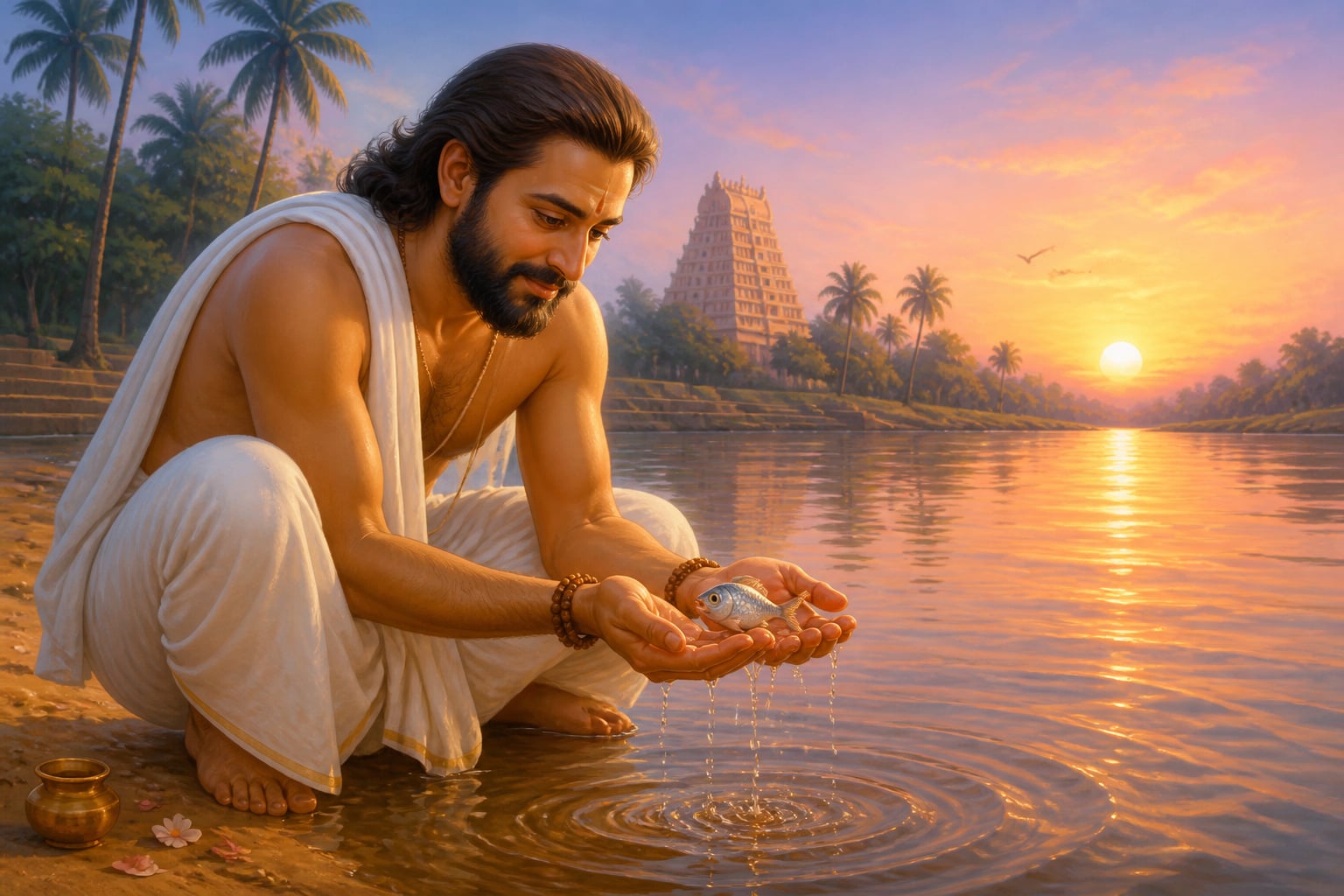
King Manu cupping a tiny silver fish at the Kritamala river at sunrise

This morning, when he cupped his hands, something small and silver swam into them.

The Fish in His Hands

It was a tiny fish. The size of his thumbnail. Two black eyes, no bigger than poppy seeds. It looked up at him.

And then, somehow, it spoke.

"Please, O King," the little fish said. "Do not put me back. The bigger fish in this river will eat me. Take me with you."

Manu blinked. He had been doing his sandhya every morning for forty years. Nothing like this had ever happened.

He was a kind king. He did not stop to argue. He gently lifted the tiny fish out of the river, walked back to the palace with it cupped in his hands, and dropped it into a small clay pot of water on his windowsill.

"You are safe now, little one," he whispered.

Bigger and Bigger

The next morning, Manu came to feed the fish.

The pot was too small.

The little fish from yesterday now filled the entire pot. Its tail was bent against the side. Its eyes were the size of his fingernails.

"O King," the fish said politely. "This pot is too small. Could you find me something bigger?"

Manu carried the fish to a large bronze water jar in the courtyard.

Next morning, the fish filled the jar.

The day after that, Manu carried it to a stone tank in the temple gardens. By evening, the fish was as long as the tank.

By the next dawn, Manu and his servants had to move it to the palace lake. Within a few hours, the lake was too small.

Manu stood at the edge of the lake, looking at the fish, which now took up most of the water. He was beginning to understand that this was no ordinary fish.

The Ocean and the Truth

Finally, with the help of his servants, Manu loaded the fish into a giant cart pulled by elephants and drove it down to the sea.

The servants tipped the cart. The fish slid into the ocean.

For a moment, the fish was the size of a small whale. Then a big whale. Then bigger than any whale anyone had ever seen. The water foamed around it. Its body shone like gold and silver in the sunrise.

Manu stood on the shore with his hands trembling.

"O King," the fish said, in a voice that was now bigger and softer than the ocean itself. "Now you know."

The water glowed. The shape of the fish shimmered. Through the silver scales, Manu could see another shape inside it. A four-armed god, smiling kindly.

It was Vishnu.

A Warning Across the Water

Vishnu, in his fish form, told Manu the news.

"In seven days," he said, "a great flood is coming. The whole earth will be covered. It is called the pralaya. It comes once every very, very long time, when the world has to be cleaned up and started fresh. And I have come to make sure something is saved through it."

Manu listened, still half in shock.

"You will need to do four things," Vishnu said.

Manu nodded.

"And then," said Vishnu, "wait. When the rain begins, take the boat to the open sea. I will come for you."

With a flick of his giant tail, the great fish slipped into the deep water and was gone.

Seven Days

Manu did exactly what he was told.

He gathered carpenters from every corner of his kingdom. They cut down a forest of teak. They built a boat the size of a small mountain. The seven sages came: Vasishtha, Atri, Kashyapa, Bharadvaja, Vishvamitra, Gautama, and Jamadagni. Each of them brought their wives and their offering pots and their scrolls.

Manu's farmers walked through every field, every forest, every garden, and gathered two seeds of every plant. Mango. Rice. Tulsi. Jamun. Banyan. Mustard. Sandalwood. They put them all in tied cloth bundles in the boat.

Manu carried the four Vedas himself, wrapped in red cloth, and laid them gently in a special chamber.

Manu loading the Vedas and sages and seeds onto the great ark

On the seventh day, he and the sages and the seeds and the books were all on board. The sky began to darken.

It began to rain.

It did not stop.

The Storm and the Horn

The rain fell harder than anyone had ever seen. The rivers swelled. The land disappeared. The cities slid under the water. The trees vanished. There was no sky anymore, just grey water everywhere, with the boat tossing on it like a tiny leaf.

Thunder cracked. Lightning lit up the boat. The sages held the seeds tightly. Manu stood at the front, soaked, scared, but holding on.

And then, out of the dark water, something rose.

A huge horn. Golden. Curved. Coming up out of the sea like the mast of another ship.

It was the fish.

Vishnu, in his Matsya form, was now bigger than a mountain. He swam right up beside the boat, and the horn rose just above the deck.

"Tie the boat to my horn," he said.

Manu remembered the rope he had been told to bring. It was no ordinary rope. It was Vasuki, the great cosmic serpent, who had agreed to be the rope for this one purpose. Manu unwound Vasuki, looped him around the horn, and tied the other end to the boat.

The great fish dipped its body and began to swim.

For seven days and seven nights, the fish pulled the boat through the storm. Manu and the sages held on. The seeds stayed dry. The Vedas stayed safe.

Matsya the great horned fish pulling the ark through the deluge storm

When the rain finally stopped, the fish swam to the very tallest peak that was still showing above the water. It was the Himalaya. It looked like just a tiny dot in a giant sea.

The fish nudged the boat against the peak. The waters slowly went down. The world began again.

The Father of Everyone

Manu and the saptarishis stepped off the boat. They planted the seeds. They taught the Vedas to the children that came after them.

In fact, every single human being in our tradition is said to be a descendant of Manu. The word manava, which means a human being, comes from him. Manava literally means one of Manu's people.

When you say manava in Sanskrit, or manuj in Hindi, you are saying child of Manu.

Which means, technically, you are the great-great-great (lots of greats) grandchild of the king who once cupped a tiny fish in his palm and decided to save it.

Because he saved a fish. The fish saved him. He saved everybody.

The First of Many Returns

This is the very first time Vishnu came down into the world to set things right. After this, he came again, and again, and again. Each time, in a new shape, for a new kind of trouble.

We are going to meet a few more of these forms in the next few lessons. A turtle. A boar. A half-lion. A small boy. A prince. A cowherd. A man with an axe.

All of them are Vishnu, slipping back into the world whenever the world really needs him.

The fish was just the first time.

In Your Life

The smallest things you take care of can grow up to be the biggest things in your life.

Think about it for a second. The plant you watered when it was just a seed in a paper cup. The kitten somebody almost left in the rain. The friend nobody else wanted to sit with. The little brother who could barely walk. The savings jar with five rupees in it. The reading habit you started one summer. The two-line song you wrote in a notebook.

None of those things look like much when they start. A king carrying a tiny fish in cupped hands looked silly to his servants. By the seventh day, that tiny fish was big enough to pull the whole world through a flood.

The rule is simple. Be kind to small things. Be patient with them. Take them seriously, even when they look like nothing. You never know which tiny fish in your hands will turn out to be the one that saves everything.

Manu found out by accident. You can find out on purpose.

Living traditions

Tirumala Venkateswara Temple receives between 50,000 and 1,00,000 pilgrims on most days, and over 5 lakh on big festival days. It is run by TTD (Tirumala Tirupati Devasthanams), which is one of the richest religious institutions in the world. Roughly 6 crore pilgrims visit every year. The Matsya story itself reaches even further: every UNESCO climate-research talk on ancient flood traditions, every Indian school textbook section on the Puranas, and every modern children's book on the Dashavatara starts with this exact tiny-fish-saves-the-world tale. The avatar concept also gave English the word 'avatar', which now means a video game character or a profile picture, but is still ultimately the same Sanskrit word for Vishnu coming down into a new form.

Reflection

More in Vishnu Saves the World

All lessons in Vishnu Saves the World ยท Heroes of Ancient Bharat course