The Boar Who Brought the Earth Back
The earth sank to the bottom of the sea. Vishnu became a giant boar and carried her back on his tusks.
A demon named Hiranyaksha steals the earth herself, rolls her up, and drops her to the bottom of the cosmic ocean. The whole world goes dark. Vishnu takes the form of a giant boar named Varaha, dives into the deep, fights the demon, and gently lifts the earth back into place on the tip of his tusks.
A World That Was Doing Just Fine
Long, long ago, before any of us were born, the earth was happy.
Flowers grew. Rivers ran. Children laughed. The grandmothers tied tulsi plants in courtyards. The cows mooed in the evenings. Everything was the way everything is supposed to be.
The earth, my dear, is not just a place. The earth is a person. Her name is Bhumi Devi. She has a soft brown body, a sari made of oceans, and her hair is the long green grass. She holds up everything that lives.
And she was being looked after. Until one day, she wasn't.
A Demon With Golden Eyes
In the dark places under the world, there lived a demon named Hiranyaksha.
His name meant "the one with golden eyes." And his eyes really did glow like little coins. He was very, very strong. He could throw mountains around like little stones. He had been doing tapas, deep meditation, for years and years, and the gods had given him many boons.
The trouble was, Hiranyaksha had a problem most strong people have. The more powerful he got, the more he wanted. Houses were not enough. Kingdoms were not enough. The whole sky was not enough.
One day he looked at Bhumi Devi, the earth, with greedy golden eyes.
"I want her," he whispered. "All of her. Just for me."
Bhumi Devi tried to escape. She trembled. She cried out to the gods.
Hiranyaksha did not stop. He grabbed her. He rolled her up like a mat, the way you might roll up a rug to put it away. He tucked her under his arm.
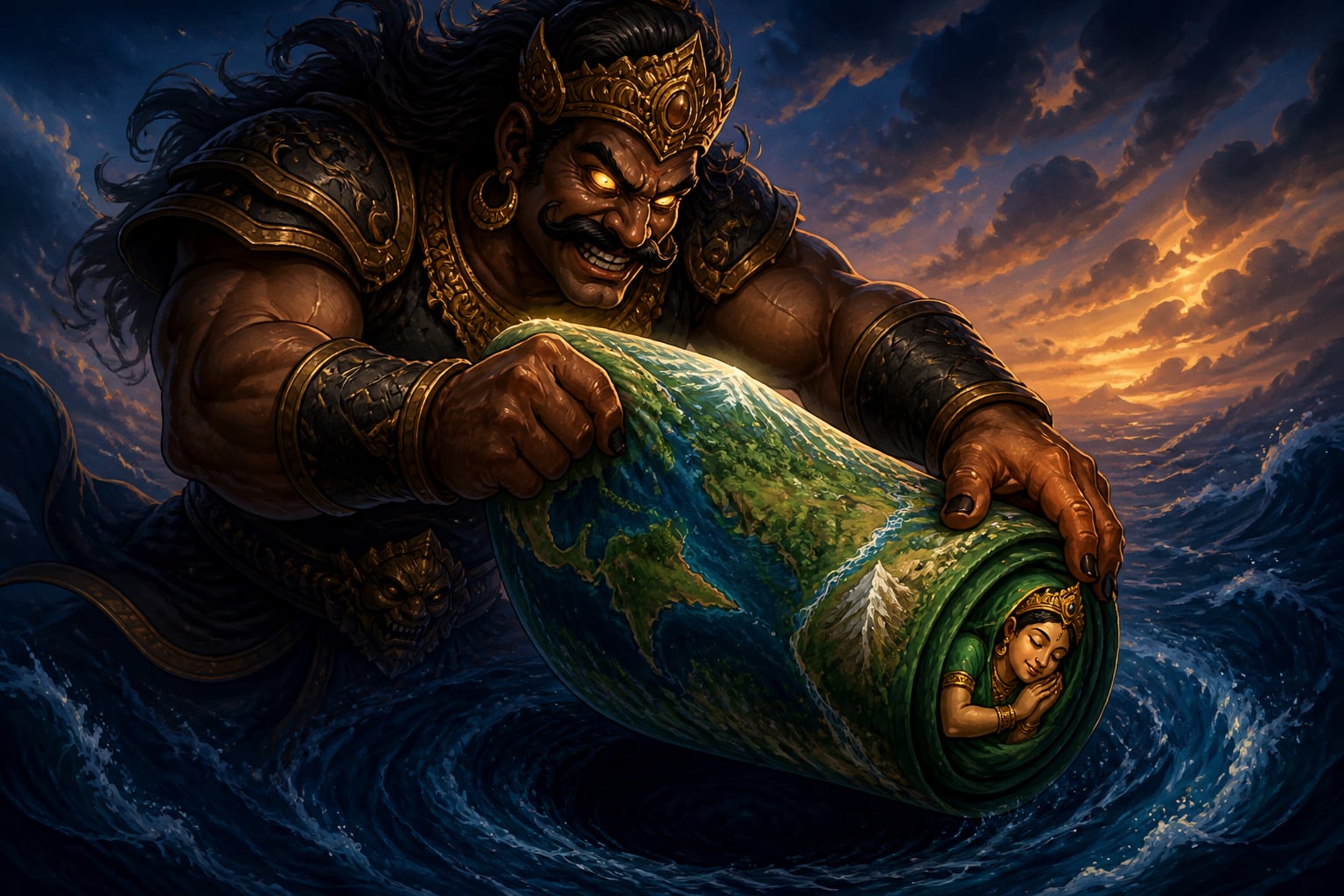
And then he ran to the deepest, darkest cosmic ocean and sank her down to the bottom of it.
The whole world went dark.
The Day Without an Earth
With Bhumi Devi gone, everything broke.
Flowers could not grow. There was nowhere to grow. Cows could not stand up. There was nothing to stand on. Rivers had nowhere to flow. Mothers had nowhere to put their babies down. Fathers had nowhere to plant their seeds.
Everything that lived was suddenly floating in nothing.
In the heavens, the gods looked down at this terrible mess. Indra, the king of the heavens, ran to Brahma. "Pitamaha, please. The earth is gone. Hiranyaksha has taken her. Help us."
Brahma's old eyes filled with tears. "My children, this is a problem too big for me. We must call Vishnu."
They all ran to Vishnu, who was lying calmly on his serpent couch in the milky ocean. The same Vishnu you have already met as Matsya the fish, and Kurma the turtle. The one who keeps coming back, again and again, in different shapes, to fix what is breaking.
Vishnu Becomes a Boar
Vishnu listened to the gods. He did not waste a single moment.
"To rescue something at the bottom of the mud, you cannot send a flying god," he said quietly. "You need a digger. A strong, wide, fearless digger. With great tusks."
The gods looked at him.
Vishnu smiled.
And in front of their eyes, his calm blue body began to change.
First he grew bigger. Then bigger. His face stretched into a long snout. Two huge white tusks curved up from his jaw. Coarse dark hair sprang up across his shoulders. His feet became heavy hooves that could plough through anything.
But his eyes, those great kind blue eyes, stayed exactly the same.
He was a giant boar. Half man and half wild boar. As tall as a hill. As wide as a forest. The most powerful digger anyone in the universe had ever seen.
This was Varaha.
The gods bowed. Then they pointed down toward the cosmic ocean.
"She is at the bottom, my lord. Please."
Down Into the Deep
Varaha did not pause to give a speech. He turned his great head, looked at the dark water below, and dived.
The splash was so huge that whole stars tumbled. Galaxies wobbled.
Down he went. Through cold black water. Past sleeping sea-creatures the size of mountains. Past pale glowing fish. Down, down, down.
The water got heavier. The dark got darker. Most beings would have turned back. Varaha kept going.
Finally his hooves touched the soft, ancient mud at the very bottom of the universe.
And there, lying small and bruised in the mud, was Bhumi Devi.
She was rolled up. She was scared. She was trembling. She had been there for a very long time.
When she saw the giant boar coming toward her, she shrank back. Another monster?
But Varaha's big blue eyes filled with tears. He bent his huge head down very gently. He pressed his face softly into the mud beside her.
"Mother," he said, in a voice as soft as a calf calling for its mother, "I have come to take you home."
Bhumi Devi looked up. She saw the eyes. She saw who was inside the boar.
And she smiled, for the first time in a long time.

A Fight in the Mud
Before Varaha could lift her, the water around them stirred.
A dark shape came swimming through the deep. Glowing golden eyes. Long sharp claws. Hiranyaksha had come to defend his stolen prize.
"Who dares come down here?" the demon roared. "This earth is mine!"
Varaha turned. He did not shout back. He just stood between Hiranyaksha and Bhumi Devi, big and steady.
"She belongs to all who live," Varaha said. "She is no one's prize."
Hiranyaksha attacked.
They fought, the boar and the demon, all the way through the bottom of the ocean. The fight went on for what felt like a thousand years. Mud flew. Mountains crumbled. Whole oceans boiled.
But Varaha's strength was the strength of the right work. The strength of someone who is fighting for something bigger than themselves. The demon, who fought only for himself, slowly grew tired.
At last Hiranyaksha stumbled. Varaha was on him in a flash. With one mighty blow, the demon was finished. The bottom of the ocean grew quiet again.
Varaha turned back to Bhumi Devi.
The Ride Up
Very, very gently, the great boar slipped his curved white tusk under the rolled-up earth.
He lifted her like a flower.
He began to swim up.
Up through the dark. Up through the heavy water. Up past the sleeping sea-creatures, who blinked sleepily. Up past the pale glowing fish, who darted in surprise.
Bhumi Devi sat on Varaha's tusk like a princess on a swing. As they rose, she slowly unrolled herself. Her oceans flowed back into place. Her mountains rose up. Her rivers found their old paths. Her forests filled themselves in.
The gods, watching from above, gasped. The earth was coming back to life as Varaha lifted her.

When Varaha finally broke the surface of the cosmic ocean, the whole world cheered. The sun came back out. The wind started to blow again. Birds, who had been floating in nothing, suddenly had branches to land on.
Varaha walked across the heavens carrying Bhumi Devi, drips of cold water falling from her sari, until he found the right spot. The exact place she belonged.
He set her down very gently. Like a father putting a sleeping baby into a bed.
A Goddess Says Thank You
Bhumi Devi opened her eyes. The grass curled up around her toes. The flowers bloomed at her sides. The rivers came running like little dogs to her hands.
She looked up at the giant boar.
"My lord," she said, in a voice that was the sound of every wind together. "You came all the way to the bottom of the ocean for me."
Varaha bowed his huge head. "Always, mother. Wherever you sink, I will come for you."
From that day on, Bhumi Devi loved Vishnu more than anyone else. In many old stories, she even married him in his Varaha form. She is still called Vishnu-patni, the wife of Vishnu, in the morning prayer that millions of Indian children say every day before they put their feet on the floor:
Samudra-vasane devi, parvata-stana-mandale, Vishnu-patni namastubhyam, pada-sparsham kshamasva me.
"O goddess wearing oceans, with mountains as your body, dear wife of Vishnu, please forgive me for touching you with my feet."
In Your Life
Bhumi Devi is not in a story book. She is right under your feet. Right now. As you sit and read this.
She is the soil in your garden. The grass in your park. The river behind your school. The little plant on your balcony. She is everywhere.
She is also still being hurt. Today, by people who throw plastic into her oceans. By those who cut her forests too fast. By those who poison her rivers and forget that she is alive.
She doesn't always need a giant boar to rescue her. Sometimes she just needs you.
Pick up one wrapper. Plant one seed. Don't waste your food. Refuse the straw you don't need. Save a glass of water. Touch the soil with your hand and say thank you.
These are tiny things. But Varaha did not start his rescue with a giant heave. He started by diving in. One brave, willing dive at a time.
The earth is your mother too. Be a small Varaha. She will know. She always knows.
Living traditions
The Varaha story is one of the earliest 'save the earth' stories in human history. Long before the modern words 'environment' and 'climate,' our tradition was already telling children that the earth is a goddess who can be wounded, who can sink, and who must be lifted back. Today, environmental groups in India sometimes call planting a tree or cleaning a river an act of 'Varaha seva,' carrying on the work the boar god began.
- Sri Varahaswamy Temple: On the holy hill of Tirumala, before going to see Lord Venkateswara, families always visit the Varaha temple by the Pushkarini pond. There is an old belief that Varahaswamy gave Vishnu permission to live on this hill, so he is to be visited first. Children love seeing the boar-faced murti. The pond next to the temple is said to be holy because Varaha himself bathed there after lifting the earth.
Reflection
- Have you ever seen something that was being damaged, like a plant, a small bird, or even a corner of your park? What did you do about it? What could you do next time?
- Vishnu chose to come as a boar, an animal most people don't think is beautiful, instead of a great king or a flying god. Why do you think he chose that form?