Nachiketa's Question to Death
Most people run from Yama. This boy sat at his door for three days and asked the hardest question anyone has ever asked.
Nachiketa is a sharp, honest boy who sees his father giving away worn-out cows and wonders if his father even means it. When he asks one too many questions, his father snaps, 'Then I give you to Yama.' The boy takes him seriously, walks to Yama's door, and waits three days for Death to come home. When Yama returns, Nachiketa earns three boons. He uses the third one to ask the question every person has ever wondered: what happens when we die?
A Father in a Hurry
Long, long ago, in a quiet ashram in a green forest, there lived a rishi named Vajashravas.
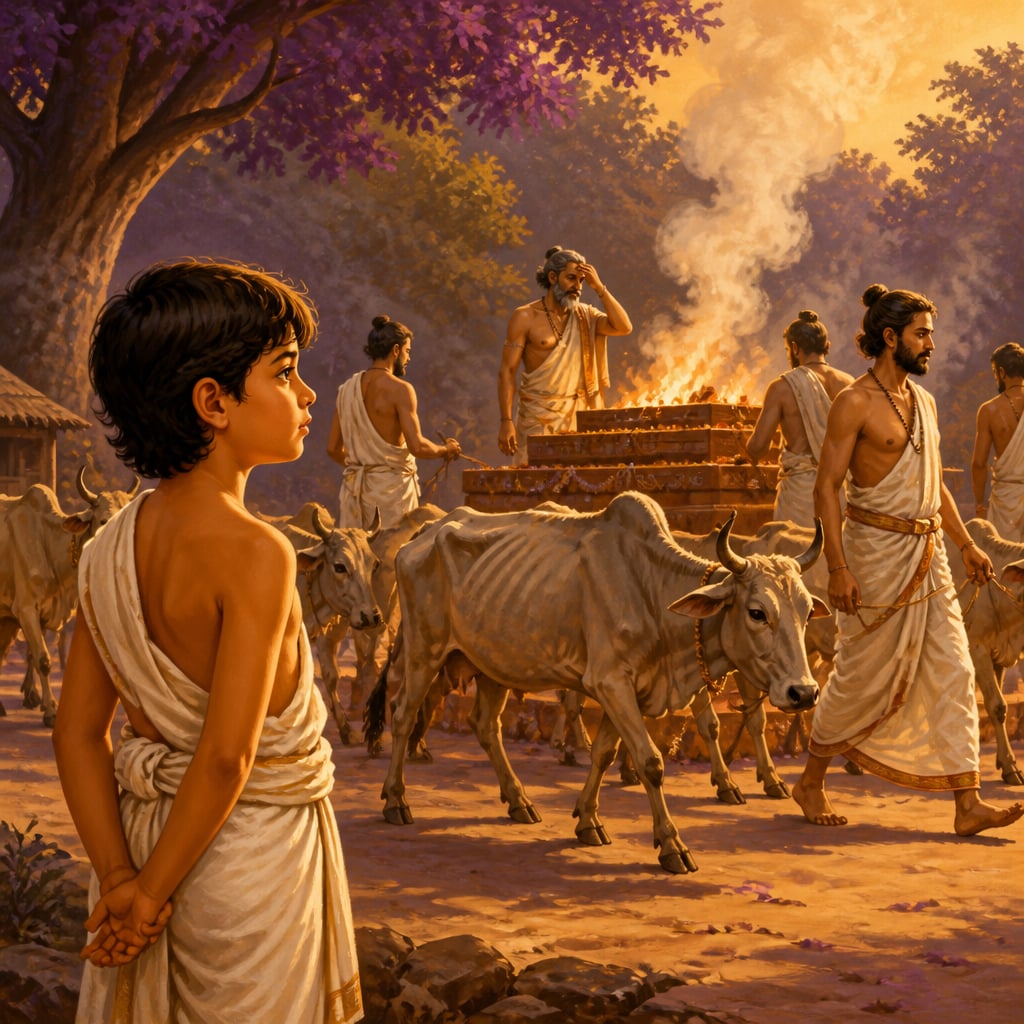
Vajashravas was performing a great yajna, a fire sacrifice. The whole ashram was busy. Smoke from the fire pit curled up to the trees. Priests chanted. Cows mooed in the back.
At the end of every great yajna, the rishi was supposed to give away his cows and his treasures to the other priests. That was the rule. Give away the things you love most, so the gift counts.
But Vajashravas was a little tired that morning. And maybe a little stingy. So he started giving away his oldest, weakest cows. Cows whose milk had stopped. Cows who could barely walk. Cows whose teeth were almost gone.
A young boy was watching all of this with very, very sharp eyes.
His name was Nachiketa. He was Vajashravas's son.
A Boy With a Difficult Question
Nachiketa walked up to his father. He was small. He was polite. He folded his hands like he had been taught.
"Pita," he said softly, "if a gift is supposed to be the best of what we have, why are you giving away cows that no one will be helped by? Will this please the gods?"
Vajashravas frowned. He did not look up.
"Pita," Nachiketa tried again, "if you are giving away your treasures, who will you give me to?"
He wasn't being cheeky. He was a sincere boy with a sincere question. I am one of your treasures. So who do I go to?
Vajashravas was busy. He waved Nachiketa away.
But Nachiketa was a careful boy who did not give up easily. He asked again. And again.
"Pita, who will you give me to?"
Vajashravas, hot from the fire, irritated by the smoke, finally snapped.
"I give you to Yama!" he shouted. "Death himself! Now go!"
The whole ashram went quiet.
Vajashravas turned back to his fire. He muttered to himself. He didn't mean it. It was just a thing you say.
But Nachiketa stood very still.
In the Raghu families, in the rishi families, in the old families of India, there was a rule. A father's word is a vow.
Nachiketa had been given. So Nachiketa had to go.
The Walk to Yama's Door
Nachiketa picked up his small bag. He touched his mother's feet. He bowed to his father, who was now staring at him with a horrified face.
"Pita," Nachiketa said, "don't worry. You said it. I will go."
Vajashravas tried to take it back. "Beta, no, no, I didn't mean..."
Nachiketa smiled. "A father's word must stand. Otherwise what kind of family are we?"
And this small, brave boy walked out of the ashram, past the trees, past the river, past the village, all the way to the gates of the kingdom of death.
When Nachiketa reached Yama's palace, the gatekeeper looked down at the small boy with surprise.
"Yama is away," the gatekeeper said. "He has gone on a journey. He will not be back for three days."
Nachiketa nodded. He sat down on the stone step at the front door. He put his hands in his lap. He waited.
No food. No water. No fear.

For three whole days.
A Death Who Apologizes
When Yama finally came home, he was tired. He had been collecting souls. He had a long staff and a heavy crown. He looked up at his palace door.
And there, on his front step, was a small boy.
A child. Sitting straight. Eyes calm. Three days without food.
Yama's heart, which most people think is hard, melted at once.
"My child," said the great god of death, kneeling down, "how long have you been waiting?"
"Three days, my lord."
Yama bowed his head. "Forgive me. A guest is sacred. A small boy as a guest is even more sacred. And I made you wait three days at my own door. That was wrong of me."
Yama folded his hands. "For each day you waited, I will give you one vara, one boon. Three boons in all. Ask anything you want, my brave little guest."
Nachiketa's eyes shone. He thought carefully.
The First Two Boons
For his first boon, Nachiketa said, "My lord, please send me back to my father with peace. Let his anger go away. Let him love me again, and let me love him with no shadow between us."
Yama nodded. "Granted. When you go home, your father will weep, hug you, and never speak to you in anger again. That gift is yours."
For his second boon, Nachiketa said, "There is a special fire ritual that takes good people to a beautiful, peaceful world. Please teach it to me, so I can teach my family and the other rishis."
Yama smiled. He sat down beside the boy and explained the fire ritual in full. Then he said, "This ritual will be named after you. It will be called the Nachiketa fire, so that as long as people light it, they will remember the boy who waited three days at my door."
Nachiketa folded his hands. "Thank you, my lord."
Yama waited. Now the third boon. The big one. What will this child ask?
The Third Boon: The Hardest Question of All
Nachiketa took a deep breath.
And then, in a small but steady voice, he asked it.
"My lord. When a person dies, some people say there is something that lives on. Other people say nothing is left, that we just disappear like a shadow when a candle goes out. I want to know the truth. What happens when we die? Who is the real me? Does any part of me last?"
Yama's smile faded. His eyes grew serious.
This child, he thought, has asked the question I do not give to anyone.
Yama tried gently to change his mind. "My boy, that is too heavy a question for a child. Ask for something else. I will give you a thousand horses, golden and swift. I will give you elephants. I will give you palaces."
Nachiketa shook his head.
"I will give you rivers of music. Beautiful dancing girls. The most delicious foods in the world."
Nachiketa shook his head.
"I will give you a long, long life. A hundred years. Two hundred years. The wealth of the whole earth."
Nachiketa looked into Yama's eyes.
"My lord," he said, very quietly, "horses get old. Music ends. Food gets eaten. Even a long life finishes. The things that fade cannot answer a question that is forever. I want the answer that does not fade. Please. Teach me what happens after we die."
Yama stared at the small boy.
And then, slowly, he stood up.
The Teaching by the Door

"My child," Yama said softly, "you have passed every test I have ever set for any human being."
He sat back down. He folded his legs. He looked at the boy as a teacher looks at the student who is finally ready.
"Listen carefully, Nachiketa. The body you wear is like a set of clothes. It grows. It tears. It wears out. One day you take it off.
"But the deepest you, the small spark that says I am me, the atman, that one is different. That one is never born. That one never dies. It did not begin when you were born. It will not end when your body falls. It is unborn, eternal, very, very ancient, and it cannot be cut by any weapon.
"When the body is gone, the atman simply puts on a new body, the way you change your clothes when the old ones get torn. That is the truth, Nachiketa. The real you cannot be killed. You will always be."
The small boy listened. The forest of death was completely silent. Only Yama's voice, low and clear, like a bell in a deep cave.
"And there is something even bigger," Yama said. "The same atman that is inside you is also inside every living thing. Every cow. Every bird. Every grandmother. Every enemy. The same little spark, in different clothes. When you understand that, fear becomes very small. Death becomes very small. Even my house at this door becomes very small."
Nachiketa's eyes filled up with quiet tears. Not sad ones. The kind that come when something true finally settles inside you.
A Boy Who Goes Home
When Yama was done, he looked at Nachiketa with deep respect.
"You came as a guest," he said. "You leave as a teacher. Go home, my child. Tell your father what you have learned. Live a long life. And when, one day far from now, you come back to my door, you will not need to wait. I will be there to welcome you."
Nachiketa bowed. He folded his small hands. He turned and walked back through the long road, past the kingdoms of the dead, past the river, past the village, all the way to his father's ashram.
Vajashravas saw him from far away. He ran. He fell to his knees. He hugged his small son, weeping, and could not let go for a long time.
Nachiketa hugged him back. There was no shadow left between them.
In Your Life
Most people, when a hard question comes near them, run.
When a beloved grandparent dies. When a pet dies. When somebody asks, what happens to us in the end? Adults change the subject. They say, don't worry about that, beta.
Nachiketa did the opposite. He sat down. He waited. He asked.
And because he asked, he heard one of the deepest truths a human being has ever heard. The same little spark that is you cannot be put out by death. It just changes its clothes.
Next time a big question comes to you, don't run. Sit with it. Bring it to a kind grandparent, or a teacher, or a parent who is patient. Most of all, never feel small for asking.
The Upanishads, the deepest books in our tradition, were taught to a little boy. Not to a king. Not to a great warrior.
A child, sitting at a door, waiting three days for the answer.
Living traditions
Nachiketa's questions in the Katha Upanishad shaped some of the deepest thought in Indian and world philosophy. The famous lines about the soul (Na jayate mriyate va kadachit, the soul is never born and never dies) were later quoted by Krishna himself in the Bhagavad Gita. Modern thinkers, from Swami Vivekananda to Robert Oppenheimer, have written about this little boy and his courage. He is proof that the biggest questions in human life were first asked by a child.
- Parmarth Niketan and Vedanta Ashrams of Rishikesh: On the banks of the Ganga, where the river is still cold and clear from the mountains, sits the holy town of Rishikesh. This is where Vedanta is taught even today. In ashrams like Parmarth Niketan and Sivananda Ashram, the Katha Upanishad, with the story of Nachiketa, is read out and explained for students of all ages. At sunset, by the river, you can hear the same verses Nachiketa might have heard from Yama.
Reflection
- Have you ever wanted to ask a grown-up a really big question, but felt shy or scared they might be annoyed? What was the question? Could you ask it now?
- Yama tried to tempt Nachiketa with horses, gold, music, and long life so he wouldn't have to answer the hard question. Why do you think the boy turned all of that down?