Abhimanyu Knew the Way In
He was sixteen. He learned the secret of the Chakravyuha while still in his mother's womb. He went in knowing he might not come out.
Long before Abhimanyu was born, he heard a story while inside his mother's belly. His father Arjuna was explaining how to break into the Chakravyuha, the most dangerous battle formation in the world. Abhimanyu listened all the way through the entry. Then his mother fell asleep and he never heard the way out. Years later, on the thirteenth day of the Kurukshetra war, that exact battle formation appeared on the field. And there was no Arjuna to fight it. Only sixteen-year-old Abhimanyu.
A Story Before He Was Born
A very long time before the war at Kurukshetra, on a quiet evening in Indraprastha, Arjuna was sitting with his wife Subhadra. She was going to be a mother. Their son was still inside her, no bigger than a small fish, with ears already listening to the world.
Arjuna was a great teacher. He loved explaining the things he knew. That evening, his head was full of war strategy. Maybe a small voice told him that one day, his family would need it.
"Subhadra," he said, "let me tell you about the Chakravyuha. The wheel formation. It is the deadliest trap a general can build."
Subhadra leaned back on the cushions. She was tired the way mothers-to-be are tired. But she liked listening to Arjuna. So she settled in.
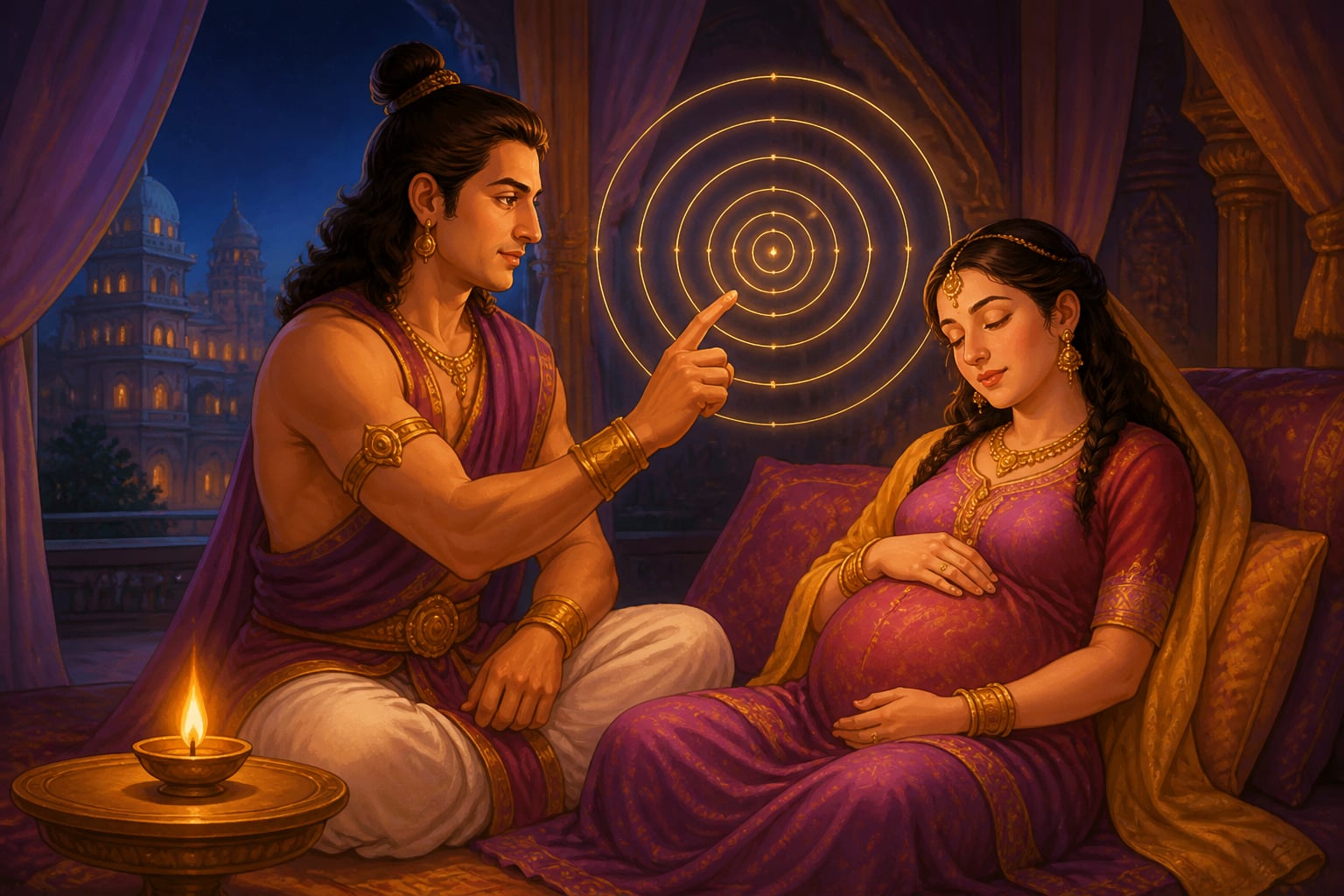
Arjuna started.
"Picture seven rings of soldiers," he said, drawing in the air. "Each ring is spinning. Each ring is sharper than the last. The outside ring is just spearmen. The next is archers. Then horsemen. Then chariots. Then the great warriors. At the very centre, the commander himself. To break in, you must defeat each ring before the next one closes behind you. To get out again, you must do the same thing in reverse."
Inside Subhadra's belly, the unborn baby was listening. With those tiny new ears, he was hearing every word.
Arjuna kept going. He explained how to face the spearmen. How to slip past the archers. How to cut through the horsemen. How to dodge the chariots. How to challenge the great warriors. How to step right up to the commander himself, the way a hunter steps up to a tiger.
It was a long, careful explanation. Step by step. Ring by ring. Subhadra murmured 'mm-hmm' every now and then. Inside her, the baby was learning. Every word. Every move.
Then, just as Arjuna started to explain how to come out of the formation, Subhadra's eyes drooped. She had been tired all day. She did not mean to. She just slipped, gently, into sleep.
The baby kept listening. But Arjuna noticed his wife was asleep, smiled, and stopped. Why explain something to a sleeping person?
So the baby heard the way in. He never heard the way out.
The Boy Who Could Do Anything
The baby was born. They named him Abhimanyu.
He grew up beautiful. Brave. Quick. Funny. He had Arjuna's archery, Krishna's smile (Krishna was his uncle), and Subhadra's stubbornness. By the time he was twelve, he could shoot arrows so fast that the air whistled. By the time he was fourteen, he could ride a chariot through any battlefield. By the time he was sixteen, he was married to a girl named Uttara, and she was already expecting their first child.
Sixteen.
Think about that for one second. Sixteen is older than your big brother or sister, maybe. Maybe an older cousin in college. Sixteen is still young. Sixteen is still someone's son, someone's nephew, someone everyone wants to feed extra rotis at dinner.
And then the great war came.
The Mahabharata war. The biggest war the world had ever seen. The five Pandava brothers, including Arjuna, on one side. Their cousins, the Kauravas, on the other. Eighteen days. Crores of soldiers. Sons fighting fathers. Students fighting teachers. The whole world tearing itself in half.
And in the middle of it all, Abhimanyu, the sixteen-year-old, in his shining chariot, driving for his father.
The Thirteenth Day
For twelve days, the two armies had been pulling and pushing at each other across the field of Kurukshetra. Arjuna was the most feared warrior in the world. Wherever Arjuna's silver bow Gandiva sang, the enemy fell back.
The Kauravas had a plan. They needed Arjuna to be somewhere else.
So on the morning of the thirteenth day, they sent a small group of chariots to challenge Arjuna in the southern part of the field. Arjuna, like a good warrior, accepted the challenge and rode after them. He went far. Very far. Out of sight of the main army.
The moment he was gone, the Kaurava general Drona smiled and gave a quiet order.
"Form the Chakravyuha."
The Kaurava soldiers began to spin. Spearmen on the outside. Then archers. Then horsemen. Then chariots. Then the great warriors. At the centre, hidden, was Drona himself, with Karna, Duryodhana, Dushasana, Shakuni, and the most fearsome warriors of the Kaurava side. Seven rings. Tightening. Spinning. Razor sharp.
The Pandava generals froze.
Yudhishthira, the eldest Pandava, looked around in panic. Only one person on earth knew how to break a Chakravyuha. That person was Arjuna. And Arjuna was kilometres away.
The young men of the camp started whispering. Then a quiet voice spoke.
"Uncle. I know."
It was Abhimanyu.
What He Knew, and What He Didn't
All the elders turned to look at the boy.
"How can you know, child?" asked Yudhishthira gently. "This is the deadliest formation in war."
Abhimanyu smiled. A small, sad smile.
"My father taught me, before I was born," he said. "I heard every word he said about how to break in. I can do it."
The elders looked at each other.
Abhimanyu kept going. "But, uncle. There is a problem. I only heard the way in. My mother fell asleep before father explained the way out. I do not know how to come back through the rings."
A terrible silence.
Then Yudhishthira said, slowly, "It is all right. You break in. Make a path through. We will all follow you. Bhima will be right behind you. Nakula and Sahadeva. Even I will come. Once you have torn the formation open, the rest of us will protect you and bring you back together."
Abhimanyu nodded. He was sixteen. He believed his uncles. Why would he not?
He touched his mother's feet in his heart. He thought of Uttara, his young wife, waiting for him at the camp. He thought of the baby she was carrying, who would one day hear stories about him. Then he climbed onto his chariot, picked up his bow, and turned toward the great wheel of soldiers.
He rode at it.

The Boy in the Wheel

What happened next, songs are still being sung about three thousand years later.
Abhimanyu hit the outer ring like lightning. The spearmen scattered. The archers tried to shoot him; he shot back faster, and the air filled with broken bowstrings. The horsemen charged him; he turned them aside. The chariots came; he sent their wheels rolling away in the dust. Ring by ring, he cut through. Just the way Arjuna had explained, all those years ago, while a sleepy mother dozed.
The Pandava brothers ran after him.
But Drona, the old general, was waiting for this. He had a warrior named Jayadratha on guard at the entrance to the wheel. Jayadratha had a special blessing from Lord Shiva. For one day, on this one battlefield, no Pandava brother could get past him.
So Bhima reached the entrance and was stopped.
Yudhishthira reached the entrance and was stopped.
Nakula. Sahadeva. All of them, stopped at the door.
Abhimanyu was alone inside.
He did not know it yet. He kept going. He cut through the warriors. He reached the centre. He fought Drona himself. He fought Karna. He fought Duryodhana's son. He fought six of the greatest warriors in the world all at once, all by himself, all sixteen years of him.
He knocked off their helmets. He broke their bows. He sent their chariots tumbling. The gods, watching from above, sat very quiet. They had never seen anyone like this.
But he was sixteen, and they were six, and the wheel had no exit for him.
At last, when his quiver was empty and his bow had been shattered, he picked up a chariot wheel from the ground. Yes, a wheel. The boy who had broken into a wheel formation now held one in his hands like a giant shield. He swung it around himself. He kept fighting.
In the end, the six warriors had to break every rule of fair war just to bring him down. Together. All at once. From every side.
Abhimanyu fell. Smiling.
When Arjuna came back from the southern field that evening and learned what had happened, he sat in the dust and cried in a way no soldier should ever have to cry.
What This Story is Really About
This is a sad story. It is one of the saddest in the Mahabharata. We are not pretending it is not.
But here is what we want you to take from it.
Abhimanyu went into that wheel knowing he might not come out. He did it anyway. Not because he was reckless. Not because he wanted to be a hero. He did it because his family needed him, and he was the only one who knew the way in.
There is a kind of courage that is loud and proud. The kind that beats its chest. That is not Abhimanyu's kind.
Abhimanyu's kind is quieter. It is the kind that sees a job nobody else can do, looks at the cost, and does the job anyway. I do not know everything. I do not know if I will be okay. I will go anyway, because someone has to.
That kind of courage is rare. It is the kind of courage that doctors and nurses showed during difficult times. The kind that firefighters show when they walk into a burning building. The kind your mother showed the day you were born.
Abhimanyu is the patron saint of brave young people who walk into hard things, knowing they might not be ready, but doing it anyway because the people they love are counting on them.
And here is a quieter lesson hidden inside the story. Even brave people deserve to be backed up.
The Pandavas were not bad uncles. They tried. Jayadratha's blessing kept them out. But the lesson for us, today, is to finish the support we promised. If you tell a friend, 'I have your back,' show up. If you tell a younger sibling, 'I am right behind you,' do not let go of their hand. Abhimanyu broke into the wheel because he trusted his family. Trust like that is sacred. The world depends on it being honoured.
When you grow up, somebody's Abhimanyu is going to need you to be right behind them.
Do not be the door that closes.
Living traditions
Abhimanyu's story has been adapted into countless plays, films, and now graphic novels in Indian publishing. The phrase 'chakravyuha' is also used in modern Indian writing on bureaucracy, debt traps, and complicated systems that draw a person in but offer no clear way out. In schools across India, Abhimanyu is often the first hero introduced when teachers want to show that bravery and youth are not opposites. His grandson Janamejaya later commissioned the first oral telling of the entire Mahabharata, which means the story you just read travels to you, in part, because of a child Abhimanyu never lived to meet.
- Kurukshetra: The actual battlefield of the Mahabharata war. Visit the Brahma Sarovar, an enormous holy pond, and Jyotisar, the place under a banyan tree where Krishna is said to have spoken the Bhagavad Gita to Arjuna. The Kurukshetra Panorama and Science Centre has beautiful murals of the war scenes including Abhimanyu's stand inside the chakravyuha. The Sthaneshwar Mahadev temple, where the Pandavas worshipped before the war, is also nearby.
Reflection
- Have you ever had to do something hard before you felt fully ready, because someone you loved needed you? It might have been small, like helping a sick parent, or standing up for a friend. What did it feel like to step in anyway?
- Abhimanyu only knew the way in, not the way out. Why do you think he still went? And is it okay to start something brave even when you do not know how it will end?