Administration and Navy

Building Institutions

Shivaji was not merely a warrior but a visionary administrator. He created the Ashtapradhan (Council of Eight Ministers) for governance, built India's first indigenous navy to protect the western coast, and implemented policies that protected farmers and respected all communities. This lesson explores how Shivaji built institutions designed to outlast any individual ruler.

Beyond the Warrior

Shivaji's military genius is legendary. But what truly set him apart from other warrior chieftains was his understanding that battles win territories while institutions build nations. Many conquerors before him had carved out kingdoms; few had created systems that outlasted their own deaths. Shivaji was determined to be different.

After his coronation in 1674, Shivaji devoted increasing attention to administration. He had six years left to live, though he didn't know it. In those years, he would create administrative structures that would govern the Maratha Empire for the next century, long after his descendants had been reduced to figureheads.

The Ashtapradhan: Council of Eight

The centerpiece of Shivaji's administration was the Ashtapradhan, the Council of Eight Ministers. Unlike the Mughal system where a single wazir (prime minister) held enormous power, Shivaji distributed authority among eight portfolios, each with specific responsibilities.
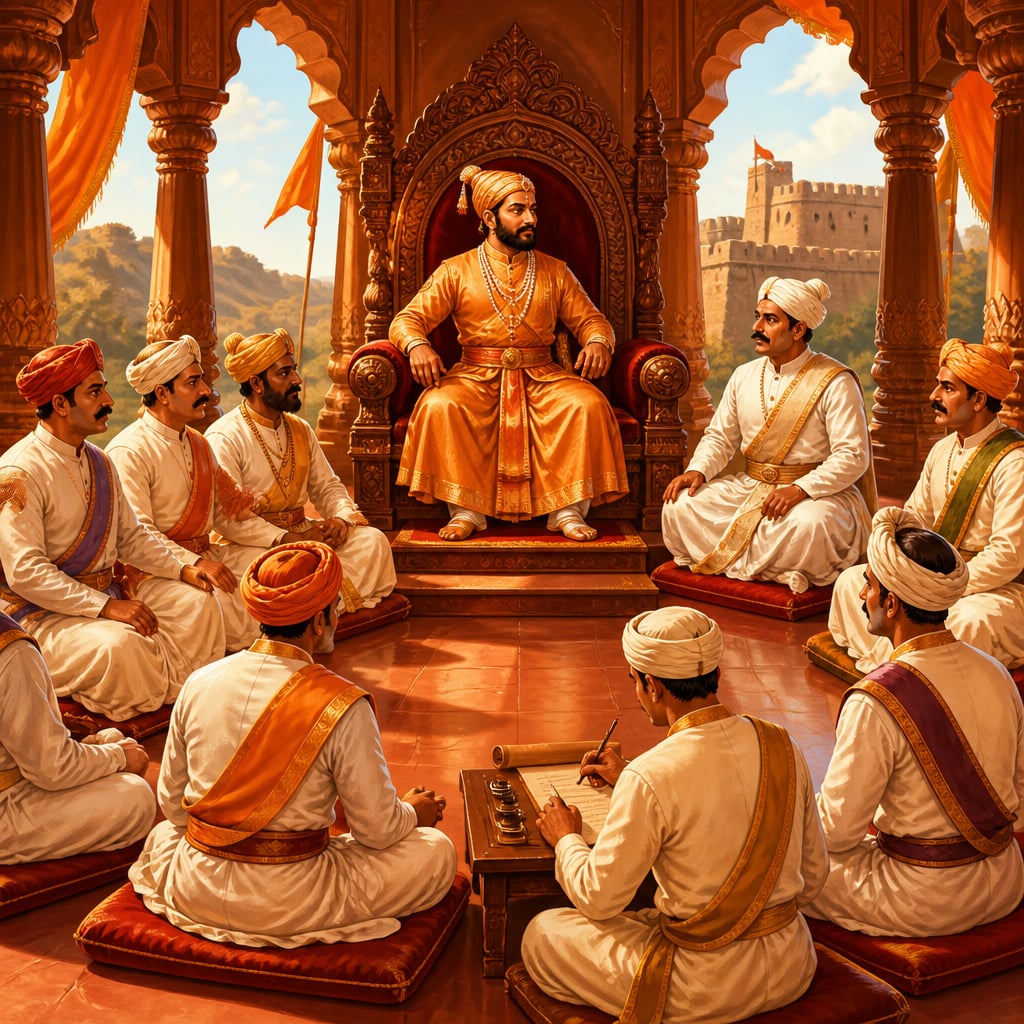
Shivaji presides over the Ashtapradhan council of eight ministers at Raigad

Peshwa (Prime Minister): Oversaw general administration and finances. The Peshwa was first among equals but could not act without consultation. Later, this office would grow so powerful that the Peshwas became the de facto rulers of the Maratha Empire.

Amatya (Finance Minister): Managed revenue collection, expenditure, and accounts. The Amatya maintained detailed records of all income and outflow, ensuring transparency and accountability.

Mantri (Interior Minister): Handled internal affairs, including intelligence gathering and record-keeping. The Mantri was responsible for maintaining the king's chronicle and monitoring potential threats from within.

Sachiv (Secretary): Managed correspondence, drafted royal letters, and maintained archives. All official communications passed through this office.

Sumant (Foreign Minister): Conducted diplomacy with other powers, the Mughals, Deccan sultanates, European traders, and neighboring kingdoms. The Sumant negotiated treaties and managed ambassadors.

Senapati (Commander-in-Chief): Led the military, managed recruitment, training, and deployment. The Senapati answered directly to the Chhatrapati in matters of war and peace.

Panditrao (Religious Affairs): Oversaw religious matters, charity, temples, and maintained the ritual calendar. The Panditrao also adjudicated religious disputes.

Nyayadhish (Chief Justice): Administered civil and criminal justice according to dharma. The Nyayadhish served as the final court of appeal below the king.

This system had several advantages. No single minister could accumulate enough power to threaten the throne. Specialization allowed expertise to develop in each domain. Collective responsibility meant decisions were debated and refined. Most importantly, the system could function even if the king was incapacitated or young, as would happen repeatedly in Maratha history.

Revenue and Land Administration

Shivaji inherited a land revenue system from the Sultanates, one designed to extract maximum wealth for distant rulers. He reformed it fundamentally.

First, he conducted a detailed survey of agricultural land in his domains. Every village was assessed for soil quality, water availability, and crop potential. Revenue demand was set at roughly one-third of the produce, lower than the Mughal rate, giving farmers incentive to improve their land.

Second, he eliminated the jagirdari system wherever possible. Under jagirdari, nobles were assigned villages whose revenue they could collect directly. This led to exploitation and local tyranny. Shivaji preferred the ryotwari system, where farmers paid directly to government officials. The officials received salaries, not land grants, reducing their incentive to oppress peasants.

Third, he protected farmers during disasters. When monsoons failed, revenue was reduced or suspended. Seed loans were provided for the next planting season. A farmer who lost crops to war received compensation. This was not mere generosity, Shivaji understood that peasant prosperity was the foundation of state power.

The Maratha Navy

Perhaps Shivaji's most innovative contribution was the creation of India's first significant indigenous navy. For centuries, Indian rulers had neglected naval power, allowing Arabs, Portuguese, Dutch, and English to dominate the western coast. Shivaji reversed this.

Maratha navy fleet at the Sindhudurg sea fort on the Konkan coast

He began building ships in the 1650s, establishing dockyards at Kalyan, Bhivandi, and later at Vijaydurg and Sindhudurg. Unlike the Portuguese carracks or English frigates, Maratha ships were designed for coastal operations, swift, maneuverable, and capable of operating in shallow waters where European vessels could not follow.

The fleet included several types of vessels:

Ghurabs: Large warships with multiple decks, capable of carrying 300-500 men and numerous cannon. These were the capital ships of the Maratha navy.

Gallivats: Smaller, faster vessels propelled by both sail and oar. Gallivats were used for reconnaissance, carrying messages, and attacking enemy ships.

Pals: Trading vessels that doubled as troop transports during military operations.

At its peak, the Maratha navy numbered over 400 vessels and controlled the Konkan coast from Mumbai to Goa. Shivaji appointed Kanhoji Angre's predecessor as the first Sarkhel (Admiral), establishing a naval command structure parallel to the army.

The navy served multiple purposes. It protected Maratha ports from European interference. It raided Mughal shipping, particularly the wealthy Surat trade. It transported troops for amphibious operations, Shivaji's capture of numerous sea forts would have been impossible without naval support. And it established Maratha presence in a domain previously ceded to foreigners.

Fort Administration

Shivaji controlled over 300 forts at the height of his power, an unprecedented number. These weren't just military installations but administrative centers, treasuries, and refugee shelters. Each fort had its own governance structure.

Every major fort had three commanders of equal rank: the Havaldar, the Sabnis, and the Sarnobat. Each came from a different caste and region. None could take major decisions without the others' consent. This triumvirate system prevented any single commander from surrendering or defecting, a crucial safeguard when enemy bribes were a constant threat.

Forts were provisioned for multi-year sieges. Wells, cisterns, and granaries were maintained even in peacetime. Weapons and ammunition were regularly inspected. The Maratha strategy depended on forts holding out until relief arrived, and Shivaji ensured they could.

Religious Policy

Despite his title as 'Protector of Hindu Dharma,' Shivaji's religious policy was remarkably tolerant by the standards of his era. He restored temples that had been destroyed by Sultanate and Mughal forces, but he also protected mosques in his territory. Muslims served at all levels of his administration and military.

Shivaji returns captured Muslim noblewomen safely to their families

Famously, when his forces captured Muslim women during raids, Shivaji ordered them treated with respect and returned to their families with gifts. He explained: 'We do not dishonor women. That is the way of the mlecchas, not of dharmic warriors.' Several accounts record him punishing his own soldiers for harassing Muslim civilians.

Shivaji's syncretic approach extended to religious patronage. He gave grants to Sufi shrines as well as Hindu temples. He employed Muslim scholars in his administration. His definition of 'Hindu self-rule' was political, not sectarian, it meant governance by Indians according to dharmic principles, not the exclusion of any community.

Justice and Law

Shivaji's legal system combined Hindu dharmashastra with local custom and practical necessity. The Nyayadhish oversaw a hierarchy of courts, with village panchayats handling minor disputes and higher courts addressing serious crimes.

Corporal punishment was common for criminals, reflecting the era's norms, but Shivaji specifically prohibited torture during interrogation. He also reduced the use of capital punishment, preferring imprisonment, fines, and banishment for most offenses. Property crimes were punished less severely than crimes against persons.

One notable reform was the treatment of prisoners of war. Mughal practice often involved mass executions or enslavement. Shivaji generally released common soldiers after disarming them. Officers were held for ransom or prisoner exchanges. This humanitarian approach also served strategic purposes, soldiers who knew they would be treated fairly were more likely to surrender, reducing casualties on both sides.

The Final Years

In his last years, Shivaji continued to campaign and expand his territory. He marched south, reaching as far as Thanjavur and Gingee, creating outposts that would prove crucial for Maratha survival in the coming decades. He consolidated control over the Konkan coast and planned expeditions against the Portuguese.

But he also devoted increasing attention to ensuring his systems would survive him. He trained his son Sambhaji in administration (though Sambhaji would prove a troubled successor). He strengthened the Ashtapradhan and clarified succession protocols. He established religious endowments that would fund temples and charities for centuries.

Shivaji died on April 3, 1680, at Raigad Fort. He was forty-nine or fifty years old. The cause remains disputed, fever, possibly worsened by exhaustion from constant campaigning. Some historians suspect poison, though no definitive evidence exists.

The Administrator's Legacy

Shivaji's military conquests were impressive but not unique, other warrior kings had won similar victories. What made him exceptional was what he built between the battles.

The Ashtapradhan system governed the Maratha Empire for over a century. The Peshwas who later dominated that empire inherited an administrative framework that allowed talented ministers to exercise power even under weak kings. The naval tradition Shivaji established made the Marathas a maritime power that European traders had to respect. His revenue reforms created a prosperous peasantry whose taxes funded Maratha expansion across India.

Perhaps most importantly, Shivaji demonstrated that Hindu kingship could be both effective and ethical. He protected dharma without persecuting Muslims. He built power without becoming a tyrant. He created institutions that could function without him.

In an era when most rulers built for their own glory, Shivaji built for those who would come after him. That is the true measure of a statesman.

Historical context

Late Shivaji Period (1674-1680 CE)

The Mughal Empire under Aurangzeb was increasingly focused on the Deccan, trying to crush both the Maratha kingdom and the remaining Sultanates. Aurangzeb's reimposition of the jizya tax in 1679 alienated Hindu subjects across the empire. Meanwhile, European trading companies, Portuguese, Dutch, English, and French, competed for coastal influence.

Living traditions

The Maratha naval tradition inspired India's modern navy. The Western Naval Command celebrates Maratha maritime heritage. Several Indian Navy vessels have been named after Maratha ships and admirals. The Ashtapradhan system influenced later Indian administrative structures, and some scholars see parallels in the modern cabinet system.

Reflection

More in Shivaji Maharaj

All lessons in Shivaji Maharaj ยท Great Emperors: Revival & Resistance course