Legacy of the World Conqueror

Empire at its Zenith

In 1044 CE, Rajendra Chola I died after a reign of unprecedented achievement. He had conquered from the Ganges to the Mekong, built a new capital, and patronized art and religion. But empires built on expansion face inevitable challenges. This concluding lesson examines Rajendra's lasting legacy, and the hard-won wisdom of what even great conquerors cannot control.

The Empire at Its Height

When Rajendra Chola I died in 1044 CE, he left behind the largest empire South India had ever seen. From the banks of the Ganges to the shores of the Malay Peninsula, from the Maldives to the kingdoms of Orissa, Chola influence extended across land and sea.

No South Indian ruler before or since matched this achievement.
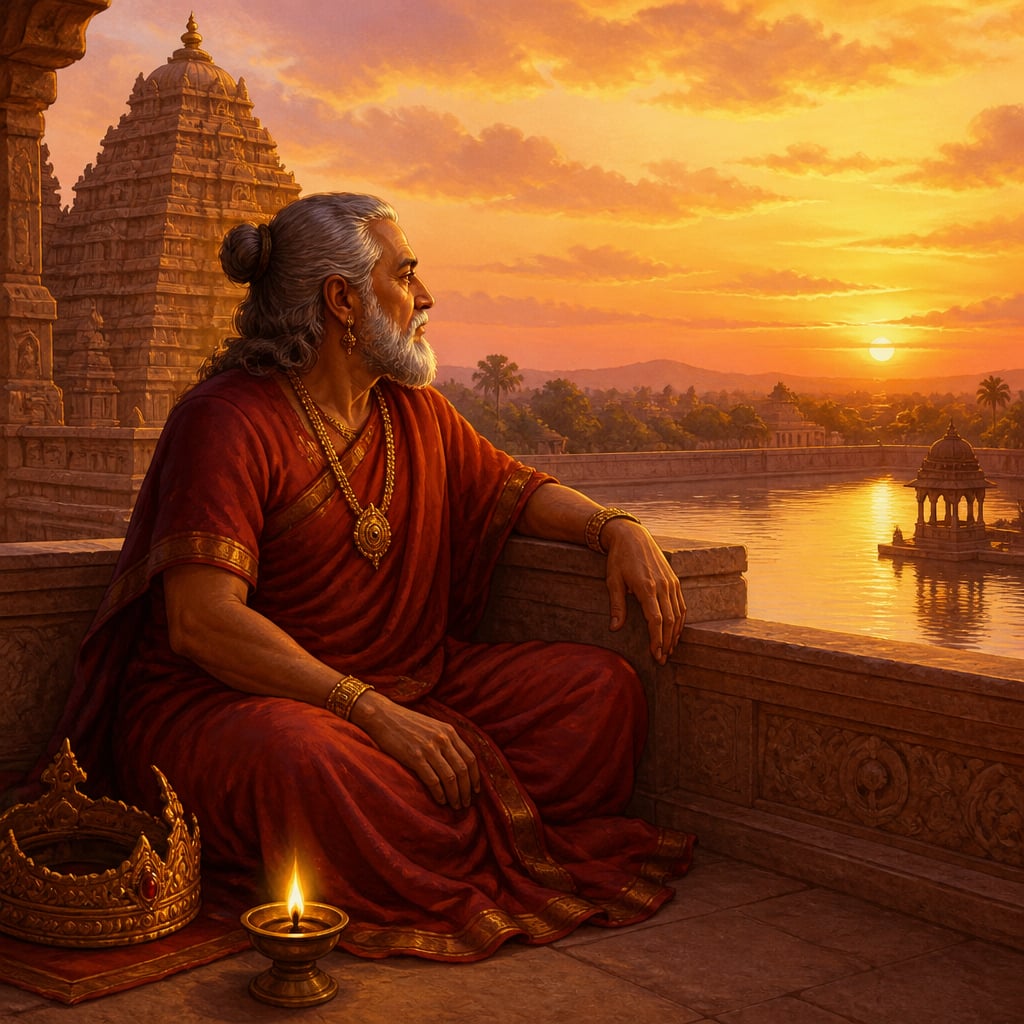
Aged Rajendra Chola at sunset on the Gangaikondacholapuram terrace

Measuring the Achievement

Geographic Extent:

The Chola Empire under Rajendra controlled or influenced:

Population:

Economic Power:

The Administrative Achievement

Rajendra's empire functioned through a sophisticated administrative system:

Central Government:

Institution Function
Rajasabha Royal court and council
Senapati Military commander
Mahamandala Treasury and finance
Olai Royal secretariat
Rajaguru Religious and ideological guidance

Provincial Administration:

The Village Assemblies:

The Cholas are renowned for their village self-governance:

These assemblies managed local irrigation, justice, temple affairs, and taxation, a remarkable system of decentralized governance that allowed central power to focus on military and diplomatic matters.

Rajendra's Successors

Rajendra had several sons, and his succession planning ensured relative stability:

Rajadhiraja I falling in battle against the Chalukyas at Koppam

Rajadhiraja I (1044-1054 CE):

Rajendra Deva II (1054-1063 CE):

Virarajendra (1063-1070 CE):

Pattern:

For about 30 years after Rajendra's death, his sons maintained the empire through capable rule and military vigilance. The system he created proved robust enough to survive his death.

The Slow Decline

Empires rise and fall. The Chola trajectory after Rajendra's immediate successors illustrates patterns common to many great powers:

The Chalukya Pressure:

The Succession Problem:

The Later Cholas (1070-1279 CE):

What the Empire Could Not Control

Rajendra's achievements were extraordinary, but they reveal the limits of even great power:

Distance and Communication:

Succession Beyond the Sons:

Permanent Enemies:

The Nature of Military Glory:

The Enduring Legacy

Despite eventual decline, Rajendra's achievements created permanent legacies:

Temple Architecture:

Administrative Innovations:

Tamil Identity:

Maritime Tradition:

Religious Continuity:

Rajendra in Historical Memory

Titles That Endure:

Scholarly Assessment:

Historians consistently rank Rajendra among India's greatest rulers:

Popular Memory:

Lessons from a Life

Rajendra Chola's career offers enduring insights:

1. Build on What You Inherit

Rajendra did not start from nothing. Raja Raja I gave him a powerful kingdom, trained administrators, battle-tested armies. Rajendra's genius was to take this inheritance and expand it, not to reject the past but to build on it.

2. Strike in Multiple Directions

Rajendra did not focus on one front. He completed the south, marched north, sailed east, and intervened across the seas. This multi-directional approach kept enemies off-balance and created a sphere of influence that exceeded what any single campaign could achieve.

3. Create Symbols That Last

Gangaikondacholapuram was not just a capital, it was a statement carved in stone. The temples, the tanks, the inscriptions were designed to outlast the ruler who created them. Rajendra understood that memory requires monuments.

4. Integrate Conquest and Culture

Rajendra was not merely a conqueror. He patronized temples, preserved literature, and supported religious institutions. The cultural achievements gave meaning to the military ones. Power without purpose is forgotten; power that serves civilization endures in memory.

5. Prepare the Next Generation

Rajendra groomed his sons, associated them with power, and ensured orderly succession. The empire survived his death because he had prepared for it. The greatest failure a leader can make is leaving no successor.

The Final Assessment

Rajendra Chola I achieved more than any South Indian ruler in history:

Domain Achievement
Military Undefeated in major campaigns; conquered in all four directions
Naval First Indian naval expedition to Southeast Asia
Administrative Refined the most sophisticated local governance in India
Cultural Patronized architecture, literature, and religion
Symbolic Created monuments and titles that defined Chola identity

He was not perfect. The northern territories could not be held. The Chalukyas were never destroyed. The maritime conquests did not create lasting colonies. The empire eventually declined.

But history does not judge rulers by whether their empires last forever, none do. It judges them by what they achieved in their time and what they left behind.

By that measure, Rajendra Chola stands among the greatest rulers India ever produced.

Conclusion: The World Conqueror's Legacy

A modern Tamil pilgrim walking through Gangaikondacholapuram temple

When pilgrims today walk through the Gangaikondacholapuram temple, they walk through Rajendra's legacy. When scholars read his inscriptions, they encounter a sophisticated mind that thought strategically and expressed itself with precision. When Tamil speakers take pride in their heritage, they invoke the Chola period as proof of what their civilization achieved.

The conquests faded. The trade routes shifted. The empire contracted and eventually fell.

But the temples still stand. The traditions continue. The memory endures.

That is the legacy of the world conqueror, not permanent power, which no ruler achieves, but permanent contribution to civilization.

Rajendra Chola I died in 1044 CE. A thousand years later, we still speak his name.

Historical context

Medieval Chola Period, Zenith and Assessment (1014-1044 CE)

At Rajendra's death, South India was dominated by the Chola-Chalukya rivalry. The north remained fragmented, with no single power matching Chola strength. The Ghaznavids had withdrawn from India after Mahmud's death. The Indian Ocean trade was at its height, with the Cholas as major players.

Living traditions

Tamil Nadu celebrates Chola achievements as the peak of Tamil civilization. Political parties invoke Chola pride; government institutions use Chola imagery. The Indian Navy's INS Rajendra honors the naval emperor. The Chola template, strong administration, cultural patronage, military power, remains an ideal of Tamil statecraft.

Reflection

More in Rajendra Chola I

All lessons in Rajendra Chola I · Great Emperors: Revival & Resistance course