Completing the South

Consolidation & Conquest

When Rajendra Chola I inherited his father's throne, he inherited both an empire and unfinished business. Raja Raja had conquered northern Sri Lanka; Rajendra would take the whole island. The Pandyas and Cheras had been defeated; Rajendra would ensure they never rose again. This lesson explores how the son completed the father's work, establishing total Chola dominance over South India and Ceylon.

The Son Who Exceeded the Father

In 1014 CE, Raja Raja Chola I, the architect of Chola greatness, passed from this world. He left behind the magnificent Brihadeeswarar Temple, a powerful navy, and an empire stretching from the Tungabhadra River to northern Sri Lanka. He also left a son who had been groomed for power since childhood.

Rajendra Chola I had served as co-ruler (yuvaraja) since 1012 CE, learning statecraft at his father's side. Now, at approximately forty years of age, he assumed sole command of the most powerful empire in southern Asia. His first task: complete what his father had begun.

Rajendra Chola at his coronation in 1014 CE

The Inheritance

Raja Raja had transformed the Cholas from a regional kingdom into a maritime empire. But his conquests remained incomplete:

Territory Status at Raja Raja's Death
Sri Lanka Northern half conquered; southern Sinhalese kingdom intact
Pandya Nadu Defeated but not fully subjugated; potential for revival
Chera Kingdom Weakened but independent; controlling western trade
Chalukyas Northern rival; constant threat

Rajendra understood that partial victories invite future wars. His father had wounded these enemies; he would ensure they could never rise again.

The Complete Conquest of Lanka

Sri Lanka, known as Ilam in Tamil, had been a prize for South Indian empires since ancient times. Raja Raja had conquered the northern kingdom of Anuradhapura, capturing its ruler Mahinda V and seizing the royal regalia. But the Sinhalese had retreated south, establishing resistance around Ruhuna.

Rajendra launched a systematic campaign to complete the conquest:

Phase 1: Securing the North (1014-1016 CE)

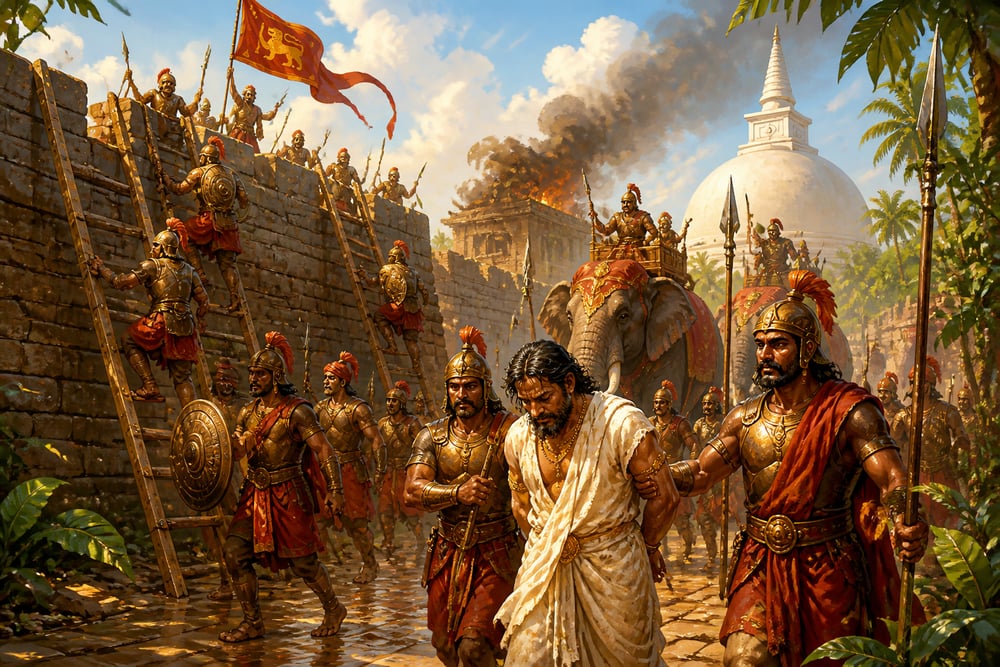
The Chola army storming the gates of Polonnaruwa in Sri Lanka

Phase 2: The Southern Campaign (1017-1018 CE)

Phase 3: Total Subjugation (1018-1020 CE)

The conquest was thorough. The Tiruvalangadu Copper Plates record that Rajendra:

"Conquered Ilam and seized the crown of the Pandya king, the queen of the lord of Ilam along with her children, and the heap of treasures collected by the king of Ilam."

Pollonnaruwa became the new administrative capital, replacing the ancient city of Anuradhapura. The entire island was incorporated into the Chola provincial system.

The Title of Triumph: Mudikonda Chola

Rajendra adopted a title that proclaimed his comprehensive victories: Mudikonda Chola, "The Chola Who Seized Crowns."

This was not mere boasting. The Chola practice was to physically capture enemy royal regalia as proof of conquest:

The captured Pandya crown carried in procession through Thanjavur

These captured symbols served multiple purposes:

  1. Legitimacy, Demonstrated complete victory over rival dynasties
  2. Humiliation, Stripped defeated kings of their royal authority
  3. Propaganda, Displayed in the Chola capital for all to see

Crushing the Pandyas Forever

The Pandya kingdom in the deep south had been the Cholas' traditional rival for centuries. Raja Raja had defeated them, but the dynasty persisted. Rajendra determined to end the Pandya threat permanently.

His campaign was methodical:

  1. Installed puppet rulers, Rather than annexing directly, placed Chola-loyal claimants on the Pandya throne
  2. Established military presence, Chola garrisons throughout Pandya territory
  3. Economic integration, Brought Pandya ports under direct Chola control
  4. Cultural assimilation, Built Shaiva temples to replace Pandya religious institutions

The Pandya king who resisted, Amarabhujanga, was captured and executed. His successors ruled only with Chola permission, effectively reducing the ancient Pandya dynasty to vassalage.

Subjugating the Cheras

The Chera kingdom (Kerala) controlled the Malabar coast, the gateway to Arabian Sea trade. Raja Raja had campaigned there, but the Cheras had maintained their independence.

Rajendra's western campaign (c. 1019-1020 CE) was decisive:

The Chera submission gave Rajendra control of the entire South Indian coastline, from the Bay of Bengal to the Arabian Sea.

The Administrative Architecture

Conquest without administration is merely raiding. Rajendra built upon his father's sophisticated governance system to integrate the new territories:

Provincial System:

Sri Lanka Administration:

Revenue Extraction:

The Strategic Vision

Rajendra's consolidation of the south was not merely about territory. It served strategic purposes:

1. Secure Base for Northern Ambitions With the south pacified, Rajendra could turn his attention northward, to the Gangetic plain and beyond.

2. Maritime Supremacy Control of Sri Lanka gave the Cholas command of the sea lanes connecting the Bay of Bengal to the Indian Ocean. No ship could pass without Chola permission.

3. Economic Integration The southern conquests brought:

4. Elimination of Rear Threats Before marching north, a general must secure his rear. Rajendra ensured no southern enemy could threaten Chola heartland while he campaigned elsewhere.

Completing the Father's Work

By 1020 CE, Rajendra had achieved what his father had envisioned:

Achievement Raja Raja Rajendra
Sri Lanka Northern half Complete conquest
Pandyas Defeated Permanently subjugated
Cheras Weakened Vassalized
Southern dominance Established Absolute

The son had not merely inherited, he had completed, consolidated, and secured. The Chola Empire now stood as the undisputed master of everything south of the Tungabhadra River.

But Rajendra was not satisfied with being master of the south. His ambitions extended far beyond what any Chola, or indeed any South Indian ruler, had ever attempted.

The march to the Ganges was about to begin.

Historical context

Early Medieval Period (1014-1020 CE)

While the Cholas dominated the south, northern India faced repeated invasions from Mahmud of Ghazni. The contrast was stark: South India experienced a golden age of temple-building, maritime trade, and cultural flourishing, while the north suffered from political fragmentation and foreign raids.

Living traditions

The Chola conquest of Sri Lanka established a precedent for Tamil-Sinhalese relations that resonates today. Tamil populations in northern and eastern Sri Lanka trace their presence to this period. The administrative integration pioneered by Rajendra influenced all subsequent South Asian governance. The Chola navy remains a point of pride in Indian naval history, with modern historians studying its logistics and organization.

Reflection

More in Rajendra Chola I

All lessons in Rajendra Chola I ยท Great Emperors: Revival & Resistance course